








BATTERY CELLS Fraunhofer ISE successfully tests high-energy battery cells with silicon-rich anodes
Related Vendors


Silicon-rich lithium-ion batteries promise high energy densities for applications in electric mobility, aerospace, and stationary energy storage. However, their industrial application has so far been limited primarily by their limited cycle life. In the project “StrOboBatt,” researchers at the Fraunhofer Institute for Solar Energy Systems ISE succeeded in operating in-house-manufactured 25-Ah pouch cells with silicon-rich anodes for more than 1,000 full cycles.
The full cells subsequently retained over 83 percent of their original capacity, with a gravimetric energy density of 280 Wh/kg in a non-optimized research cell format. This marks an important step toward the application of silicon-rich anodes in high-energy batteries.
“Cycle life is one of the key hurdles to the widespread industrial use of silicon-rich anodes. More than 1,000 cycles with a capacity retention of at least 80 percent is considered an important performance target here,” explains Dr. Lukas Dold, team leader for battery materials technology and scaling at Fraunhofer ISE. “With our pouch cells, we were able to achieve this goal while also demonstrating a gravimetric energy density of 280 Wh/kg at the cell level in the PrecISE research cell format designed by Fraunhofer ISE. In an industrially optimized pouch cell format, a gravimetric energy density of approximately 330 Wh/kg is expected.”
Industrial-scale pouch cells with silicon-rich anodes
In the “StrOboBatt—Structure- and Surface-Optimized Silicon Anodes and High-Energy Cathodes for High-Energy-Density Lithium-Ion Batteries” project, the team fabricated multilayer full cells (40 layers) with a capacity of 25 Ah. Commercially available electrode foils were used, featuring a silicon-carbon/graphite anode and a nickel-rich nickel-manganese-cobalt oxide cathode. Compared to graphite, which is currently used as an anode material, silicon has a theoretical specific capacity that is ten times higher. When used in structurally optimized silicon-carbon composites, it can reduce global dependence on graphite as a raw material. This would allow value creation—particularly in raw material extraction—to be shifted toward the EU. In the test cells, the silicon-carbon composite accounted for 51 percent of the anode active material. The anodes achieve a specific capacity of more than 1,000 mAh/g and a areal specific capacity of more than 5 mAh/cm2.
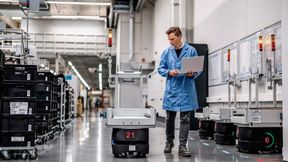
The multilayer pouch cells were manufactured on a semi-automatic production line in the cleanroom of the Center for Electrical Energy Storage at Fraunhofer ISE. They thus combine high electrode capacities with an industry-standard cell format and serve as reference cells in the project for evaluating new materials, cell designs, and operating conditions.
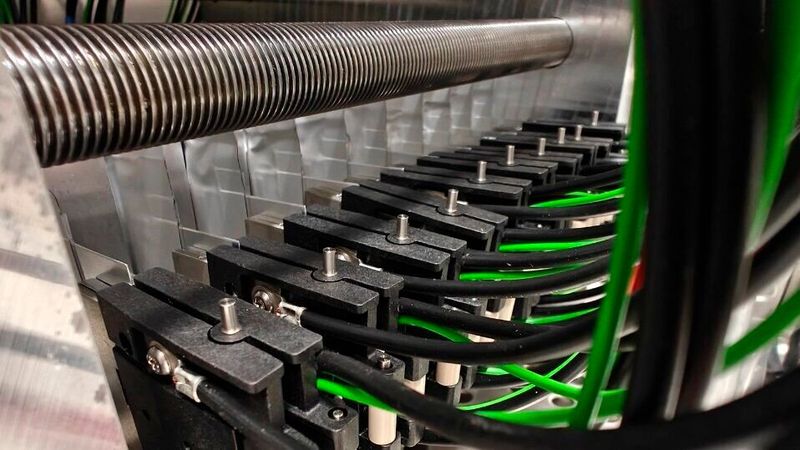
In addition to cycle life, the researchers investigated the effect of mechanical pressure on the pouch cells during operation. To do this, the cells were charged and discharged (1 C operation) within one hour at two different axial contact pressures (300 and 1,000 kPa, respectively). External axial pressure applied to the cell results, among other things, in improved interfacial resistance and reduces the risk of the electrode materials detaching from one another and from the substrate, which is particularly relevant for silicon-containing anodes. Through regular check-up cycles at lower current rates, the influence of pressure on cycle stability could be evaluated.
“Axial pressure has a significant impact on the long-term behavior of the cells. At a contact pressure of 1,000 kPa, our cells still retain over 83 percent of their original capacity even after more than 1,000 full cycles,” explains Marc Kissling, group leader for battery cell production and technology evaluation at Fraunhofer ISE. “At a lower contact pressure of 300 kPa, a significantly greater decline in usable capacity over time is observed, particularly during 1C operation. Mechanical cell pressure is therefore an important parameter for the stable operation of silicon-rich pouch cells.”
At the same time, the studies reveal a growing discrepancy between the residual capacity determined at a low discharge rate and the capacity available during regular 1C operation. This underscores that, when evaluating silicon-rich cells, their performance under real-world operating conditions must be taken into account in addition to pure capacity retention.
From materials to industry-scale pouch cells
At Fraunhofer ISE, new battery materials can be investigated along the entire process chain—from electrode fabrication to the electrochemical characterization of large-format pouch cells. The existing infrastructure includes, among other things, batch mixing, roll-to-roll coating, pouch cell assembly, as well as cell formation and electrochemical characterization.
“Since we can map the entire process chain in-house—from mixing the electrode materials to electrochemical characterization—new materials and cell concepts can be validated under industry-standard conditions throughout the entire manufacturing process,” says Marc Kissling.
(ID:50996265)