


:quality(80)/p7i.vogel.de/wcms/40/62/4062c2d596e53b038e0f05f6c3182509/0133843963v2.jpeg "Littelfuse introduces ultra-low-capacitance TVS diode arrays with a 6.5 V clamping voltage for transient protection in automotive and consumer electronics. (Source: Littelfuse)")
:quality(80)/p7i.vogel.de/wcms/e5/9e/e59ecc43d3c278aece316be4209113c9/0133732079v2.jpeg "Renesas introduces its first low-voltage GaN FET family, with 100 V devices for power conversion in AI data centers, robotics and industrial systems. (Source: Renesas)")
:quality(80)/p7i.vogel.de/wcms/c4/a7/c4a7243caa7c26af5fe5108f7894050a/0133626683v2.jpeg "Wolfspeed’s new premium 200 mm SiC substrates are designed to provide more consistent starting material for power semiconductor manufacturing. (Source: © Marina - stock.adobe.com)")
:quality(80)/p7i.vogel.de/wcms/91/8b/918b533161e7327075370338d7af97af/0133589801v2.jpeg "Acbel will present scalable DC charging power modules and an 11kW passively cooled 2-in-1 on-board power solution at New Mobility Congress 2026 in Katowice, covering both charging infrastructure and vehicle applications. (Source: Acbel)")
:quality(80)/p7i.vogel.de/wcms/4f/47/4f473b006be95fb33ec3d8e3fd727b06/0133732443v2.jpeg "SEMI Europe joins the European Commission’s STEAM Executive Panel, bringing the semiconductor industry’s skills needs into discussions on education, training and workforce development. (Source: © phonlamaiphoto - stock.adobe.com)")
:quality(80)/p7i.vogel.de/wcms/c4/59/c459b75bff747399a7a7fd58381f3983/0133731182v2.jpeg "Infineon has completed its acquisition of C2i Semiconductors, adding expertise in software-defined power management and multiphase control for AI data-center power systems. (Source: © InfiniteFlow - stock.adobe.com)")
:quality(80)/p7i.vogel.de/wcms/fd/2c/fd2c2388e7985cd4c75cff39f07f6361/0133676222v2.jpeg "Greenconn expands its connector portfolio with the compact WF28 wire-to-board series and new 25 mm and 30 mm stacking-height options for its GC01 floating connectors. (Source: © Greenconn)")
:quality(80)/p7i.vogel.de/wcms/69/06/6906b5f22bfbb3f8b874ba9e459c7d26/0133675448v2.jpeg "New backend manufacturing hub strengthens and further diversifies Infineon's global production network. (Source: © Apriew - stock.adobe.com)")
:quality(80)/p7i.vogel.de/wcms/b4/93/b493d5ce620cf7eb558ca6bcd9852a1e/0133811655v2.jpeg "The massive integration of utility-scale solar photovoltaics demands BESS platforms equipped with high-power-density inverters to mitigate generation intermittency. (Source: Pixabay)")
:quality(80)/p7i.vogel.de/wcms/f8/cb/f8cbf79cc21d48d7cad08e2b620218f7/0133738515v2.jpeg "Microchip and Navitas are demonstrating a 20 kW reference design that converts an 800 VDC data-center bus to a 6 V server rail, combining GaN power devices with digital control. (Source: © Formoney - stock.adobe.com)")
:quality(80)/p7i.vogel.de/wcms/ee/de/eedef7055c094757eb208a9d181e85dc/0133371000v2.jpeg "Resonac has developed 300 mm SiC single-crystal substrates, advancing larger-diameter wafer technology for next-generation power electronics and other high-performance semiconductor applications. (Source: © Resonac)")
:quality(80)/p7i.vogel.de/wcms/7b/76/7b76005554b556df2a7a3794bdf69d44/0132365246v2.jpeg "Hioki’s ST5680A DC Hipot Tester combines CE/UKCA/CSA compliance, an integrated capacitance‑based contact check and time‑series waveform recording (voltage, leakage current, insulation resistance) to standardize hipot and insulation testing across EV cell, module and pack production lines. (Source: Hioki)")
:quality(80)/p7i.vogel.de/wcms/af/7f/af7f7b0fb7f29219fc991b1130f65477/0132241333v2.jpeg "Comprehensive laboratory testing regimens—combining thermal cycling, high‑current stress, EMC, and accelerated lifetime tests—are essential to validate advanced power designs and ensure reliability in real‑world applications. (Source: PRBX)")
:quality(80)/p7i.vogel.de/wcms/16/3d/163df69363f8125315a9826e13ea4b05/0131927425v2.jpeg "Solution will maximize data center and AI factory profitability while delivering engineering-grade insights to design and operations for more efficient, sustainable, and resilient infrastructure. (Source: Cadence)")
:quality(80)/p7i.vogel.de/wcms/85/b7/85b7e90733a2bd8f21515d8f7137f2fc/0131917677v2.jpeg "Renesas acquires Pictorus to integrate its embedded application software platform with Renesas’ MCU and MPU portfolio, helping developers shorten time‑to‑market and simplify system integration. (Source: © lucadp - stock.adobe.com)")
:quality(80)/p7i.vogel.de/wcms/27/07/2707280c807689b437baed3660257404/0133626052v2.jpeg "The quantum behavior of electrons shapes semiconductor devices—and the power converters that deliver electricity to modern computing systems. (Source: © Celt Studio - stock.adobe.com)")
POWER BY MAURIZIO Quantum weirdness, real watts: The physics connecting electrons and power
Related Vendors
:fill(fff,0)/p7i.vogel.de/companies/6a/20/6a202a4f89a62/mrs-white-on-blue-bg.png "mrs-white-on-blue-bg ()")
:fill(fff,0)/p7i.vogel.de/companies/68/2c/682c3e2e9a195/logotype-rvb.jpeg "logotype-rvb (MERSEN France)")
:fill(fff,0)/p7i.vogel.de/companies/66/8b/668becd1c07eb/dowa-logo-word--1-.jpeg "dowa-logo-word--1- (DOWA)")
Quantum mechanics was born from the need to describe a part of reality inaccessible to our senses. We are used to seeing the world at the macroscopic level: cars, buildings, computers, people, and planets. We can measure their position, velocity, and energy and, in many cases, describe their behavior using the laws of classical physics. But when we go down to the scale of the atom, this description is not sufficient.
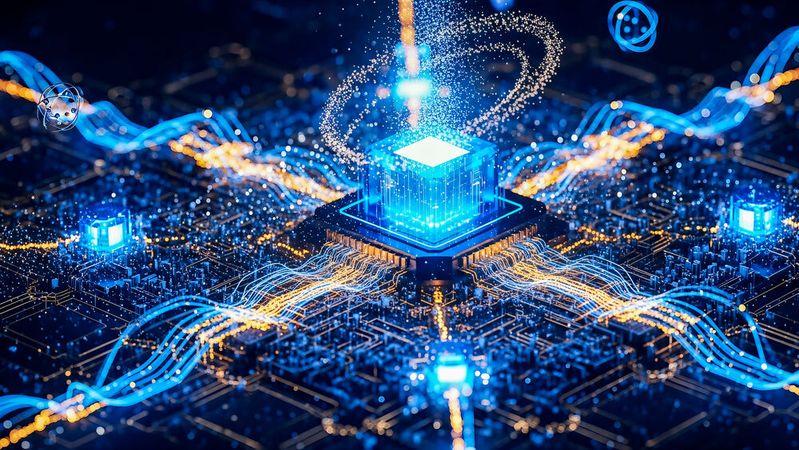
On this level we see electrons, protons, neutrons, photons, and other subatomic particles. The behavior of these particles cannot be interpreted as that of smaller versions of the everyday objects we encounter. Quantum mechanics is the fundamental theory we use to describe this world.
The intriguing point is that this invisible reality is not at all separated from our everyday lives. On the contrary, a huge part of modern technology originates from our ability to understand and control phenomena that occur at the atomic level. In fact, long before we learned how to power up a computer, we had to learn how to control the electrons inside it.
Power by Maurizio
About the author

Maurizio Di Paolo Emilio is a physicist, engineer, and technical author with a passion for technology and innovation. Curious by nature, he explores how technology works, how it evolves, and where it is heading.
To understand a computer, as well as a power supply, we therefore have to start from the invisible: the behavior of electrons in materials. This behavior determines the electrical properties of semiconductors and makes it possible to create devices capable of controlling the flow of current.
Power devices, from MOSFETs to transistors based on materials such as silicon, GaN, and SiC, exploit the properties of semiconductors to operate as extremely fast and efficient switches. In other words, phenomena originating in the quantum world are used to control electrical energy at the macroscopic scale.
This is where power electronics enters the story. The connection becomes even more evident in modern computing. Processors, accelerators, and artificial intelligence systems require increasing amounts of energy, which must be converted, regulated, and distributed with maximum efficiency. Power electronics is therefore the bridge connecting the microscopic behavior of electrons to the power required to run modern computing systems.
As computing becomes faster, denser, and more power-hungry, however, simply adding more power is no longer enough. We need to power up computing smarter—with higher efficiency, faster switching, greater power density, and better thermal performance. This is where wide-bandgap semiconductor technologies such as GaN and SiC become increasingly important.
So, to understand how we can power up the next generation of computing, we need to go all the way back to where it begins: the quantum world of electrons, energy levels, bandgaps, and electromagnetic fields.
:quality(80)/p7i.vogel.de/wcms/83/ae/83ae0b00e573da9977ce19195d28c6b0/0132366058v2.jpeg "Researchers from EPC, The University of Hong Kong and Virginia Tech demonstrated a fully integrated GaN boost converter operating entirely at 4 K, achieving 91.6% efficiency at 7.6 W by combining monolithic GaN power ICs, on‑chip gate drivers and cryo‑qualified passive components. (Source: © Maurizio Di Paolo Emilio)")
GAN CONVERTER
Demonstration of a fully cryogenic GaN power converter operating at 4 K
The quantum reality behind electronics
I’ll start with a simple question. Why do we care about quantum mechanics? To answer it we have to change the scale at which we see reality. The objects we see every day, from buildings to electronic circuits, behave very differently on the microscopic level. When we look at the scale of atoms and subatomic particles, quantum mechanics is the most effective description of nature we have. It was through the work of many scientists in the 20th century that quantum theory was developed. Max Planck, Niels Bohr, Werner Heisenberg, Wolfgang Pauli, Albert Einstein, Erwin Schrödinger, and Louis de Broglie. Increasingly, their work began to challenge the classical idea of a fully deterministic and continuous reality. Planck proposed that energy could be transferred only in discrete packets or quanta. This idea Bohr used to describe the structure of an atom. He showed that electrons can exist at certain energy levels and can jump between them by absorbing or emitting energy. With the concept of uncertainty, Heisenberg helped define a fundamental limit to our ability to know certain physical properties of a particle simultaneously.
It is this discreteness and probability that makes quantum mechanics so alien to our everyday intuition. At the microscopic level we cannot always describe a particle as an object with well-defined position and trajectory. Mathematically, a quantum system is described by a wavefunction, usually denoted Ψ. The wave function contains the state of the system and the probabilities of the possible results of a measurement.
But why should anyone in electronics or power electronics care, as in this PCIM blog? Because the behavior of electronic devices ultimately reflects the physics of electrons inside materials. When we study the behavior of electrons inside a semiconductor, we are seeing the direct consequences of quantum rules. Electrons can only exist at certain energy levels, and for many particles in a material this leads to energy bands. Depending on how you put these bands together, the material will either conduct or insulate. This principle is the basis of modern electronics. We can control the behavior of electrons and use that to represent and manipulate information. Transistors do that. The transition between the conducting and non-conducting states allows the creation of the logical states, which we interpret as 0 and 1 on the digital level. Behind the apparent simplicity of a bit, there is a microscopic reality. Energy levels, electronic states, and interactions between charge carriers determine how semiconductor devices behave. The same relation can be found when we consider light. Photons are the quantized excitations of the electromagnetic field and can transfer energy to electrons, e.g., in the photoelectric effect, which underpins the conversion of light to electrical energy in photovoltaic devices. Similarly, quantum physics is crucial for understanding phenomena ranging from the operation of lasers to the properties of semiconductors.
So understanding quantum mechanics is not about entering a universe apart from electronics. It involves exploring the fundamental processes occurring at the core of electronics. Before we start discussing transistors, semiconductors, power, energy conversion, or advanced technologies, we must remember that the construction of all these systems takes advantage of matter's behavior at the microscopic level. The technology we use every day is, often, the macroscopic manifestation of phenomena belonging to an invisible, discrete, and profoundly quantum world.
The birth of the quantum
At the beginning of the 20th century, physics underwent one of its most important transformations. Classical mechanics achieved extraordinary success, yet the theories available at the time could not correctly explain some phenomena.
Classical physics could not explain the spectrum of radiation emitted by an ideal body, known as a blackbody, capable of absorbing and emitting electromagnetic radiation at all frequencies. When scientists applied the classical laws of electromagnetism and thermodynamics, they obtained an absurd mathematical result known as the ultraviolet catastrophe: the amount of energy emitted at high frequencies, such as ultraviolet radiation, would have to be infinite. This prediction was contradicted by experimental observations.
In 1900, Max Planck introduced an apparently arbitrary hypothesis that would change physics: the energy associated with radiation could not be exchanged in a completely continuous manner but only in discrete amounts.
The fundamental concept can be expressed by the relation E = hf, where E is the energy of the quantum, h is Planck’s constant, and f is the frequency of the radiation. The energy of a quantum therefore increases with frequency. Radiation at a higher frequency carries more energy per quantum than radiation at a lower frequency. This idea, initially introduced to solve a specific problem in thermal radiation, became one of the starting points of quantum mechanics.
A few years later, Albert Einstein used the concept of quantization to explain the photoelectric effect. Light could be considered to be composed of quanta, later called photons, which are capable of transferring energy to electrons in matter.
This phenomenon has a very concrete technological consequence.
A photovoltaic panel can convert the energy of light into electrical energy precisely because of the interaction between photons and electrons. A phenomenon belonging to the quantum world thus becomes a macroscopic technology.
:quality(80)/p7i.vogel.de/wcms/cc/67/cc670ea2029cd2af5c641af70e1bf734/0129816392v4.jpeg "Fraunhofer IAF coordinates the EU SUPREME project to accelerate GaN and SiC power semiconductor innovation in Europe. (Source: Fraunhofer IAF)")
POWER SEMICONDUCTORS
EU funds SUPREME consortium for next-generation power semiconductors
The atom Is not a tiny planetary system
Niels Bohr later introduced the concept of discrete energy levels for electrons in the hydrogen atom. An electron can occupy specific energy states. If it absorbs the appropriate amount of energy, it can move to a higher-energy state. When it returns to a lower-energy state, it can emit a photon. The frequency of the emitted photon is related to the energy difference between the two states. This relationship explains why atoms can emit or absorb radiation at specific frequencies.
The image of an electron orbiting the nucleus like a planet orbiting the Sun is useful as a first analogy, but it should not be taken literally. In quantum mechanics, an electron is not described as a small sphere following a defined trajectory. Its behavior is described by a quantum state and, in a common formulation, by a wave function.
The distinction is fundamental. We are describing an object that we cannot yet observe clearly enough. We are describing a system that, at the quantum level, cannot be fully represented using the categories of classical physics.
Wave function
Its interpretation is one of the deepest aspects of quantum theory. The squared magnitude of the wave function, |Ψ|2, is associated with the probability of obtaining a particular result when a measurement is performed. This introduces a fundamental difference from classical physics. If we throw a ball, we can ideally describe its position and velocity at a given instant and use this information to predict its motion.
For a quantum system, the situation is different. Werner Heisenberg formulated the uncertainty principle, according to which certain pairs of physical quantities cannot be known simultaneously with arbitrary precision. Position and momentum are the most famous example. This phenomenon is not simply a limitation of measurement technology. Uncertainty is built into the mathematical structure of the theory. This is one of the reasons why quantum mechanics can appear so distant from our daily lives.
From quantum behavior to power computing
In solid-state materials, and particularly in semiconductors, the energy states of electrons form structures known as energy bands. The presence of a forbidden band, or bandgap, determines many of the material’s electrical properties.
By controlling carrier concentration, material structure, and the applied electric fields, it is possible to control the transport of electrons. The transistor is based precisely on the ability to control this behavior. BJTs, MOSFETs, HEMTs, and other semiconductor architectures represent highly sophisticated implementations of this ability to control charge transport. At the logical level, however, the principle can be reduced to a basic representation: one or zero, on or off, a bit. A modern processor takes this principle to an entirely different scale. Millions or billions of transistors are integrated into the same device, and the ability to control the microscopic behavior of electrons is transformed into the ability to process information. It is one of the fundamental steps in modern technology: an understanding of an invisible reality becomes a tangible technology.
But computing is not just about information
When we discuss computing, we tend to focus on information: transistors, processors, GPUs, memory, algorithms, and software. All of these are essential, but they represent only part of the challenge. A transistor can process information because it is powered. A processor can execute instructions because it receives electrical energy. A GPU performs billions of operations by converting and delivering a specific amount of power to its circuits. Data centers make all of this possible, enabling us to browse the internet and much more.
Computing, therefore, is not just an information problem. It is also, and above all, an energy problem. This is where power electronics becomes relevant.
:quality(80)/p7i.vogel.de/wcms/65/22/65223bc58811ced76adbfa7b5615d532/0129061536v2.jpeg "This article explains topological insulators and explores whether they can optimize electronic systems. (Source: © Rick - stock.adobe.com)")
INSULATORS
Groundbreaking discovery of Topological Insulators
Invisible power
When we use a computer, we see the result of the computation: an image on the screen, an application responding to a command, a simulation, or, increasingly, an artificial intelligence model generating an output. Behind this seemingly intangible experience, however, lies a complex physical reality. Inside the processor, billions of transistors continuously change state through the control of electrical charge, while a power delivery network provides the energy needed to keep the devices operating under the required conditions.
We do not see the electrons moving through the transistors, nor the electric and magnetic fields that govern the operation of electronic devices. Likewise, we do not directly see the current flowing through a circuit board, the circuits regulating voltage, or the converters that transform the energy available at the system input into the levels required by its various components.
Power electronics performs precisely this function: controlling energy.
Modern electronic systems rarely use the voltage available directly from the power source. Energy must be converted and adapted to the requirements of the load. A DC-DC converter, for example, can receive a given input voltage and generate a different output voltage while simultaneously controlling the current and power delivered to the load.
In a processor, a voltage regulator module (VRM) can convert a relatively high voltage from the power system into a much lower voltage required by the processor while maintaining it within extremely tight limits.
This function becomes particularly complex in high-performance computing systems. The electrical load of a CPU or GPU is not constant; it varies according to the operations being performed. A processor can rapidly move from a low-load condition to a situation requiring substantial computing resources. The accelerators used for artificial intelligence can produce significant variations in power demand.
The power system must therefore respond rapidly to changes in load while maintaining a stable voltage at the processor.
This creates a direct relationship between computing architecture and power architecture. A processor’s ability to perform a given amount of computation depends not only on the number of transistors, operating frequency, or device architecture. It also depends on the ability of the power system to deliver the required power with sufficient stability, speed of response, and efficiency.
When current becomes a limitation
When a processor operates at a relatively low voltage but requires high power, the current it needs can become very significant. This represents one of the main challenges in designing power systems for high-density computing.
Increasing current does not simply require adequately sized devices and interconnections. It also increases resistive losses.
The quadratic dependence on current makes the problem particularly important. For a given resistance, doubling the current results in a fourfold increase in resistive losses.
Part of the electrical energy is therefore converted into heat and must subsequently be removed from the system. For this reason, as computing power requirements increase, it is not enough to consider only processor efficiency. The entire chain of energy conversion and distribution must be analyzed.
Power electronics is therefore not simply the system that delivers energy to the computer. It is the system that transforms, regulates, and controls energy while the computer performs its computations.
As computing capacity continues to grow, this function becomes increasingly important because every increase in computing density must be matched by the ability to deliver, convert, distribute, and dissipate a growing amount of power.
The problem is not just efficiency
For a long time, efficiency has been considered one of the key parameters for evaluating the performance of a power supply. The principle is simple: if a converter receives 100 W and delivers 98 W to the load, its efficiency is 98%, while the remaining 2 W represent losses that are primarily converted into heat.
Increasing efficiency means reducing these losses and, consequently, the amount of energy that must be removed from the system. However, as the power processed increases to the levels required by modern computing systems, percentage efficiency alone is no longer enough to describe the scale of the problem. A system processing 1 MW with 1% losses dissipates 10 kW. This power must be transferred to the environment through a cooling system, increasing the thermal requirements and the overall energy consumption of the infrastructure. The challenge, therefore, becomes one of optimizing the efficiency of the entire power chain, rather than that of a single converter.
In high-density computing systems, energy passes through multiple stages of conversion and distribution: from the electrical grid to the data center, from the data center to the rack, from the rack to the electronic board, and finally to the processor. At each stage, voltage may be converted, current regulated, and power delivered to the load.
The thermal system must minimize and manage the losses introduced by every conversion. As power density increases, not only converter efficiency becomes critical, but also current distribution, parasitic resistance, interconnect design, and thermal management. The transition from relatively small systems to increasingly large power infrastructures therefore changes the nature of the problem. It is no longer simply a matter of designing a converter with the highest possible efficiency but of optimizing an entire energy chain in which conversion, distribution, control, and cooling must be considered as parts of the same system.
:quality(80)/p7i.vogel.de/wcms/18/0b/180b7b63afc91e523592d8a5ce161c96/0129847487v2.jpeg "InGaAs-based photodetectors enable sensitive and fast detection in the short-wave infrared spectrum for modern sensing and communication applications. (Source: © VITALII - stock.adobe.com)")
SWIR TECHNOLOGY
InGaAs and Near-Infrared Optoelectronics
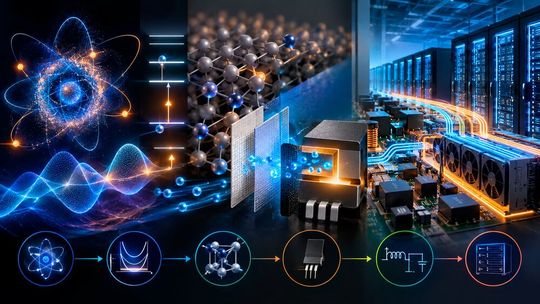
Wide-bandgap semiconductors and the physics of power conversion
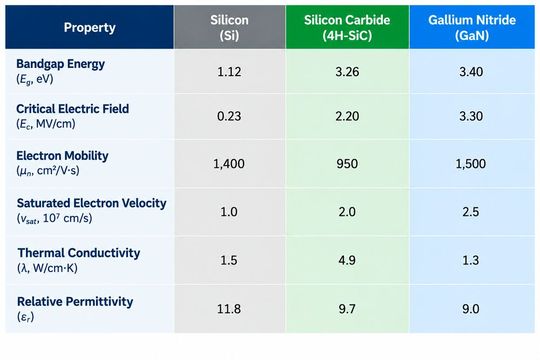
The transition from silicon to wide-bandgap (WBG) semiconductors, particularly gallium nitride (GaN) and silicon carbide (SiC), is fundamentally driven by semiconductor physics. Their larger bandgaps, higher critical electric fields, and different carrier-transport mechanisms allow power devices to operate at higher electric fields, temperatures, switching frequencies, and power densities than conventional silicon devices.
The significance of the bandgap extends beyond its role in determining whether a material behaves as a semiconductor. A wider bandgap device increases the energy required to generate electron-hole pairs while allowing a safer operation at high temperatures and lower intrinsic carrier concentration. More importantly for power devices, the critical electric field is substantially higher in WBG materials. This parameter determines how much voltage can be supported across a given semiconductor thickness before breakdown occurs.
For a unipolar power device, the fundamental relationship between breakdown voltage and specific on-resistance illustrates the advantage. In a simplified one-dimensional model:
RDS(on) = 4VBR2 / (ε0εr μn Ecrit3)
where VBR is the breakdown voltage, εr is the relative dielectric constant, μn is the electron mobility, and Ecrit is the critical electric field. The dependence on the third power of the critical electric field is particularly important. Increasing the critical field therefore has a disproportionately large impact on the theoretical conduction loss of a high-voltage device. This is one of the fundamental reasons why GaN and SiC can achieve much lower specific resistance than silicon at comparable blocking voltages.
GaN introduces another important physical mechanism through its heterostructure. A typical GaN HEMT uses an AlGaN barrier layer grown on a GaN layer. Because of the wurtzite crystal structure, GaN and AlGaN exhibit strong spontaneous and piezoelectric polarization. The discontinuity in polarization at the AlGaN/GaN interface produces a high-density sheet of electrons, forming a two-dimensional electron gas (2DEG).
The 2DEG is a particularly important feature of GaN power technology. Carrier concentrations can reach approximately 1013 cm-2, while electron mobility can be on the order of 1500–2000 cm2/V·s. The resulting high sheet conductivity allows substantial current to flow through a very small active region. Unlike a conventional bulk conduction path, the 2DEG is confined to a narrow interface region, providing the high current density and low channel resistance that are central to GaN HEMT operation.
This device physics also explains why GaN is particularly attractive for high-frequency power conversion. Switching losses are not determined only by RDS(on), but also by the amount of charge and energy that must be moved during each switching transition. Important device-level figures of merit include RDS(on) × QG and RDS(on) × COSS. The first combines conduction resistance with gate charge, while the second relates conduction resistance to output capacitance and is particularly relevant when capacitive switching losses dominate.
A low RDS(on) × QG figure of merit allows a transistor to combine low conduction losses with fast gate transitions. Low parasitic capacitances and low stored switching energy further reduce losses at high frequency. Higher switching frequency has an important system-level consequence: magnetic components, filters, and energy-storage elements can become smaller. Increasing frequency can therefore increase power density, although it simultaneously makes PCB layout, parasitic inductance, electromagnetic interference, gate-loop design, and thermal management more critical.
SiC follows a somewhat different optimization path. Its wide bandgap of approximately 3.2 eV and high critical electric field make it particularly suitable for high-voltage power devices. SiC MOSFETs can support high blocking voltages with relatively low conduction losses, while their thermal properties are advantageous in high-power environments. These characteristics make SiC particularly relevant to EV traction inverters, high-power industrial converters, renewable-energy systems, and high-voltage power infrastructure.
The distinction becomes particularly relevant in the emerging architecture of AI data centers. As AI accelerators increase rack-level power from tens of kilowatts toward hundreds of kilowatts and ultimately megawatt-class racks, conventional low-voltage distribution becomes increasingly difficult to scale. One response is the move toward 800 VDC distribution, which reduces current for a given power level and can reduce conductor losses and the amount of copper required throughout the distribution system.
This creates different opportunities for SiC and GaN along the grid-to-GPU power path. SiC is well suited to higher-voltage, high-power conversion stages, including the upstream conversion required to establish an 800 VDC bus. Its high-voltage capability, efficiency, and thermal robustness make it suitable for power levels that can approach the megawatt scale at the rack level. GaN, by contrast, becomes particularly attractive further downstream, where high switching frequency, low switching losses, and compact magnetics can enable high-density conversion from the intermediate bus toward the voltage rails required by servers and AI processors.
The important point is that GaN and SiC do not necessarily compete for the same position in the power architecture. Their different material properties can make them complementary technologies, except for a small overlap at medium voltages. SiC can address the high-voltage, high-power stages, while GaN can exploit its high-frequency switching capability in compact downstream converters and point-of-load architectures. As conversion stages are reduced, the requirements placed on each remaining stage become increasingly demanding in terms of voltage rating, current density, efficiency, transient response, isolation, and thermal performance.
This system-level perspective is increasingly important because the data center itself is becoming an energy-conversion system. At megawatt-scale rack power, the electrical infrastructure, power converters, distribution network, and cooling system directly influence computing performance. The question is no longer simply how much computational power a processor can deliver, but how efficiently the infrastructure can convert, distribute, and dissipate the energy required to sustain that computation.
The evolution of WBG technology therefore represents more than the replacement of one semiconductor material with another. It is an example of how quantum and solid-state physics propagate through device engineering into system architecture. The band structure determines carrier behavior; crystal structure and polarization determine the properties of the 2DEG; electric-field limits determine voltage capability; charge and capacitance determine switching performance; and these parameters ultimately define how efficiently and how densely electrical energy can be converted.
The invisible behavior of electrons introduced at the beginning of this chapter therefore becomes directly measurable at the system level—as voltage, current, efficiency, switching frequency, thermal dissipation, and power density. The physics of the semiconductor is not simply the foundation of the transistor. It is one of the fundamental constraints defining what modern power electronics—and ultimately modern computing—can achieve.
(ID:50969741)
:quality(80)/p7i.vogel.de/wcms/b9/26/b9265548cf4e6fe7e45789b711d01f8f/0130098748v2.jpeg "Gallium nitride (GaN) power devices are increasingly challenging silicon MOSFETs in low-voltage power conversion by enabling higher efficiency and switching performance. (Source: AI-generated (OpenAI DALL·E))")
:quality(80)/p7i.vogel.de/wcms/94/ad/94adeaeec77b29a3b7686c34ee304809/0133333835v2.jpeg "AI data centers are moving toward 800 VDC distribution and megawatt-scale racks, creating a new power architecture in which SiC and GaN technologies serve different stages from the grid connection to the GPU. (Source: © Ahmed - stock.adobe.com)")