


:quality(80)/p7i.vogel.de/wcms/40/62/4062c2d596e53b038e0f05f6c3182509/0133843963v2.jpeg "Littelfuse introduces ultra-low-capacitance TVS diode arrays with a 6.5 V clamping voltage for transient protection in automotive and consumer electronics. (Source: Littelfuse)")
:quality(80)/p7i.vogel.de/wcms/e5/9e/e59ecc43d3c278aece316be4209113c9/0133732079v2.jpeg "Renesas introduces its first low-voltage GaN FET family, with 100 V devices for power conversion in AI data centers, robotics and industrial systems. (Source: Renesas)")
:quality(80)/p7i.vogel.de/wcms/c4/a7/c4a7243caa7c26af5fe5108f7894050a/0133626683v2.jpeg "Wolfspeed’s new premium 200 mm SiC substrates are designed to provide more consistent starting material for power semiconductor manufacturing. (Source: © Marina - stock.adobe.com)")
:quality(80)/p7i.vogel.de/wcms/91/8b/918b533161e7327075370338d7af97af/0133589801v2.jpeg "Acbel will present scalable DC charging power modules and an 11kW passively cooled 2-in-1 on-board power solution at New Mobility Congress 2026 in Katowice, covering both charging infrastructure and vehicle applications. (Source: Acbel)")
:quality(80)/p7i.vogel.de/wcms/4f/47/4f473b006be95fb33ec3d8e3fd727b06/0133732443v2.jpeg "SEMI Europe joins the European Commission’s STEAM Executive Panel, bringing the semiconductor industry’s skills needs into discussions on education, training and workforce development. (Source: © phonlamaiphoto - stock.adobe.com)")
:quality(80)/p7i.vogel.de/wcms/c4/59/c459b75bff747399a7a7fd58381f3983/0133731182v2.jpeg "Infineon has completed its acquisition of C2i Semiconductors, adding expertise in software-defined power management and multiphase control for AI data-center power systems. (Source: © InfiniteFlow - stock.adobe.com)")
:quality(80)/p7i.vogel.de/wcms/fd/2c/fd2c2388e7985cd4c75cff39f07f6361/0133676222v2.jpeg "Greenconn expands its connector portfolio with the compact WF28 wire-to-board series and new 25 mm and 30 mm stacking-height options for its GC01 floating connectors. (Source: © Greenconn)")
:quality(80)/p7i.vogel.de/wcms/69/06/6906b5f22bfbb3f8b874ba9e459c7d26/0133675448v2.jpeg "New backend manufacturing hub strengthens and further diversifies Infineon's global production network. (Source: © Apriew - stock.adobe.com)")
:quality(80)/p7i.vogel.de/wcms/b4/93/b493d5ce620cf7eb558ca6bcd9852a1e/0133811655v2.jpeg "The massive integration of utility-scale solar photovoltaics demands BESS platforms equipped with high-power-density inverters to mitigate generation intermittency. (Source: Pixabay)")
:quality(80)/p7i.vogel.de/wcms/f8/cb/f8cbf79cc21d48d7cad08e2b620218f7/0133738515v2.jpeg "Microchip and Navitas are demonstrating a 20 kW reference design that converts an 800 VDC data-center bus to a 6 V server rail, combining GaN power devices with digital control. (Source: © Formoney - stock.adobe.com)")
:quality(80)/p7i.vogel.de/wcms/ee/de/eedef7055c094757eb208a9d181e85dc/0133371000v2.jpeg "Resonac has developed 300 mm SiC single-crystal substrates, advancing larger-diameter wafer technology for next-generation power electronics and other high-performance semiconductor applications. (Source: © Resonac)")
:quality(80)/p7i.vogel.de/wcms/7b/76/7b76005554b556df2a7a3794bdf69d44/0132365246v2.jpeg "Hioki’s ST5680A DC Hipot Tester combines CE/UKCA/CSA compliance, an integrated capacitance‑based contact check and time‑series waveform recording (voltage, leakage current, insulation resistance) to standardize hipot and insulation testing across EV cell, module and pack production lines. (Source: Hioki)")
:quality(80)/p7i.vogel.de/wcms/af/7f/af7f7b0fb7f29219fc991b1130f65477/0132241333v2.jpeg "Comprehensive laboratory testing regimens—combining thermal cycling, high‑current stress, EMC, and accelerated lifetime tests—are essential to validate advanced power designs and ensure reliability in real‑world applications. (Source: PRBX)")
:quality(80)/p7i.vogel.de/wcms/16/3d/163df69363f8125315a9826e13ea4b05/0131927425v2.jpeg "Solution will maximize data center and AI factory profitability while delivering engineering-grade insights to design and operations for more efficient, sustainable, and resilient infrastructure. (Source: Cadence)")
:quality(80)/p7i.vogel.de/wcms/85/b7/85b7e90733a2bd8f21515d8f7137f2fc/0131917677v2.jpeg "Renesas acquires Pictorus to integrate its embedded application software platform with Renesas’ MCU and MPU portfolio, helping developers shorten time‑to‑market and simplify system integration. (Source: © lucadp - stock.adobe.com)")
:quality(80)/p7i.vogel.de/wcms/27/07/2707280c807689b437baed3660257404/0133626052v2.jpeg "The quantum behavior of electrons shapes semiconductor devices—and the power converters that deliver electricity to modern computing systems. (Source: © Celt Studio - stock.adobe.com)")
POWER TESTING Laboratory testing regimens for advanced power design
Related Vendors
:fill(fff,0)/p7i.vogel.de/companies/6a/20/6a202a4f89a62/mrs-white-on-blue-bg.png "mrs-white-on-blue-bg ()")
:fill(fff,0)/p7i.vogel.de/companies/68/2c/682c3e2e9a195/logotype-rvb.jpeg "logotype-rvb (MERSEN France)")
:fill(fff,0)/p7i.vogel.de/companies/68/08/6808a2b3b6595/het-logo.jpeg "het-logo (Heraeus Electronics)")
Replacing established silicon technology requires more than design alone. It requires proven reliability under real operating conditions. To ensure a new power supply can perform in demanding environments, particularly in medical and industrial systems, hardware must undergo extensive endurance testing before deployment.
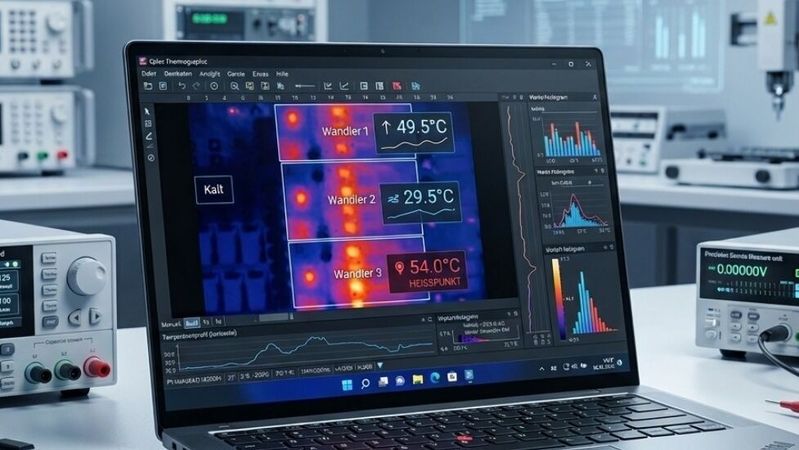
As the industry moves beyond the limitations of legacy compliance standards and builds on established reliability validation frameworks, laboratory stress testing provides the final step in verifying wide bandgap semiconductor performance under real operating conditions.
An inside look at stress testing
The definitive benchmark for proving a component’s reliability is called the High Temperature Reverse Bias (HTRB) test. Think of this as a simulated, high-speed aging process designed to deliberately force hidden material flaws or early failures to show themselves in the lab rather than out in the field.
During this standard industry evaluation, components are placed inside a specialized laboratory oven heated up to a controlled 150°C environment. While enduring that intense heat, the parts are continuously blasted with up to 100% of their maximum electrical voltage rating. Instead of a quick check, engineers leave the components trapped under this combined thermal and electrical stress for a full 1,000 hours. This corresponds to roughly 42 days of non-stop operation.
:quality(80)/p7i.vogel.de/wcms/84/1f/841f6921da6203c30dac2963c7a0df81/0131601493v2.jpeg "New multi‑chemistry systems from CATL target fast charging, higher energy density and lightweight flexible applications, with sodium‑ion mass‑production plans announced for 2026. (Source: CATL)")
ENERGY STORAGE
CATL launches world’s largest energy storage testbed
The two tiers of validation testing
As active members of both the European Power Supply Manufacturers Association (EPSMA) and the Power Sources Manufacturers Association (PSMA), our engineering teams align their validation testing with strict global safety expectations. This requires analyzing the power supply on two distinct levels:
1. Component Stress:
- What the lab does: 42 days of continuous runtime inside a 150°C oven under maximum electrical voltage.
- What it proves: Catches micro-level material weaknesses before mass assembly.
2. Full-System Aging
- What the lab does: 1,000 hours of non-stop operation at full workload inside the final metal casing.
- What it proves: Ensures the entire unit runs cool and stays perfectly stable.
:quality(80)/p7i.vogel.de/wcms/c7/05/c7057930a5fbf4e7ce7b63feecdad91c/0131786248v2.jpeg "PCIM 2026 award winners recognised for innovative, application‑focused power‑electronics research — Best Paper, Young Engineer and Young Researcher awards presented during the conference ceremony. (Source: Mesago Messe Frankfurt GmbH / Arturo Rivas Gonzalez)")
CONFERENCE AWARDS
The PCIM conference awards 2026: recognizing innovative research
Verifying long-term system stability
Surviving individual component stress testing is only step one. Once those parts are integrated into the actual power supply, the completed unit undergoes its own 1,000-hour full-load test. This step evaluates how advanced components interact with internal transformers and filters under real-world workloads, proving that the entire system will run safely without degrading over time.
These testing processes provide the data needed to reduce the risks associated with adopting new technology. The result is a clear pathway to custom power solutions that run cooler, fit into smaller spaces, and provide absolute peace of mind in critical care environments.
- Demanding transparent laboratory benchmarks before deploying hardware.
- Using long-term stress data to safeguard mission-critical operations.
- Transitioning safely to advanced hardware via verified EPSMA and PSMA design standards.
(ID:50895616)
:quality(80)/p7i.vogel.de/wcms/84/1f/841f6921da6203c30dac2963c7a0df81/0131601493v2.jpeg "New multi‑chemistry systems from CATL target fast charging, higher energy density and lightweight flexible applications, with sodium‑ion mass‑production plans announced for 2026. (Source: CATL)")
:quality(80)/p7i.vogel.de/wcms/8b/42/8b4271e1bedea432ab03c83959e30431/0128818204v2.jpeg "Rows of batteries on Kauai island provide more than just power: They stabilize the grid. A project between the Kauai Island Utility Cooperative, NLR, and several more partners showed that electronics can offer equal grid strength to spinning resources. (Source: Connor O’Neil, National Laboratory of the Rockies)")