






MANAGEMENT STATEMENT “The chip sets the potential. Packaging determines how much of it we can use.”
Sponsored by

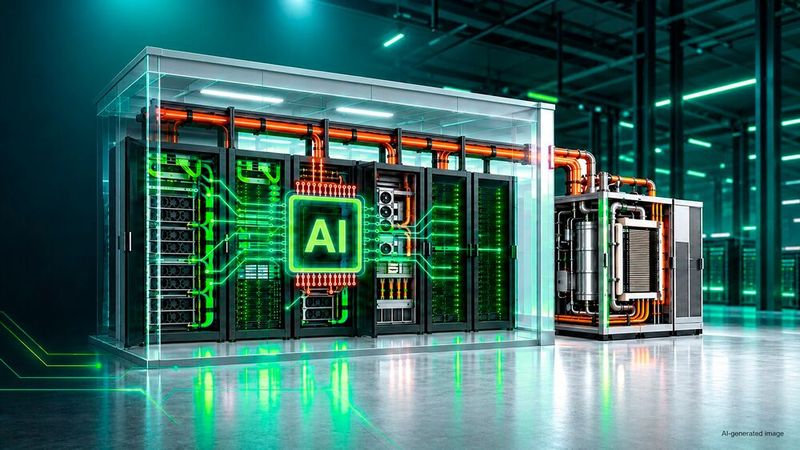
AI is pushing data center electricity demand and rack power density to new levels. Dr. Michael Jörger explains why efficient conversion depends on more than the semiconductor, and how die attach, substrates and top-side interconnects help determine the performance and reliability of future AI power infrastructure.
Power & Beyond: AI used to be a computing topic. Why has it become a power electronics topic as well?
Michael Jörger: Every AI calculation starts with electricity, and a surprising amount of engineering sits between the grid connection and the voltage used by the processors. Power must be converted several times from a grid voltage of several hundred kV to less than a volt at chip level, and every conversion creates losses and heat. As data centers become larger and rack power rises, small efficiency gains have a large overall effect.
The scale is becoming clearer. The International Energy Agency expects global electricity demand from data centers to more than double to about 945 terawatt-hours by 2030. It also expects demand from AI-optimized data centers to more than quadruple. That makes conversion efficiency a system-level priority, not a detail inside the power supply.
For me, this is the most important shift: the data center can no longer treat power delivery as supporting infrastructure. Power electronics now helps determine how much useful computing a facility can deliver from the electricity and space available.
About Michael Jörger

Michael Jörger is a chemist by training and holds a doctorate in material sciences. After 15 years in product development at Heraeus Electronics, he became Global Head of Technology in February 2026. His work focuses on the materials and interconnects that enable power modules to operate efficiently and reliably under increasingly demanding conditions.
Power & Beyond: The industry is discussing 800 VDC distribution for future AI data centers. What changes when the voltage rises?
Michael Jörger: For the same power, a higher voltage means a lower current. That reduces resistive losses and the amount of copper needed for cables and busbars. Current industry roadmaps are therefore moving toward 800 VDC distribution to the racks and, over time, toward fewer conversion stages between the medium-voltage grid and the compute equipment.
That architecture creates demanding jobs for power semiconductors. They must switch efficiently at high voltage and high frequency while handling considerable thermal loads. Silicon carbide is particularly relevant for high-power conversion stages. Gallium nitride can be attractive where very high switching frequency and compact conversion are the priority.
The semiconductor, however, is only one part of the design. Higher voltage, frequency and power density also increase the demands on electronic packaging materials such as die attach, substrates, top-side interconnects and module attach. The overall system performance is determined by the weakest component.
Power & Beyond: What happens when packaging materials cannot keep pace with the semiconductor, and which material changes address that?
Michael Jörger: Think of it this way: a powerful engine cannot deliver its performance through tires designed for a much lower speed. The same applies to a SiC chip. It may tolerate higher temperatures and switch faster than silicon, but the surrounding materials still have to carry the current, remove heat and survive repeated temperature changes.
One important response is the move from soldered to sintered die attach. Typical power electronics solder alloys melt at roughly 220 to 250 °C. Silver melts at about 962 °C and copper at about 1085 °C, so a sintered joint provides much more thermal headroom. We also examine thermal expansion across the complete stack because mismatches can cause cracks, delamination or substrate warping.
For top-side connections, copper conducts electricity and heat more effectively than aluminum, but it is harder and can damage the chip during wire bonding. A die top system solves this by sintering a thin copper foil onto the source contact. The foil distributes current and acts as a bond buffer, allowing copper wires or ribbons to be attached to the chip. The benefits is a module with higher reliability and ultimately a higher lifetime.
Active metal brazed ceramics can add the thermomechanical stability needed at substrate level. The exact combination depends on the application, process and lifetime target. The analogy brings us back to the central point: reliability comes from the interaction of the complete material stack, not from one impressive data sheet value. That is also what makes matched materials so important.
Power & Beyond: How much can data center developers learn from automotive power electronics?
Michael Jörger: Quite a lot. Automotive engineering has built deep experience with SiC modules, sintered joints, copper interconnects and metal-ceramic substrates. The underlying questions are familiar: How do we remove heat? How do we manage thermal expansion? How do we preserve electrical isolation and stable performance over time?
The duty profiles are different, so we should not copy an automotive qualification plan and assume the job is done. The failure mechanisms can be comparable, but their relative importance changes. The useful transfer is therefore the method: model the full stack, test under a realistic mission profile and study interfaces rather than isolated materials.
Power & Beyond: What should engineers and procurement teams ask of a materials partner as these designs move toward production?
Michael Jörger: Start with evidence in the actual process. Materials can look excellent in a laboratory and still behave differently in the customers’ manufacturing process and end application. Engineers need application testing early enough to influence the design, plus pilot capacity that helps them learn before the specification is frozen.
Procurement teams need a second layer of evidence. Can the supplier maintain consistent quality and availability when volumes rise? Is there local technical support close to the production site? Are manufacturing and raw material structures robust enough to avoid a single point of failure? Performance only creates value when it remains repeatable in production.
The most productive projects bring semiconductor companies, module makers, equipment suppliers and materials specialists together before the design is fixed. This connects material development with production readiness. In my experience, that is where technical problems become shared engineering work and progress becomes much faster.
Thank you for the Interview, Mr. Jörger
Editorial source notes
- 1. Data center electricity forecast: International Energy Agency, Energy and AI, April 2025. The IEA projects around 945 TWh of global data center electricity demand in 2030 and more than fourfold growth in electricity demand from AI-optimized data centers.
- 2. 800 VDC architecture context: NVIDIA 800 VDC Architecture and Open Compute Project industry update, August 2026.
(ID:50988777)