


:quality(80)/p7i.vogel.de/wcms/7f/4b/7f4b97757cea82c0675209630577dc22/0133974130v2.jpeg "Vox Power’s EIRE600 delivers up to 600 W in a compact 5 × 3-inch package, with forced-air or conduction cooling options for industrial and medical equipment. (Source: Vox Power)")
:quality(80)/p7i.vogel.de/wcms/55/97/5597c3436e3bc92ee7ba23b6f9d289e9/0134032539v2.jpeg "Littelfuse’s TP7.0SMD-XC automotive TVS diode series uses foldback technology to provide low clamping voltage for protecting sensitive vehicle electronics. (Bild: Littelfuse)")
:quality(80)/p7i.vogel.de/wcms/51/f8/51f84448e666230bb11a02566abd1177/0133958187v3.jpeg "Microchip’s radiation-tolerant GaN point-of-load converter supplies up to 20 A for space-based processors, FPGAs, microcontrollers and ASICs. (Source: Microchip)")
:quality(80)/p7i.vogel.de/wcms/0a/7c/0a7c08f368ae1d91f758dd18d2a32e88/0133978423v2.jpeg "EPFL researchers have demonstrated a GaN transistor that withstands nearly 4 kV, using an intrinsic polarization superjunction design to distribute electric fields more evenly. (Source: EPFL)")
:quality(80)/p7i.vogel.de/wcms/5b/94/5b94232ca4183d6fcc2dccc7394d7544/0134041114v4.jpeg "Siemens and NVIDIA are testing AI applications at Siemens’ Erlangen electronics factory, using digital twins to support production planning and prepare inspection systems before physical prototypes are available. (Bild: Siemens)")
:quality(80)/p7i.vogel.de/wcms/b4/1f/b41f2731a07b608e60eca3663e280301/0133980549v2.jpeg "Multi-year agreement with Wolfspeed supports Infineon’s conversion from 150-millimeter to 200-millimeter silicon carbide (SiC) manufacturing (Source: © Ada - stock.adobe.com)")
:quality(80)/p7i.vogel.de/wcms/e3/0a/e30a8813bcf44b16f0dceb63a0747d29/0133984094v2.jpeg "The semiconductor is only one part of the design. Higher voltage, frequency and power density also increase the demands on electronic packaging materials such as die attach, substrates, top-side interconnects and module attach. (Source: Generated by AI)")
:quality(80)/p7i.vogel.de/wcms/5d/fb/5dfba5e5f38daf2b8597b05656af29c0/0133956337v2.jpeg "Wolfspeed has received a conditional commitment for a loan of up to $1.5 billion from the U.S. Department of War to support its domestic wide-bandgap semiconductor supply chain. (Source: © AspctStyle - stock.adobe.com)")
:quality(80)/p7i.vogel.de/wcms/bf/b6/bfb6ac295759be32d567df9849b6767e/0134094495v2.jpeg "Fraunhofer ISE reports that 25 Ah pouch cells with silicon-rich anodes retained more than 83% of their initial capacity after 1,000 cycles when tested under 1,000 kPa axial pressure. (Bild: Fraunhofer ISE)")
:quality(80)/p7i.vogel.de/wcms/16/dc/16dca55e6ef80e6b5da68bc628da2dcc/0133844782v2.jpeg "This article explains virtual power plants in modern renewable-heavy grids. (Source: © M@rketVisualsStudio - stock.adobe.com)")
:quality(80)/p7i.vogel.de/wcms/e8/33/e8330aae4bea3578b98ec2c1403d367a/0133980001v2.jpeg "IRENA’s 2026 World Energy Transition Outlook identifies faster electrification powered by renewables as central to meeting future global energy needs. (Source: Irena)")
:quality(80)/p7i.vogel.de/wcms/6c/b4/6cb405f47d25035e256ae90fe3a66ee6/0134032112v2.jpeg "Sungrow’s PowerTitan 3.0 energy storage platform uses onsemi EliteSiC hybrid power modules, with the companies reporting peak inverter efficiency above 99.3%. (Bild: onsemi)")
:quality(80)/p7i.vogel.de/wcms/7b/76/7b76005554b556df2a7a3794bdf69d44/0132365246v2.jpeg "Hioki’s ST5680A DC Hipot Tester combines CE/UKCA/CSA compliance, an integrated capacitance‑based contact check and time‑series waveform recording (voltage, leakage current, insulation resistance) to standardize hipot and insulation testing across EV cell, module and pack production lines. (Source: Hioki)")
:quality(80)/p7i.vogel.de/wcms/af/7f/af7f7b0fb7f29219fc991b1130f65477/0132241333v2.jpeg "Comprehensive laboratory testing regimens—combining thermal cycling, high‑current stress, EMC, and accelerated lifetime tests—are essential to validate advanced power designs and ensure reliability in real‑world applications. (Source: PRBX)")
:quality(80)/p7i.vogel.de/wcms/16/3d/163df69363f8125315a9826e13ea4b05/0131927425v2.jpeg "Solution will maximize data center and AI factory profitability while delivering engineering-grade insights to design and operations for more efficient, sustainable, and resilient infrastructure. (Source: Cadence)")
:quality(80)/p7i.vogel.de/wcms/85/b7/85b7e90733a2bd8f21515d8f7137f2fc/0131917677v2.jpeg "Renesas acquires Pictorus to integrate its embedded application software platform with Renesas’ MCU and MPU portfolio, helping developers shorten time‑to‑market and simplify system integration. (Source: © lucadp - stock.adobe.com)")
:quality(80)/p7i.vogel.de/wcms/f8/34/f834240d434a0c265a2ccafe614c8cd7/0134032109v4.jpeg "Hard- and soft-switching techniques shape voltage and current during device transitions, influencing switching losses, EMI and thermal performance in power converters. (Bild: © Mrthullab - stock.adobe.com)")
:quality(80)/p7i.vogel.de/wcms/27/07/2707280c807689b437baed3660257404/0133626052v2.jpeg "The quantum behavior of electrons shapes semiconductor devices—and the power converters that deliver electricity to modern computing systems. (Source: © Celt Studio - stock.adobe.com)")
BATTERY CELLS Battery technology: Up to double the cycle life at double the energy density
Related Vendors
:fill(fff,0)/p7i.vogel.de/companies/6a/20/6a202a4f89a62/mrs-white-on-blue-bg.png "mrs-white-on-blue-bg ()")
:fill(fff,0)/p7i.vogel.de/companies/62/a0/62a0a0de7d56a/aic-europe-logo.jpeg "aic-europe-logo (AIC Europe)")
:fill(fff,0)/p7i.vogel.de/companies/5f/71/5f71d5f92a5f6/2000px-rogers-corporation-logo-svg.png "2000px-Rogers_Corporation_Logo.svg.png (rogers germany)")
Recent University of Cambridge research highlights the importance of mechanical boundary conditions in battery cells. Hofer technology has been working on this topic for over five years and has used unique insights to develop a new battery module.
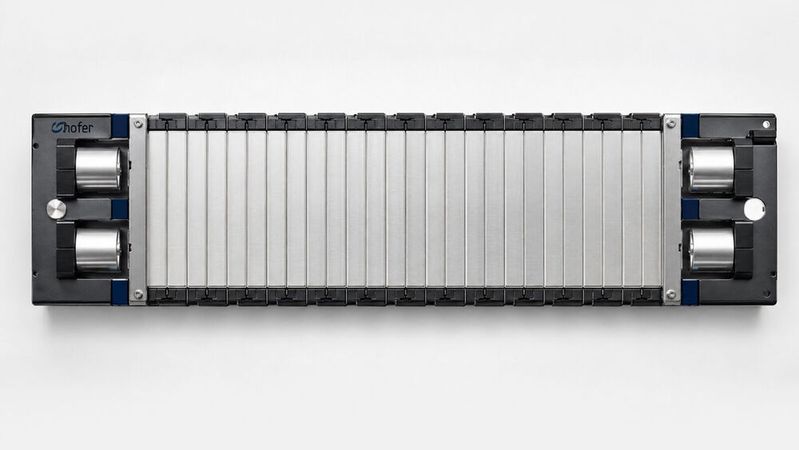
How long a battery maintains its performance depends not only on cell chemistry, temperature and state of charge. The mechanical conditions within a battery module also play an important role. In particular, the pressure applied to each cell can influence how quickly it ages. Recent research from the University of Cambridge has brought greater attention to this topic. The studies show that carefully controlled mechanical loading can significantly reduce the aging of lithium-ion cells. Under certain test conditions, the service life of the cells tested was significantly extended.
hofer technology has investigated in a range of customer projects how cell preload, breathing, swelling and mechanical deformation affect the cycle life and performance of different battery cells. The objective is not simply to determine how quickly a cell ages, but rather to identify the mechanical conditions under which it can maintain its performance for as long as possible.
To support this work, the hofer technology team has developed proprietary test methods and fully programmable test equipment. During defined charge and load profiles, parameters including cell deformation, temperature, voltage, capacity and impedance are recorded. This makes it possible to determine at an early stage which mechanical constraints are best suited to a specific cell technology. Experience also shows that there is no single optimum pressure that works for every battery cell. Both insufficient and excessive mechanical forces can accelerate cell degradation. Cell chemistry, cell format, state of charge, temperature and operating profile therefore need to be considered as an integrated system. The specially developed test methodology is already being applied across a wide range of cell technologies – from NMC and LFP to next-generation solid-state cells.
A smart battery module
The insights gained from our development work and from the successful use of the new test method in numerous projects form the basis for a new generation of battery modules from hofer technology. Smart pressure control is a key feature: the battery module can adapt to the specific requirements of the cell, providing greater flexibility in terms of performance, service life and future cell technologies.
A freely programmable force map allows the pressure applied to the cells to be adjusted according to the respective operating condition. This turns what has traditionally been a fixed mechanical design parameter into an actively controllable parameter within the battery system. The high level of development already achieved allows us to support our customers in moving toward series application within a short timeframe.
How significant the effect is in each case depends on the cell technology, operating profile and initial system design. A longer battery life brings more than just technical benefits. If batteries can be used for longer, their economic value also improves. Replacement and recycling can be delayed, while residual value, total cost of ownership and resource use may also benefit. The potential applications go beyond conventional electric vehicles. High cycle life and long service life can also be important for commercial vehicles, stationary energy storage systems, marine applications, as well as future aviation and aerospace systems.
For energy storage systems using solid-state cells in particular, longer battery life and a high number of cycles can have a direct impact on the overall economics of the system. Future battery systems in vehicles will also need to support Vehicle-to-Home (V2H) and Vehicle-to-Grid (V2G) functions. V2G applications in particular can require several times as many charge and discharge cycles. This creates an additional challenge for energy storage systems based on solid-state cells. Smart pressure control helps maintain stable cell performance over a high number of charge and discharge cycles. This makes cell mechanics an important factor in the development of future battery systems.
(ID:50937867)
:quality(80)/p7i.vogel.de/wcms/0f/c0/0fc0527692a3207dfc0b61dfaf956d29/0128767713v2.jpeg "Donut Lab introduced new high-performance solid state batteries ready for OEM sse and powering all 2026 model verge motorcycles on the road in Q1 2026. (Source: Donut Lab)")
:quality(80)/p7i.vogel.de/wcms/bf/b6/bfb6ac295759be32d567df9849b6767e/0134094495v2.jpeg "Fraunhofer ISE reports that 25 Ah pouch cells with silicon-rich anodes retained more than 83% of their initial capacity after 1,000 cycles when tested under 1,000 kPa axial pressure. (Bild: Fraunhofer ISE)")