










CURRENT SENSORS Yokogawa Test & Measurement to release split core current sensors
Sponsored by

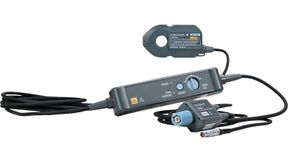
Yokogawa Test & Measurement Corporation announces the release of its new AC/DC split core current sensors, the CT500SA and CT200SA. These products have been developed to meet the need for more accurate and simplified current measurement in high current applications such as electric vehicles (xEVs) and renewable energy where energy efficiency is increasingly important.
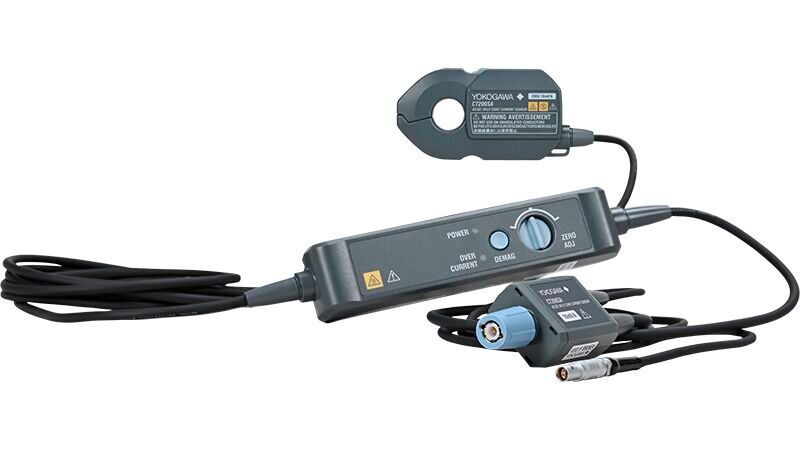
Designed specifically for space-constrained environments, such as in-vehicle xEV testing, they offer high-accuracy current measurements for the 200 A and 500 A ranges. The sensors are compatible with both power analyzers and waveform measurement instruments, delivering improved testing reliability, efficiency, and reduced sensor costs.
Development background
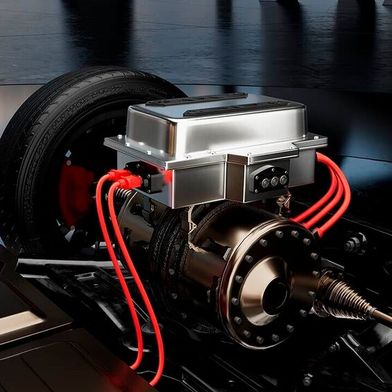
Automotive and electrified vehicle (xEV) validation requires that measurements of inverters and motors take place post-assembly. At this stage, the space around components is limited, and cables cannot be cut. While through-hole sensors may offer greater accuracy, they require wires to pass through their central aperture. This creates serious logistical installation and removal hurdles in late-stage production testing. Split core current sensors, on the other hand, readily meet these requirements as they clamp directly onto wires. Given that engineers typically have to install and remove sensors repeatedly as they progress through test phases and switch between waveform and power analysis, split core current sensors use a far more practical installation method. Lighter, more compact vehicle architectures have only made conditions more challenging, limiting accessibility for sensors sized for 1000 A, like the existing CT1000S, particularly for applications at lower current ratings. Conventional split core current sensors do not meet the required accuracy ratings due to challenges introduced by their clamp on design.
Yokogawa Test & Measurement developed the CT500SA and CT200SA to address these challenges directly. With accuracy ratings comparable to through-hole sensors, wide frequency bandwidth, and the convenience of split core installation, both sensors deliver compact measurement solutions ideal for tight spaces and a wide range of applications, from product development to real-world testing.
Main features
Compact measurement in tight spaces
The main sensor unit of both devices measures a compact 110mm width × 62mm height × 25mm depth, ideal for space-constrained test environments. Each features a single unlock-and-open button for one-handed clamp-on installation, while the body includes both an M4 screw hole and a cable tie slot to secure the sensor in place – directly improving measurement repeatability as outputs are sensitive to positioning.
High accuracy, wide bandwidth, split core design
The CT500SA and CT200SA deliver guaranteed accuracy of ±0.09% of reading + 0.01% of full scale within a temperature range of 23 ± 5°C. This represents an order-of-magnitude improvement over conventional current sensors, providing through-hole sensor level accuracy while retaining the convenience of clamp-on installation.
Available frequency bandwidths differ between the two models. The CT500SA delivers a frequency bandwidth of 500 kHz (−3 dB), while the CT200SA extends to 1 MHz (−3 dB). The CT200SA and CT500SA can also measure switching frequencies, used for motor inverter validation and requiring wideband measurement. Both models hold a phase accuracy of ±0.1° (0.1Hz ≦ f ≦ 1kHz).
Versatile measurements
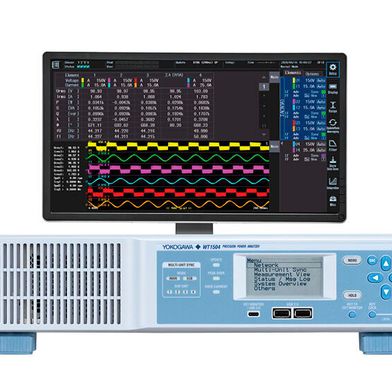
Current sensors are typically compatible with only one type of instrument, whether a power analyzer or waveform measurement instrument. The CT500SA and CT200SA can connect to both directly without the need for a conversion connector or supporting accessory. In addition to the time and labor savings from eliminating sensor swaps and reduced equipment costs, measuring identical signals improves reliability and removes the need to synchronize data. Furthermore, with the growing adoption of AI data centers, there has been an increase in the development of various power conversion devices for power grids and air conditioning equipment. There is a growing need to measure currents in the 500A and 200A ranges without cutting cables on these devices as well, and the CT500SA and CT200SA help improve work efficiency.
Major Target Markets
- EV/xEV
- Renewable energy: Photovoltaic (PV) / solar
- HVAC
- AI data centers
Applications
- In-vehicle xEV measurement on near-finished vehicles, where space is limited
- Inverter efficiency analysis involving wide-bandwidth measurement of pulse width modulation (PWM) controlled outputs with harmonic content
- PV system output current measurement and performance evaluation
- HVAC and air conditioning system current monitoring
(ID:50996278)