


:quality(80)/p7i.vogel.de/wcms/10/fc/10fcb98e44d61826e641bc8d3f20f616/0133193677v2.jpeg "The new AEVA and AEVB Series aluminum electrolytic capacitors are engineered for harsh industrial environments, delivering high-CV, long-lifetime performance in compact, surface-mount packages that reliably withstand up to 30g acceleration and operating temperatures extending from -55° to +125°C. (Source: Kyocera)")
:quality(80)/p7i.vogel.de/wcms/f7/42/f74208db9f5f87dca384b38b71c4782e/0133196365v2.jpeg "YAGEO’s EC Flat‑Series temperature sensors combine fast, accurate measurement with resistance to vibration, shock, moisture and dust for demanding automotive and industrial applications. (Source: Yageo)")
:quality(80)/p7i.vogel.de/wcms/b2/82/b28212428745dd8a4634ad4f4912012f/0132902689v2.jpeg "New 15 V, 25 V and 40 V eGaN FETs deliver ultra-low on-resistance, high current capability, and exceptional radiation immunity for high-density space power conversion (Source: EPC Space)")
:quality(80)/p7i.vogel.de/wcms/7b/4f/7b4f433302c490cac22eee9c12499e65/0132780211v2.jpeg "Littelfuse introduces the TPSMD‑FL series of high‑power surface‑mount TVS diodes, designed to simplify ISO 7637 load‑dump protection and safeguard automotive electronics against severe voltage transients. (Source: Littlefuse)")
:quality(80)/p7i.vogel.de/wcms/78/38/783841efab284c1b4453777e7ebea26d/0133190419v2.jpeg "Diodes has completed its acquisition of Elevate Semiconductor, expanding its analog and mixed-signal portfolio and strengthening its presence in the high-growth automated test equipment market. (Source: © peopleimages.com - stock.adobe.com)")
:quality(80)/p7i.vogel.de/wcms/1f/79/1f79d69530465de26a832c742fc60319/0133117717v2.jpeg "With 30,000 sqm of exhibition space, 20,157 trade visitors, 271 exhibitors, and 131 expert presentations as part of the conference program, the event sent a strong message about the industry's innovative strength and dynamism. (Source: Mesago Messe Frankfurt GmbH)")
:quality(80)/p7i.vogel.de/wcms/43/4d/434db2291567e847e54332004942a225/0132958267v2.jpeg "GlobalWafers has joined the SEMI Taiwan Materials Alliance, with CEO Doris Hsu serving as co‑chair, to advance critical materials technologies, accelerate collaborative innovation and strengthen global semiconductor supply chain resilience. (Source: © jiwon - stock.adobe.com)")
:quality(80)/p7i.vogel.de/wcms/6f/72/6f72f93d1e4c5a248a97dd3b8f32a336/0132997898v2.jpeg "Infineon plans to acquire C2i Semiconductors to combine software‑defined multiphase control and smart power stages with its broad power‑semiconductor portfolio for intelligent, scalable AI data‑center power delivery. (Source: © Grispb - stock.adobe.com)")
:quality(80)/p7i.vogel.de/wcms/87/97/879728679e7010f81e53a86923cde74c/0133218625v2.jpeg "Conceptual illustration of polar wurtzite niobium aluminum nitride (NbAlN), a transition-metal-containing nitride semiconductor that preserves the crystal structure and polarity of GaN. (Source: Associate Professor Atsushi Kobayashi from Tokyo University of Science, Japan)")
:quality(80)/p7i.vogel.de/wcms/ac/31/ac31c9478d80894d725d02883ae7ed5d/0133176534v2.jpeg "Average models allow power designers to simulate DC‑DC converters and three‑phase PFC circuits quickly, analyse small‑signal behaviour and evaluate loop stability without modelling every switching event. (Source: © AI - stock.adobe.com)")
:quality(80)/p7i.vogel.de/wcms/96/80/9680b468d7f682c8b6c15b07300afbb0/0133177854v2.jpeg "Grid-forming inverters are also known as grid-forming resources and grid-forming IBR. This article explains grid-forming inverters in detail. (Bild: © only_kim - stock.adobe.com)")
:quality(80)/p7i.vogel.de/wcms/57/c6/57c6fa81922a9849a917bdfed82eddf7/0133052494v2.jpeg "Rising demand for high-end materials shifts production toward higher-margin products, reducing output of standard loss materials. (Source: NCAB)")
:quality(80)/p7i.vogel.de/wcms/7b/76/7b76005554b556df2a7a3794bdf69d44/0132365246v2.jpeg "Hioki’s ST5680A DC Hipot Tester combines CE/UKCA/CSA compliance, an integrated capacitance‑based contact check and time‑series waveform recording (voltage, leakage current, insulation resistance) to standardize hipot and insulation testing across EV cell, module and pack production lines. (Source: Hioki)")
:quality(80)/p7i.vogel.de/wcms/af/7f/af7f7b0fb7f29219fc991b1130f65477/0132241333v2.jpeg "Comprehensive laboratory testing regimens—combining thermal cycling, high‑current stress, EMC, and accelerated lifetime tests—are essential to validate advanced power designs and ensure reliability in real‑world applications. (Source: PRBX)")
:quality(80)/p7i.vogel.de/wcms/16/3d/163df69363f8125315a9826e13ea4b05/0131927425v2.jpeg "Solution will maximize data center and AI factory profitability while delivering engineering-grade insights to design and operations for more efficient, sustainable, and resilient infrastructure. (Source: Cadence)")
:quality(80)/p7i.vogel.de/wcms/85/b7/85b7e90733a2bd8f21515d8f7137f2fc/0131917677v2.jpeg "Renesas acquires Pictorus to integrate its embedded application software platform with Renesas’ MCU and MPU portfolio, helping developers shorten time‑to‑market and simplify system integration. (Source: © lucadp - stock.adobe.com)")
CONTROL TECHNOLOGY Why PID control technology continues to thrive
Related Vendors
:fill(fff,0)/p7i.vogel.de/companies/6a/20/6a202a4f89a62/mrs-white-on-blue-bg.png "mrs-white-on-blue-bg ()")
:fill(fff,0)/p7i.vogel.de/companies/62/b9/62b980cddf5d6/ceramtec.png "ceramtec (www.ceramtec-group.com)")
:fill(fff,0)/p7i.vogel.de/companies/5f/71/5f71d5f92a5f6/2000px-rogers-corporation-logo-svg.png "2000px-Rogers_Corporation_Logo.svg.png (rogers germany)")
PID control originally became popular across many industries because of its versatility, simplicity, and effectiveness. It has maintained its popularity and even spread its influence as ongoing advances in both software and hardware steadily improve its capabilities.This article looks at PID technology and how it has advanced.
Proportional–integral–derivative controllers, also known as PID controllers or three-term controllers, have been with us for a long time; their first use was for ship steering control in 1922. From the mid-twentieth century, they became ubiquitous in industrial control applications.
However, continuous hardware and software advances have allowed the controllers to become ever smaller, lower-cost and more functional. This has facilitated their spread into many new applications, some of them perhaps unexpected – they are found in our mobile phones, electric vehicles, and electric ovens, for example.
So just how far have they evolved, and what do they look like now? After a brief recap of basic PID functionality, this article answers these questions by reviewing both the software and the hardware advances that have driven the PID evolution.
Basic PID control
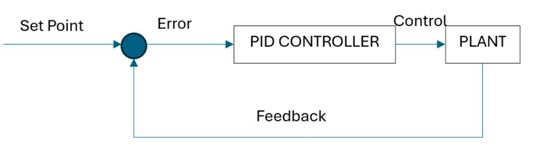
Figure 1 shows a basic PID control loop. The adjustable set point is the target value for a plant variable such as temperature. A sensor on the plant continuously measures the actual temperature value, which is fed back and compared with the set point value. The error signal, which is the difference between these two values, drives the PID controller which uses its internal algorithm to generate the control signal for the plant temperature control system. The controller is working to eliminate the error signal, which happens when the feedback equals the setpoint – or, in other words, when the plant is running at the desired temperature value.
When the controller is in full PID (Proportional, Integral and Differential) mode, it implements a three-term PID algorithm as shown below:

Where
e(t) = SP(t) – PV(t)
SP(t) is the setpoint
PV(t) is the process variable being fed back
The K values are proportional, integral and differential gains. If a gain is set to zero, the whole term becomes zero. This way, the PID mechanism can be turned into a P controller, a PI controller, and other modifications1.
The proportional term is the difference between the set point (SP) and the measured process variable (PV) – the error value, or e(t) - multiplied by the P gain (Kp).
The proportional gain (Kp) defines the speed of the control system response. If this is too large, the process variable starts to oscillate and can even oscillate out of control.
In certain systems, using only the P term cannot reduce the error value to zero. The remaining difference between the set point and process variable is called the steady-state error. In such cases, we need to add the integral term to the equation.
While the P term only considers the current error value, the integral term is proportional to the time integral of the error value. It means the I component considers the history of the error. The integral gain (Ki) increases the weight of this component in the actuating output.
If there is even a small error, the integral term will increase continuously (or decrease if the error is negative) until the steady state error equals zero.
The derivative term uses the difference between the current and previous error values divided by the time between measurements (dt).
The term is proportional to the rate of change of the process variable. While the P term fixes the current error and the I term considers previous errors, the derivative term works on future error values. The D component compensates for sharp fluctuations in the system, prevents it from strong overshoot, and decreases oscillations. The derivative gain (Kd) changes the weight of this component in the control signal.
The D term is important for systems such as quadcopters that face violent changes. However, it also amplifies measurement noise and external disturbances. It is often excluded when dealing with slow systems.
:quality(80)/p7i.vogel.de/wcms/82/60/826040325c637bb13630347a8c820524/87980254.jpeg "A proportional–integral–derivative controller (PID controller or three-term controller) is a control loop mechanism employing feedback that is widely used in industrial control systems and a variety of other applications requiring continuously modulated control. (Source: Adobe Stock)")
PID CONTROLLER
PID Controller - Definition and explanations
From steam engine control to your smartphone – how PID hardware has evolved
The earliest modern PID controllers – from the 1920s onwards – were built using mechanical or pneumatic components. Then the appearance of operational amplifiers in the mid Sixties allowed analog electronic PID designs – and these are still in widespread use today.
However, from the late Seventies, PID control could be implemented digitally. Manufacturers started using microcontrollers such as the Intel 8048; an innovation which significantly enhanced process control systems with more precise and reliable automation, more functionality, and compact designs. Online connectivity also becomes possible – an essential feature in today’s IoT environment.
Note that other PID controller implementations are also available. FPAAs (Field-programmable analog arrays)2, FPGAs (Field-programmable gate arrays) and ASICs (Application-specific integrated circuits) can all be used, to yield advantages such as ease of programming, and set-up and modification of complex systems using building blocks.
Continuous-discrete conversion
To run a PID algorithm, which represents a continuous process, on a digital device such as a microprocessor, some type of continuous-discrete conversion method must be used. MathWorks offers several discretization and interpolation methods for converting dynamic system models between continuous time and discrete time and for resampling discrete-time models. Their ‘Continuous-Discrete Conversion Methods’ document provides a table of methods, along with advice on how to choose the best type for a given application.3
A practical microcontroller-based PID controller implementation
One readily-accessible approach to implementing a PID algorithm on a microcontroller is available through Arduino - an open-source electronics platform based on easy to use microcontroller hardware and software. Although Arduino was originally introduced as a simple development tool for students lacking an electronics or programming background, it has extended into a package used by professional designers to develop complex scientific instruments and other demanding applications.
The boards can read inputs such as light on a sensor, and generate outputs to control motors, turn on LEDs, and perform many other actions4.
Arduino can be coded using a language called Wiring, while the code is managed by the Arduino Software IDE (Integrated Development Environment). The IDE works with a Library Manager, which allows users to install libraries for any application. One example is ArduPID5, which supports PID functionality on an Arduino and claims greater accuracy that the legacy Arduino PID library.
The benefits arising from PID digitization
One immediate benefit is that once PID is transferred into a digital – and programmable – environment, functionality possibilities increase dramatically, with more compact and versatile hardware solutions. Integration with related functions is also possible.
For example, the Nano 33 BLE6, an Arduino microcontroller product, features a 9-axis inertial measurement unit and the possibility for Bluetooth Low Energy connectivity. With its small size and PID processing capability, it becomes a good solution for mobile phones and other wearable devices.
For automotive applications, STMicroelectronics’ 32-bit SPC5 microcontroller family can run PID and other control algorithms. These can be implemented by using the SPC5Studio IDE, which provides tools and libraries for developing applications on SPC5 microcontrollers. The IDE includes examples and templates to help users get started with their PID control implementation.
This means that the algorithm can run in a complete family of microcontrollers of various capabilities, all with automotive quality and capable of running safety critical applications7. They can also be paired with other chips for more functionality - for example with the ST L9963E Battery Management IC and its companion isolated transceiver L9963T to build a complete battery management system. This achieves high accuracy measurements of up to 14 cells in series, on mono or bi-directional daisy-chain configurations, embedding sophisticated cell monitoring and diagnostic features. It also meets the stringent Automotive Safety Integrity Level (ASIL) D8 regulations.
Although the PID algorithm remains popular as a fundamental process control tool, its ability to control a process accurately depends on how well it is tuned. Its viability also depends on the level of nonlinearity and other unpredictable factors in the system being controlled.
PID tuning
The Ziegler–Nichols heuristic tuning method is the most popular way of tuning a PID controller. It was developed by John G. Ziegler and Nathaniel B. Nichols9. It is performed by setting the I (integral) and D (derivative) gains to zero. The "P" (proportional) gain, Kp is then increased (from zero) until it reaches the ultimate gain Ku, at which the output of the control loop has stable and consistent oscillations. Ku and the oscillation period Tu are then used to set the P, I, and D gains depending on the type of controller used and behavior desired.
Other tuning methods include the Cohen Coon Method and the Gain and Phase Method10.
More advanced tuning and control strategies
As process systems become non-linear or unpredictable, more advanced control approaches become necessary. With PID control migrating to intelligent, programmable hardware, these become easier to develop and implement.
More sophisticated control strategies start with adaptive PID controllers, whose parameters can be adjusted in real time by measured system behavior. This improves performance in systems with varying dynamics.
Fuzzy logic control (FLC) is being used to handle complex, ill-defined problems, where it can be applied by an efficient human operator without knowledge of their underlying dynamics. FLC comprises a set of subsystems, built with simple P, PI, or PID controllers11.
Artificial neural networks (ANNs) are computing systems which are based on biological neural networks and human brain emulation. They have been used in many applications since 1940; examples include image processing, signal classification, function approximation, nonlinear system identification, nonlinear system control, and other fields.
While classical PID controllers remain popular in industrial applications because of their simplicity and predictable behavior, ANNs can take on industrial process challenges such as nonlinearities, parameter uncertainties, and load disturbances which are beyond basic PID capability. And research into quantum neural networks is under way; these can further improve ANNs in areas such as reducing computing burden and improving convergence speed12.
Other approaches available for handling complex processes include cascade control, feedforward control, gain scheduling, genetic algorithm-based PID control, particle swarm optimization13, and model predictive PID control.
The future of PID and the impact of AI
As AI technology advances and becomes more prevalent, it becomes an alternative option for process control – but is it necessarily superior?
A blog post on the subject, written by Dynamic Measurement & Control Solution LLC, explains that the answer depends on the user’s circumstances14. The post says:
“One of the primary advantages of AI in PID control is its ability to learn from data and adapt to changing conditions. AI algorithms can analyze large amounts of data, identify patterns, and predict the system's behavior. As a result, an AI component can optimize the control variables and ensure that the system operates at peak efficiency. Additionally, AI can reduce the system's complexity by automating specific processes, thus improving the overall control performance.
“However, using AI in PID control also presents some challenges. One of the most significant is the need for large amounts of data to train AI algorithms. This data must accurately represent the system's behavior to ensure that the AI can learn effectively. Another challenge is the requirement for specialized skills to develop and maintain AI algorithms. This can be a significant barrier for small organizations lacking the resources to hire AI experts.
“In short, choosing between PID control and AI depends on the specific application and requirements of the control system. For simple designs, PID control may be sufficient. However, AI may be the better choice for complex and dynamic systems. Ultimately, it is up to the control engineer to decide which method to use based on their expertise and knowledge of the system.”
Conclusion
This article has explained why PID control became established as the most popular method for process control, and enjoys continued development because the algorithm can be run by ever more powerful microcontrollers.
This means that PID control is now found in a very wide range of applications of all types and sizes, including many related to power management in control.
Look out for future articles in Power & Beyond which explore different uses of the technology in various power applications.
References
(ID:50158109)
:quality(80)/p7i.vogel.de/wcms/ef/1c/ef1c6a123496f3c00da6ea8b85385de9/0130926273v2.jpeg "Resistors are among the three fundamental electronic components, along with inductors and capacitors. (Source: © Kan - stock.adobe.com)")
:quality(80)/p7i.vogel.de/wcms/ac/31/ac31c9478d80894d725d02883ae7ed5d/0133176534v2.jpeg "Average models allow power designers to simulate DC‑DC converters and three‑phase PFC circuits quickly, analyse small‑signal behaviour and evaluate loop stability without modelling every switching event. (Source: © AI - stock.adobe.com)")