


:quality(80)/p7i.vogel.de/wcms/7f/4b/7f4b97757cea82c0675209630577dc22/0133974130v2.jpeg "Vox Power’s EIRE600 delivers up to 600 W in a compact 5 × 3-inch package, with forced-air or conduction cooling options for industrial and medical equipment. (Source: Vox Power)")
:quality(80)/p7i.vogel.de/wcms/55/97/5597c3436e3bc92ee7ba23b6f9d289e9/0134032539v2.jpeg "Littelfuse’s TP7.0SMD-XC automotive TVS diode series uses foldback technology to provide low clamping voltage for protecting sensitive vehicle electronics. (Bild: Littelfuse)")
:quality(80)/p7i.vogel.de/wcms/51/f8/51f84448e666230bb11a02566abd1177/0133958187v3.jpeg "Microchip’s radiation-tolerant GaN point-of-load converter supplies up to 20 A for space-based processors, FPGAs, microcontrollers and ASICs. (Source: Microchip)")
:quality(80)/p7i.vogel.de/wcms/0a/7c/0a7c08f368ae1d91f758dd18d2a32e88/0133978423v2.jpeg "EPFL researchers have demonstrated a GaN transistor that withstands nearly 4 kV, using an intrinsic polarization superjunction design to distribute electric fields more evenly. (Source: EPFL)")
:quality(80)/p7i.vogel.de/wcms/5b/94/5b94232ca4183d6fcc2dccc7394d7544/0134041114v4.jpeg "Siemens and NVIDIA are testing AI applications at Siemens’ Erlangen electronics factory, using digital twins to support production planning and prepare inspection systems before physical prototypes are available. (Bild: Siemens)")
:quality(80)/p7i.vogel.de/wcms/b4/1f/b41f2731a07b608e60eca3663e280301/0133980549v2.jpeg "Multi-year agreement with Wolfspeed supports Infineon’s conversion from 150-millimeter to 200-millimeter silicon carbide (SiC) manufacturing (Source: © Ada - stock.adobe.com)")
:quality(80)/p7i.vogel.de/wcms/e3/0a/e30a8813bcf44b16f0dceb63a0747d29/0133984094v2.jpeg "The semiconductor is only one part of the design. Higher voltage, frequency and power density also increase the demands on electronic packaging materials such as die attach, substrates, top-side interconnects and module attach. (Source: Generated by AI)")
:quality(80)/p7i.vogel.de/wcms/5d/fb/5dfba5e5f38daf2b8597b05656af29c0/0133956337v2.jpeg "Wolfspeed has received a conditional commitment for a loan of up to $1.5 billion from the U.S. Department of War to support its domestic wide-bandgap semiconductor supply chain. (Source: © AspctStyle - stock.adobe.com)")
:quality(80)/p7i.vogel.de/wcms/bf/b6/bfb6ac295759be32d567df9849b6767e/0134094495v2.jpeg "Fraunhofer ISE reports that 25 Ah pouch cells with silicon-rich anodes retained more than 83% of their initial capacity after 1,000 cycles when tested under 1,000 kPa axial pressure. (Bild: Fraunhofer ISE)")
:quality(80)/p7i.vogel.de/wcms/16/dc/16dca55e6ef80e6b5da68bc628da2dcc/0133844782v2.jpeg "This article explains virtual power plants in modern renewable-heavy grids. (Source: © M@rketVisualsStudio - stock.adobe.com)")
:quality(80)/p7i.vogel.de/wcms/e8/33/e8330aae4bea3578b98ec2c1403d367a/0133980001v2.jpeg "IRENA’s 2026 World Energy Transition Outlook identifies faster electrification powered by renewables as central to meeting future global energy needs. (Source: Irena)")
:quality(80)/p7i.vogel.de/wcms/6c/b4/6cb405f47d25035e256ae90fe3a66ee6/0134032112v2.jpeg "Sungrow’s PowerTitan 3.0 energy storage platform uses onsemi EliteSiC hybrid power modules, with the companies reporting peak inverter efficiency above 99.3%. (Bild: onsemi)")
:quality(80)/p7i.vogel.de/wcms/7b/76/7b76005554b556df2a7a3794bdf69d44/0132365246v2.jpeg "Hioki’s ST5680A DC Hipot Tester combines CE/UKCA/CSA compliance, an integrated capacitance‑based contact check and time‑series waveform recording (voltage, leakage current, insulation resistance) to standardize hipot and insulation testing across EV cell, module and pack production lines. (Source: Hioki)")
:quality(80)/p7i.vogel.de/wcms/af/7f/af7f7b0fb7f29219fc991b1130f65477/0132241333v2.jpeg "Comprehensive laboratory testing regimens—combining thermal cycling, high‑current stress, EMC, and accelerated lifetime tests—are essential to validate advanced power designs and ensure reliability in real‑world applications. (Source: PRBX)")
:quality(80)/p7i.vogel.de/wcms/16/3d/163df69363f8125315a9826e13ea4b05/0131927425v2.jpeg "Solution will maximize data center and AI factory profitability while delivering engineering-grade insights to design and operations for more efficient, sustainable, and resilient infrastructure. (Source: Cadence)")
:quality(80)/p7i.vogel.de/wcms/85/b7/85b7e90733a2bd8f21515d8f7137f2fc/0131917677v2.jpeg "Renesas acquires Pictorus to integrate its embedded application software platform with Renesas’ MCU and MPU portfolio, helping developers shorten time‑to‑market and simplify system integration. (Source: © lucadp - stock.adobe.com)")
:quality(80)/p7i.vogel.de/wcms/f8/34/f834240d434a0c265a2ccafe614c8cd7/0134032109v4.jpeg "Hard- and soft-switching techniques shape voltage and current during device transitions, influencing switching losses, EMI and thermal performance in power converters. (Bild: © Mrthullab - stock.adobe.com)")
:quality(80)/p7i.vogel.de/wcms/27/07/2707280c807689b437baed3660257404/0133626052v2.jpeg "The quantum behavior of electrons shapes semiconductor devices—and the power converters that deliver electricity to modern computing systems. (Source: © Celt Studio - stock.adobe.com)")
ENERGY STORAGE CATL launches world’s largest energy storage testbed
Related Vendors
:fill(fff,0)/p7i.vogel.de/companies/6a/20/6a202a4f89a62/mrs-white-on-blue-bg.png "mrs-white-on-blue-bg ()")
:fill(fff,0)/p7i.vogel.de/companies/5f/71/5f71d5f92a5f6/2000px-rogers-corporation-logo-svg.png "2000px-Rogers_Corporation_Logo.svg.png (rogers germany)")
:fill(fff,0)/p7i.vogel.de/companies/68/2c/682c3e2e9a195/logotype-rvb.jpeg "logotype-rvb (MERSEN France)")
CATL's Xiamen Energy Storage Validation Research Institute (ESVL) officially commenced operations on May 28th, marking a major step into the era of real-world validation for the industry. Spanning 10 hectares and backed by an investment of roughly RMB 3 billion (about 440 million U.S. dollars), the proving ground is designed as an open and shared infrastructure accessible to all players in the global energy storage sector.
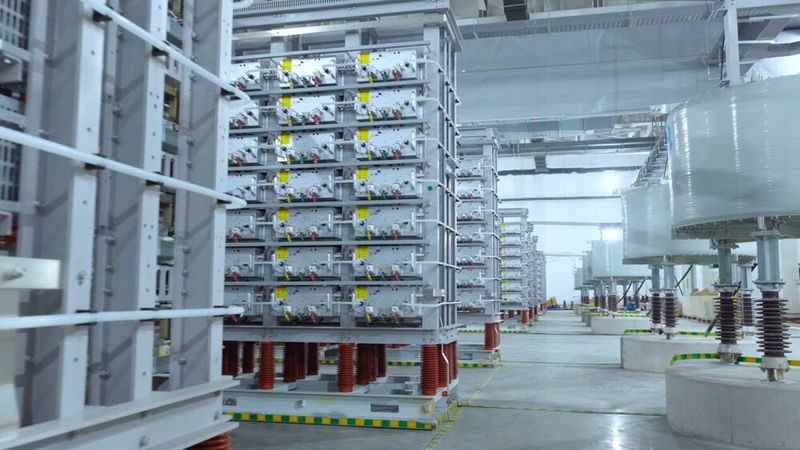
As energy storage scales rapidly as a core enabler of the global energy transition, the industry is facing a widening gap between installed capacity and real-world performance. Nearly one in five large-scale energy storage power stations worldwide are underperforming, while 46.5% of energy storage systems experience grid-connection delays of more than two months. With validation capabilities still largely limited to component and scenario testing, the industry increasingly needs a more credible station-level validation framework.
Real-world validated energy storage is built on the premise of the grid's most demanding operating conditions. It moves validation from component-level testing to full-system and station-level verification, covering safety, grid-support capability and long-term reliability before deployment.
“Scientific rigor is more critical than ever as energy storage enters the gigawatt era,” said Dr. Wu Kai, Chief Scientist of CATL. “That means being honest about equipment performance, respectful of grid dynamics and disciplined in testing results — while raising industry quality standards to the station level and bringing validation forward to the pre-delivery stage. ESVL is designed to reflect that rigor, and to help usher in a more trusted and sustainable era of real-world validation.”
“ESVL is open to the global energy storage industry and works with leading certification bodies, including TÜV SÜD, TÜV Rheinland, CGC and CSA, to provide one-test, multi-witness, globally recognized services,” said Dr. Chen Xiaobo, Head of ESVL. “As energy storage increasingly becomes a critical infrastructure asset, ESVL's independent, traceable real-world validated data can help regulators make evidence-based decisions, insurers price risk more precisely and financial institutions assess energy storage as a more credible, bankable asset.”
Grid connection that mirrors real-world grids. The world's first station-level grid integration laboratory is equipped with a 35kV/100MVA grid simulator and a real-time simulator, 14 times larger than NREL's 13.8kV/7MVA platform, setting a new global benchmark for grid‑level testing. It can test more than 10 large-scale energy storage containers at the same time, simulate 1,000-node grid topologies, and cover a frequency range of 15 Hz to 60 Hz. It can also validate station-level grid-forming capability and multi-unit coordination under complex grid conditions, helping improve commissioning safety and shorten commissioning cycles.
High-voltage failures traced to the root cause. Covering 1kV to 500kV, the High-Voltage Safety Laboratory can help investigate the underlying mechanisms of fire and explosion under extreme high-voltage conditions, including lightning impulses, power-frequency and DC withstand voltage, and partial discharge testing. By identifying the safety boundaries of key components and full systems, it helps guide equipment design toward preventing fire and explosion.
Controlled combustion testing at scale. The Thermal Safety and Combustion Laboratory is the world's first large indoor combustion facility equipped with a 20MW calorimeter. With 100,000 cubic meters of indoor combustion space, it can carry out explosion testing on nine large energy storage containers at the same time. It provides critical data for assessing safety spacing, deployment planning and system iteration.
Reliability proven in extreme climates. Equipped with climate, environmental, salt spray, rain and sand chambers, the Environment Reliability Laboratory can verify full-system energy storage containers under extreme conditions ranging from -50°C to 100°C and simulated high-altitude pressure environments up to 7,200 meters. It helps validate long-term performance under desert heat, high-altitude low pressure, coastal salt spray and other harsh environments.
EMC testing under real operating conditions. The Electromagnetic Compatibility Laboratory is the world's only facility capable of accommodating a full 40-foot container, equipped with a 65-ton turntable and a 5MW power supply, and able to perform EMC testing in an anechoic chamber under real high-power charge and discharge conditions. By replicating real operating conditions, it helps identify electromagnetic interference risks before deployment and improve communication and control reliability.
(ID:50860417)
:quality(80)/p7i.vogel.de/wcms/af/7f/af7f7b0fb7f29219fc991b1130f65477/0132241333v2.jpeg "Comprehensive laboratory testing regimens—combining thermal cycling, high‑current stress, EMC, and accelerated lifetime tests—are essential to validate advanced power designs and ensure reliability in real‑world applications. (Source: PRBX)")
:quality(80)/p7i.vogel.de/wcms/8b/42/8b4271e1bedea432ab03c83959e30431/0128818204v2.jpeg "Rows of batteries on Kauai island provide more than just power: They stabilize the grid. A project between the Kauai Island Utility Cooperative, NLR, and several more partners showed that electronics can offer equal grid strength to spinning resources. (Source: Connor O’Neil, National Laboratory of the Rockies)")