


:quality(80)/p7i.vogel.de/wcms/e9/5b/e95bc9c43c57018499c83a2c91ff9764/0132237640v2.jpeg "Yageo’s KH‑AT series automotive‑grade MOVs deliver robust surge absorption and stable electrical performance for demanding vehicle environments, protecting ECUs and power rails from transients. (Source: Yageo)")
:quality(80)/p7i.vogel.de/wcms/f4/61/f461d1f6bf3a6030877d90efced438f2/0132110372v2.jpeg "Taiyo Yuden’s new HVX and HTX hybrid conductive‑polymer capacitors offer AEC‑Q200 qualification, 80 V rating and high ripple capability at 135°C for noise suppression and power smoothing in automotive systems such as ADAS and power steering. (Source: Taiyo Yuden)")
:quality(80)/p7i.vogel.de/wcms/a4/b6/a4b6256bef45368325659f926c268ebe/0132104622v2.jpeg "Toshiba’s new 80 V N‑channel power MOSFET, built on the company’s latest process, improves conduction and switching efficiency for AI server power supplies and high‑frequency data‑center converters. (Source: Toshiba)")
:quality(80)/p7i.vogel.de/wcms/c0/c5/c0c5bdbaf6df6fdd0fecc97c419ea9b4/0132022612v2.jpeg "Magnachip’s 6th‑generation 600 V super‑junction MOSFETs deliver improved efficiency and thermal performance for AI server power supplies and EV fast‑charging systems. (Source: © AntonKhrupinArt - stock.adobe.com)")
:quality(80)/p7i.vogel.de/wcms/51/72/51726a890dc35d74f494908b29681028/0132478976v2.jpeg "Bosch intends to start U.S. based commercial manufacturing in 2026 – just three years after acquiring the Roseville site. (Source: Bosch)")
:quality(80)/p7i.vogel.de/wcms/cc/f5/ccf52ac525f49330b780868db8f9565c/0132364990v2.jpeg "Infineon and LS ELECTRIC sign a memorandum to co‑develop high‑efficiency DC power infrastructure for AI data centers and next‑generation grids, targeting power conversion, energy storage integration, solid‑state transformers and semiconductor circuit breakers. (Source: © Yuliia - stock.adobe.com)")
:quality(80)/p7i.vogel.de/wcms/c6/16/c616f00139ce1575d3292524579868ed/0132241890v2.jpeg "GlobalWafers and Micron announce a strategic collaboration—including proposed financing support and a long‑term wafer supply agreement—to strengthen U.S. wafer manufacturing capacity and shore up the semiconductor supply chain for AI and data‑center demand. (Source: © Fervix Neon - stock.adobe.com)")
:quality(80)/p7i.vogel.de/wcms/ef/6d/ef6da8753871e0ea5c7b7203d31b2c9c/0132144857v2.jpeg "Keysight and WIN Semiconductor partner to reduce design risk for high‑frequency RF components by combining advanced measurement and modeling workflows with foundry‑level device validation for mmWave and high‑frequency applications. (symbolic image) (Source: © Mahmuda - stock.adobe.com)")
:quality(80)/p7i.vogel.de/wcms/83/ae/83ae0b00e573da9977ce19195d28c6b0/0132366058v2.jpeg "Researchers from EPC, The University of Hong Kong and Virginia Tech demonstrated a fully integrated GaN boost converter operating entirely at 4 K, achieving 91.6% efficiency at 7.6 W by combining monolithic GaN power ICs, on‑chip gate drivers and cryo‑qualified passive components. (Source: © Maurizio Di Paolo Emilio)")
:quality(80)/p7i.vogel.de/wcms/3c/a1/3ca1e2527a00068eb37f1db220c5463a/0132042920v2.jpeg "Energy harvesting removes the need for periodic battery swaps in hard‑to‑reach sensors — economically and regulatorily attractive as EU battery rules raise compliance and lifecycle costs. (Source: © Plaifah - stock.adobe.com)")
:quality(80)/p7i.vogel.de/wcms/81/04/8104b7c9a2ce5645d844ca4a1b9a736f/0132261940v2.jpeg "At The Smarter E 2026 Huawei launched LUTERRA, its next‑generation grid‑forming ESS platform, and showcased the award‑winning SUN2000‑506KTL 506 kW smart string inverter — technologies aimed at 1000 Vac architectures and plant‑level grid‑forming functionality. (Source: © Thares2020 - stock.adobe.com)")
:quality(80)/p7i.vogel.de/wcms/76/27/7627729494f2cddf62d276e5d6cd0aa1/0132245568v2.jpeg "Aluminum nitride crystal with a diameter of 2 inches – grown in the Joint Lab of Fraunhofer IISB and PVA TePla. (Source: Jennifer Reißig / Fraunhofer IISB)")
:quality(80)/p7i.vogel.de/wcms/7b/76/7b76005554b556df2a7a3794bdf69d44/0132365246v2.jpeg "Hioki’s ST5680A DC Hipot Tester combines CE/UKCA/CSA compliance, an integrated capacitance‑based contact check and time‑series waveform recording (voltage, leakage current, insulation resistance) to standardize hipot and insulation testing across EV cell, module and pack production lines. (Source: Hioki)")
:quality(80)/p7i.vogel.de/wcms/af/7f/af7f7b0fb7f29219fc991b1130f65477/0132241333v2.jpeg "Comprehensive laboratory testing regimens—combining thermal cycling, high‑current stress, EMC, and accelerated lifetime tests—are essential to validate advanced power designs and ensure reliability in real‑world applications. (Source: PRBX)")
:quality(80)/p7i.vogel.de/wcms/16/3d/163df69363f8125315a9826e13ea4b05/0131927425v2.jpeg "Solution will maximize data center and AI factory profitability while delivering engineering-grade insights to design and operations for more efficient, sustainable, and resilient infrastructure. (Source: Cadence)")
:quality(80)/p7i.vogel.de/wcms/85/b7/85b7e90733a2bd8f21515d8f7137f2fc/0131917677v2.jpeg "Renesas acquires Pictorus to integrate its embedded application software platform with Renesas’ MCU and MPU portfolio, helping developers shorten time‑to‑market and simplify system integration. (Source: © lucadp - stock.adobe.com)")
SEMICONDUCTOR CHIPS 20 top-notch featrues of power management integrated circuits
Related Vendors
:fill(fff,0)/p7i.vogel.de/companies/6a/20/6a202a4f89a62/mrs-white-on-blue-bg.png "mrs-white-on-blue-bg ()")
:fill(fff,0)/p7i.vogel.de/companies/60/7e/607ec89d5d9b5/white-frame.jpg "white frame.jpg (www.rohm.com)")
:fill(fff,0)/p7i.vogel.de/companies/67/62/67627f3f3487a/logo-caltest-instruments-rgb.png "logo-caltest-instruments-rgb (Caltest Instruments GmbH)")
Power management integrated circuits, commonly called PMICs, are power chips used in power electronics and various other industries. These power chips are so effective that they can reduce the size of your next PCB.
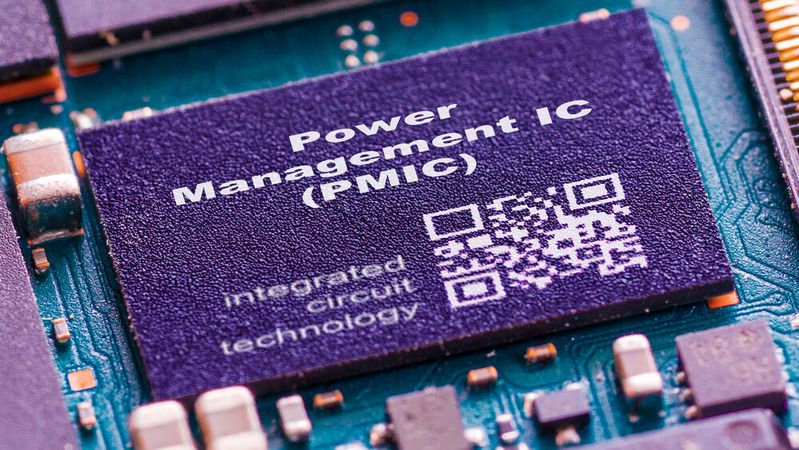
Power Management Integrated Circuit (PMIC) is a chip that performs, manages, and simplifies power-related operations in a system. PMIC chips integrate multiple components for power supply, control, and conversion into a single package.
PMIC market
PMIC is a type of power IC. Power devices are of three types: discrete components, modules, and power integrated circuits. In the early 2000s, discrete components dominated the industry. Power ICs and modules were not used much.
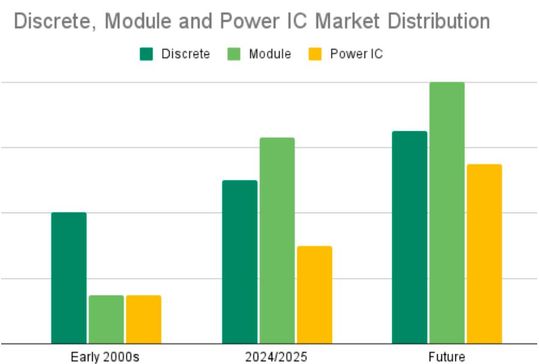
At present, modules have overtaken discrete components in sales. The market for power ICs has also grown throughout these years. As per some reports, power ICs have the strongest growth potential for the next decade.
PMIC applications
PMIC chips are used in various applications:
- Consumer electronics
- Portable devices and wearables
- Home appliances
- Smart home automation
- Networking devices like routers
- Medical devices
- Security systems
- Power chargers
- Embedded systems
- VLSI systems
- Communication systems like Radars
- Edge computing systems
- Industrial electronics
- Autonomous vehicles
- Motor control in robotics and automation
- Renewable energy technologies
PMIC features and functions
Being semiconductors, power management integrated circuits are solid-state devices that promise power delivery and control. PMIC chips are available in logic and memory modules alike. They are manufactured using a combination of BJT and CMOS fabrication processes, known as the BiCMOS process. PMICs have top-notch features; 20 of them are described below.
:quality(80):fill(efefef,0)/p7i.vogel.de/wcms/5f/fe/5ffedb2e0ffa6/listing.jpg "listing")
1. Seamless integration
PMIC chips can effectively integrate with industrial-grade MPUs (Microprocessors), MCUs (Microcontrollers), SoCs (System on Chips), SOMs (System on Modules), SiPs (System in Package), and FPGAs (Field Programmable Gated Arrays). These chips can also be integrated into software— to ease hardware and software development. Simply put, PMICs simplify power management in complex embedded systems.
2. Intelligent power switching
Each component in a PCB has a different supply voltage and power needs. Most PCBs need to supply different voltages to different components, whether active or passive. PMIC chips offer pin-selectable supply voltage of about 3.3 V, 5 V, and 1.8 V internally to circuits and components. The voltage is converted at the point of load and supplied further.
3. Power path management
Power management integrated circuits can handle multiple power sources in a system. Simply put, PMICs can handle battery and AC adapters alike, ensuring an uninterrupted power supply. They perform automatic switching and carry out charging and powering operations simultaneously.
4. Multiple functionalities
PMICs consist of multiple power rails and management functions. PMIC chips can perform multiple power-related functions during operation. It means that they can carry out power conversion and power control functions simultaneously. In simple words, power management integrated circuit chips cater to multiple power requirements of associated devices.
5. Miniaturization support
As mentioned above, power management integrated circuits offer complete power supply solutions and integrate single or multiple output voltage regulators and various control functionalities into a single chip. It eliminates the need to use discrete components. PMICs decrease the circuit board space— the size of PCBs by 40-50 %. As a result, PMIC chips are simple and compact.
:quality(80)/p7i.vogel.de/wcms/7c/cb/7ccb277e1236a7e7d469d5e18b89682b/88322653v2.jpeg "A voltage regulator is a system designed to automatically maintain a constant voltage level. (Source: Adobe Stock)")
BASIC KNOWLEDGE - VOLTAGE REGULATOR
Different types of voltage regulators and working principle
6. Decreased component count
Complex PCBs have difficult power stages that require two or more discrete components besides converters. PMICs reduce the discrete component count by 60 %. Due to lower component counts, engineering teams get rid of sourcing efforts. Using fewer discrete components can sometimes lead to cost-cutting.
7. Optimized hardware costs
From an enterprise perspective, PMICs result in hardware cost reductions. Software and firmware handle most functions of the PCB. Newly designed functions can be reused later. Hence, enterprises tend to ignore high hardware costs instead of software. PMICs reduce hardware costs by reducing the size of the PCB, optimizing power utilization, reducing sourcing efforts, and using discrete parts. PMICs further lead to a reduction in the development cycle and time-to-market.
8. Effective power control
PMIC chips can control complex power systems. Power control functions include power sequencing, voltage referencing, power source selection, voltage supervision, and protection against under-voltage.
9. Coordinated power sequencing
PMICs enable power sequencing in digital MOS transistors. Power sequencing refers to the startup and shutdown of voltage at the right time and in the right sequence. Power sequencing Irregularities lead to unwanted spikes and latch-up conditions.
10. Efficient voltage conversion
Power management integrated circuits can perform voltage conversion in chips. They integrate multiple buck and boost converters. Functions such as DC-to-DC conversion promote voltage scaling, leading to a superior conversion efficiency of about 95 %. In photovoltaic PMIC chips, built-in MPPT solutions increase power conversion efficiency.
11. Stable voltage regulation
PMIC chips implement the PWM (Pulse Width Modulation) technique to perform voltage regulation with medium to high loads. PWM adjusts the duty cycle of the switching load to maintain a stable output voltage.
12. Battery management
PMIC chips offer battery management in portable devices through voltage regulation and faster battery charging solutions. Effective battery management increases the lifespan of consumer electronics like mobile phones, tablets, laptops, smartwatches, and many more.
13. Battery life extension
PMIC chips improve battery life through low-quiescent and leakage-free current and reduced EMI. Power management integrated chips regulate charging and discharging cycles in wearable and wireless devices.
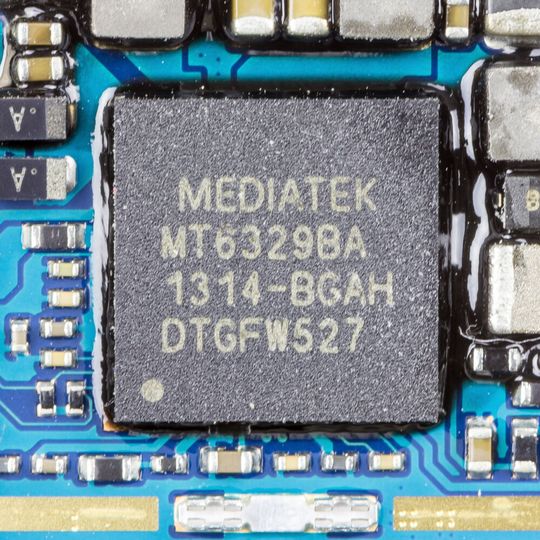
14. Smart voltage programmability
Voltage programmability refers to a chip’s ability to adjust voltage in response to power-saving and enhancing modes. PMICs monitor and adjust incoming and outgoing voltages in systems.
15. Adaptive power saving
PMIC chips in microprocessors and microcontrollers can conserve power through multiple operating modes. They perform dynamic voltage frequency scaling. The processor frequency is automatically adjusted according to actual needs to reduce unnecessary power consumption and combat heat generation.
:quality(80)/p7i.vogel.de/wcms/0a/70/0a70c0be9c74b858b4d17bf9edb635ed/0108035227.jpeg "The terms semiconductor, microchip, and integrated circuit are often used interchangeably. (Source: Shuo - stock.adobe.com)")
BASIC KNOWLEDGE
Semiconductor vs microchip vs integrated circuit: What’s the difference?
16. Advanced thermal management
Power management integrated circuits use multiple integrated low-dropout regulators (LDOs), leading to a small device size and simpler design. LDOs are cost-effective components that generate less heat and do not exhibit switching noise. As a result, PMICs can operate even when the supply voltage equals the output voltage.
17. Fine-tuned audio delivery
PMIC chips use switching power amplifiers like Class D amplifiers to deliver audio signals to mobile devices, wearables, and tablets. These audio amplifiers reduce the overall system size.
18. Lower switching losses
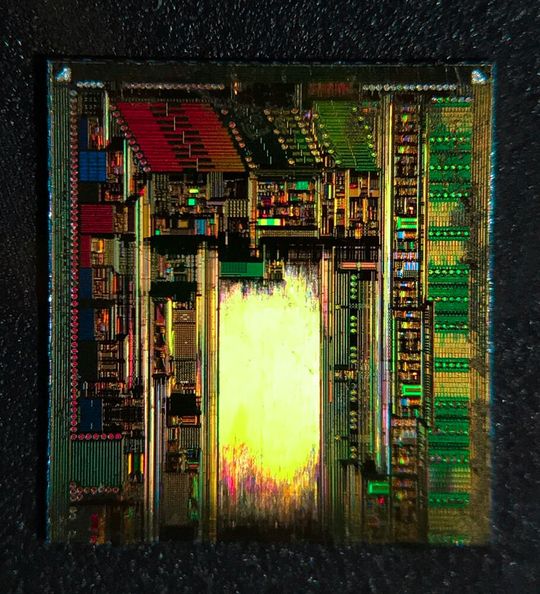
PMIC chips use the PFM (Pulse Frequency Modulation) technique to reduce switching losses and increase battery life in IoT devices and light loads like wearable devices. Unlike PWM, PFM adjusts the frequency of pulses on demand. PFM tends to produce less heat.
19. Precise switching control
Power management integrated circuits perform switching and load control functions. They offer advanced turn-on and turn-off functionalities. Soft start avoids sudden current flow during turn-on, and auto discharge drops the output voltage to 0 V after turn-off. In simple words, PMICs can turn components on and off to save power.
20. Robust protection
Power management integrated circuits offer advanced protective solutions like eFuses, current limiters, and power breakers. PMIC chips constantly monitor supply voltage. These chips are known as reset ICs or voltage supervisors. If the voltage level goes below a predefined level, the signal stops the device and lets it reset.
Power Electronics in the Energy Transition
The parameters for energy transition and climate protection solutions span education, research, industry, and society. In the new episode of "Sound On. Power On.", Frank Osterwald of the Society for Energy and Climate Protection Schleswig‐Holstein talks about the holistic guidance his organization can provide.
Listen now!
(ID:50415724)
:quality(80)/p7i.vogel.de/wcms/3f/77/3f77be835f67d66c9c7bbf179577577a/0131631955v2.jpeg "Inspector examination of photovoltaic modules using a thermal imaging camera (Source: © kanpisut - stock.adobe.com)")
:quality(80)/p7i.vogel.de/wcms/95/24/95246ac2572b954cf4961975285e43ab/0132042146v2.jpeg "Materials and integration are reshaping energy harvesting — from GaN/SiC at the high‑power edge to SOI and low‑leakage CMOS for nanoamp quiescent current in battery‑free sensors. (Source: © Plaifah - stock.adobe.com)")