


:quality(80)/p7i.vogel.de/wcms/7f/4b/7f4b97757cea82c0675209630577dc22/0133974130v2.jpeg "Vox Power’s EIRE600 delivers up to 600 W in a compact 5 × 3-inch package, with forced-air or conduction cooling options for industrial and medical equipment. (Source: Vox Power)")
:quality(80)/p7i.vogel.de/wcms/55/97/5597c3436e3bc92ee7ba23b6f9d289e9/0134032539v2.jpeg "Littelfuse’s TP7.0SMD-XC automotive TVS diode series uses foldback technology to provide low clamping voltage for protecting sensitive vehicle electronics. (Bild: Littelfuse)")
:quality(80)/p7i.vogel.de/wcms/51/f8/51f84448e666230bb11a02566abd1177/0133958187v3.jpeg "Microchip’s radiation-tolerant GaN point-of-load converter supplies up to 20 A for space-based processors, FPGAs, microcontrollers and ASICs. (Source: Microchip)")
:quality(80)/p7i.vogel.de/wcms/0a/7c/0a7c08f368ae1d91f758dd18d2a32e88/0133978423v2.jpeg "EPFL researchers have demonstrated a GaN transistor that withstands nearly 4 kV, using an intrinsic polarization superjunction design to distribute electric fields more evenly. (Source: EPFL)")
:quality(80)/p7i.vogel.de/wcms/5b/94/5b94232ca4183d6fcc2dccc7394d7544/0134041114v4.jpeg "Siemens and NVIDIA are testing AI applications at Siemens’ Erlangen electronics factory, using digital twins to support production planning and prepare inspection systems before physical prototypes are available. (Bild: Siemens)")
:quality(80)/p7i.vogel.de/wcms/b4/1f/b41f2731a07b608e60eca3663e280301/0133980549v2.jpeg "Multi-year agreement with Wolfspeed supports Infineon’s conversion from 150-millimeter to 200-millimeter silicon carbide (SiC) manufacturing (Source: © Ada - stock.adobe.com)")
:quality(80)/p7i.vogel.de/wcms/e3/0a/e30a8813bcf44b16f0dceb63a0747d29/0133984094v2.jpeg "The semiconductor is only one part of the design. Higher voltage, frequency and power density also increase the demands on electronic packaging materials such as die attach, substrates, top-side interconnects and module attach. (Source: Generated by AI)")
:quality(80)/p7i.vogel.de/wcms/5d/fb/5dfba5e5f38daf2b8597b05656af29c0/0133956337v2.jpeg "Wolfspeed has received a conditional commitment for a loan of up to $1.5 billion from the U.S. Department of War to support its domestic wide-bandgap semiconductor supply chain. (Source: © AspctStyle - stock.adobe.com)")
:quality(80)/p7i.vogel.de/wcms/bf/b6/bfb6ac295759be32d567df9849b6767e/0134094495v2.jpeg "Fraunhofer ISE reports that 25 Ah pouch cells with silicon-rich anodes retained more than 83% of their initial capacity after 1,000 cycles when tested under 1,000 kPa axial pressure. (Bild: Fraunhofer ISE)")
:quality(80)/p7i.vogel.de/wcms/16/dc/16dca55e6ef80e6b5da68bc628da2dcc/0133844782v2.jpeg "This article explains virtual power plants in modern renewable-heavy grids. (Source: © M@rketVisualsStudio - stock.adobe.com)")
:quality(80)/p7i.vogel.de/wcms/e8/33/e8330aae4bea3578b98ec2c1403d367a/0133980001v2.jpeg "IRENA’s 2026 World Energy Transition Outlook identifies faster electrification powered by renewables as central to meeting future global energy needs. (Source: Irena)")
:quality(80)/p7i.vogel.de/wcms/6c/b4/6cb405f47d25035e256ae90fe3a66ee6/0134032112v2.jpeg "Sungrow’s PowerTitan 3.0 energy storage platform uses onsemi EliteSiC hybrid power modules, with the companies reporting peak inverter efficiency above 99.3%. (Bild: onsemi)")
:quality(80)/p7i.vogel.de/wcms/7b/76/7b76005554b556df2a7a3794bdf69d44/0132365246v2.jpeg "Hioki’s ST5680A DC Hipot Tester combines CE/UKCA/CSA compliance, an integrated capacitance‑based contact check and time‑series waveform recording (voltage, leakage current, insulation resistance) to standardize hipot and insulation testing across EV cell, module and pack production lines. (Source: Hioki)")
:quality(80)/p7i.vogel.de/wcms/af/7f/af7f7b0fb7f29219fc991b1130f65477/0132241333v2.jpeg "Comprehensive laboratory testing regimens—combining thermal cycling, high‑current stress, EMC, and accelerated lifetime tests—are essential to validate advanced power designs and ensure reliability in real‑world applications. (Source: PRBX)")
:quality(80)/p7i.vogel.de/wcms/16/3d/163df69363f8125315a9826e13ea4b05/0131927425v2.jpeg "Solution will maximize data center and AI factory profitability while delivering engineering-grade insights to design and operations for more efficient, sustainable, and resilient infrastructure. (Source: Cadence)")
:quality(80)/p7i.vogel.de/wcms/85/b7/85b7e90733a2bd8f21515d8f7137f2fc/0131917677v2.jpeg "Renesas acquires Pictorus to integrate its embedded application software platform with Renesas’ MCU and MPU portfolio, helping developers shorten time‑to‑market and simplify system integration. (Source: © lucadp - stock.adobe.com)")
:quality(80)/p7i.vogel.de/wcms/f8/34/f834240d434a0c265a2ccafe614c8cd7/0134032109v4.jpeg "Hard- and soft-switching techniques shape voltage and current during device transitions, influencing switching losses, EMI and thermal performance in power converters. (Bild: © Mrthullab - stock.adobe.com)")
:quality(80)/p7i.vogel.de/wcms/27/07/2707280c807689b437baed3660257404/0133626052v2.jpeg "The quantum behavior of electrons shapes semiconductor devices—and the power converters that deliver electricity to modern computing systems. (Source: © Celt Studio - stock.adobe.com)")
SILICON CARBIDE SiC on-board charger: The EV component quietly winning the wide-bandgap race
Related Vendors
:fill(fff,0)/p7i.vogel.de/companies/68/2c/682c3e2e9a195/logotype-rvb.jpeg "logotype-rvb (MERSEN France)")
:fill(fff,0)/p7i.vogel.de/companies/66/8b/668becd1c07eb/dowa-logo-word--1-.jpeg "dowa-logo-word--1- (DOWA)")
Silicon carbide on-board charger (SiC OBC) is a power converter, factory-fitted by the automaker into battery electric vehicles (BEVs) and plug-in hybrid EVs (PHEVs). For years, automakers chose silicon to build on-board chargers, but now they have shifted to choosing a compound made from silicon and carbon: silicon carbide, a wide-bandgap power semiconductor, to manufacture 98% more efficient on-board chargers.With high efficiency, high costs come as a trade-off!
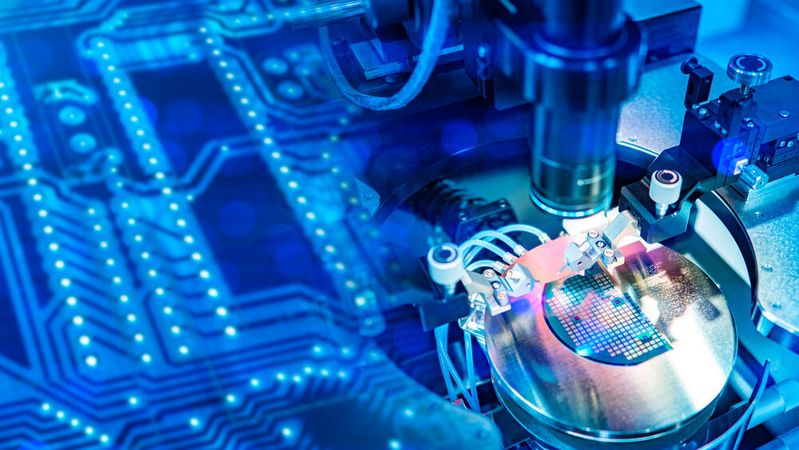
SiC OBCs are not something that vehicle owners can buy as an accessory. They can only buy a vehicle that incorporates an SiC OBC and take advantage of its performance throughout the vehicle lifecycle.
What is a SiC on-board charger actually?
A SiC on-board charger is a power converter that converts AC power from the charging outlet (the grid) into DC for the EV, which goes on to charge the high-voltage battery pack. In addition to power conversion, SiC OBCs regulate power flow and adjust levels to maintain optimal conditions during the charging process. In short, SiC OBCs bridge the gap between the external power source and the vehicle charging system.
SiC OBCs use switches to rapidly turn current on and off – which converts AC into DC. Traditionally, silicon-based on-board chargers used switches made from either metal oxide semiconductor field effect transistors (MOSFETs) or insulated gate bipolar transistors (IGBTs). SiC on-board chargers, on the other hand, simply use SiC MOSFETs for switching.
Based on how much AC power OBC chargers can convert to DC, they are categorized by three main power classes: 3.3 kW to 7.4 kW, 11 kW, and 22 kW.
3.3 — 7.4 kW: Most basic single-phase entry-level OBCs found in 2-wheelers, PHEVs, and small BEVs.
11 kW: Three-phase mainstream OBC chargers. They are used in multi-phase and public destination charging for standard and long-range BEVs.
22 kW: Three-phase advanced chargers used in premium BEVs and heavy-duty EVs.
:quality(80):fill(efefef,0)/p7i.vogel.de/wcms/6a/73/6a733eb791f81/pcim-2026-best-paper-award-appleby.jpeg "PCIM 2026_Best Paper Award_Appleby")
Why is SiC taking over the OBC market?
Anything renewable, whether 2030 climate goals, fleet electrification, or EV adoption, would drive SiC OBC—overall OBC market growth. In 2025, the global EV OBC market was valued at USD 6.93 billion and is projected to grow to USD 24.94 billion by 2034 at a CAGR of 13.43%. Manufacturers in the US are innovating 60% of OBC designs with SiC and gallium nitride (GaN).
Early EVs in the 2010s ran on roughly 400 V battery packs. The ongoing transition in EVs is from 400 V to 800 V. The logic is simple: the higher the voltage, the lower the current you have to deal with. At 800 V, especially in the 11 kW category, silicon OBCs would incur heavy losses and heating, forcing automakers to look for other options.
Benefits of a SiC OBC
The fact that modern on-board chargers are made from SiC means numerous benefits kick in: for OEMs and consumers alike. Due to the higher power density of SiC, SiC OBCs are lightweight and compact. It frees up space for the vehicle and reduces the overall weight (slightly). From a manufacturer’s perspective, EVs can be designed to have better looks.
All thanks to the high thermal conductivity of SiC and wider bandgap (3.3 eV), SiC OBCs can hit 98% system efficiency and withstand higher voltages and temperatures. During the power conversion stage, SiC OBCs switch faster than silicon. This can shrink magnetics and cut power losses. As a result, the charger runs cooler and requires minimal heat management options.
Downsides that manufacturers don’t put on datasheets
Integrating a SiC OBC in the EV, for OEMs, is a one-time task that multiplies during production. But EV Buyers have to deal with SiC OBCs for their entire vehicle lifecycle. Of course, there are more gas stations than EV charging points, at regular intervals across the globe. Lack of standardization in charging infrastructure is a bottleneck for on-board chargers, whether they are silicon or SiC, and EVs in general.
In a battle of SiC vs silicon, SiC OBCs might win due to physics, but lag because of economics. EVs supporting 800 V, 11 kW charging with SiC OBCs are costlier than conventional EVs with silicon OBCs. Buyers have to pay a premium for the SiC OBC cost to take advantage of cooling and efficiency benefits.
Where does the market for SiC OBC go next?
Integration of SiC OBCs into vehicles is facilitated by bidirectional charging. Unidirectional charging is where an EV gets charged through the grid, drains its battery, and comes back again, and so on. V2G bidirectional charging is where an EV can send power back out and take it in, feeding power to the grid, known as vehicle-to-grid (V2G). In homes, it’s known as vehicle-to-home (V2H). As bidirectional charging is rapidly growing, the SiC OBC market follows suit.
SiC vs GaN for on-board chargers: who wins?
Both SiC and GaN are wide-bandgap semiconductors, proven to outshine silicon in the power industry. GaN chargers largely make up ultra-fast and compact consumer chargers. In EVs, GaN chargers can support lower than 11 kW and DC charging. SiC OBC chargers, with their high-power capabilities, are a good fit for 11 kW and 22 kW charging.
References
https://www.wolfspeed.com/knowledge-center/article/advantages-of-sic-over-si-for-unidirectional-on-board-chargers/
https://www.fortunebusinessinsights.com/electric-vehicle-on-board-charger-market-106166
https://www.indexbox.io/store/united-states-electric-vehicle-on-board-charger-market-analysis-forecast-size-trends-and-insights/
https://www.gdwecent.com/gan-vs-sic-which-is-better-for-ev-chargers/
(ID:50940067)
:quality(80)/p7i.vogel.de/wcms/84/8c/848c7bba38a1285b0dfa2510988d631d/0131577029v2.jpeg "This article talks about multiport power converters. (Source: © Moviebirth - stock.adobe.com)")
:quality(80)/p7i.vogel.de/wcms/0e/13/0e132310ca94e4d27cfc167cbcf567f9/0128546543v2.jpeg "GaN, SiC, and AI are reshaping power electronics in 2025, responding to rising energy demand and the rapid expansion of data centers, EVs, and electrification. (Source: © Dreamy Shots - stock.adobe.com)")