


:quality(80)/p7i.vogel.de/wcms/99/dd/99dd64ae87c0855129bd405f61d81f81/0133290217v2.jpeg "Microchip’s new 1.2 V SY757xx clock buffers connect modern low-voltage SoCs, FPGAs and AI accelerators with higher-voltage clock components, supporting frequencies up to 250 MHz and additive jitter as low as 26 fs. (Source: Microchip)")
:quality(80)/p7i.vogel.de/wcms/83/d0/83d0b8ea52378c77f98358e29ceccfc0/0133339307v2.jpeg "Capacitors are a critical yet often overlooked component in AI data center power supplies, buffering energy and stabilizing voltage as racks scale toward the megawatt range. (Source: © Parilov - stock.adobe.com)")
:quality(80)/p7i.vogel.de/wcms/10/fc/10fcb98e44d61826e641bc8d3f20f616/0133193677v2.jpeg "The new AEVA and AEVB Series aluminum electrolytic capacitors are engineered for harsh industrial environments, delivering high-CV, long-lifetime performance in compact, surface-mount packages that reliably withstand up to 30g acceleration and operating temperatures extending from -55° to +125°C. (Source: Kyocera)")
:quality(80)/p7i.vogel.de/wcms/f7/42/f74208db9f5f87dca384b38b71c4782e/0133196365v2.jpeg "YAGEO’s EC Flat‑Series temperature sensors combine fast, accurate measurement with resistance to vibration, shock, moisture and dust for demanding automotive and industrial applications. (Source: Yageo)")
:quality(80)/p7i.vogel.de/wcms/57/b6/57b6d33cb929fa4408ad56803ed5f0bc/0133311998v2.jpeg "Elmos and SK keyfoundry are expanding their collaboration on 130 nm technology and have agreed on long-term wafer capacity through 2037 to support reliable automotive semiconductor production. (Source: © remake - stock.adobe.com)")
:quality(80)/p7i.vogel.de/wcms/b4/0a/b40a1de3c8fa631b2aff74ec436c43db/0133314066v2.jpeg "ZF Aftermarket expands its EV service portfolio with new repair kits and solutions for e‑motors, inverters, hybrid modules, mechatronics and electric drive units. (Source: ZF Aftermarket)")
:quality(80)/p7i.vogel.de/wcms/48/e1/48e107b92f976652532facf5ca1e0855/0133290826v2.jpeg "Infineon and SolarEdge are extending their collaboration to develop solid-state protection solutions for 800 VDC AI data centers, aiming to improve fault response, system reliability and power density. (Source: © Grispb - stock.adobe.com)")
:quality(80)/p7i.vogel.de/wcms/99/84/9984f5888ecc71c249f65cea3f0658d1/0133069650v2.jpeg "Yokogawa’s integrated measurement setup helps Vertiv analyse AI-driven pulsed loads, combining power, waveform and thermal data to validate UPS performance and input power smoothing. (Source: YOKOGAWA)")
:quality(80)/p7i.vogel.de/wcms/a4/29/a429b944eb0a69e268015f8300ba8940/0133311989v2.jpeg "Hitachi Energy and Daikin are establishing a German supply of C4‑FN, a specialty insulating gas used in SF₆‑free high‑voltage equipment for more sustainable power grids. (Source: © Ahmed - stock.adobe.com)")
:quality(80)/p7i.vogel.de/wcms/d5/32/d5326e4b05d5cd759e88062f1c0b097a/0133344193v2.jpeg "Co-packaged optics is the latest innovation in data centers where optical modules on silicon chips can assist in scaling megawatt AI infrastructure. (Source: © Rachakrit - stock.adobe.com)")
:quality(80)/p7i.vogel.de/wcms/76/a9/76a9333bc7c6abbf7e29d1b910edb5e2/0133335959v2.jpeg "This article explains PMBus in data center power supplies. (Source: © Gibster - stock.adobe.com)")
:quality(80)/p7i.vogel.de/wcms/35/9c/359cfb6c855204e4d114f88cf5b98b5f/0133078984v2.jpeg "Photonic integrated circuits are next-level chips that will dominate data centers in the upcoming years. (Source: © pier - stock.adobe.com)")
:quality(80)/p7i.vogel.de/wcms/7b/76/7b76005554b556df2a7a3794bdf69d44/0132365246v2.jpeg "Hioki’s ST5680A DC Hipot Tester combines CE/UKCA/CSA compliance, an integrated capacitance‑based contact check and time‑series waveform recording (voltage, leakage current, insulation resistance) to standardize hipot and insulation testing across EV cell, module and pack production lines. (Source: Hioki)")
:quality(80)/p7i.vogel.de/wcms/af/7f/af7f7b0fb7f29219fc991b1130f65477/0132241333v2.jpeg "Comprehensive laboratory testing regimens—combining thermal cycling, high‑current stress, EMC, and accelerated lifetime tests—are essential to validate advanced power designs and ensure reliability in real‑world applications. (Source: PRBX)")
:quality(80)/p7i.vogel.de/wcms/16/3d/163df69363f8125315a9826e13ea4b05/0131927425v2.jpeg "Solution will maximize data center and AI factory profitability while delivering engineering-grade insights to design and operations for more efficient, sustainable, and resilient infrastructure. (Source: Cadence)")
:quality(80)/p7i.vogel.de/wcms/85/b7/85b7e90733a2bd8f21515d8f7137f2fc/0131917677v2.jpeg "Renesas acquires Pictorus to integrate its embedded application software platform with Renesas’ MCU and MPU portfolio, helping developers shorten time‑to‑market and simplify system integration. (Source: © lucadp - stock.adobe.com)")
RENEWABLE ENERGY Agrivoltaics explained: Power electronics behind solar-sharing farms
Related Vendors
:fill(fff,0)/p7i.vogel.de/companies/5f/71/5f71d5f92a5f6/2000px-rogers-corporation-logo-svg.png "2000px-Rogers_Corporation_Logo.svg.png (rogers germany)")
:fill(fff,0)/p7i.vogel.de/companies/68/2c/682c3e2e9a195/logotype-rvb.jpeg "logotype-rvb (MERSEN France)")
:fill(fff,0)/p7i.vogel.de/companies/66/8b/668becd1c07eb/dowa-logo-word--1-.jpeg "dowa-logo-word--1- (DOWA)")
Agrivoltaics refers to the practice of placing photovoltaic (PV) arrays above agricultural land, where solar panels generate electricity for the grid but also provide shade to the crops. During the sunny season, crops shaded by solar panels can grow with a reduced need for extra irrigation, which further lowers water loss in agriculture.
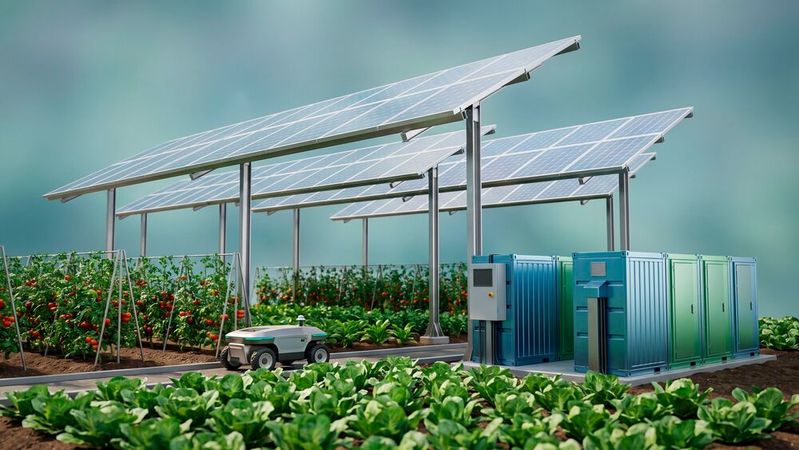
Compared to conventional closely spaced panels in residential and commercial areas, agrivoltaic panels are different because they sit at a height, are far apart, and must support crop microclimate needs. As shading is deliberate and uneven, designs rely heavily on module-level power electronics, such as microinverters. Maximum power point tracking (MPPT) becomes equally important. Real agrivoltaic project deployments worldwide generate power for homes and offices, while supporting the growth of green leafy and root vegetables, including basil, broccoli, corn, maize, wheat, lettuce, potatoes, tomatoes, spinach, strawberries, and many others.
What power electronics does an agrivoltaic project need?
Power electronics of an agrivoltaic system is the same as any other solar panel deployment–DC needs to flow from modules to grid-tie–the point that connects solar panels to the utility grid, or from modules to some storage unit. The newer strategy is placement of modules that support the functioning of far-spaced and elevated panels.
Agrivoltaics can be implemented in several ways, out of which the first method is to use conventional ground-mount systems. The second agrivoltaic implementation method is to use elevated PV systems. Besides crops, animals can graze/take shelter. Both methods are common across real-world agrivoltaic deployments.
In both cases, arrays stay 2-5 m apart, increasing the length requirements for DC links. Conventional solar panels on our rooftops are tightly packed. All of them are connected in series, where equal sunlight falls on each string. In agrivoltaics, wider space between modules varies irradiance, where each string receives an unequal amount of sunlight, complicating further processing.
In series, all panels must share the same current; however, panel current depends on the sunlight it receives. Due to inter-string distance, one side receives more sunlight than the other. The string with higher sunlight adds to the current, while the string receiving lower sunlight caps the whole current.
An optimal solution is to place a DC-DC optimizer, an electronics box, across each panel to stop the weak panel (shaded) from delivering the lowest current. DC-DC optimizers stop the shaded weak panel from dragging down the rest of the current.
The third agrivoltaic implementation method is to use vertical bifacial solar panels on fences or separate support, placed between the fields. Now bifacial panels have two faces: one faces the sun, and the other faces the opposite. The front face processes the sunlight, while the back face processes the reflected light from soil and plants, adding about 5-15% power.
The net power produced in bifacial is more than that of any other agrivoltaic implementation. As a result, engineers need to have power electronic components with a higher rating to process additional output. Extra care is needed during peak hours. The fourth agrivoltaic implementation method is to place solar panels above the greenhouse; however, simulations indicate that crop yields are lower.
:quality(80)/p7i.vogel.de/wcms/63/d5/63d5cb8e8029d9826e610bd1c54a00ad/0131310853v2.jpeg "IRENA finds that 24/7 renewable systems—combining solar, wind, storage and flexible resources—can deliver firm power at lower cost than fossil fuels, accelerating the clean energy transition. (Source: IRENA)")
RENEWABLE ENERGY
24/7 renewables outcompete fossil fuels on costs
How do inverters and MPPT handle power shading?
MPPT is important for agrivoltaics to maximize energy extraction as conditions vary for crop growth. The real job of MPPT is to match the power generated by PV modules to the actual power requirement needed to be delivered to the load. MPPT algorithm automatically converts and delivers the required power to drive the load.
MPPT algorithms consider sunlight, shading, temperature, angle, and orientation to determine the required power. In residential and commercial solar projects, shading must be designed out; however, shading is a goal for agrivoltaic design. Shading, which changes every day and every season, is critical for crop yield.
Designers cannot apply MPPT to spaced-out panels because one side may show higher power magnitude, while the other responds with lower magnitude. It cannot work on a single setting. They can use several MPPT values and per-panel optimization to recover lost energy. Bifacial configuration adds a second variable, known as bifacial gain, to MPPT, where it does not deliver excess power to result in heat loss. Only “required” power is delivered to the load.
What are design trade-offs?
The main tradeoff in agrivoltaics exists between power and crop yield. Crops under PV modules must deliver similar yields to normal farms, while generating power for the grid. Raising the height of solar panel placement or perhaps increasing the distance between each module affects the power output. On the other hand, the amount of shading can alter crop choices for an agrivoltaic-supported farm. Leafy vegetables and herbs can tolerate 30-50% shade, while others lose yield.
:quality(80)/p7i.vogel.de/wcms/f5/b4/f5b498c35b52c552abe2da62e5627d4c/0130737471v2.jpeg "New IRENA policy advisory shows strategic role of renewables for energy security and resilience; recommends actions for policy makers to address today’s energy crisis: (Source: IRENA)")
RENEWABLE ENERGY
Moving from energy crisis to energy security with renewables
Market outlook
The agrivoltaic initiative was first introduced in 1981 in Germany by the founder of the Fraunhofer Institute for Solar Energy Systems ISE, Prof. Dr. Goetzberger and Dr. Zastrow. At present, agrivoltaics is supported globally with 600 deployment sites. Other than Germany, many countries have innovated agrivoltaics as aquavoltaics, which is a combination of solar panels and fish farms. In such arrangements, PV arrays are placed over water, in which fishes are farmed.
Simply put, the definition of agrivoltaics has shifted from a combination of power + agriculture + livestock grazing + bee pollinator habitats + irrigation water savings. On the market front, agrivoltaics is valued at USD 14.05 billion and is expected to hit USD 49.44 billion, driven by global climate initiatives. Countries like China, Japan, and Germany are market leaders. According to a recent report, a 3.2 MWp agrivoltaic project in Germany is reported to produce similar crop yields to conventional farms.
References
- https://www.sciencedirect.com/science/article/pii/S2352550925000569
- https://www.nature.com/articles/s44264-026-00141-0
- https://www.mordorintelligence.com/industry-reports/agrivoltaics-market
- https://knowledge.energyinst.org/new-energy-world/article?id=139849
(ID:50908583)
:quality(80)/p7i.vogel.de/wcms/47/e1/47e15fce96f9a6bbc8e0e26c6723fc2f/0131803702v5.jpeg "Sustainable architecture: Advanced photovoltaic solar glass (Source: © Jo-El - stock.adobe.com)")
:quality(80)/p7i.vogel.de/wcms/c2/c5/c2c511e7ac135d380af0e8a85decfb7c/0131575680v2.jpeg "This article discusses the problem with renewable grids and how FACTS devices can help. (Source: © Endang - stock.adobe.com)")