


:quality(80)/p7i.vogel.de/wcms/99/dd/99dd64ae87c0855129bd405f61d81f81/0133290217v2.jpeg "Microchip’s new 1.2 V SY757xx clock buffers connect modern low-voltage SoCs, FPGAs and AI accelerators with higher-voltage clock components, supporting frequencies up to 250 MHz and additive jitter as low as 26 fs. (Source: Microchip)")
:quality(80)/p7i.vogel.de/wcms/83/d0/83d0b8ea52378c77f98358e29ceccfc0/0133339307v2.jpeg "Capacitors are a critical yet often overlooked component in AI data center power supplies, buffering energy and stabilizing voltage as racks scale toward the megawatt range. (Source: © Parilov - stock.adobe.com)")
:quality(80)/p7i.vogel.de/wcms/10/fc/10fcb98e44d61826e641bc8d3f20f616/0133193677v2.jpeg "The new AEVA and AEVB Series aluminum electrolytic capacitors are engineered for harsh industrial environments, delivering high-CV, long-lifetime performance in compact, surface-mount packages that reliably withstand up to 30g acceleration and operating temperatures extending from -55° to +125°C. (Source: Kyocera)")
:quality(80)/p7i.vogel.de/wcms/f7/42/f74208db9f5f87dca384b38b71c4782e/0133196365v2.jpeg "YAGEO’s EC Flat‑Series temperature sensors combine fast, accurate measurement with resistance to vibration, shock, moisture and dust for demanding automotive and industrial applications. (Source: Yageo)")
:quality(80)/p7i.vogel.de/wcms/57/b6/57b6d33cb929fa4408ad56803ed5f0bc/0133311998v2.jpeg "Elmos and SK keyfoundry are expanding their collaboration on 130 nm technology and have agreed on long-term wafer capacity through 2037 to support reliable automotive semiconductor production. (Source: © remake - stock.adobe.com)")
:quality(80)/p7i.vogel.de/wcms/b4/0a/b40a1de3c8fa631b2aff74ec436c43db/0133314066v2.jpeg "ZF Aftermarket expands its EV service portfolio with new repair kits and solutions for e‑motors, inverters, hybrid modules, mechatronics and electric drive units. (Source: ZF Aftermarket)")
:quality(80)/p7i.vogel.de/wcms/48/e1/48e107b92f976652532facf5ca1e0855/0133290826v2.jpeg "Infineon and SolarEdge are extending their collaboration to develop solid-state protection solutions for 800 VDC AI data centers, aiming to improve fault response, system reliability and power density. (Source: © Grispb - stock.adobe.com)")
:quality(80)/p7i.vogel.de/wcms/99/84/9984f5888ecc71c249f65cea3f0658d1/0133069650v2.jpeg "Yokogawa’s integrated measurement setup helps Vertiv analyse AI-driven pulsed loads, combining power, waveform and thermal data to validate UPS performance and input power smoothing. (Source: YOKOGAWA)")
:quality(80)/p7i.vogel.de/wcms/a4/29/a429b944eb0a69e268015f8300ba8940/0133311989v2.jpeg "Hitachi Energy and Daikin are establishing a German supply of C4‑FN, a specialty insulating gas used in SF₆‑free high‑voltage equipment for more sustainable power grids. (Source: © Ahmed - stock.adobe.com)")
:quality(80)/p7i.vogel.de/wcms/d5/32/d5326e4b05d5cd759e88062f1c0b097a/0133344193v2.jpeg "Co-packaged optics is the latest innovation in data centers where optical modules on silicon chips can assist in scaling megawatt AI infrastructure. (Source: © Rachakrit - stock.adobe.com)")
:quality(80)/p7i.vogel.de/wcms/76/a9/76a9333bc7c6abbf7e29d1b910edb5e2/0133335959v2.jpeg "This article explains PMBus in data center power supplies. (Source: © Gibster - stock.adobe.com)")
:quality(80)/p7i.vogel.de/wcms/35/9c/359cfb6c855204e4d114f88cf5b98b5f/0133078984v2.jpeg "Photonic integrated circuits are next-level chips that will dominate data centers in the upcoming years. (Source: © pier - stock.adobe.com)")
:quality(80)/p7i.vogel.de/wcms/7b/76/7b76005554b556df2a7a3794bdf69d44/0132365246v2.jpeg "Hioki’s ST5680A DC Hipot Tester combines CE/UKCA/CSA compliance, an integrated capacitance‑based contact check and time‑series waveform recording (voltage, leakage current, insulation resistance) to standardize hipot and insulation testing across EV cell, module and pack production lines. (Source: Hioki)")
:quality(80)/p7i.vogel.de/wcms/af/7f/af7f7b0fb7f29219fc991b1130f65477/0132241333v2.jpeg "Comprehensive laboratory testing regimens—combining thermal cycling, high‑current stress, EMC, and accelerated lifetime tests—are essential to validate advanced power designs and ensure reliability in real‑world applications. (Source: PRBX)")
:quality(80)/p7i.vogel.de/wcms/16/3d/163df69363f8125315a9826e13ea4b05/0131927425v2.jpeg "Solution will maximize data center and AI factory profitability while delivering engineering-grade insights to design and operations for more efficient, sustainable, and resilient infrastructure. (Source: Cadence)")
:quality(80)/p7i.vogel.de/wcms/85/b7/85b7e90733a2bd8f21515d8f7137f2fc/0131917677v2.jpeg "Renesas acquires Pictorus to integrate its embedded application software platform with Renesas’ MCU and MPU portfolio, helping developers shorten time‑to‑market and simplify system integration. (Source: © lucadp - stock.adobe.com)")
ELECTRONIC SYSTEMS Solar, thermal, or piezo? Choosing the right power electronics for different energy harvesting sources
Related Vendors
:fill(fff,0)/p7i.vogel.de/companies/6a/20/6a202a4f89a62/mrs-white-on-blue-bg.png "mrs-white-on-blue-bg ()")
:fill(fff,0)/p7i.vogel.de/companies/63/c7/63c7da97be945/diotec.png "diotec (Diotec Semiconductor AG)")
:fill(fff,0)/p7i.vogel.de/companies/68/2c/682c3e2e9a195/logotype-rvb.jpeg "logotype-rvb (MERSEN France)")
The rise of the Internet of Things (IoT), implantable medical devices, and structural health sensors has fueled the demand for self-sustaining electronic systems. Relying solely on batteries is no longer viable due to high maintenance costs, strict space constraints, and environmental impacts. Ambient energy harvesting has emerged as the definitive solution to achieve true energy autonomy.

However, ambient energy is neither consistent nor ready for direct consumption. It originates from sources with radically different physical and electrical characteristics:
- Solar or ambient ight: Offers relatively high power densities but suffers from extreme volatility due to shading and day/night cycles.
- Thermal gradients (TEGs): Provide a steady, reliable flow in industrial settings but generate extremely low output voltages, often in the millivolt range.
- Mechanical vibrations (Piezoelectric): Generate high voltage spikes but deliver negligible current and feature massive output impedance.
The true design challenge does not lie in the transducer capturing the energy, but in the Power Management Integrated Circuit (PMIC) downstream. A generic power stage is the enemy of efficiency. To maximize energy extraction, the power electronics must be precisely tailored to the unique electrical profile of the source. This article analyzes the critical design requirements for solar, thermal, and piezoelectric transducers, providing system designers with a clear decision framework to select the ideal PMIC architecture.
:quality(80)/p7i.vogel.de/wcms/3f/77/3f77be835f67d66c9c7bbf179577577a/0131631955v2.jpeg "Inspector examination of photovoltaic modules using a thermal imaging camera (Source: © kanpisut - stock.adobe.com)")
POWER CONVERSION
The battle for every nano-watt: Challenges in designing ultra-low-power converters
Comparison of the electrical requirements for each source
To effectively manage harvested energy, the power electronics stage must accommodate the distinct electrical behaviors of each transducer. The primary challenge shifts dramatically depending on the source: a Thermoelectric Generator (TEG) demands an ultra-low-voltage start-up, a solar cell requires constant dynamic optimization, and a piezoelectric element requires efficient high-voltage AC-to-DC conversion.
The table below outlines the core electrical characteristics and primary PMIC requirements for each technology:
-
Electrical Parameter
Solar (Photovoltaic)
Thermal (TEG)
Piezoelectric
Output Type
DC
DC
AC (Impulsive / Sinusoidal)
Voltage Range
0.5V – 3.0V (Per cell)
10mV – 500mV (Ultra-low)
1.0V – 50V+ (High spikes)
Current Capability
Microamps (µA) to Milliamps (mA)
Microamps (µA) to Milliamps (mA)
Nanoamps (nA) to Microamps (µA)
Internal Impedance
Non-linear (Light dependent)
Low (0.5 Ω–10 Ω)
Very High (10 kΩ–1MΩ)
Primary PMIC Challenge
Dynamic tracking of the MPP
Cold-start at <100mV voltages
Low-loss rectification
Core Architecture
Buck or Boost Converter with MPPT
Extreme Boost (Step-up)
Active Rectifier + Buck Converter
The core architectural mandates
1. Thermal: The Need for an Extreme Boost Converter
Thermoelectric generators operate on the Seebeck effect, producing electricity from temperature differentials (ΔT). In wearable or localized industrial applications, this ΔT is often minimal (less than 5℃), yielding voltages as low as 10mV to 50mV.
Standard silicon electronics cannot turn on at these levels. Therefore, a thermal PMIC must incorporate an extreme boost converter with a specialized "cold-start" circuit. This architecture frequently utilizes a transformer-based resonant oscillator or an ultra-low-threshold JFET to kickstart the system, stepping up sub-100mV inputs to a usable 1.8V–3.3V bus.
2. Solar: The Mandate for Precise MPPT
Photovoltaic cells exhibit a highly non-linear current-voltage (I-V) characteristic that shifts continuously with lux levels and shading. Operating the cell at its Open Circuit Voltage (Voc) or Short Circuit Current (Isc) yields zero power. Maximum power extraction occurs only at a single operating point: the Maximum Power Point (MPP).
A solar PMIC must implement precise Maximum Power Point Tracking (MPPT). For ultra-low-power IoT nodes, fractional Open Circuit Voltage (f-Voc) sampling—typically setting the operating voltage to ≅70%-80% of Voc—provides a low-overhead, highly efficient solution compared to computationally heavy algorithms like Perturb and Observe (P&O).
3. Piezo: The Demand for an Efficient Rectifier
Piezoelectric materials generate electricity when subjected to mechanical strain or vibration. Unlike solar and thermal sources, a piezo harvester outputs an alternating current (AC) characterized by high-voltage peaks and negligible current.
Standard diode bridge rectifiers are highly inefficient here, as the forward voltage drop (Vf) of conventional silicon or even Schottky diodes can consume a massive percentage of the harvested energy. Consequently, a piezo PMIC demands an efficient active rectifier—often utilizing MOSFETs controlled by zero-crossing detection circuits—combined with Synchronous Electric Charge Extraction (SECE) or Bias Flip techniques to overcome the massive internal capacitive impedance of the element.
:quality(80)/p7i.vogel.de/wcms/5d/d1/5dd149a739adc01e402a30c4ad8d3c2c/0131249119v2.jpeg "Power‑over‑Fiber transmits energy via laser and optical fiber to provide true galvanic isolation for auxiliary supplies and gate drivers in SSTs and HVDC circuit breakers, eliminating parasitic coupling and withstanding extreme dv/dt. (Source: EBV Elektronik)")
POWER-OVER-FIBER IN HIGH VOLTAGE ENGINEERING
A fundamental shift for galvanic isolation and auxiliary power supplies in critical infrastructure
The designer decision framework: a PMIC selection logic
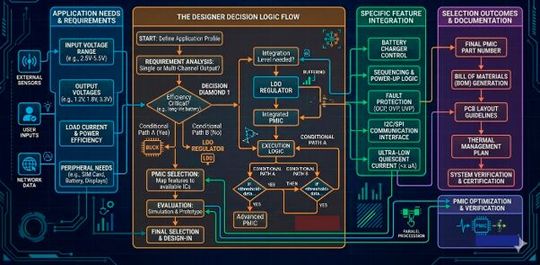
Selecting the optimal Power Management Integrated Circuit (PMIC) requires a systematic elimination process based on environmental constraints and raw source outputs. Designers should not start by looking at PMIC datasheets; instead, they must audit the physical environment of the application.
The following structural flowchart logic guides system designers from ambient energy availability to the final power architecture selection.
Step 1: Characterize the Primary Ambient Source
The selection journey begins by categorizing the environmental kinetic, thermal, or luminous profile:
- If Kinetic (Vibrations, Rotational, Shock): Route to the High-Impedance AC Branch. Your primary focus is handling voltage spikes and high internal capacitance.
- If Thermal (Industrial pipes, Exhaust, Human Skin): Route to the Low-Voltage DC Branch. Your primary focus is managing ultra-low DC inputs and minimizing conductive losses.
- If Luminous (Outdoor Sun, Indoor LED): Route to the Variable DC Branch. Your primary focus is handling rapid impedance shifts caused by varying lux levels.
Step 2: Evaluate Input Thresholds and Voltage Conditioning
Once the source branch is selected, engineers must evaluate the worst-case electrical thresholds:
- The AC (Piezo) Path: Evaluate if Vpeak > 5V. If yes, a standard Schottky diode bridge will introduce unacceptably high reverse leakage and voltage clipping. The framework mandates an Active MOSFET Rectifier paired with Synchronous Electric Charge Extraction (SECE) to harvest energy only at peak displacement.
- The Low-Voltage DC (Thermal) Path: Evaluate the minimum operational temperature gradient (ΔT). If ΔT drops below 2℃, the output drops below 50mV. The design requires an Extreme Boost PMIC featuring an integrated charge pump or an external transformer-based resonant oscillator for cold-start capability. If the output is reliably >100mV, a standard high-efficiency synchronous boost converter is sufficient.
- The Low-Voltage DC (Thermal) Path: Evaluate the light consistency and voltage range. If the solar array configuration outputs a voltage higher than the storage element, select a Buck topology with fractional Open-Circuit Voltage (f-Voc) tracking (sampling at 70-80% for low overhead). If light is highly intermittent and weak (indoor harvesting), select a Boost topology with dynamic Perturb and Observe (P&O) MPPT to squeeze power out of fluctuating milliwatt environments.
Step 3: Source Topology Architecture
Before choosing the final silicon, determine if the system relies on a single environment or a hybrid topology:
- Single-Source Solution: Opt for dedicated, highly optimized PMICs (e.g., Analog Devices ADP5091 for solar/thermal or TI BQ25570 for boost/MPPT configurations). This minimizes total Bill of Materials (BOM) cost and quiescent current (Iq).
- Multi-Source (Hybrid) Solution: If the IoT node combines solar cells for daytime and indoor TEGs for nighttime, the framework dictates a Multi-Input Matrix PMIC (e.g., Matrix Industries Mercury series or similar energy-harvesting aggregators). These chips manage independent input impedance matching dynamically without cross-conduction.
:quality(80)/p7i.vogel.de/wcms/06/77/0677d551cae883cdeb0780b326d4e06e/0131459728v2.jpeg "Infineon has launched Moore4Power, a €91 million EU “Chips JU” flagship project with 62 partners across 15 countries to accelerate sustainable, smart and integrated power‑electronics solutions in Europe. (Source: © Dzmitry - stock.adobe.com)")
SUSTAINABLE POWER ELECTRONICS
Infineon launches Moore4Power EU flagship project
Navigating the hardware compromises
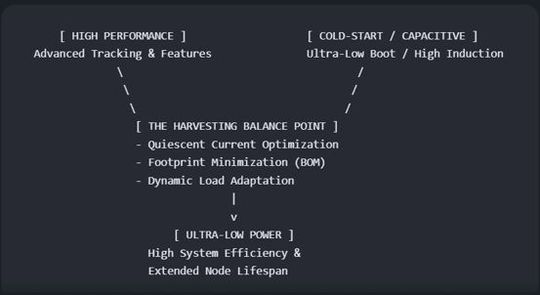
Designing an efficient energy harvesting system is a game of micro-ambients and nano-amperes. As ambient intelligence expands, the choice of power electronics dictates whether a remote IoT node operates indefinitely or suffers from premature system failure.
In practical deployment, system designers must balance three irreconcilable technical trade-offs:
- Quiescent Current (Iq) vs. Feature Set: Implementing sophisticated dynamic tracking algorithms (like P&O MPPT) or multi-stage active rectification increases the PMIC’s internal processing overhead. If the ambient source drops below a critical threshold, the power consumed by the PMIC itself can exceed the energy being harvested.
- Cold-Start Voltage vs. System Efficiency: PMICs designed to boot from sub-50mV thermal gradients often utilize raw, less efficient oscillator networks during startup. A designer must verify whether the ambient source can provide sustained power to exit the cold-start phase into high-efficiency synchronous regulation.
- BOM Footprint vs. Extraction Yield: Specialized techniques like SECE for piezo systems require additional external inductors or precise component arrays. Designers must weigh the increased PCB layout space and BOM cost against the percentage increase in micro-watt extraction.
Conclusion
There is no universally superior ambient energy source, nor is there a "one-size-fits-all" power management IC. Solar, thermal, and kinetic sources occupy distinct operational niches that directly dictate downstream circuit architectures.
- Photovoltaic cells require highly dynamic tracking to handle volatile lux levels, making low-overhead MPPT techniques a mandatory requirement for variable light environments.
- Thermoelectric generators provide stable but minute voltages, forcing designers to select PMICs capable of ultra-low-voltage resonant cold-starts.
- Piezoelectric harvesters present an altogether different challenge, generating high-voltage, high-impedance AC peaks that demand efficient active rectification to prevent internal clipping and conductive loss.
Ultimately, successful energy harvesting design requires looking beyond the transducer. True system autonomy is achieved in the silent intervals between active states, where ultra-low quiescent currents, precise impedance matching, and targeted power topologies convert volatile ambient physics into reliable, long-term digital uptime.
(ID:50871607)
:quality(80)/p7i.vogel.de/wcms/c3/83/c3837a0e30fea1910a63fabb02550258/0132479419v2.jpeg "Practical mathematical methods to size storage, set dynamic impedance targets and budget nanoamp quiescent losses — ensuring reliable startup and sustained operation for energy‑harvesting sensor nodes. (Source: © Jai Izzam - stock.adobe.com)")
:quality(80)/p7i.vogel.de/wcms/14/cb/14cb5de653f1cd959cd73991651da34c/0132042004v2.jpeg "Energy harvesting succeeds or fails at the PMIC level — from cold‑start circuits and nanopower quiescent currents to MPPT and buffer management, power electronics determine whether microwatt sources can sustain real devices.
(Source: © Johnnii - stock.adobe.com)")