













Oct 2, 2026
Diotec’s 5.0SMCJ24A-AQ - Managing inductive transients in applications
As electric vehicles (EVs) place greater demands on thermal management systems, the reliability of their electronic components becomes increasingly important. The cabin HVAC system is a good example: brushless DC (BLDC) motors are used extensively for fans, pumps and compressors, with electronic switching controlling their operation. Every time an inductive motor load is switched off, stored magnetic energy can generate a voltage transient. Without appropriate suppression, the resulting voltage spike can exceed the voltage rating of the MOSFET used to drive the motor. Repeated exposure to these transients can increase component stress and, in the worst case, lead to premature failure.
This challenge is particularly relevant in EVs. Unlike vehicles with combustion engines, EVs cannot rely on engine waste heat for cabin heating. The thermal management system therefore has to provide both heating and cooling, potentially increasing the operating time and switching activity of HVAC-related motors and electronics.
More operating cycles mean more transient events - and consequently more opportunities for electrical components to be exposed to potentially damaging overvoltage conditions.
TVS diodes for transient protection
A practical way to protect the MOSFET and associated circuitry is to provide a dedicated transient voltage suppression path.
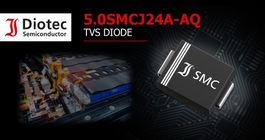
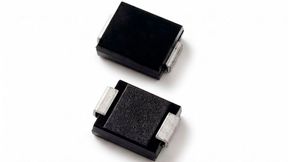
Diotec Semiconductor, with its headquarters in Germany, offers the 5.0SMCJ24A-AQ, a high-power transient voltage suppressor (TVS) diode designed for automotive applications.
With a 24 V stand-off voltage and a clamping voltage below 39 V, the device is intended to limit short-duration voltage transients before they can reach and overstress sensitive semiconductor components.
It is specified for 5,000 W peak pulse power, providing a high-energy solution for transient suppression in demanding automotive electronic environments.
Key parameters of the 5.0SMCJ24A-AQ:
· Peak pulse power: 5,000 W
· Stand-off voltage (VRWM): 24 V
· Clamping voltage: <39 V
· Package: SMC / DO-214AB
· Qualification: AEC-Q101
· Production: PPAP capable
For engineers designing BLDC motor control and HVAC electronics, the combination of appropriate stand-off voltage, controlled clamping and high pulse-power capability can help establish a robust protection strategy around the MOSFET switching stage.
Reliability matters beyond the electronics
HVAC reliability in an EV is not only an issue of passenger comfort. Thermal conditions inside a vehicle can also influence driver performance and safety.
Research has investigated the effects of cabin temperature on driving behaviour and task performance, including changes in following distance, braking response and cognitive performance under uncomfortable thermal conditions. This makes reliable operation of vehicle thermal-management systems an important consideration in overall vehicle-system design.
From the semiconductor perspective, protecting the switching devices that control these systems is therefore one element of designing for long-term reliability.
Diotec: semiconductor solutions for automotive applications
For automotive engineers and technical buyers, selecting the protection component is only part of the design process. Qualification, production capability and supply reliability are equally important.
The Diotec 5.0SMCJ24A-AQ combines automotive qualification with a high-power TVS architecture in the compact SMC package, making it suitable for applications where PCB space, transient performance and automotive production requirements must all be considered.
As EV architectures continue to increase the operating demands placed on thermal-management electronics, robust transient protection. High-power TVS are an important part of protecting the MOSFETs and other semiconductor devices at the heart of these systems.