







Sep 25, 2026
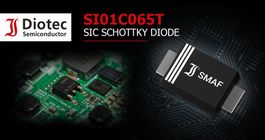
Diotec’s SI01C065T: Reducing High-Frequency Switching Losses with SiC Schottky Diodes
As switching frequencies increase in modern power-conversion systems, semiconductor switching losses become an increasingly important factor in overall efficiency and thermal design. One often-overlooked contributor is the charge that must be removed from a diode during each switching transition.
A conventional silicon fast-recovery diode can involve tens of nanocoulombs of stored charge. At a switching frequency of 100 kHz, that charge is processed 100,000 times per second. The resulting power loss increases with the applied voltage, switching frequency and charge involved in the transition.
For example, considering a 400 V operating voltage and a diode with 75 nC of charge, the associated capacitive switching-energy component can represent approximately 1.5 W at 100 kHz. This loss occurs independently of the power being delivered to the load: it is a consequence of the semiconductor's own switching behaviour.
As switching frequency increases, these losses increase proportionally. This can limit the practical frequency range of a power converter and reduce some of the benefits of operating at higher frequencies, such as smaller magnetic components and reduced passive-component size.
SiC Schottky technology reduces charge-related losses
Diotec Semiconductor, headquartered in Germany, offers a different approach with its SI01C065T, a 1 A, 650 V silicon-carbide (SiC) Schottky diode.
With a total capacitive charge of just 7.5 nC, the device significantly reduces the charge that has to be handled during each switching transition. Under the same 400 V and 100 kHz operating conditions, the corresponding capacitive switching-energy component is approximately 0.15 W.
This represents roughly one-tenth of the charge-related loss of the 75 nC example.
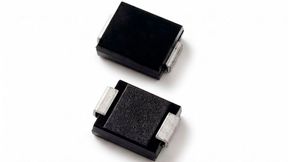
The SI01C065T combines these electrical characteristics with a compact DO-221AC (SMAF) package, making it suitable for applications where both power density and thermal performance are important.
Designed for high-frequency power conversion
Lower switching losses can be particularly valuable in applications such as:
· Auxiliary power supplies
· Solar and photovoltaic inverters
· Telecom power supplies
· Power-factor correction (PFC) stages
· High-frequency DC/DC converters
For designers, reducing semiconductor losses has a direct impact on system-level thermal management. Every watt dissipated by a diode ultimately has to be removed by the thermal system, while the input power must also increase to maintain the same delivered output power.
By reducing capacitive charge and associated switching losses, SiC Schottky technology can therefore help engineers increase switching frequency, improve power density and simplify thermal design.
As a semiconductor manufacturer, Diotec develops and produces solutions for demanding power-electronics applications, combining semiconductor technology with application-oriented package options such as the compact DO-221AC (SMAF).