


:quality(80)/p7i.vogel.de/wcms/40/62/4062c2d596e53b038e0f05f6c3182509/0133843963v2.jpeg "Littelfuse introduces ultra-low-capacitance TVS diode arrays with a 6.5 V clamping voltage for transient protection in automotive and consumer electronics. (Source: Littelfuse)")
:quality(80)/p7i.vogel.de/wcms/e5/9e/e59ecc43d3c278aece316be4209113c9/0133732079v2.jpeg "Renesas introduces its first low-voltage GaN FET family, with 100 V devices for power conversion in AI data centers, robotics and industrial systems. (Source: Renesas)")
:quality(80)/p7i.vogel.de/wcms/c4/a7/c4a7243caa7c26af5fe5108f7894050a/0133626683v2.jpeg "Wolfspeed’s new premium 200 mm SiC substrates are designed to provide more consistent starting material for power semiconductor manufacturing. (Source: © Marina - stock.adobe.com)")
:quality(80)/p7i.vogel.de/wcms/91/8b/918b533161e7327075370338d7af97af/0133589801v2.jpeg "Acbel will present scalable DC charging power modules and an 11kW passively cooled 2-in-1 on-board power solution at New Mobility Congress 2026 in Katowice, covering both charging infrastructure and vehicle applications. (Source: Acbel)")
:quality(80)/p7i.vogel.de/wcms/4f/47/4f473b006be95fb33ec3d8e3fd727b06/0133732443v2.jpeg "SEMI Europe joins the European Commission’s STEAM Executive Panel, bringing the semiconductor industry’s skills needs into discussions on education, training and workforce development. (Source: © phonlamaiphoto - stock.adobe.com)")
:quality(80)/p7i.vogel.de/wcms/c4/59/c459b75bff747399a7a7fd58381f3983/0133731182v2.jpeg "Infineon has completed its acquisition of C2i Semiconductors, adding expertise in software-defined power management and multiphase control for AI data-center power systems. (Source: © InfiniteFlow - stock.adobe.com)")
:quality(80)/p7i.vogel.de/wcms/fd/2c/fd2c2388e7985cd4c75cff39f07f6361/0133676222v2.jpeg "Greenconn expands its connector portfolio with the compact WF28 wire-to-board series and new 25 mm and 30 mm stacking-height options for its GC01 floating connectors. (Source: © Greenconn)")
:quality(80)/p7i.vogel.de/wcms/69/06/6906b5f22bfbb3f8b874ba9e459c7d26/0133675448v2.jpeg "New backend manufacturing hub strengthens and further diversifies Infineon's global production network. (Source: © Apriew - stock.adobe.com)")
:quality(80)/p7i.vogel.de/wcms/b4/93/b493d5ce620cf7eb558ca6bcd9852a1e/0133811655v2.jpeg "The massive integration of utility-scale solar photovoltaics demands BESS platforms equipped with high-power-density inverters to mitigate generation intermittency. (Source: Pixabay)")
:quality(80)/p7i.vogel.de/wcms/f8/cb/f8cbf79cc21d48d7cad08e2b620218f7/0133738515v2.jpeg "Microchip and Navitas are demonstrating a 20 kW reference design that converts an 800 VDC data-center bus to a 6 V server rail, combining GaN power devices with digital control. (Source: © Formoney - stock.adobe.com)")
:quality(80)/p7i.vogel.de/wcms/ee/de/eedef7055c094757eb208a9d181e85dc/0133371000v2.jpeg "Resonac has developed 300 mm SiC single-crystal substrates, advancing larger-diameter wafer technology for next-generation power electronics and other high-performance semiconductor applications. (Source: © Resonac)")
:quality(80)/p7i.vogel.de/wcms/7b/76/7b76005554b556df2a7a3794bdf69d44/0132365246v2.jpeg "Hioki’s ST5680A DC Hipot Tester combines CE/UKCA/CSA compliance, an integrated capacitance‑based contact check and time‑series waveform recording (voltage, leakage current, insulation resistance) to standardize hipot and insulation testing across EV cell, module and pack production lines. (Source: Hioki)")
:quality(80)/p7i.vogel.de/wcms/af/7f/af7f7b0fb7f29219fc991b1130f65477/0132241333v2.jpeg "Comprehensive laboratory testing regimens—combining thermal cycling, high‑current stress, EMC, and accelerated lifetime tests—are essential to validate advanced power designs and ensure reliability in real‑world applications. (Source: PRBX)")
:quality(80)/p7i.vogel.de/wcms/16/3d/163df69363f8125315a9826e13ea4b05/0131927425v2.jpeg "Solution will maximize data center and AI factory profitability while delivering engineering-grade insights to design and operations for more efficient, sustainable, and resilient infrastructure. (Source: Cadence)")
:quality(80)/p7i.vogel.de/wcms/85/b7/85b7e90733a2bd8f21515d8f7137f2fc/0131917677v2.jpeg "Renesas acquires Pictorus to integrate its embedded application software platform with Renesas’ MCU and MPU portfolio, helping developers shorten time‑to‑market and simplify system integration. (Source: © lucadp - stock.adobe.com)")
:quality(80)/p7i.vogel.de/wcms/27/07/2707280c807689b437baed3660257404/0133626052v2.jpeg "The quantum behavior of electrons shapes semiconductor devices—and the power converters that deliver electricity to modern computing systems. (Source: © Celt Studio - stock.adobe.com)")
POWER SEMICONDUTORS Toshiba develops SiC power module technology for high-frequency inverters
Related Vendors
:fill(fff,0)/p7i.vogel.de/companies/60/7e/607ec89d5d9b5/white-frame.jpg "white frame.jpg (www.rohm.com)")
:fill(fff,0)/p7i.vogel.de/companies/5f/71/5f71d5f92a5f6/2000px-rogers-corporation-logo-svg.png "2000px-Rogers_Corporation_Logo.svg.png (rogers germany)")
:fill(fff,0)/p7i.vogel.de/companies/68/2c/682c3e2e9a195/logotype-rvb.jpeg "logotype-rvb (MERSEN France)")
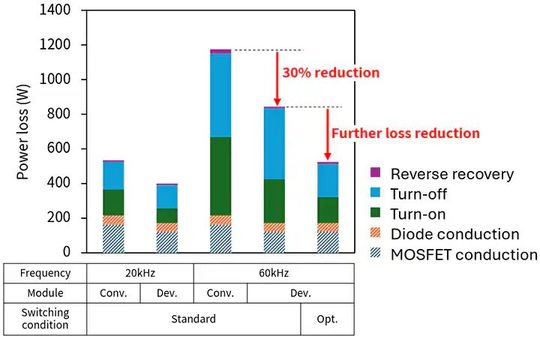
Toshiba Electronic Devices & Storage Corporation has developed silicon carbide (SiC) power module technology for high-frequency inverter applications that delivers lower power loss and higher reliability. The technology combines Toshiba’s proprietary Schottky barrier diode (SBD) embedded SiC MOSFET with an optimized module design to realize high reliability and low loss operation during high-speed switching. Simulation results indicate that, under high-frequency inverter operation at 60kHz, total inverter power loss can be reduced by approximately 30% compared with a module using a conventional SBD-embedded SiC MOSFET structure.
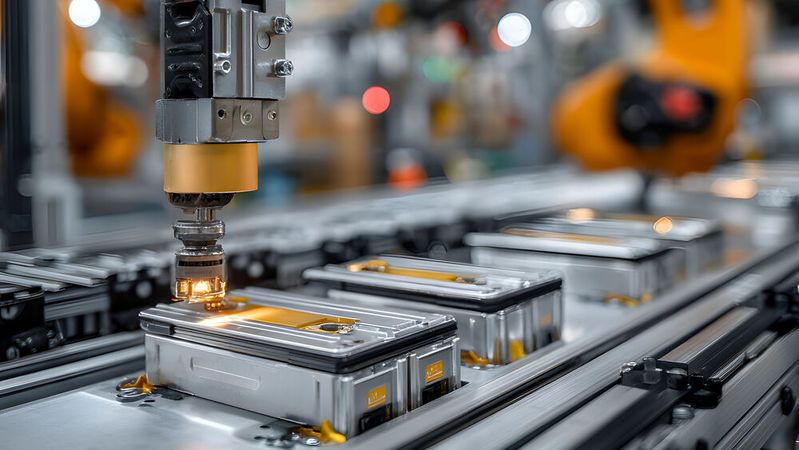
The widespread adoption of AI and the increasing sophistication of data centers is fast raising power consumption. The power systems that support them are required to deliver higher efficiency and higher power density, which is increasing the importance of power semiconductors that operate at high frequencies. This is particularly true for power equipment such as inverters and uninterruptible power supplies (UPS) that must meet efficiency and size requirements. In these circumstances, 1200V-class SiC power modules are expected to play a central role in next-generation power systems, but this requires further improvements in chip and module design.
Toshiba has addressed reliability challenges during diode conduction associated with SiC material characteristics by developing SBD-embedded SiC MOSFETs. However, conventional device structures constrain the layout of channel and SBD regions, making it difficult to balance low on-resistance with diode reliability. In addition, reducing the total chip area in a power module improves switching speed but introduces trade-offs, including increased on-resistance, reduced diode reliability, and degraded thermal performance.
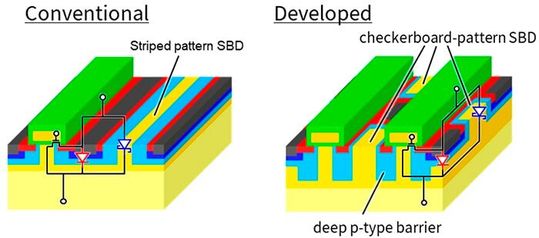
The newly developed SBD-embedded SiC MOSFET has a structure that combines a checkerboard-pattern SBD layout with a deep p-type barrier region (Figure 1). Utilizing the increased design flexibility realized by the electric-field suppression effect of the deep p-type barrier region, allows integrated optimization of multiple design parameters—including the channel, drift layer, JFET region, and gate-drive conditions. As a result, the device suppresses localized current concentration, improves current flow through the channel and drift layer, and enables stable current operation in both on-state operation and diode operation. This improves the trade-off between on-resistance and diode reliability. The achievement of a specific on-resistance of 1.8mΩ·cm2 at 25°C and 2.7mΩ·cm2 at 150°C, represents an approximately 50% reduction against the typical device structure, and increases SBD current conduction capability per unit area by approximately 40%.
:quality(80)/p7i.vogel.de/wcms/f0/a1/f0a1ae7496e69c9ec84186d7ebdf897d/0130870335v2.jpeg "Semiconductors enable the energy transition but are also associated with significant material and environmental impacts. (Source: AI generated)")
SEMICONDUCTORS
The material footprint of the energy transition
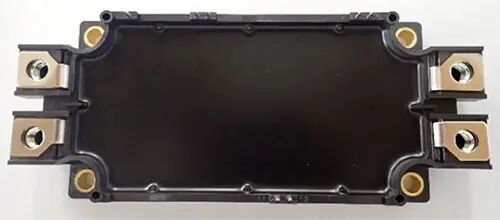
The developed device was applied to a 1200V-class SiC power module (Figure 2). The total chip area in the module was reduced by approximately 36% against the conventional structure. At the same time, improved chip performance, achieved through reduced on-resistance and enhanced reliability, delivered lower module-level conduction loss while maintaining diode reliability. Furthermore, improvements in the packaging structure and design, including the adoption of a resin-insulated substrate, allowed Toshiba to reduce thermal resistance per unit area by approximately 25%. This improves heat spreading and maintains heat dissipation performance even under the increased thermal density resulting from the reduction in total chip area.
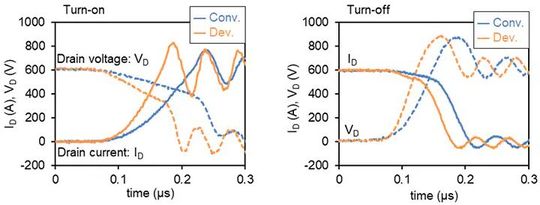
Further reduction in switching losses was confirmed as a result of these improvements (Figure 3). Simulation results indicate that total inverter power loss can be reduced by approximately 30% under 60kHz high-frequency operation (Figure 4). Further reductions in switching loss are expected through optimization of switching conditions, including gate-drive speed. The results indicate that significant performance improvements can be achieved in high-frequency power conversion.
This technology is expected to serve as a key platform for achieving higher efficiency and smaller size in power conversion systems, including data center UPS, industrial equipment, and renewable energy applications. Toshiba will continue to advance development toward practical application and mass production, while further enhancing high-frequency operation and performance to improve the energy efficiency of power systems, thereby contributing to a sustainable society.
(ID:50873128)
:quality(80)/p7i.vogel.de/wcms/b9/26/b9265548cf4e6fe7e45789b711d01f8f/0130098748v2.jpeg "Gallium nitride (GaN) power devices are increasingly challenging silicon MOSFETs in low-voltage power conversion by enabling higher efficiency and switching performance. (Source: AI-generated (OpenAI DALL·E))")
:quality(80)/p7i.vogel.de/wcms/2c/ef/2cef65d84ca2bd65519e1831cbf9d458/0128092593v2.jpeg "Symbolic Image: 1200V Silicon Carbide Six-Pack Power Modules for charging efficiency and performance for electric vehicles. (Source: © Lumos Maxima - stock.adobe.com)")