


:quality(80)/p7i.vogel.de/wcms/99/dd/99dd64ae87c0855129bd405f61d81f81/0133290217v2.jpeg "Microchip’s new 1.2 V SY757xx clock buffers connect modern low-voltage SoCs, FPGAs and AI accelerators with higher-voltage clock components, supporting frequencies up to 250 MHz and additive jitter as low as 26 fs. (Source: Microchip)")
:quality(80)/p7i.vogel.de/wcms/83/d0/83d0b8ea52378c77f98358e29ceccfc0/0133339307v2.jpeg "Capacitors are a critical yet often overlooked component in AI data center power supplies, buffering energy and stabilizing voltage as racks scale toward the megawatt range. (Source: © Parilov - stock.adobe.com)")
:quality(80)/p7i.vogel.de/wcms/10/fc/10fcb98e44d61826e641bc8d3f20f616/0133193677v2.jpeg "The new AEVA and AEVB Series aluminum electrolytic capacitors are engineered for harsh industrial environments, delivering high-CV, long-lifetime performance in compact, surface-mount packages that reliably withstand up to 30g acceleration and operating temperatures extending from -55° to +125°C. (Source: Kyocera)")
:quality(80)/p7i.vogel.de/wcms/f7/42/f74208db9f5f87dca384b38b71c4782e/0133196365v2.jpeg "YAGEO’s EC Flat‑Series temperature sensors combine fast, accurate measurement with resistance to vibration, shock, moisture and dust for demanding automotive and industrial applications. (Source: Yageo)")
:quality(80)/p7i.vogel.de/wcms/57/b6/57b6d33cb929fa4408ad56803ed5f0bc/0133311998v2.jpeg "Elmos and SK keyfoundry are expanding their collaboration on 130 nm technology and have agreed on long-term wafer capacity through 2037 to support reliable automotive semiconductor production. (Source: © remake - stock.adobe.com)")
:quality(80)/p7i.vogel.de/wcms/b4/0a/b40a1de3c8fa631b2aff74ec436c43db/0133314066v2.jpeg "ZF Aftermarket expands its EV service portfolio with new repair kits and solutions for e‑motors, inverters, hybrid modules, mechatronics and electric drive units. (Source: ZF Aftermarket)")
:quality(80)/p7i.vogel.de/wcms/48/e1/48e107b92f976652532facf5ca1e0855/0133290826v2.jpeg "Infineon and SolarEdge are extending their collaboration to develop solid-state protection solutions for 800 VDC AI data centers, aiming to improve fault response, system reliability and power density. (Source: © Grispb - stock.adobe.com)")
:quality(80)/p7i.vogel.de/wcms/99/84/9984f5888ecc71c249f65cea3f0658d1/0133069650v2.jpeg "Yokogawa’s integrated measurement setup helps Vertiv analyse AI-driven pulsed loads, combining power, waveform and thermal data to validate UPS performance and input power smoothing. (Source: YOKOGAWA)")
:quality(80)/p7i.vogel.de/wcms/a4/29/a429b944eb0a69e268015f8300ba8940/0133311989v2.jpeg "Hitachi Energy and Daikin are establishing a German supply of C4‑FN, a specialty insulating gas used in SF₆‑free high‑voltage equipment for more sustainable power grids. (Source: © Ahmed - stock.adobe.com)")
:quality(80)/p7i.vogel.de/wcms/d5/32/d5326e4b05d5cd759e88062f1c0b097a/0133344193v2.jpeg "Co-packaged optics is the latest innovation in data centers where optical modules on silicon chips can assist in scaling megawatt AI infrastructure. (Source: © Rachakrit - stock.adobe.com)")
:quality(80)/p7i.vogel.de/wcms/76/a9/76a9333bc7c6abbf7e29d1b910edb5e2/0133335959v2.jpeg "This article explains PMBus in data center power supplies. (Source: © Gibster - stock.adobe.com)")
:quality(80)/p7i.vogel.de/wcms/35/9c/359cfb6c855204e4d114f88cf5b98b5f/0133078984v2.jpeg "Photonic integrated circuits are next-level chips that will dominate data centers in the upcoming years. (Source: © pier - stock.adobe.com)")
:quality(80)/p7i.vogel.de/wcms/7b/76/7b76005554b556df2a7a3794bdf69d44/0132365246v2.jpeg "Hioki’s ST5680A DC Hipot Tester combines CE/UKCA/CSA compliance, an integrated capacitance‑based contact check and time‑series waveform recording (voltage, leakage current, insulation resistance) to standardize hipot and insulation testing across EV cell, module and pack production lines. (Source: Hioki)")
:quality(80)/p7i.vogel.de/wcms/af/7f/af7f7b0fb7f29219fc991b1130f65477/0132241333v2.jpeg "Comprehensive laboratory testing regimens—combining thermal cycling, high‑current stress, EMC, and accelerated lifetime tests—are essential to validate advanced power designs and ensure reliability in real‑world applications. (Source: PRBX)")
:quality(80)/p7i.vogel.de/wcms/16/3d/163df69363f8125315a9826e13ea4b05/0131927425v2.jpeg "Solution will maximize data center and AI factory profitability while delivering engineering-grade insights to design and operations for more efficient, sustainable, and resilient infrastructure. (Source: Cadence)")
:quality(80)/p7i.vogel.de/wcms/85/b7/85b7e90733a2bd8f21515d8f7137f2fc/0131917677v2.jpeg "Renesas acquires Pictorus to integrate its embedded application software platform with Renesas’ MCU and MPU portfolio, helping developers shorten time‑to‑market and simplify system integration. (Source: © lucadp - stock.adobe.com)")
DATA CENTERS 12V to 48V to 400V to 800V evolution of data center power distribution
Related Vendors
:fill(fff,0)/p7i.vogel.de/companies/5f/71/5f71d5f92a5f6/2000px-rogers-corporation-logo-svg.png "2000px-Rogers_Corporation_Logo.svg.png (rogers germany)")
:fill(fff,0)/p7i.vogel.de/companies/68/2c/682c3e2e9a195/logotype-rvb.jpeg "logotype-rvb (MERSEN France)")
:fill(fff,0)/p7i.vogel.de/companies/66/8b/668becd1c07eb/dowa-logo-word--1-.jpeg "dowa-logo-word--1- (DOWA)")
Data centers consume massive amounts of energy, between 1.5-3% of the world's total electricity demand. Power electronics, covering converter technologies, distribution buses, and cooling systems, is the backbone of modern AI-ruled data centers.
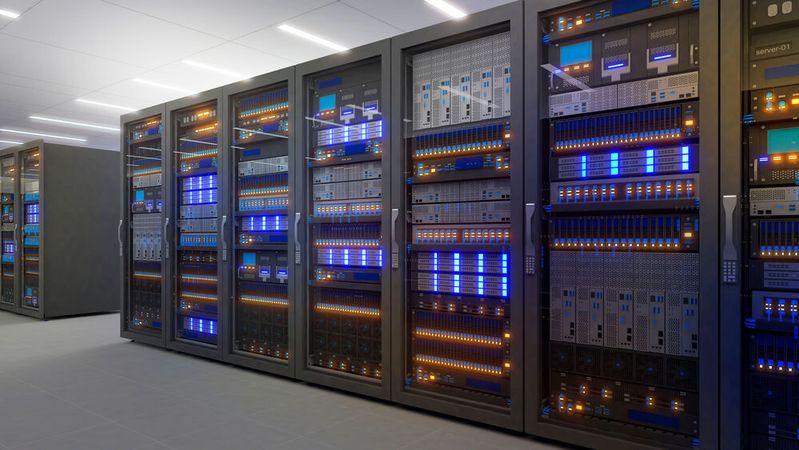
12V DC was the legacy rack-level distribution voltage in data centers. In 2017, Google introduced the 48V rack distribution. 400V rack distribution is being deployed by hyperscalers to address the limitations of 48V standard. NVIDIA now calls for 800V DC. The article details what each era — 12V, 48V, 400V, and 800V- is.
12V legacy and problems
Three-phase 380V/480V AC is the norm for powering data centers, heavy machinery, large motors, and industrial sites. AC grid voltage in data center facilities undergoes initial processing via uninterrupted power supplies (UPS), which is converted to 380V/400V DC power that serves as the facility-level distribution backbone.
Facility-level power distribution units (PDUs) distribute power via these facility buses and heavy-gauge cables to individual racks positioned throughout the data center. A rack is a standardized vertical cabinet that houses servers, network switches, storage systems, and accelerators.
Each rack consists of input terminals (typically dual inlets), networking ports, and cooling systems. Facility-level PDUs send 380/400V DC to individual rack input terminals. A rack-level PDU or power module converts this voltage to the 12V DC standard.
The voltage conversion of three-phase AC from the utility grid to rack-level DC voltage is known as grid-to-rack conversion. Inside each server, a power supply unit (PSU) steps down this 12V input to 5V, 3.3V, or 1.8V, required by processors, memories, accelerators, chips, and other components.
UPS and bulky PDUs spread across the data center consume substantial floor space and rack footprint. In addition, a server/GPU module typically draws between 2 and 10 kW of power. When delivering this power at 12V from the rack PDU, the maximum current reaches 800A +.
Power = Voltage x Current
10 kW = 12V x Current
Current = 10 kW/12V
Current = 833A
These high currents above 800A cause a substantial resistive loss in copper conductors, bus bars, and cables. Heat is an effect of current. Increasing current increases heat. As a result, data centers need to implement heavy cooling methods that increase operational expenses. That’s the problem with legacy 12V.
:quality(80)/p7i.vogel.de/wcms/94/c0/94c0221bedb88a883b9d451560a8dd95/0130559763v2.jpeg "The Humpback Creek hydroelectric facility in Cordova, Alaska, was the site of an edge data center pilot project. (Source: Chelsea Haisman via NLR)")
COMPUTE INFRASTRUCTURE
The grid can't keep up with AI: Data centers are bringing their own power plants
48V: Google’s 2017 catalyst
In 2017, Google introduced 48V distribution in data centers. A rack-level PDU or power module converts heavy DC from the facility bus to 48V DC. Now, instead of 12V, 48V becomes the primary distribution bus within the rack. The 48V distribution bus feeds isolated point-of-load (PoL) converters mounted directly at each processor, GPU, accelerator, or other components.
PoL converters step down 48V to 5V, 3.3V, 1.8V, or 0.8V, based on component voltage needs. The 12V DC rack distribution was mature node. Initially, it was difficult to step down 48V to lower voltages for rack components. Direct-to-PoL modules, containing cool-power, buck-boost converter, regulator, and current multiplier modules to enable efficient conversion. 48V now needs to deliver 10 kW+ per rack to support advanced workloads.
Power = Voltage x Current
10 kW = 48V x Current
Current = 10 kW/48V
Current = 208A
The current values come down to 200A+. 48V carries four times less current, resulting in sixteen times lesser losses than legacy 12V rack distribution. As a result, the 48V rack distribution shows a significant decrease in heat generation. The cooling requirements are reduced, further lowering the operational expense.
Due to significant reductions in resistive losses, cooling needs decrease. Data centers with 48V rack distribution were marketed as “green data centers”. However, data centers are not green due to excessive fresh water consumption. Data centers use liquid cooling with fresh water to cool heated racks. The excessive heating leads to wastage of fresh water. Seawater cannot be used due to its corrosive characteristics and high implementation costs.
It is important to note that AI-dedicated racks consume 100 kW+, which 48V can reasonably handle. The low-current benefit is long gone. Hyperscalers, such as Google, Microsoft, Meta, Amazon, IBM, Oracle, and many others, rely on a 48V rack distribution. 48V is getting out-of-phase with 400V rack deployment.
:quality(80)/p7i.vogel.de/wcms/cb/aa/cbaa3bbaed9f2eed05ed6747db579c09/0130182472v2.jpeg "PCIM Europe 2026 will once again bring together industry experts to discuss the latest developments in power electronics, energy management, and intelligent motion. (Source: Mesago Messe Frankfurt GmbH / Arturo Rivas Gonzalez)")
POWER INNOVATION
PCIM Expo & Conference 2026 puts AI in the spotlight
400V roll-out
The advent of AI has placed an extensive demand on data centers. While central processing units (CPUs) cannot handle all the load, graphic processing units (GPUs), tensor processing units (TPUs), network interface cards (NICs), and AI accelerators are a critical part of the data center infrastructure. Excessive power needs increase current requirements. While a legacy rack consumes between 2 and 10 kW, an AI-dedicated rack consumes 60 kW+.
NVIDIA GB300 NVL72 is a massive rack-scale AI supercomputer that integrates 72 NVIDIA GPUs and 36 ARM CPUs and consumes 120 kW+. Next-gen NVIDIA Kyber-class consumes 600 kW+. The 48V rack distribution cannot serve such extensive demands as before. For example, 300 kW at 48V needs 6,250A — Impossible! 600 kW at 400V rack distribution needs 750A, which is quite manageable.
Google and Meta are transitioning to 400V rack distribution. The three-phase AC voltage is processed via UPS and rectifiers, outputting heavy 400V DC. The 400V serves as the primary facility for the data center, which is distributed to racks via facility-level PDUs. The 400V rack distribution is bipolar. Two voltage rails, +400V and -400V, with a grounded midpoint, enable using SiC or GaN-based FETs and storage capacitors.
400V rack bipolar is distributed through the rack at around 750A, resulting in lower losses. Instead of stepping down +/-400V to 12V, or perhaps 48V, 400V stays the same. At each accelerator unit, PoL converters reduce 400V to the final chip-level voltage of 5V, 3.3V, 1.8V, and others.
Proof-of-concept 800V
In the near future, NVIDIA Vera Rubin is expected to consume 800 kW+. High current requirements up to 2 kA in the 400V rack distribution become a bottleneck. That’s where the 800V rack distribution comes into play. The 800V rack distribution is a futuristic concept that rolls out in H2 2026 or perhaps 2027. The 800V rack has an interesting architecture that reduces DC/DC power conversion stages.
The grid AC voltage is processed through a solid-state transformer (SST). SST converts AC to 800V DC, eliminating the rectification stage. NVIDIA talks about using advanced rectifier technology to convert 13.8 kV AC from the grid to 800V. At each accelerator unit, the PoL converter steps down 800V to chip-level low-voltage. Compared with current rack infrastructure, 800V rack distribution reduces reliance on copper, resulting in lower losses and operational costs.
References
- https://developer.nvidia.com/blog/nvidia-800-v-hvdc-architecture-will-power-the-next-generation-of-ai-factories/
- https://www.vicorpower.com/press-room/48v-direct-to-cpu
- https://www.microchip.com/en-us/about/media-center/blog/2025/next-gen-ai-data-centers-optimize-power-efficiency-with-sic
- https://wawt.tech/2024/10/01/datacenters-find-48v-power-architecture-more-relevant/
(ID:50871711)
:quality(80)/p7i.vogel.de/wcms/d5/32/d5326e4b05d5cd759e88062f1c0b097a/0133344193v2.jpeg "Co-packaged optics is the latest innovation in data centers where optical modules on silicon chips can assist in scaling megawatt AI infrastructure. (Source: © Rachakrit - stock.adobe.com)")
:quality(80)/p7i.vogel.de/wcms/83/d0/83d0b8ea52378c77f98358e29ceccfc0/0133339307v2.jpeg "Capacitors are a critical yet often overlooked component in AI data center power supplies, buffering energy and stabilizing voltage as racks scale toward the megawatt range. (Source: © Parilov - stock.adobe.com)")