


:quality(80)/p7i.vogel.de/wcms/99/dd/99dd64ae87c0855129bd405f61d81f81/0133290217v2.jpeg "Microchip’s new 1.2 V SY757xx clock buffers connect modern low-voltage SoCs, FPGAs and AI accelerators with higher-voltage clock components, supporting frequencies up to 250 MHz and additive jitter as low as 26 fs. (Source: Microchip)")
:quality(80)/p7i.vogel.de/wcms/83/d0/83d0b8ea52378c77f98358e29ceccfc0/0133339307v2.jpeg "Capacitors are a critical yet often overlooked component in AI data center power supplies, buffering energy and stabilizing voltage as racks scale toward the megawatt range. (Source: © Parilov - stock.adobe.com)")
:quality(80)/p7i.vogel.de/wcms/10/fc/10fcb98e44d61826e641bc8d3f20f616/0133193677v2.jpeg "The new AEVA and AEVB Series aluminum electrolytic capacitors are engineered for harsh industrial environments, delivering high-CV, long-lifetime performance in compact, surface-mount packages that reliably withstand up to 30g acceleration and operating temperatures extending from -55° to +125°C. (Source: Kyocera)")
:quality(80)/p7i.vogel.de/wcms/f7/42/f74208db9f5f87dca384b38b71c4782e/0133196365v2.jpeg "YAGEO’s EC Flat‑Series temperature sensors combine fast, accurate measurement with resistance to vibration, shock, moisture and dust for demanding automotive and industrial applications. (Source: Yageo)")
:quality(80)/p7i.vogel.de/wcms/57/b6/57b6d33cb929fa4408ad56803ed5f0bc/0133311998v2.jpeg "Elmos and SK keyfoundry are expanding their collaboration on 130 nm technology and have agreed on long-term wafer capacity through 2037 to support reliable automotive semiconductor production. (Source: © remake - stock.adobe.com)")
:quality(80)/p7i.vogel.de/wcms/b4/0a/b40a1de3c8fa631b2aff74ec436c43db/0133314066v2.jpeg "ZF Aftermarket expands its EV service portfolio with new repair kits and solutions for e‑motors, inverters, hybrid modules, mechatronics and electric drive units. (Source: ZF Aftermarket)")
:quality(80)/p7i.vogel.de/wcms/48/e1/48e107b92f976652532facf5ca1e0855/0133290826v2.jpeg "Infineon and SolarEdge are extending their collaboration to develop solid-state protection solutions for 800 VDC AI data centers, aiming to improve fault response, system reliability and power density. (Source: © Grispb - stock.adobe.com)")
:quality(80)/p7i.vogel.de/wcms/99/84/9984f5888ecc71c249f65cea3f0658d1/0133069650v2.jpeg "Yokogawa’s integrated measurement setup helps Vertiv analyse AI-driven pulsed loads, combining power, waveform and thermal data to validate UPS performance and input power smoothing. (Source: YOKOGAWA)")
:quality(80)/p7i.vogel.de/wcms/a4/29/a429b944eb0a69e268015f8300ba8940/0133311989v2.jpeg "Hitachi Energy and Daikin are establishing a German supply of C4‑FN, a specialty insulating gas used in SF₆‑free high‑voltage equipment for more sustainable power grids. (Source: © Ahmed - stock.adobe.com)")
:quality(80)/p7i.vogel.de/wcms/d5/32/d5326e4b05d5cd759e88062f1c0b097a/0133344193v2.jpeg "Co-packaged optics is the latest innovation in data centers where optical modules on silicon chips can assist in scaling megawatt AI infrastructure. (Source: © Rachakrit - stock.adobe.com)")
:quality(80)/p7i.vogel.de/wcms/76/a9/76a9333bc7c6abbf7e29d1b910edb5e2/0133335959v2.jpeg "This article explains PMBus in data center power supplies. (Source: © Gibster - stock.adobe.com)")
:quality(80)/p7i.vogel.de/wcms/35/9c/359cfb6c855204e4d114f88cf5b98b5f/0133078984v2.jpeg "Photonic integrated circuits are next-level chips that will dominate data centers in the upcoming years. (Source: © pier - stock.adobe.com)")
:quality(80)/p7i.vogel.de/wcms/7b/76/7b76005554b556df2a7a3794bdf69d44/0132365246v2.jpeg "Hioki’s ST5680A DC Hipot Tester combines CE/UKCA/CSA compliance, an integrated capacitance‑based contact check and time‑series waveform recording (voltage, leakage current, insulation resistance) to standardize hipot and insulation testing across EV cell, module and pack production lines. (Source: Hioki)")
:quality(80)/p7i.vogel.de/wcms/af/7f/af7f7b0fb7f29219fc991b1130f65477/0132241333v2.jpeg "Comprehensive laboratory testing regimens—combining thermal cycling, high‑current stress, EMC, and accelerated lifetime tests—are essential to validate advanced power designs and ensure reliability in real‑world applications. (Source: PRBX)")
:quality(80)/p7i.vogel.de/wcms/16/3d/163df69363f8125315a9826e13ea4b05/0131927425v2.jpeg "Solution will maximize data center and AI factory profitability while delivering engineering-grade insights to design and operations for more efficient, sustainable, and resilient infrastructure. (Source: Cadence)")
:quality(80)/p7i.vogel.de/wcms/85/b7/85b7e90733a2bd8f21515d8f7137f2fc/0131917677v2.jpeg "Renesas acquires Pictorus to integrate its embedded application software platform with Renesas’ MCU and MPU portfolio, helping developers shorten time‑to‑market and simplify system integration. (Source: © lucadp - stock.adobe.com)")
:quality(80)/thumbor.vogel.de/kNr3yG3hu6lnpJYlKwKfoOwkLA4=/500x500/p7i.vogel.de/wcms/69/79/6979e4b5bc84c/maurizio-dpe.jpeg "Dr Maurizio Di Paolo Emilio")
GAN VS. MOSFET How GaN is killing the MOSFET
Related Vendors
:fill(fff,0)/p7i.vogel.de/companies/5f/71/5f71d5f92a5f6/2000px-rogers-corporation-logo-svg.png "2000px-Rogers_Corporation_Logo.svg.png (rogers germany)")
:fill(fff,0)/p7i.vogel.de/companies/66/8b/668becd1c07eb/dowa-logo-word--1-.jpeg "dowa-logo-word--1- (DOWA)")
The silicon power MOSFET has been the most important device for changing low- and medium-voltage power for more than forty years. It was the best choice for everything from consumer electronics and telecom infrastructure to industrial power supplies and automotive systems because it was easy to use, had a well-established manufacturing ecosystem, and its performance was easy to predict.
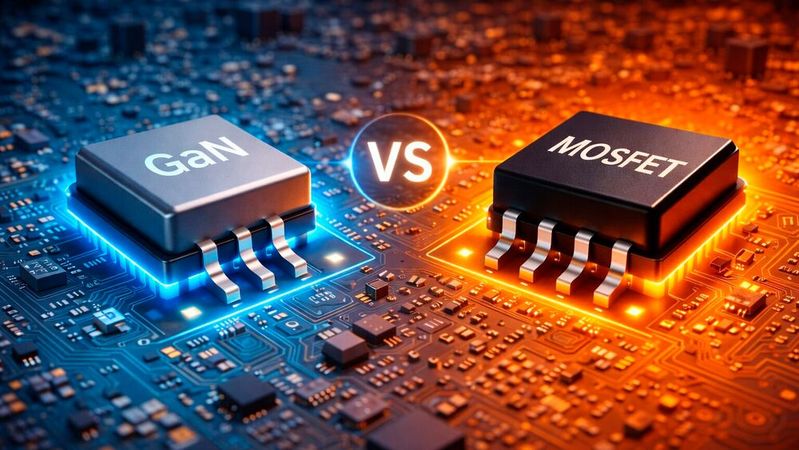
Architectural improvements that have been made over time, such as moving from planar to trench and superjunction designs, have steadily lowered on-resistance while keeping voltage capability.
But silicon MOSFET technology is getting close to its basic physical limits. Wide-bandgap semiconductors, especially gallium nitride (GaN), are becoming the natural successor in the low-voltage range as modern electronics need more efficiency, more power density, and faster dynamic performance. GaN changes the way power devices work at the atomic level, which opens up new power conversion architectures and changes the way systems work as a whole.
The Physical Limits of Silicon MOSFETs
Silicon MOSFET performance is constrained by a well-known trade-off between conduction losses and switching losses. Achieving low on-resistance (RDS(on)) typically requires increasing the device area, which in turn increases parasitic capacitances such as gate charge (Qg) and output capacitance (Coss). The trade-off between higher capacitance and slower transition speeds is due to the properties of silicon, especially its relatively low critical electric field. Silicon can't handle high electric fields, so devices need to be bigger to block voltage, which directly increases capacitance. Because of this, MOSFETs become less efficient as the switching frequency goes up, which means that designers have to run converters at lower frequencies. For decades, the need to balance conduction and switching losses while keeping switching frequencies within practical limits has shaped the design of power electronics.
:quality(80)/p7i.vogel.de/wcms/d8/18/d8181873ad07a9b0f77c8ef2d82441cb/0129407783v2.jpeg "Advances in low-voltage GaN devices are enabling higher efficiency and power density in applications traditionally served by silicon MOSFETs. (Source: © roei - stock.adobe.com)")
EXPERT ARTICLE
Evaluating GaN as a low-voltage alternative to Silicon MOSFETs
On-Resistance vs. Breakdown Voltage
In unipolar devices such as MOSFETs, the relationship between on-resistance and breakdown voltage is fundamentally determined by the properties of the semiconductor material. The specific on-resistance of the drift region can be approximated as:
RDS(on) = 4*VBR2/ (ε0 εr μn Ecrit3)
where VBR is the breakdown voltage, μn is electron mobility, εr is relative permittivity, and Ecrit is the material’s critical electric field.
This relationship reveals the dominant role of the critical electric field. Since RDS(on) scales with the inverse cube of Ecrit, materials capable of sustaining higher electric fields allow dramatically lower resistance at the same voltage rating.
Silicon has a relatively low critical electric field (~0.23 MV/cm). Consequently, devices designed to block higher voltages require thick, lightly doped drift regions, which dramatically increase resistance and chip area. This is the fundamental trade-off that has shaped silicon power electronics for decades.
The 2DEG: The Heart of the GaN HEMT
GaN devices use a special device structure that is based on a heterojunction between aluminum gallium nitride (AlGaN) and GaN.
When a thin layer of AlGaN is grown on GaN, the difference in lattice structure and polarization create strong electric fields inside the material. At the interface between the two materials, these fields make a two-dimensional electron gas (2DEG).
This 2DEG creates a very thin conduction channel with a very high carrier density and electron mobility that is much higher than that of bulk GaN. The outcome is a conduction path with very low resistance that doesn't require heavy doping, which would otherwise make mobility worse.
This mechanism allows GaN high-electron-mobility transistors (HEMTs) to achieve exceptionally low RDS(on) while maintaining high voltage capability.
:quality(80):fill(efefef,0)/p7i.vogel.de/wcms/6a/02/6a02d06fa2e86/wp-magnachip-sustainably-strong--mastering-the-reduction-of-oxides-coverbild.jpeg "WP_Magnachip_Optimizing 600V SJ MOSFETs for High-Density Server Design_Coverbild")
Normally-Off Operation for Power Conversion
The native GaN HEMT is a depletion-mode device, meaning it conducts at zero gate bias due to the presence of the 2DEG channel. While this behavior is acceptable in RF amplifiers, power conversion systems require normally-off operation to ensure safe startup and fault handling.
Several device architectures enable enhancement-mode GaN operation. Among the most widely adopted is the p-GaN gate structure, where a thin p-type GaN layer suppresses the 2DEG at zero gate bias. Applying a positive gate voltage re-establishes the channel and turns the device on, creating behavior similar to a conventional MOSFET.
Alternative approaches include recessed-gate structures, fluorine implantation, and hybrid cascode configurations combining a low-voltage silicon MOSFET with a depletion-mode GaN HEMT.
How GaN Breaks the Silicon Trade-off
Gallium Nitride is a semiconductor with a wide bandgap that has very different material properties from silicon. One of the best things about it is that its critical electric field is about ten times higher than that of silicon.
Gallium nitride is a type of semiconductor with a wide bandgap. It has a bandgap of about 3.39 eV, which is much higher than silicon's 1.12 eV. This means it can work at higher temperatures. GaN's critical electric field is about 3.3 MV/cm, which is more than ten times higher than silicon's.
GaN devices need a much thinner drift region to handle the same blocking voltage because breakdown capability goes up with the strength of the electric field. This makes the device's resistance and capacitance go down a lot.
The theoretical specific on-resistance of GaN devices is about two orders of magnitude lower than that of silicon and much lower than that of SiC in the same voltage class at 600 V. This material benefit is the only reason why GaN is quickly taking over MOSFETs in mid-voltage power conversion.
Because of this property, GaN devices can block voltage with a much smaller structure. Because of this, GaN transistors can have very low capacitances and still have low on-resistance. The combination makes switching transitions happen very quickly and cuts down on switching losses by a large amount.
Another big benefit of GaN devices is that they don't have a reverse recovery charge. When switching happens in silicon MOSFETs, the body diode causes reverse recovery losses, especially in hard-switching topologies. GaN transistors get rid of this effect, which makes things even more efficient and lets them switch faster.
These features work together to make GaN devices work well at switching frequencies that are much higher than what silicon MOSFETs can usually handle.
:quality(80)/p7i.vogel.de/wcms/7b/a0/7ba0a5453a2ba24e3edc852527ed7f27/0128662544v2.jpeg "Collaboration expands onsemi’s power portfolio to include high-performance 650V lateral GaN solutions for AI data centers, automotive, aerospace, and other critical markets. (Source: onsemi)")
GaN Power
Next generation GaN power devices advance manufacturing capabilities
Higher Switching Frequency Enables Smaller Systems
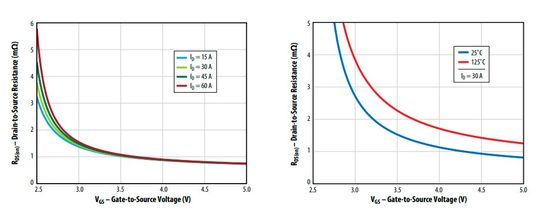
The ability to switch efficiently at higher frequencies has profound implications at the system level. In traditional silicon-based converters, passive components such as inductors and transformers dominate the size and weight of the power supply. These components are directly related to switching frequency: the higher the frequency, the smaller the required magnetics.
Because GaN devices maintain high efficiency even at megahertz switching frequencies, designers can dramatically reduce the size of magnetics and filtering components. This leads to power supplies with significantly higher power density, reduced weight, and faster transient response.
These improvements are particularly valuable in applications such as AI data centers, robotics, high-performance computing, and advanced automotive systems, where efficiency and compact design are critical.
A System-Level Revolution
GaN has many advantages that go beyond how well transistors work. GaN devices have very low capacitances and almost no reverse-recovery charge, which means that switching losses are much lower than with silicon MOSFETs.
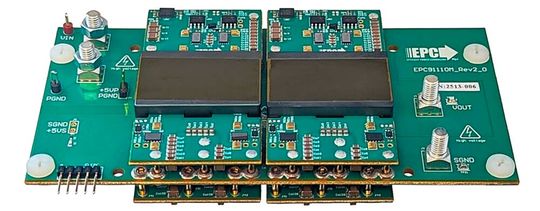
This makes it possible to work well at much higher switching frequencies, often in the megahertz range. Power supplies that work at higher frequencies are much smaller and lighter because they use smaller inductors and transformers.
Also, GaN's lateral device architecture makes it possible to package chips at the chip level and even integrate power stages, drivers, and control circuitry on a single die.
GaN technology can make converter architectures simpler in addition to making them more efficient and powerful. Silicon MOSFET designs often need extra circuits to reduce switching losses or deal with parasitic effects. Engineers often use snubbers, complicated gate-drive strategies, or soft-switching techniques to get the best performance.
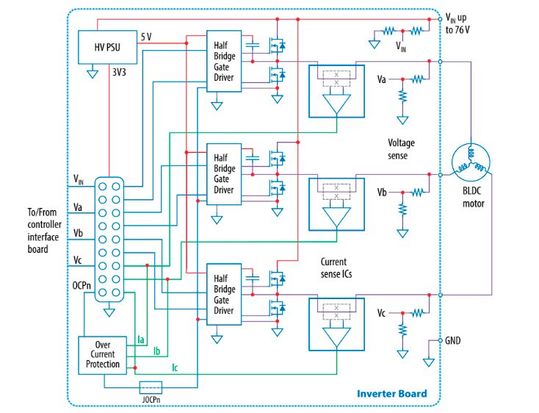
Many of these design problems can be made simpler or even go away because GaN devices have lower capacitances and almost no reverse recovery. This can cut down on the number of parts and make the whole system more reliable.
In some cases, GaN devices may cost more than silicon MOSFETs at the device level, but the lower number of passive components and better system efficiency usually mean that the total system cost is lower.
Enabling the Next Generation of AI Infrastructure
A typical AI server power architecture begins with AC input - commonly around 240 V AC -followed by power factor correction (PFC), isolation stages, and multiple DC distribution levels before reaching the processor-level power supplies. In modern Open Rack Version 3 architectures, power distribution commonly transitions through intermediate voltage buses such as 400 V DC or 48 V DC before being converted into lower rails like 12 V, 8 V, or even below 1 V for processors, GPUs, and memory subsystems.
GaN technology enables performance improvements at every stage of this power delivery chain. Compared with traditional silicon MOSFETs, GaN devices provide faster switching speeds, lower losses, and significantly improved figures of merit in both soft- and hard-switching applications. These advantages allow designers to increase switching frequencies, reduce passive component size, and achieve higher power densities - critical attributes for high-performance computing and AI server infrastructure.
One example of this approach is the use of GaN-based isolated converters for high-voltage architectures, such as an 800 V DC to 12.5 V DC server supply capable of delivering approximately 6 kW. An eight-stage input-series, output-parallel (ISOP) architecture can be used, where primary stages are connected in series while secondary outputs are paralleled. This configuration allows lower device voltage stress, improved performance, and better thermal distribution across multiple phases. In addition, the interleaved structure reduces output capacitance requirements and simplifies transformer design.
Higher-power implementations are also possible, including isolated 800 V to 50 V server supplies exceeding 10 kW. These solutions demonstrate how GaN technology can support the increasing power demands of AI accelerators while maintaining compact form factors suitable for modern rack architectures.
Beyond the front-end conversion stages, GaN devices are also enabling more efficient point-of-load (POL) converters. These converters deliver extremely low voltages - down to around 0.5–0.8 V - required by advanced processors. With zero reverse-recovery charge and lower switching losses, GaN FETs significantly reduce secondary-side losses compared with the best MOSFET alternatives, in some cases by as much as 40–67%.
As AI data centers continue to scale in power consumption and computational density, the ability to optimize efficiency across the entire power delivery network becomes critical. End-to-end GaN-based solutions - from high-voltage front-end converters to low-voltage POL regulators—are poised to play a central role in enabling the next generation of high-performance, energy-efficient computing infrastructure.
:quality(80)/p7i.vogel.de/wcms/ef/0a/ef0adb0acf793fe147cc27c21f6a7a67/0129954238v2.jpeg "Empower Semiconductor introduces embedded silicon capacitors designed to improve power delivery and stability in AI and high-performance computing processors. (symbolic image) (Source: © IF.arc - stock.adobe.com)")
SEMICONDUCTOR TECHNOLOGY
Empower launches high-density silicon capacitors for AI processors
48 V and motor driver applications
A key stage in this architecture is the conversion from 400 V or 800 V DC to 48 V, often implemented using ISOP (Input-Series Output-Parallel) converter architectures. In ISOP designs, multiple LLC modules operate with series-connected inputs and parallel outputs, enabling efficient handling of high input voltages while sharing load current at the output. This modular approach distributes losses, simplifies transformer design, and enables scalable power levels for AI server platforms.
Once the 48 V rail is generated, power is delivered to intermediate bus converters (48 V to 12 V) and finally to point-of-load (PoL) regulators, which generate the sub-1 V supply required by modern processors. Thanks to GaN’s low RDS(on) and superior switching performance, these stages can achieve up to ~98% peak efficiency in compact 1 kW modules, supporting the demanding power requirements of next-generation AI computing platforms.
GaN technology is rapidly improving the performance and integration of BLDC motor drivers, particularly in robotics, drones, and compact servo systems. Modern three-phase inverter designs based on 100 V eGaN FETs can deliver up to 50 ARMS (70 A peak) phase current while operating at switching frequencies as high as 150 kHz. The high switching speed and low losses of GaN devices reduce motor noise, improve torque-per-ampere, and allow smaller passive components and DC-link capacitors.
Highly integrated designs combine the GaN power stage with gate drivers, sensing, and control electronics, enabling compact solutions that fit directly into space-constrained applications such as robotic joints. This level of integration increases power density while simplifying system design and accelerating development of high-efficiency BLDC motor drive platforms
:quality(80)/p7i.vogel.de/wcms/f5/d2/f5d2bce7c01775fe62d4c6ecebc8c5ba/0129188745v2.jpeg "A gate driver designed for bridge circuits enables reliable control of high-current brushed DC motors in automotive applications. (Source: © javu - stock.adobe.com)")
MOTOR CONTROL
New gate driver supports high-current dc motor bridge circuits
Why GaN Will Kill MOSFETs
Silicon MOSFETs will not disappear overnight. Their cost advantage and mature ecosystem ensure they will remain in many applications.
However, the physics is clear. GaN offers lower resistance, faster switching, higher efficiency, and dramatically higher power density in the critical 40–600 V range.
Segments such as fast chargers,48-V power systems, data center power architectures, and high-frequency DC-DC converters are rapidly adopting GaN technology. As manufacturing volumes increase and costs decline, GaN is expected to penetrate even broader areas of the power electronics market.
As the demand for more efficient and compact electronic systems continues to grow, GaN technology is poised to play a central role in the future of power electronics.
When a new technology simultaneously improves efficiency, reduces system size, and simplifies design, the transition becomes inevitable.
In that sense, GaN is not simply competing with the silicon MOSFET.
Instead, it is capturing many of the new and fastest-growing applications, while silicon MOSFETs continue to serve established and legacy markets supported by their mature ecosystem. Over time, as new designs increasingly adopt GaN, silicon MOSFETs may gradually recede from the leading edge of power electronics.
References
- GaN Power Devices for Efficient Power Conversion, Fourth Edition - by Alex Lidow, Michael de Rooij, John Glaser, Alejandro Pozo Arribas, Shengke Zhang, Marco Palma, David Reusch, Johan Strydom.
(ID:50782960)
:quality(80)/p7i.vogel.de/wcms/95/21/9521286b6f497c77e8bb0bf5264328ea/0131499453v2.jpeg "Power conversion becomes more and more a system level engineering problem than just a voltage translation function. (Source: Brightloop)")
:quality(80)/p7i.vogel.de/wcms/d8/18/d8181873ad07a9b0f77c8ef2d82441cb/0129407783v2.jpeg "Advances in low-voltage GaN devices are enabling higher efficiency and power density in applications traditionally served by silicon MOSFETs. (Source: © roei - stock.adobe.com)")