


:quality(80)/p7i.vogel.de/wcms/e8/fd/e8fd4af6dd0e278b3bb58348d9ad61f6/0133814015v2.jpeg "HYBRO+ in its final configuration as a bronze-iron composite strip for connector applications in combination with a press-fit zone (Source: Voestalpine Precision Strip)")
:quality(80)/p7i.vogel.de/wcms/ba/09/ba0999beb91dd39375daf1c08e5d4612/0133894462v2.jpeg "Toshiba’s 1100 TP Series provides uninterruptible power protection for critical equipment and systems. (Source: 2025 TRACY EASON PHOTOGRAPHY)")
:quality(80)/p7i.vogel.de/wcms/40/62/4062c2d596e53b038e0f05f6c3182509/0133843963v2.jpeg "Littelfuse introduces ultra-low-capacitance TVS diode arrays with a 6.5 V clamping voltage for transient protection in automotive and consumer electronics. (Source: Littelfuse)")
:quality(80)/p7i.vogel.de/wcms/e5/9e/e59ecc43d3c278aece316be4209113c9/0133732079v2.jpeg "Renesas introduces its first low-voltage GaN FET family, with 100 V devices for power conversion in AI data centers, robotics and industrial systems. (Source: Renesas)")
:quality(80)/p7i.vogel.de/wcms/5d/fb/5dfba5e5f38daf2b8597b05656af29c0/0133956337v2.jpeg "Wolfspeed has received a conditional commitment for a loan of up to $1.5 billion from the U.S. Department of War to support its domestic wide-bandgap semiconductor supply chain. (Source: © AspctStyle - stock.adobe.com)")
:quality(80)/p7i.vogel.de/wcms/4f/47/4f473b006be95fb33ec3d8e3fd727b06/0133732443v2.jpeg "SEMI Europe joins the European Commission’s STEAM Executive Panel, bringing the semiconductor industry’s skills needs into discussions on education, training and workforce development. (Source: © phonlamaiphoto - stock.adobe.com)")
:quality(80)/p7i.vogel.de/wcms/c4/59/c459b75bff747399a7a7fd58381f3983/0133731182v2.jpeg "Infineon has completed its acquisition of C2i Semiconductors, adding expertise in software-defined power management and multiphase control for AI data-center power systems. (Source: © InfiniteFlow - stock.adobe.com)")
:quality(80)/p7i.vogel.de/wcms/87/cc/87cc38908c0e49aaa15f5a3fb656890a/0133677566v2.jpeg "For power module manufacturers, material selection now involves both technical performance and the reliability of the supply chain behind it. (Source: © CuteBee - stock.adobe.com)")
:quality(80)/p7i.vogel.de/wcms/39/78/39789123b9bcd644fbdb3e5fede04a7d/0133893589v2.jpeg "This article shows how designers must be extra careful when designing power supplies for medical equipment. (Source: © saichon - stock.adobe.com)")
:quality(80)/p7i.vogel.de/wcms/b4/93/b493d5ce620cf7eb558ca6bcd9852a1e/0133811655v2.jpeg "The massive integration of utility-scale solar photovoltaics demands BESS platforms equipped with high-power-density inverters to mitigate generation intermittency. (Source: Pixabay)")
:quality(80)/p7i.vogel.de/wcms/7b/76/7b76005554b556df2a7a3794bdf69d44/0132365246v2.jpeg "Hioki’s ST5680A DC Hipot Tester combines CE/UKCA/CSA compliance, an integrated capacitance‑based contact check and time‑series waveform recording (voltage, leakage current, insulation resistance) to standardize hipot and insulation testing across EV cell, module and pack production lines. (Source: Hioki)")
:quality(80)/p7i.vogel.de/wcms/af/7f/af7f7b0fb7f29219fc991b1130f65477/0132241333v2.jpeg "Comprehensive laboratory testing regimens—combining thermal cycling, high‑current stress, EMC, and accelerated lifetime tests—are essential to validate advanced power designs and ensure reliability in real‑world applications. (Source: PRBX)")
:quality(80)/p7i.vogel.de/wcms/16/3d/163df69363f8125315a9826e13ea4b05/0131927425v2.jpeg "Solution will maximize data center and AI factory profitability while delivering engineering-grade insights to design and operations for more efficient, sustainable, and resilient infrastructure. (Source: Cadence)")
:quality(80)/p7i.vogel.de/wcms/85/b7/85b7e90733a2bd8f21515d8f7137f2fc/0131917677v2.jpeg "Renesas acquires Pictorus to integrate its embedded application software platform with Renesas’ MCU and MPU portfolio, helping developers shorten time‑to‑market and simplify system integration. (Source: © lucadp - stock.adobe.com)")
:quality(80)/p7i.vogel.de/wcms/27/07/2707280c807689b437baed3660257404/0133626052v2.jpeg "The quantum behavior of electrons shapes semiconductor devices—and the power converters that deliver electricity to modern computing systems. (Source: © Celt Studio - stock.adobe.com)")
POWER SUPLLY UNITS Introduction to designing power supplies for medical equipment
Related Vendors
:fill(fff,0)/p7i.vogel.de/companies/62/a0/62a0a0de7d56a/aic-europe-logo.jpeg "aic-europe-logo (AIC Europe)")
:fill(fff,0)/p7i.vogel.de/companies/5f/71/5f71d5f92a5f6/2000px-rogers-corporation-logo-svg.png "2000px-Rogers_Corporation_Logo.svg.png (rogers germany)")
:fill(fff,0)/p7i.vogel.de/companies/68/2c/682c3e2e9a195/logotype-rvb.jpeg "logotype-rvb (MERSEN France)")
Data center power gets all the hype. Medical equipment, even more safety-critical, is rarely discussed. The power supply unit (PSU) supports patient monitors, CT scanners, PET scanners, or infusion pumps that cannot tolerate an unstable voltage/power rail. In some situations, the equipment can also be connected to the patient's heart. That’s why medical PSUs must function properly.
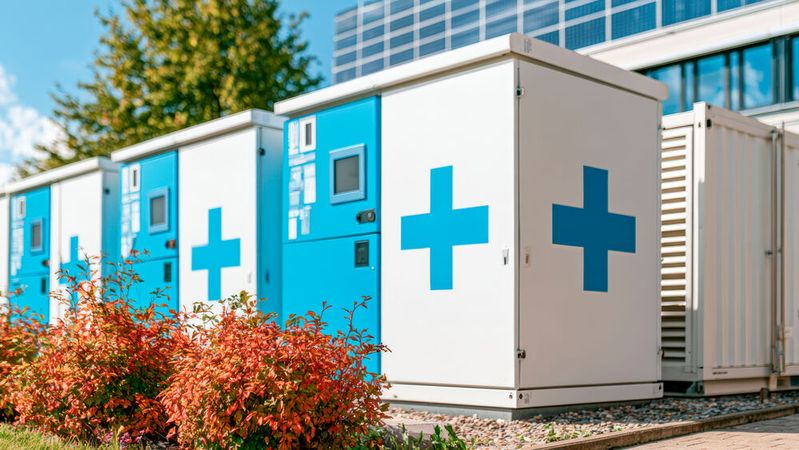
Medical equipment parts, such as power supply units, must meet certain standards and undergo extensive safety certifications. One such standard is IEC 60601-1, the primary international safety standard, which ensures the design, construction, and basic performance of medical equipment and systems.
IEC 60601-1 is the base of the 60601 series, which further splits into collateral and particular standards for device types. Meeting IEC 60601-1 means that medical PSUs don’t create an unacceptable risk of injury for patients or operators. Global markets in the U.S., Europe, Canada, and India comply with this standard.
The European version of this standard is EN 60601-1. Another standard is UL 60601-1. It is the North American version that applies tighter limits. When medical PSUs meet these standards, they become professional, medical-grade, and safe devices.
Range of medical power supplies
Medical power supply design and development cycles are long. Their lifecycle is long as well. There are two types of medical PSUs: linear power supplies and switch-mode power supplies. Both are applicable in dental, ultrasound, ophthalmic, surgical, and ventilator systems.
Hand-portable blood pressure monitors, handheld battery-powered devices, and wearable healthcare devices run on the low-power end through internal DC-DC converters. They use encapsulated medical PSUs, which are tightly enclosed in a capsule or casing.
CT, PET, and MRI scanners draw kW across various subsystems in AC-DC and DC-DC converters. These large scanners and radiography equipment run multiple subsystems and multi-rails with fitted modular medical PSUs built from configurable sections. They’re on the higher end of the price range.
While these scanners' medical PSUs aren't in direct contact with patients, ventilators, anaesthesia machines, suction pumps, and trolley-mounted devices stay close to humans. Power supplies that keep all the circuitry within an enclosure ensure utmost safety.
Designing a compliant medical PSU
All types of medical PSUs must meet IEC 60601-1, EN 60601-1, and UL 60601-1 standards. This is a non-negotiable rule for patient safety.
From IEC 60601-1, 2nd edition, there are three applied-part classes.
“B” stands for Body. This is the class of PSUs that don’t come in physical contact with the patient. For example, medical PSUs in operating tables, MRI scans, CT scans, patient beds, surgical lighting, and phototherapy units.
“BF” stands for Body Floating. This is the class of PSUs that makes physical contact with the patient's skin. Protection is mandatory. The medical PSU “part” is isolated from other parts of the equipment. For example, medical PSUs in ultrasound scanners, pulse oximeters, incubators, and muscle stimulation units.
“CF” stands for Cardiac Floating. The medical PSU is directly connected to the human heart. This is the class that requires the highest level of patient protection. For example, medical PSUs in cardiac catheterization with imaging, external pacemakers, and defibrillators.
The IEC 60601-1, 3rd edition, defines means of protection for both the patient and the operator: Means of protection (MOP), means of operator protection (MOOP), and means of patient protection (MOPP). It depends upon the application for which the medical PSU is used and how much physical contact is actually needed.
This is not the whole job. As part of the 3rd edition of IEC 60601, a risk management process under ISO 14971 is critical for medical PSUs. It defines a structured cycle for risk evaluation, control, and documentation.
Insulation: Medical supplies that come in contact with humans, especially portable devices, require extra insulation. Encapsulated and enclosed medical PSUs are some examples.
Low leakage current: Leakage current is the current that flows externally either to other components or to humans if they come in physical contact. There are types of leakage currents: Earth current and touch current. Earth current flows from the mains part of the supply to the protective earth conductor, whereas touch current reaches humans if they happen to touch the circuit.
For example, IT-grade supplies must comply with IEC 60950-1. The earth leakage current of IT PSUs should be 3.5 mA, and the touch current should be 0.25 mA. However, the earth leakage current of medical PSUs should be 0.5 mA, and the touch current should be 0.1 mA. The values for leakage currents of IT-grade equipment are higher because humans are unlikely to come in direct, continuous contact with IT PSUs.
The values of leakage currents must be lower in medical PSUs, as physical contact between humans and medical equipment continues for long. In such cases, higher current might pose a serious threat to the human heart. The main goal of medical-grade PSUs is to protect humans from lethal voltages and currents.
EMI compatibility: The term “compliance” with respect to medical power supplies covers the whole system, not just a single portable device or external wall supplies. For example, medical PSUs, separated over different consoles, control, and examination rooms, must be EMC compliant.
References
- https://www.globalspec.com/learnmore/electrical_electronic_components/power_supplies_conditioners/medical_power_supplies
- https://my.avnet.com/abacus/solutions/technologies/power/the-design-engineers-guide/understanding-medical-power-supply-requirements/
- https://www.mornsun-power.com/html/news-detail/blog-posts/462.html
- https://www.fsp-group.com/en/microsite/medical/index.html
(ID:50983161)
:quality(80)/p7i.vogel.de/wcms/76/a9/76a9333bc7c6abbf7e29d1b910edb5e2/0133335959v2.jpeg "This article explains PMBus in data center power supplies. (Source: © Gibster - stock.adobe.com)")
:quality(80)/p7i.vogel.de/wcms/c2/90/c2900da3fdc8cfaea5c3ac8944ccab86/0127527872v2.jpeg "Capacitors are prone to failure. With the help of a multimeter, you can easily assess their health. (Source: © PoodPhoto - stock.adobe.com)")