












MOTION CONTROL EPC expands 100 V GaN motor drive portfolio with two inverter evaluation platforms
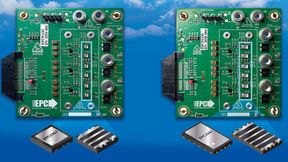
Efficient Power Conversion (EPC) has announced the availability of the EPC91124 and EPC91125, two new 100 V three-phase BLDC motor drive evaluation boards designed to simplify the development of next-generation high-performance motion-control systems.
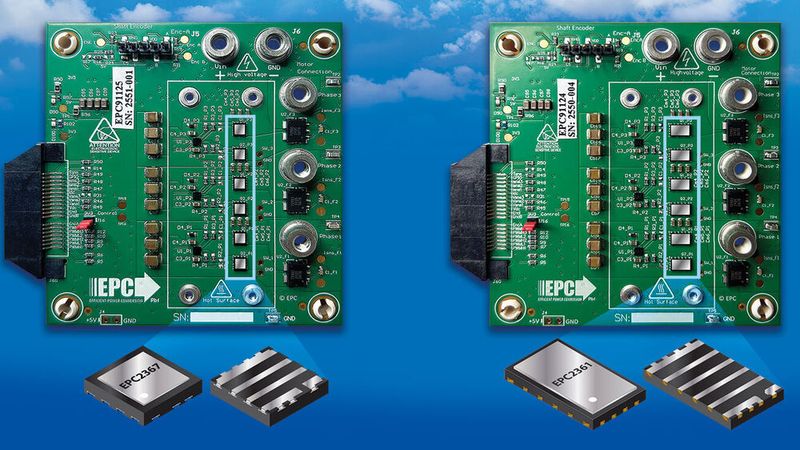
The new platforms, based on EPC’s latest enhancement-mode GaN FET technology, enable designers to evaluate high-frequency motor drive architectures with operating voltages from 18 V to 80 V and PWM switching frequencies up to 100 kHz (150 kHz max). The boards are designed for applications such as industrial automation, collaborative robots, autonomous mobile robots (AMRs), drones, servo drives, and precision motion control.
The EPC91124 features the EPC2361 100 V eGaN FET with a typical R(DS)on of 0.75 mΩ, delivering up to 35 ARMS continuous phase current and 45 ARMS peak. The EPC91125 is based on the EPC2367 100 V eGaN FET with a typical RDS(on) of 1.2 mΩ, providing 30 ARMS continuous and 40 ARMS peak capability. Both platforms share the same compact 79 mm × 80 mm footprint, allowing engineers to evaluate different current levels using a common hardware and software ecosystem.
The evaluation boards are complete inverter development platforms that include gate drivers, three-phase current sensing, phase and DC bus voltage monitoring, on-board housekeeping power supplies, temperature monitoring and encoder/Hall sensor interfaces. This integration lets engineers focus on motor control algorithms and reduces hardware design complexity.
The boards are compatible with a broad range of digital control platforms, including Microchip dsPIC, Texas Instruments C2000, STMicroelectronics STM32, and Renesas RAxT2 controllers, providing flexibility for both evaluation and rapid prototyping.
Unlike conventional silicon-based motor drives that typically operate at switching frequencies around 20 kHz, the new GaN platforms enable efficient operation at up to 100 kHz. Higher switching frequencies contribute to reduced current ripple, lower acoustic noise, smaller passive components, improved dynamic response, and increased overall power density.

The boards are set up with controlled dv/dt under about 10 V/ns, rather than maximizing switching speed. This helps designers achieve an effective balance between efficiency and electromagnetic compatibility (EMC). The gate-drive configuration can also be optimized for applications that require faster switching transitions.
The current feedback is provided by integrated Hall-effect sensors with 250 kHz bandwidth, 13.2 mV/A sensitivity, and a dynamic measurement range of about ±125 A. This allows accurate current reconstruction for advanced field-oriented control (FOC) algorithms at high switching frequencies.
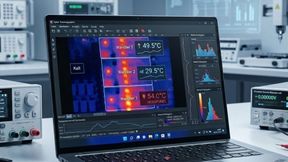
Thermal characterization under realistic operating conditions demonstrates continuous operation up to 40 ARMS with passive cooling, and pulsed torque testing confirms significantly higher transient current capability for demanding dynamic motion applications.
"Motor control applications are evolving rapidly as robotics, industrial automation, and intelligent motion systems demand higher efficiency, greater power density, and increasingly dynamic performance," said Marco Palma, Vice President Motor Drive Marketing and System Engineering at EPC. "These new evaluation platforms demonstrate how 100 V GaN technology enables high-frequency inverter operation while integrating the sensing, thermal management, and controller interfaces engineers need to accelerate development. By providing two current levels within the same ecosystem, designers can more easily optimize performance, size, and cost for their specific application."
(ID:51030633)