


:quality(80)/p7i.vogel.de/wcms/7f/4b/7f4b97757cea82c0675209630577dc22/0133974130v2.jpeg "Vox Power’s EIRE600 delivers up to 600 W in a compact 5 × 3-inch package, with forced-air or conduction cooling options for industrial and medical equipment. (Source: Vox Power)")
:quality(80)/p7i.vogel.de/wcms/55/97/5597c3436e3bc92ee7ba23b6f9d289e9/0134032539v2.jpeg "Littelfuse’s TP7.0SMD-XC automotive TVS diode series uses foldback technology to provide low clamping voltage for protecting sensitive vehicle electronics. (Bild: Littelfuse)")
:quality(80)/p7i.vogel.de/wcms/51/f8/51f84448e666230bb11a02566abd1177/0133958187v3.jpeg "Microchip’s radiation-tolerant GaN point-of-load converter supplies up to 20 A for space-based processors, FPGAs, microcontrollers and ASICs. (Source: Microchip)")
:quality(80)/p7i.vogel.de/wcms/0a/7c/0a7c08f368ae1d91f758dd18d2a32e88/0133978423v2.jpeg "EPFL researchers have demonstrated a GaN transistor that withstands nearly 4 kV, using an intrinsic polarization superjunction design to distribute electric fields more evenly. (Source: EPFL)")
:quality(80)/p7i.vogel.de/wcms/5b/94/5b94232ca4183d6fcc2dccc7394d7544/0134041114v4.jpeg "Siemens and NVIDIA are testing AI applications at Siemens’ Erlangen electronics factory, using digital twins to support production planning and prepare inspection systems before physical prototypes are available. (Bild: Siemens)")
:quality(80)/p7i.vogel.de/wcms/b4/1f/b41f2731a07b608e60eca3663e280301/0133980549v2.jpeg "Multi-year agreement with Wolfspeed supports Infineon’s conversion from 150-millimeter to 200-millimeter silicon carbide (SiC) manufacturing (Source: © Ada - stock.adobe.com)")
:quality(80)/p7i.vogel.de/wcms/e3/0a/e30a8813bcf44b16f0dceb63a0747d29/0133984094v2.jpeg "The semiconductor is only one part of the design. Higher voltage, frequency and power density also increase the demands on electronic packaging materials such as die attach, substrates, top-side interconnects and module attach. (Source: Generated by AI)")
:quality(80)/p7i.vogel.de/wcms/5d/fb/5dfba5e5f38daf2b8597b05656af29c0/0133956337v2.jpeg "Wolfspeed has received a conditional commitment for a loan of up to $1.5 billion from the U.S. Department of War to support its domestic wide-bandgap semiconductor supply chain. (Source: © AspctStyle - stock.adobe.com)")
:quality(80)/p7i.vogel.de/wcms/bf/b6/bfb6ac295759be32d567df9849b6767e/0134094495v2.jpeg "Fraunhofer ISE reports that 25 Ah pouch cells with silicon-rich anodes retained more than 83% of their initial capacity after 1,000 cycles when tested under 1,000 kPa axial pressure. (Bild: Fraunhofer ISE)")
:quality(80)/p7i.vogel.de/wcms/16/dc/16dca55e6ef80e6b5da68bc628da2dcc/0133844782v2.jpeg "This article explains virtual power plants in modern renewable-heavy grids. (Source: © M@rketVisualsStudio - stock.adobe.com)")
:quality(80)/p7i.vogel.de/wcms/e8/33/e8330aae4bea3578b98ec2c1403d367a/0133980001v2.jpeg "IRENA’s 2026 World Energy Transition Outlook identifies faster electrification powered by renewables as central to meeting future global energy needs. (Source: Irena)")
:quality(80)/p7i.vogel.de/wcms/6c/b4/6cb405f47d25035e256ae90fe3a66ee6/0134032112v2.jpeg "Sungrow’s PowerTitan 3.0 energy storage platform uses onsemi EliteSiC hybrid power modules, with the companies reporting peak inverter efficiency above 99.3%. (Bild: onsemi)")
:quality(80)/p7i.vogel.de/wcms/7b/76/7b76005554b556df2a7a3794bdf69d44/0132365246v2.jpeg "Hioki’s ST5680A DC Hipot Tester combines CE/UKCA/CSA compliance, an integrated capacitance‑based contact check and time‑series waveform recording (voltage, leakage current, insulation resistance) to standardize hipot and insulation testing across EV cell, module and pack production lines. (Source: Hioki)")
:quality(80)/p7i.vogel.de/wcms/af/7f/af7f7b0fb7f29219fc991b1130f65477/0132241333v2.jpeg "Comprehensive laboratory testing regimens—combining thermal cycling, high‑current stress, EMC, and accelerated lifetime tests—are essential to validate advanced power designs and ensure reliability in real‑world applications. (Source: PRBX)")
:quality(80)/p7i.vogel.de/wcms/16/3d/163df69363f8125315a9826e13ea4b05/0131927425v2.jpeg "Solution will maximize data center and AI factory profitability while delivering engineering-grade insights to design and operations for more efficient, sustainable, and resilient infrastructure. (Source: Cadence)")
:quality(80)/p7i.vogel.de/wcms/85/b7/85b7e90733a2bd8f21515d8f7137f2fc/0131917677v2.jpeg "Renesas acquires Pictorus to integrate its embedded application software platform with Renesas’ MCU and MPU portfolio, helping developers shorten time‑to‑market and simplify system integration. (Source: © lucadp - stock.adobe.com)")
:quality(80)/p7i.vogel.de/wcms/f8/34/f834240d434a0c265a2ccafe614c8cd7/0134032109v4.jpeg "Hard- and soft-switching techniques shape voltage and current during device transitions, influencing switching losses, EMI and thermal performance in power converters. (Bild: © Mrthullab - stock.adobe.com)")
:quality(80)/p7i.vogel.de/wcms/27/07/2707280c807689b437baed3660257404/0133626052v2.jpeg "The quantum behavior of electrons shapes semiconductor devices—and the power converters that deliver electricity to modern computing systems. (Source: © Celt Studio - stock.adobe.com)")
:quality(80)/thumbor.vogel.de/kNr3yG3hu6lnpJYlKwKfoOwkLA4=/500x500/p7i.vogel.de/wcms/69/79/6979e4b5bc84c/maurizio-dpe.jpeg "Dr Maurizio Di Paolo Emilio")
GAN CONVERTER Demonstration of a fully cryogenic GaN power converter operating at 4 K
Related Vendors
:fill(fff,0)/p7i.vogel.de/companies/6a/20/6a202a4f89a62/mrs-white-on-blue-bg.png "mrs-white-on-blue-bg ()")
:fill(fff,0)/p7i.vogel.de/companies/63/d8/63d8d8a4c1ec0/mev-logo-rgb-s.jpeg "mev-logo-rgb-s (MEV Logo)")
:fill(fff,0)/p7i.vogel.de/companies/5f/71/5f71d5f92a5f6/2000px-rogers-corporation-logo-svg.png "2000px-Rogers_Corporation_Logo.svg.png (rogers germany)")
Power electronics have traditionally been designed to operate at ambient or moderately elevated temperatures. However, emerging applications such as quantum computing, deep-space exploration, superconducting magnets, and future electric transportation require reliable power conversion at temperatures approaching absolute zero.
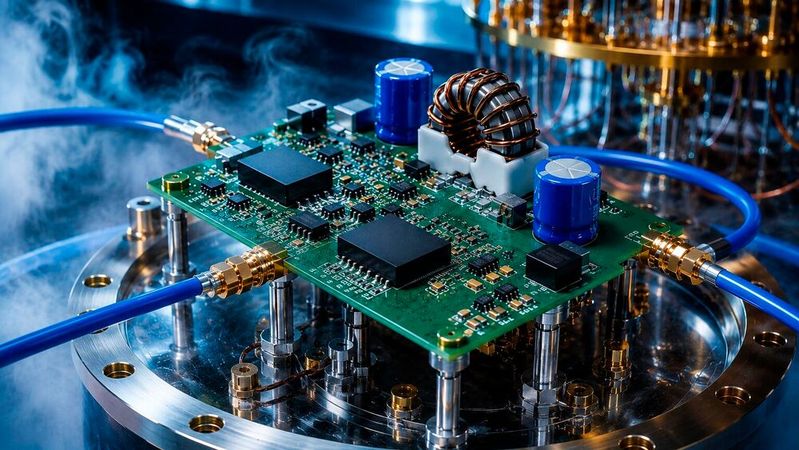
A recent study reports the demonstration of a fully functional power converter operating at 4 Kelvin (−269°C) through a collaborative research effort between Efficient Power Conversion (EPC), The University of Hong Kong, and Virginia Tech [1]. All active and passive components are within the cryogenic environment, eliminating the need for room temperature electronics that have limited previous demonstrations.
This work represents an important step in cryogenic power electronics by demonstrating a fully integrated power converter operating at 4 K. The results show that GaN technology can support reliable power conversion under ultra-low-temperature conditions.
This milestone is also the natural progression of several years of cryogenic GaN research. Previous studies showed that commercial GaN devices can be operated successfully at cryogenic temperatures and the important electrical parameters improve as the temperature decreases. However, the main focus of these studies was for individual device characterization. The latest work takes the next critical step, demonstrating that the benefits observed at the device level can be translated into a fully functional power converter operating at 4 K, bringing practical cryogenic power electronics much closer to reality. [2]
Why 4 Kelvin matters
Why is 4 Kelvin important? Cryogenic temperatures are of growing importance in a variety of advanced industries. To keep the qubits coherent, quantum computers need to be cooled to millikelvin temperatures. MRI scanners and superconducting magnets are usually operated at between 4 K and 20 K. Spacecraft in deep space are naturally cryogenic. Future superconducting propulsion systems for aircraft are expected to use low temperature electronics.
As these systems become more sophisticated it becomes imperative to locate the power electronics close to the cryogenic load to reduce transmission losses, minimize cable complexity and improve the overall system efficiency.
Until now, however, this has remained a significant challenge. Previous power converters have generally been demonstrated only down to 77 K and have typically relied on passive components or gate drivers operating at room temperature. In contrast, the reported converter operates entirely at 4 K, with both active and passive components located within the cryogenic environment [1].
That limitation creates longer interconnections, increased losses, additional thermal challenges, and greater system complexity. The reported converter addresses this limitation by integrating both the active and passive components within the cryogenic environment.
GaN technology
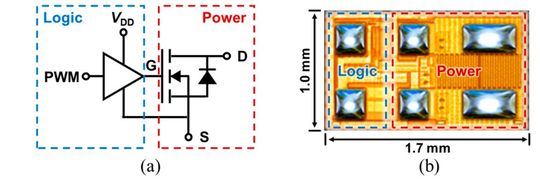
GaN Power ICs play a central role in this work. By integrating a GaN power transistor and an on-chip GaN gate driver within the same die, the design eliminates the need for external room-temperature gate drivers while maintaining reliable operation down to 4 Kelvin. This monolithic integration simplifies system implementation for cryogenic power conversion (figure 1).
GaN HEMTs do not rely on dopant-generated carriers as in the case of traditional silicon devices. Instead, the conductive path is provided by a polarization-induced two-dimensional electron gas (2DEG) at the AlGaN/GaN interface, making the technology inherently immune to carrier freeze-out at cryogenic temperatures. Earlier cryogenic studies also showed that carrier mobility increases with decreasing temperature, enabling GaN devices not only to keep working but in many cases to improve their electrical performance in environments where conventional semiconductor technologies start to fail.
The experimental characterization led to several striking observations:
- 37.5% lower RDS(on) compared with room temperature
- Reliable GaN gate-driver operation at 4 K
- Stable high-frequency switching despite threshold voltage shifts
- Fully integrated cryogenic power conversion without room-temperature electronics
- Proof that commercial GaN Power ICs operate reliably at cryogenic temperatures
These results are consistent with previous publications on cryogenic GaN, demonstrating successful operation down to 4.2 K for multiple commercial GaN technologies, including enhancement-mode, cascode and gate injection transistor (GIT) devices. While each architecture exhibited different threshold-voltage behavior as temperature decreases, all demonstrated the robustness needed for cryogenic applications, further strengthening GaN’s position as the semiconductor technology of choice for ultra-low-temperature power electronics. [3,4]
Lower on-resistance directly reduces conduction losses, while stable gate-driver operation confirms that integrated GaN power ICs can function without external room-temperature circuitry. These results demonstrate that integrated GaN Power ICs can support high-frequency power conversion under cryogenic operating conditions.
Passive components were equally critical
A cryogenic converter is more than semiconductor performance. The bottleneck is often passive components. Their electrical characteristics can change dramatically at extremely low temperature. Capacitors drift, magnetic materials can degrade and inductors become unpredictable.
Industrial polypropylene (PP) film capacitors and a custom Nb-Ti superconducting air-core inductor exhibited stable electrical performance at 4 K. Using these components, the researchers successfully demonstrated a 100 kHz boost converter operating entirely at cryogenic temperature [1].
This careful component selection provides valuable guidance for engineers designing future cryogenic power systems, where passive reliability is every bit as important as semiconductor performance.
Demonstrating a complete 4 K boost converter
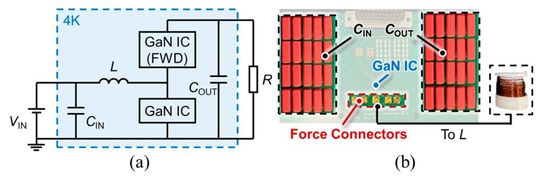
The team demonstrated the technology by implementing a 100 kHz boost converter entirely inside a cryogen-free dilution refrigerator.
The converter is powered from a 10 V input and provides output voltages close to 40 V with a maximum efficiency of 91.6 % at an output power of 7.6 W. Instead of a device characterization only, the work demonstrates a complete power conversion system operating at one of the lowest reported temperatures.
Although the prototype is intended for research rather than commercial deployment, it provides a practical demonstration of the key elements required for integrated cryogenic power conversion and offers a foundation for future developments in this area.
What this means for quantum computing and beyond
The significance of this work extends beyond the laboratory demonstration.
As quantum processors scale to thousands and eventually millions of qubits, efficient cryogenic power delivery is expected to become increasingly important. These results are consistent with previous studies demonstrating successful operation of commercial GaN technologies at temperatures down to 4 K.
Room-temperature power electronics introduce additional thermal load, wiring complexity, and energy losses within the cryostat. The demonstrated 4 K GaN-based converter provides a proof of concept for integrated cryogenic power conversion and illustrates how power electronics could be located closer to quantum processors and other superconducting systems.
Potential applications also include superconducting scientific instruments, MRI systems, particle accelerators, deep-space electronics, and future electric aircraft based on superconducting propulsion technologies.
The reported results demonstrate the feasibility of fully integrated power conversion at 4 K and provide a foundation for future research on cryogenic power architectures for quantum computing, superconducting systems, and other ultra-low-temperature applications.
References
- 1. Xin Yang, Ricardo Garcia, Shengke Zhang et al., "First Demonstration of Cryogenic Power Converter Operational at 4 Kelvin using GaN Power IC," 2026 IEEE 38th International Symposium on Power Semiconductor Devices and ICs (ISPSD 2026).
- 2. Maurizio Di Paolo Emilio, "GaN for Cryogenic Applications," Power Electronics News, January 24, 2022.
- 3. Luca Nela, Nirmana Perera, Catherine Erine, Elison Matioli, "Performance of GaN Power Devices for Cryogenic Applications Down to 4.2 K," IEEE Transactions on Power Electronics, vol. 36, no. 7, pp. 7412–7416, 2021.
- 4. Justin Colmenares, Trevor Foulkes, Christopher Barth, Thomas Modeer, Robert C. N. Pilawa-Podgurski, "Experimental Characterization of Enhancement-Mode Gallium-Nitride Power Field-Effect Transistors at Cryogenic Temperatures," 2016 IEEE Workshop on Wide Bandgap Power Devices and Applications (WiPDA 2016).
(ID:50902629)
:quality(80)/p7i.vogel.de/wcms/c9/5f/c95fd082477eb5f3ddafbb76b2f36c47/0129660958v4.jpeg "Due to the presence of superconducting material, SMES shows a high efficiency of more than 95%. (Source: © Faizer - stock.adobe.com)")
:quality(80)/p7i.vogel.de/wcms/0e/13/0e132310ca94e4d27cfc167cbcf567f9/0128546543v2.jpeg "GaN, SiC, and AI are reshaping power electronics in 2025, responding to rising energy demand and the rapid expansion of data centers, EVs, and electrification. (Source: © Dreamy Shots - stock.adobe.com)")