


:quality(80)/p7i.vogel.de/wcms/7f/4b/7f4b97757cea82c0675209630577dc22/0133974130v2.jpeg "Vox Power’s EIRE600 delivers up to 600 W in a compact 5 × 3-inch package, with forced-air or conduction cooling options for industrial and medical equipment. (Source: Vox Power)")
:quality(80)/p7i.vogel.de/wcms/55/97/5597c3436e3bc92ee7ba23b6f9d289e9/0134032539v2.jpeg "Littelfuse’s TP7.0SMD-XC automotive TVS diode series uses foldback technology to provide low clamping voltage for protecting sensitive vehicle electronics. (Bild: Littelfuse)")
:quality(80)/p7i.vogel.de/wcms/51/f8/51f84448e666230bb11a02566abd1177/0133958187v3.jpeg "Microchip’s radiation-tolerant GaN point-of-load converter supplies up to 20 A for space-based processors, FPGAs, microcontrollers and ASICs. (Source: Microchip)")
:quality(80)/p7i.vogel.de/wcms/0a/7c/0a7c08f368ae1d91f758dd18d2a32e88/0133978423v2.jpeg "EPFL researchers have demonstrated a GaN transistor that withstands nearly 4 kV, using an intrinsic polarization superjunction design to distribute electric fields more evenly. (Source: EPFL)")
:quality(80)/p7i.vogel.de/wcms/5b/94/5b94232ca4183d6fcc2dccc7394d7544/0134041114v4.jpeg "Siemens and NVIDIA are testing AI applications at Siemens’ Erlangen electronics factory, using digital twins to support production planning and prepare inspection systems before physical prototypes are available. (Bild: Siemens)")
:quality(80)/p7i.vogel.de/wcms/b4/1f/b41f2731a07b608e60eca3663e280301/0133980549v2.jpeg "Multi-year agreement with Wolfspeed supports Infineon’s conversion from 150-millimeter to 200-millimeter silicon carbide (SiC) manufacturing (Source: © Ada - stock.adobe.com)")
:quality(80)/p7i.vogel.de/wcms/e3/0a/e30a8813bcf44b16f0dceb63a0747d29/0133984094v2.jpeg "The semiconductor is only one part of the design. Higher voltage, frequency and power density also increase the demands on electronic packaging materials such as die attach, substrates, top-side interconnects and module attach. (Source: Generated by AI)")
:quality(80)/p7i.vogel.de/wcms/5d/fb/5dfba5e5f38daf2b8597b05656af29c0/0133956337v2.jpeg "Wolfspeed has received a conditional commitment for a loan of up to $1.5 billion from the U.S. Department of War to support its domestic wide-bandgap semiconductor supply chain. (Source: © AspctStyle - stock.adobe.com)")
:quality(80)/p7i.vogel.de/wcms/bf/b6/bfb6ac295759be32d567df9849b6767e/0134094495v2.jpeg "Fraunhofer ISE reports that 25 Ah pouch cells with silicon-rich anodes retained more than 83% of their initial capacity after 1,000 cycles when tested under 1,000 kPa axial pressure. (Bild: Fraunhofer ISE)")
:quality(80)/p7i.vogel.de/wcms/16/dc/16dca55e6ef80e6b5da68bc628da2dcc/0133844782v2.jpeg "This article explains virtual power plants in modern renewable-heavy grids. (Source: © M@rketVisualsStudio - stock.adobe.com)")
:quality(80)/p7i.vogel.de/wcms/e8/33/e8330aae4bea3578b98ec2c1403d367a/0133980001v2.jpeg "IRENA’s 2026 World Energy Transition Outlook identifies faster electrification powered by renewables as central to meeting future global energy needs. (Source: Irena)")
:quality(80)/p7i.vogel.de/wcms/6c/b4/6cb405f47d25035e256ae90fe3a66ee6/0134032112v2.jpeg "Sungrow’s PowerTitan 3.0 energy storage platform uses onsemi EliteSiC hybrid power modules, with the companies reporting peak inverter efficiency above 99.3%. (Bild: onsemi)")
:quality(80)/p7i.vogel.de/wcms/7b/76/7b76005554b556df2a7a3794bdf69d44/0132365246v2.jpeg "Hioki’s ST5680A DC Hipot Tester combines CE/UKCA/CSA compliance, an integrated capacitance‑based contact check and time‑series waveform recording (voltage, leakage current, insulation resistance) to standardize hipot and insulation testing across EV cell, module and pack production lines. (Source: Hioki)")
:quality(80)/p7i.vogel.de/wcms/af/7f/af7f7b0fb7f29219fc991b1130f65477/0132241333v2.jpeg "Comprehensive laboratory testing regimens—combining thermal cycling, high‑current stress, EMC, and accelerated lifetime tests—are essential to validate advanced power designs and ensure reliability in real‑world applications. (Source: PRBX)")
:quality(80)/p7i.vogel.de/wcms/16/3d/163df69363f8125315a9826e13ea4b05/0131927425v2.jpeg "Solution will maximize data center and AI factory profitability while delivering engineering-grade insights to design and operations for more efficient, sustainable, and resilient infrastructure. (Source: Cadence)")
:quality(80)/p7i.vogel.de/wcms/85/b7/85b7e90733a2bd8f21515d8f7137f2fc/0131917677v2.jpeg "Renesas acquires Pictorus to integrate its embedded application software platform with Renesas’ MCU and MPU portfolio, helping developers shorten time‑to‑market and simplify system integration. (Source: © lucadp - stock.adobe.com)")
:quality(80)/p7i.vogel.de/wcms/f8/34/f834240d434a0c265a2ccafe614c8cd7/0134032109v4.jpeg "Hard- and soft-switching techniques shape voltage and current during device transitions, influencing switching losses, EMI and thermal performance in power converters. (Bild: © Mrthullab - stock.adobe.com)")
:quality(80)/p7i.vogel.de/wcms/27/07/2707280c807689b437baed3660257404/0133626052v2.jpeg "The quantum behavior of electrons shapes semiconductor devices—and the power converters that deliver electricity to modern computing systems. (Source: © Celt Studio - stock.adobe.com)")
BASIC KNOWLEDGE Resistor color codes: Black, brown, red, orange, yellow, green, blue, violet, grey, white, gold, silver
Better Be Right Or Your Great Big Vacation Goes Wrong. Big Boys Race Our Young Girls But Violet Generally Wins. That’s not a story, but rather how electronic and electrical engineers worldwide have been using different phrases to remember resistance color codes, possibly since the 1960s or 1970s.
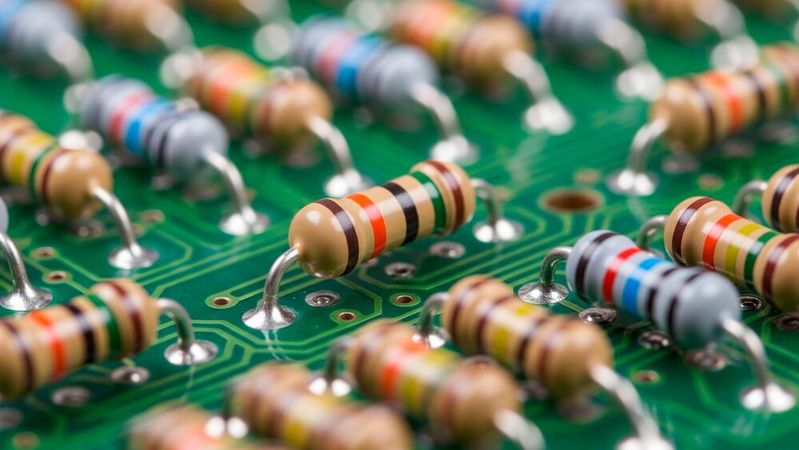
This article shares how to calculate standard resistance values using resistor color codes. The resistor color code system focuses on the color of bands on the body of a THT resistor to extract important values for practical use.
What are resistor color codes?
If we look closely at a resistor, we can notice different colored bands across its body. There can be three, four, five, or even six bands. These colored bands are present to convey meaningful information about each resistor.
The resistance color code is a visual coding system that allows engineers to calculate standard resistance values, tolerance, and temperature coefficient. IEC 60062 standardizes the resistor color code for global recognition. The resistor color code chart is shown below.
-
Color Name
Digit
Multiplier
Tolerance
Temperature Coefficient (ppm)
Black
0
100 = 1
x 1
--
250
Brown
1
101 = 10
x 10
+/- 1%
100
Red
2
102 = 100
x 100
+/- 2%
50
Orange
3
103 = 1,000
x 1 k
--
15
Yellow
4
104 = 10,000
x 10 k
--
25
Green
5
105 = 100,000
x 100 k
+/- 0.5%
20
Blue
6
106 = 1,000,000
x 1 M
+/- 0.25%
10
Violet
7
107 = 10,000,000
x 10 M
+/- 0.1%
5
Grey
8
108 = 100,000,000
x 100 M
+/-0.05%
1
White
9
109 = 1,000,000,000
x 1 G
--
--
Gold
--
10-1 = 0.1
x 0.1
+/- 5%
--
Silver
--
10-2 = 0.01
x 0.01
+/- 10%
--
--
--
–
+/- 20%
--
The resistance color code chart contains three main markings: Digits, multiplier, and tolerance. In resistors with higher bands, another marking, the temperature coefficient, is important. The general formula for the resistor color code calculator varies with the number of bands. Digits can be one, two, or even three. However, only one band can represent the multiplier, tolerance, and temperature coefficient, respectively.
Digits: Quantity used to calculate the value of resistance. The first two or three bands of the resistor represent digits. In the case of 3 and 4-band resistors, the first and second bands represent digits. In 5 and 6-band resistors, the first, second, and third bands represent digits.
Multiplier: The resistor color code calculator has only one multiplier quantity. In 3-band and 4-band resistors, the third band represents the multiplier.
In the case of 5-band and 6-band resistors, the fourth band represents the multiplier.
The multiplier falls in the order of 10. It indicates the resistor value in kilo, mega, or giga ohms.
Tolerance: The tolerance column is applicable in 4, 5, or 6 bands. In resistors with 4 and 5 bands, the last band represents the tolerance value. For 6-band resistors, the fifth band represents the tolerance value.
The tolerance value tells us the range of resistance for which it may vary. For example, a 100 Ohm resistor may have a tolerance of 10%. It means that the resistor can exhibit a value between 90 Ohms and 110 Ohms.
Temperature coefficient: The temperature coefficient does not apply to 3-band, 4-band, or 5-band resistors. In 6-band resistors, the last band represents the temperature coefficient in PPM.
How to read resistors?
Resistor color code charts enable engineers to read standard resistor values through color bands. Resistor color bands must be read from left to right. Start reading from the opposite side of the metallic band.
Let us understand the resistor color code chart with examples for each type.
3-band resistors
Resistors with three bands are found in basic, low-cost circuits. The accuracy of resistance values is low, about 20%. As a result, 3-band resistors can show large variations and unstable circuit performance. Students and hobbyists use 3-band resistors.
The resistor color code calculator formula for a 3-band resistor is as follows.
Resistance = (Digit Digit x Multiplier)
Problem statement (1): Calculate the standard resistor values from 3 bands: yellow, white, and orange.
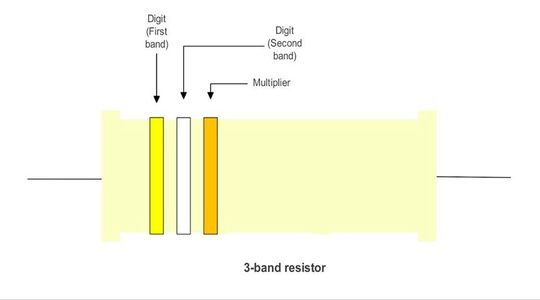
Solution: Start reading from left to right. The first two bands represent digits, and the third band represents the multiplier. Fetch the corresponding values from the resistor color code chart.
Step 1: For yellow and white, check the digit value from the resistor color code chart.
Yellow
Digit = 4
White
Digit = 9
Step 2: For orange, we check the value of the multiplier from the resistor color code chart.
Orange
Multiplier = 1000 Ohms
Step 3: According to the resistor color code chart, the absence of the fourth band indicates a tolerance of +/-20%.
Range = +/- 20%
Step 4: Putting all of these in the formula for a 3-band resistor.
Resistance: (Digit Digit x Multiplier)
(4 9 x 1000)
49000 Ohms
49 Kilo Ohms
Resistance: 49 Kilo Ohms
The resistance of a 3-band resistor with yellow, white, and orange bands is 49 kilo-ohms with a tolerance of 20%.
49k Ohms 20%
4-band resistors
Commercial-grade resistors in consumer tech and general electronics consist of 4 bands.
The resistor color code calculator formula for a 4-band resistor is as follows.
Resistance: (Digit Digit x Multiplier)
Range: Resistance +/- Tolerance
Problem statement (2): Calculate the standard resistor values from 4 bands: brown, green, red, and silver.
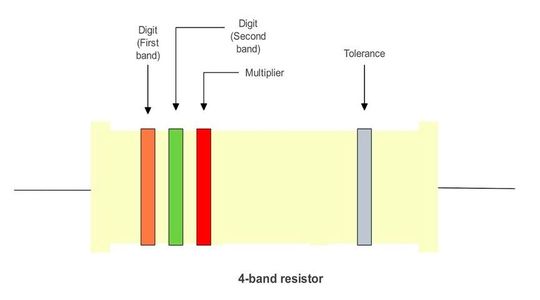
Solution: Don’t start reading from the metallic silver band. The first two bands represent digits. The third band represents the multiplier, and the fourth band represents tolerance in %. Fetch the corresponding values from the resistor color code chart.
Step 1: For brown and green, we check the value of the digit from the resistor color code chart.
Brown
Digit = 1
Green
Digit = 5
Step 2: For red, we check the value of the multiplier from the resistor color code chart.
Red
Multiplier = 100 Ohms
Step 3: As it is a 4-band resistor, we check the value of silver for tolerance from the resistor color code chart.
Silver
Tolerance = +/- 10%
Step 4: Putting all of these in the formula for a 4-band resistor.
Resistance: (Digit Digit x Multiplier)
Range: Resistance +/- Tolerance
(1 5 x 100)
1500 Ohms
Resistance: 1.5 Kilo Ohms
Range: 1.5 Kilo Ohms +/- 10%
Range: 1.35 Kilo Ohms to 1.65 Kilo Ohms
The resistance of a 4-band resistor with brown, green, red, and silver bands is 1.5 kilo-ohms with a tolerance of 10%.
1.5k Ohms 10%
5-band resistors
Industrial electronics, analog applications, and precision circuits use 5-band resistors.
The resistor color code calculator formula for a 5-band resistor is as follows.
Resistance: (Digit Digit Digit x Multiplier)
Range: Resistance +/- Tolerance
Problem statement (3): Calculate the standard resistor values from 5 bands: violet, black, yellow, orange, and gold.
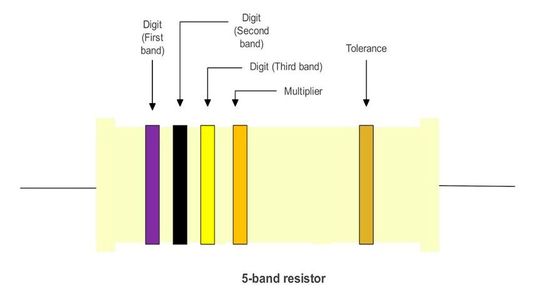
Solution: The first three bands represent digits. The fourth band represents the multiplier, and the fifth band represents tolerance in %. Fetch the corresponding values from the resistor color code chart.
Step 1: Check the value of the digit from the resistor color code chart for the first three bands, violet, black, and yellow.
Violet
Digit = 7
Black
Digit = 0
Yellow
Digit = 4
Step 2: Check the value of the multiplier from the resistor color code chart for orange.
Orange
Multiplier = 1000 Ohms
Step 3: As it is a 5-band resistor, the last band represents tolerance. Check the value of gold.
Gold
Tolerance = +/- 5%
Step 4: Putting all of these in the formula for a 5-band resistor.
Resistance: (Digit Digit Digit x Multiplier)
Range: Resistance +/- Tolerance
(7 0 4 x 1000)
704 Kilo Ohms
Resistance: 704 Kilo Ohms
Range: 704 Kilo Ohms +/- 5%
Range: 668.8 Kilo Ohms to 739.2 Kilo Ohms
The resistance of a 5-band resistor with violet, black, yellow, orange, and gold bands is 704 kilo-ohms with a tolerance of 5%.
704k Ohms 5%
6-band resistors
Space electronics, aerospace applications, medical equipment, and advanced electronics use 6-band resistors. The presence of the sixth band indicates a temperature coefficient, which is an important factor to assess environmental stability.
The resistor color code calculator formula for a 6-band resistor is as follows.
Resistance: (Digit Digit Digit x Multiplier)
Range: Resistance +/- Tolerance
Temperature coefficient: ppm
Problem statement (4): Calculate the standard resistor values from 6 bands: blue, grey, white, green, silver, and red.
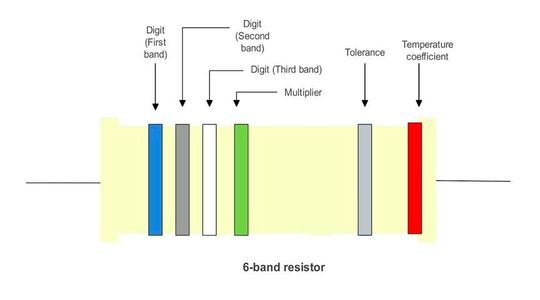
Solution: The first three bands represent digits. The fourth band represents the multiplier, the fifth band represents tolerance in %, and the sixth band represents the temperature coefficient. Fetch the corresponding values from the resistor color code chart.
Step 1: Check the value of the digit from the resistor color code chart for the first three bands, blue, grey, and white.
Blue
Digit = 6
Grey
Digit = 8
White
Digit = 9
Step 2: The fourth band - green, indicates the multiplier. Check the value of the multiplier.
Green
Multiplier = 100,000 Ohms
Step 3: The fifth band represents tolerance. Check the tolerance of silver from the resistor color code chart.
Silver
Tolerance = +/- 10%
Step 4: The last band represents the temperature coefficient. Check the value of the red band.
Red
Temperature coefficient = 50 ppm
Step 5: Putting all of these in the formula for a 6-band resistor.
Resistance: (Digit Digit Digit x Multiplier)
Range: Resistance +/- Tolerance
Temperature coefficient: ppm
(6 8 9 x 100,000)
68,900,000 Ohms
68.9 Mega Ohms
Resistance: 68.9 Mega Ohms
Range: 68.9 Mega Ohms +/- 10%
Range: 62.01 Mega Ohms to 75.79 Mega Ohms
Temperature coefficient: 50 ppm
The resistance of a 6-band resistor with blue, grey, white, green, silver, and red bands is 68.9 mega-ohms with a tolerance of 10% and a temperature coefficient of 50 ppm.
68.9M Ohms 10% 50ppm
Online resistor color code calculator
Calculation of resistance from the resistor color code chart can be complicated. Many commercial websites feature the resistor color code calculator, such as Digikey, Resistor Calculator, and All About Circuits.
Steps to use online resistor color code calculators.
Step 1: Choose from the number of bands: 3 Band, 4 Band, 5 Band, and 6 Band.
Step 2: Choose colors.
Step 3: Press calculate.
The online resistor color code calculator will display standard resistor values along with the resistor diagram.
References
- https://www.digikey.com/en/articles/big-boys-race-young-girls-violet-wins-resistors-color-codes
- https://www.digikey.in/en/resources/conversion-calculators/conversion-calculator-resistor-color-code
- https://www.calculator.net/resistor-calculator.html
(ID:50829846)
:quality(80)/p7i.vogel.de/wcms/ef/1c/ef1c6a123496f3c00da6ea8b85385de9/0130926273v2.jpeg "Resistors are among the three fundamental electronic components, along with inductors and capacitors. (Source: © Kan - stock.adobe.com)")
:quality(80)/p7i.vogel.de/wcms/3d/d0/3dd068b74bc92e76f00a3051fc28558b/0131309601v2.jpeg "This article differentiates between direct and indirect bandgap semiconductors. (Source: © cgrtart - stock.adobe.com)")