


:quality(80)/p7i.vogel.de/wcms/10/fc/10fcb98e44d61826e641bc8d3f20f616/0133193677v2.jpeg "The new AEVA and AEVB Series aluminum electrolytic capacitors are engineered for harsh industrial environments, delivering high-CV, long-lifetime performance in compact, surface-mount packages that reliably withstand up to 30g acceleration and operating temperatures extending from -55° to +125°C. (Source: Kyocera)")
:quality(80)/p7i.vogel.de/wcms/f7/42/f74208db9f5f87dca384b38b71c4782e/0133196365v2.jpeg "YAGEO’s EC Flat‑Series temperature sensors combine fast, accurate measurement with resistance to vibration, shock, moisture and dust for demanding automotive and industrial applications. (Source: Yageo)")
:quality(80)/p7i.vogel.de/wcms/b2/82/b28212428745dd8a4634ad4f4912012f/0132902689v2.jpeg "New 15 V, 25 V and 40 V eGaN FETs deliver ultra-low on-resistance, high current capability, and exceptional radiation immunity for high-density space power conversion (Source: EPC Space)")
:quality(80)/p7i.vogel.de/wcms/7b/4f/7b4f433302c490cac22eee9c12499e65/0132780211v2.jpeg "Littelfuse introduces the TPSMD‑FL series of high‑power surface‑mount TVS diodes, designed to simplify ISO 7637 load‑dump protection and safeguard automotive electronics against severe voltage transients. (Source: Littlefuse)")
:quality(80)/p7i.vogel.de/wcms/78/38/783841efab284c1b4453777e7ebea26d/0133190419v2.jpeg "Diodes has completed its acquisition of Elevate Semiconductor, expanding its analog and mixed-signal portfolio and strengthening its presence in the high-growth automated test equipment market. (Source: © peopleimages.com - stock.adobe.com)")
:quality(80)/p7i.vogel.de/wcms/1f/79/1f79d69530465de26a832c742fc60319/0133117717v2.jpeg "With 30,000 sqm of exhibition space, 20,157 trade visitors, 271 exhibitors, and 131 expert presentations as part of the conference program, the event sent a strong message about the industry's innovative strength and dynamism. (Source: Mesago Messe Frankfurt GmbH)")
:quality(80)/p7i.vogel.de/wcms/43/4d/434db2291567e847e54332004942a225/0132958267v2.jpeg "GlobalWafers has joined the SEMI Taiwan Materials Alliance, with CEO Doris Hsu serving as co‑chair, to advance critical materials technologies, accelerate collaborative innovation and strengthen global semiconductor supply chain resilience. (Source: © jiwon - stock.adobe.com)")
:quality(80)/p7i.vogel.de/wcms/6f/72/6f72f93d1e4c5a248a97dd3b8f32a336/0132997898v2.jpeg "Infineon plans to acquire C2i Semiconductors to combine software‑defined multiphase control and smart power stages with its broad power‑semiconductor portfolio for intelligent, scalable AI data‑center power delivery. (Source: © Grispb - stock.adobe.com)")
:quality(80)/p7i.vogel.de/wcms/87/97/879728679e7010f81e53a86923cde74c/0133218625v2.jpeg "Conceptual illustration of polar wurtzite niobium aluminum nitride (NbAlN), a transition-metal-containing nitride semiconductor that preserves the crystal structure and polarity of GaN. (Source: Associate Professor Atsushi Kobayashi from Tokyo University of Science, Japan)")
:quality(80)/p7i.vogel.de/wcms/ac/31/ac31c9478d80894d725d02883ae7ed5d/0133176534v2.jpeg "Average models allow power designers to simulate DC‑DC converters and three‑phase PFC circuits quickly, analyse small‑signal behaviour and evaluate loop stability without modelling every switching event. (Source: © AI - stock.adobe.com)")
:quality(80)/p7i.vogel.de/wcms/96/80/9680b468d7f682c8b6c15b07300afbb0/0133177854v2.jpeg "Grid-forming inverters are also known as grid-forming resources and grid-forming IBR. This article explains grid-forming inverters in detail. (Bild: © only_kim - stock.adobe.com)")
:quality(80)/p7i.vogel.de/wcms/57/c6/57c6fa81922a9849a917bdfed82eddf7/0133052494v2.jpeg "Rising demand for high-end materials shifts production toward higher-margin products, reducing output of standard loss materials. (Source: NCAB)")
:quality(80)/p7i.vogel.de/wcms/7b/76/7b76005554b556df2a7a3794bdf69d44/0132365246v2.jpeg "Hioki’s ST5680A DC Hipot Tester combines CE/UKCA/CSA compliance, an integrated capacitance‑based contact check and time‑series waveform recording (voltage, leakage current, insulation resistance) to standardize hipot and insulation testing across EV cell, module and pack production lines. (Source: Hioki)")
:quality(80)/p7i.vogel.de/wcms/af/7f/af7f7b0fb7f29219fc991b1130f65477/0132241333v2.jpeg "Comprehensive laboratory testing regimens—combining thermal cycling, high‑current stress, EMC, and accelerated lifetime tests—are essential to validate advanced power designs and ensure reliability in real‑world applications. (Source: PRBX)")
:quality(80)/p7i.vogel.de/wcms/16/3d/163df69363f8125315a9826e13ea4b05/0131927425v2.jpeg "Solution will maximize data center and AI factory profitability while delivering engineering-grade insights to design and operations for more efficient, sustainable, and resilient infrastructure. (Source: Cadence)")
:quality(80)/p7i.vogel.de/wcms/85/b7/85b7e90733a2bd8f21515d8f7137f2fc/0131917677v2.jpeg "Renesas acquires Pictorus to integrate its embedded application software platform with Renesas’ MCU and MPU portfolio, helping developers shorten time‑to‑market and simplify system integration. (Source: © lucadp - stock.adobe.com)")
NEGATIVE RESISTANCE Is there a negative resistor?
Related Vendors
:fill(fff,0)/p7i.vogel.de/companies/69/a8/69a8093b1b5e1/hvp-png.png "hvp-png (HVP-Logo)")
:fill(fff,0)/p7i.vogel.de/companies/5f/71/5f71d5f92a5f6/2000px-rogers-corporation-logo-svg.png "2000px-Rogers_Corporation_Logo.svg.png (rogers germany)")
:fill(fff,0)/p7i.vogel.de/companies/68/2c/682c3e2e9a195/logotype-rvb.jpeg "logotype-rvb (MERSEN France)")
Is there a negative resistor? Yes and No. There is no standalone component as a negative resistor. The “negative resistance” effect is a paradox that exists! It means that a voltage drop could paradoxically boost circuit current, instead of decreasing it.
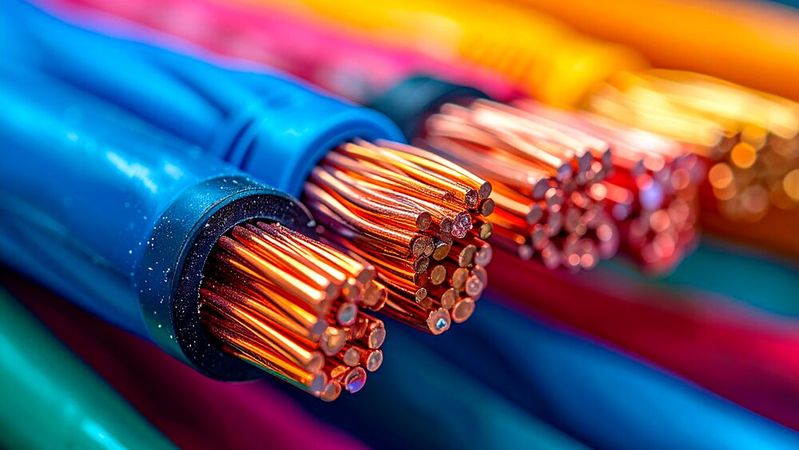
Historical devices, such as gas discharge lamps, exhibit the strange physics of negative resistance. Some engineers suggest using the term “negristor” to describe devices that exhibit negative resistance.
Is there a negative resistor?
The negative resistance effect has been verified in both real devices and simulated circuits. The negative resistance effect is a local nonlinear behavior that occurs when increasing the voltage causes a decrease in the circuit current. The opposite is also true. Decreasing the voltage causes the circuit current to increase.
Simply put, voltage and current must follow an inverse relationship for negative resistance to exist. The traditional physics of voltage and current relationships is quite friendly. According to Ohm’s law, voltages and currents remain directly proportional. In practical terms, it means that if the voltage in a circuit increases, the current also increases.
Ohmic devices follow a linear slope. When discussing negative resistance, the common resistance becomes "positive resistance". In broader terms, positive resistance is known as static resistance.
According to Ohm’s law,
V = IR
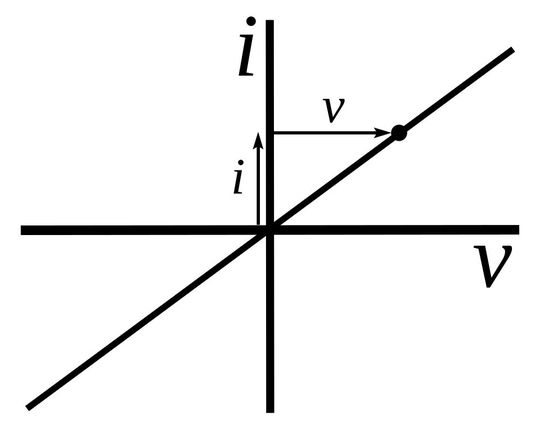
The simple equation represents the proportional relationship between voltage and current. It’s where this gets tricky. In practical applications, the slope is not always linear. It keeps on changing instantaneously. To calculate instantaneous values, we must differentiate the static resistance equation with respect to the current.
The value dv/di is known as differential resistance. In ohmic devices, positive differential resistance suggests that the slope is increasing. The positive slope indicates normal resistance operation.
In non-linear devices, the slope is not straight. It can bend at some point in time and then, perhaps, follow Ohm's law later. The concept of negative resistance appears briefly when the slope of dv/di is negative. It’s a relatively small region of operation.
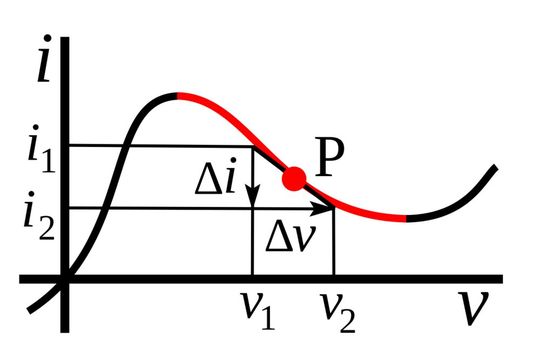
The answer to the question of is there a negative resistor lies in the equation, which proves that negative resistance is a part of positive/normal resistance. It’s just an unstable region of the I-V characteristics where the slope is negative.
:quality(80)/p7i.vogel.de/wcms/9e/b0/9eb01567f828f28e7922897edc690be2/0130454119v2.jpeg "Voltage drop is a result of current flowing through a resistor. (Source: © Viktor - stock.adobe.com)")
RESISTOR CALCULATION
How to calculate voltage drop across a resistor?
Negative resistance applications
Is there a negative resistor? Negative resistance exists due to device physics, but can also be engineered.
High-frequency devices: Many semiconductor devices, such as Gunn diodes, tunnel diodes, thyratron tubes, magnetron tubes, IMPATT and TRIPATT RF diodes, exhibit negative resistance.
These devices “naturally” exhibit negative slopes in I-V curves. They function with the help of an external power supply, hence they’re called passive negative differential resistance devices.
Oscillations: Negative resistance-based devices are applicable in LC tanks, RF oscillators, signal generators, and various microwave devices. Such devices cancel losses and sustain oscillations.
Active filters: Frequency-dependent negative resistors (FDNR) can replace inductors and capacitors in filter circuits by offering greater phase shift and faster roll-off. FDNRs can help design compact filters using less bulky op-amps.
Amplification: Negative resistance can enhance and amplify small signals. A subreddit thread on negative resistance reports that negative resistance can provide gain.
Thyristor operations: Active negative resistance devices are manufactured to create the negative resistance effect. Examples include various thyristors.
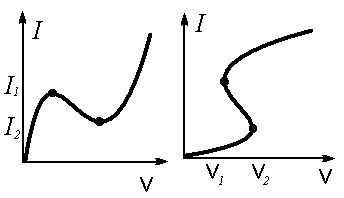
The left graph shows voltage-controlled devices. It resembles the shape of the alphabet “N”, hence it’s known as N-type. The right graph shows current controlled devices.
The right graph is shaped like the alphabet “S”, hence known as S-type. Such characteristics are visible in oscillators and active filters.
:quality(80)/p7i.vogel.de/wcms/ef/1c/ef1c6a123496f3c00da6ea8b85385de9/0130926273v2.jpeg "Resistors are among the three fundamental electronic components, along with inductors and capacitors. (Source: © Kan - stock.adobe.com)")
BASIC KNOWLEDGE
The current “speed breaker”
Conclusion
Is there a negative resistor by clear definition? Negative resistance is not a device but refers to the point in the I-V characteristic curve where the slope is negative. It’s a brief period observed in many high-frequency semiconductor devices.
Normal resistor operation: Push more voltage — Get more current. Power is dissipated as heat.
Negative resistance operation( Negristor): Push more voltage — Current fights back. Such devices produce or source the power. They can also be made to consume more power overall.
Negative differential resistance can give rise to numerous applications, such as oscillation, amplification, and compact filter design.
References
- https://www.sciencedirect.com/topics/chemistry/negative-resistance
- https://www.reddit.com/r/AskElectronics/comments/kbl3j4/what_actually_is_negative_resistance/
- https://electronics.stackexchange.com/questions/86612/what-is-negative-resistance
(ID:50829728)
:quality(80)/p7i.vogel.de/wcms/5c/f5/5cf53b6db2706b86ac6eb5c407704d27/0131699647v2.jpeg "This article explains inductors in electrical and electronics engineering. (Source: © Iurii - stock.adobe.com)")
:quality(80)/p7i.vogel.de/wcms/ef/1c/ef1c6a123496f3c00da6ea8b85385de9/0130926273v2.jpeg "Resistors are among the three fundamental electronic components, along with inductors and capacitors. (Source: © Kan - stock.adobe.com)")