


:quality(80)/p7i.vogel.de/wcms/c4/a7/c4a7243caa7c26af5fe5108f7894050a/0133626683v2.jpeg "Wolfspeed’s new premium 200 mm SiC substrates are designed to provide more consistent starting material for power semiconductor manufacturing. (Source: © Marina - stock.adobe.com)")
:quality(80)/p7i.vogel.de/wcms/91/8b/918b533161e7327075370338d7af97af/0133589801v2.jpeg "Acbel will present scalable DC charging power modules and an 11kW passively cooled 2-in-1 on-board power solution at New Mobility Congress 2026 in Katowice, covering both charging infrastructure and vehicle applications. (Source: Acbel)")
:quality(80)/p7i.vogel.de/wcms/f4/4b/f44b9261224e3ca11e192af6efd69f77/0133585612v2.jpeg "Diodes Incorporated introduces field-plated super barrier rectifiers designed to improve efficiency and reliability in automotive power circuits. (symbolic image) (Source: © Natalia - stock.adobe.com)")
:quality(80)/p7i.vogel.de/wcms/ba/85/ba857c3717c65949ba410b1be3feb221/0133616146v2.jpeg "Two TESVOLT FORTON Battery Storage Systems Shave Peak Loads at the Pschorr-Bräurosl Festival Tent at Oktoberfest. (Source: TESVOLT AG)")
:quality(80)/p7i.vogel.de/wcms/fd/2c/fd2c2388e7985cd4c75cff39f07f6361/0133676222v2.jpeg "Greenconn expands its connector portfolio with the compact WF28 wire-to-board series and new 25 mm and 30 mm stacking-height options for its GC01 floating connectors. (Source: © Greenconn)")
:quality(80)/p7i.vogel.de/wcms/69/06/6906b5f22bfbb3f8b874ba9e459c7d26/0133675448v2.jpeg "New backend manufacturing hub strengthens and further diversifies Infineon's global production network. (Source: © Apriew - stock.adobe.com)")
:quality(80)/p7i.vogel.de/wcms/b0/02/b002b3cb7aea4dfdf92a46bb18cf0283/0133588910v2.jpeg "Mitutoyo expands its semiconductor metrology activities with a new competence center in Dresden. (Source: © ryanking999 - stock.adobe.com)")
:quality(80)/p7i.vogel.de/wcms/5e/f4/5ef48dd7abee0653f5336af22540f3fa/0133369680v2.jpeg "SEMI Europe has joined the ReSiLient consortium to strengthen Europe’s silicon and silicon carbide raw-material value chains and develop more sustainable, resilient supply routes for semiconductor and power-device manufacturing. (Source: © Suriyo - stock.adobe.com)")
:quality(80)/p7i.vogel.de/wcms/ee/de/eedef7055c094757eb208a9d181e85dc/0133371000v2.jpeg "Resonac has developed 300 mm SiC single-crystal substrates, advancing larger-diameter wafer technology for next-generation power electronics and other high-performance semiconductor applications. (Source: © Resonac)")
:quality(80)/p7i.vogel.de/wcms/85/fb/85fb707b75a2f58a5b5809fba66e8713/0133372184v2.jpeg "INFAC integrates an isolated and regulated 800 V-to-48 V DC‑DC converter into the EV battery pack, using the existing cooling system while reducing high-voltage cabling, external components and packaging requirements. (symbolic image) (Source: © NAMONA_Design - stock.adobe.com)")
:quality(80)/p7i.vogel.de/wcms/a4/29/a429b944eb0a69e268015f8300ba8940/0133311989v2.jpeg "Hitachi Energy and Daikin are establishing a German supply of C4‑FN, a specialty insulating gas used in SF₆‑free high‑voltage equipment for more sustainable power grids. (Source: © Ahmed - stock.adobe.com)")
:quality(80)/p7i.vogel.de/wcms/d5/32/d5326e4b05d5cd759e88062f1c0b097a/0133344193v2.jpeg "Co-packaged optics is the latest innovation in data centers where optical modules on silicon chips can assist in scaling megawatt AI infrastructure. (Source: © Rachakrit - stock.adobe.com)")
:quality(80)/p7i.vogel.de/wcms/7b/76/7b76005554b556df2a7a3794bdf69d44/0132365246v2.jpeg "Hioki’s ST5680A DC Hipot Tester combines CE/UKCA/CSA compliance, an integrated capacitance‑based contact check and time‑series waveform recording (voltage, leakage current, insulation resistance) to standardize hipot and insulation testing across EV cell, module and pack production lines. (Source: Hioki)")
:quality(80)/p7i.vogel.de/wcms/af/7f/af7f7b0fb7f29219fc991b1130f65477/0132241333v2.jpeg "Comprehensive laboratory testing regimens—combining thermal cycling, high‑current stress, EMC, and accelerated lifetime tests—are essential to validate advanced power designs and ensure reliability in real‑world applications. (Source: PRBX)")
:quality(80)/p7i.vogel.de/wcms/16/3d/163df69363f8125315a9826e13ea4b05/0131927425v2.jpeg "Solution will maximize data center and AI factory profitability while delivering engineering-grade insights to design and operations for more efficient, sustainable, and resilient infrastructure. (Source: Cadence)")
:quality(80)/p7i.vogel.de/wcms/85/b7/85b7e90733a2bd8f21515d8f7137f2fc/0131917677v2.jpeg "Renesas acquires Pictorus to integrate its embedded application software platform with Renesas’ MCU and MPU portfolio, helping developers shorten time‑to‑market and simplify system integration. (Source: © lucadp - stock.adobe.com)")
:quality(80)/thumbor.vogel.de/kNr3yG3hu6lnpJYlKwKfoOwkLA4=/500x500/p7i.vogel.de/wcms/69/79/6979e4b5bc84c/maurizio-dpe.jpeg "Dr Maurizio Di Paolo Emilio")
GAN POWER GaN-based motor drive architecture for robotics and UAV applications
Related Vendors
:fill(fff,0)/p7i.vogel.de/companies/5f/71/5f71d5f92a5f6/2000px-rogers-corporation-logo-svg.png "2000px-Rogers_Corporation_Logo.svg.png (rogers germany)")
:fill(fff,0)/p7i.vogel.de/companies/68/2c/682c3e2e9a195/logotype-rvb.jpeg "logotype-rvb (MERSEN France)")
The proliferation of small electric motors in robotics and unmanned aerial systems is creating demand for highly integrated and efficient motor-drive electronics. In the context of humanoid robot joints, robotic hands, and lightweight drone propulsion systems, we require power converters that have a high current density in very limited mechanical space.

The motors are usually characterized by low phase inductance and low winding resistance, so that the inverter switching performance is particularly important. Higher switching frequencies can enhance current regulation bandwidth and dynamic response and improve overall efficiency while reducing the size of passive components under these operating conditions.
For these applications, GaN power devices are considered more and more, due to their capability of fast switching and reduced switching losses as compared to conventional silicon MOSFETs. GaN technology allows PWM operation way above 100 kHz enabling higher power density and more compact inverter architectures.
At the same time, the trend toward miniaturization is pushing the integration of semiconductors to the limit. Reducing the number of external components and simplifying PCB layout are becoming critical design objectives in compact motion systems. The monolithic integration of power devices, gate drivers, and auxiliary circuitry can greatly facilitate the system and improve the overall electrical performance.
The experimental system described in this article is based on the EPC91132 reference design developed by Efficient Power Conversion (EPC) and employs the EPC33110 integrated GaN power module.
:quality(80)/p7i.vogel.de/wcms/d8/18/d8181873ad07a9b0f77c8ef2d82441cb/0129407783v2.jpeg "Advances in low-voltage GaN devices are enabling higher efficiency and power density in applications traditionally served by silicon MOSFETs. (Source: © roei - stock.adobe.com)")
EXPERT ARTICLE
Evaluating GaN as a low-voltage alternative to Silicon MOSFETs
Compact three-phase inverter architecture
To explore the advantages of highly integrated GaN technology in miniature motor-drive applications, a compact three-phase inverter platform was developed. The system is designed to operate in a DC bus voltage range from 10 V to 60 V and integrates the main functions needed for closed-loop motor control.
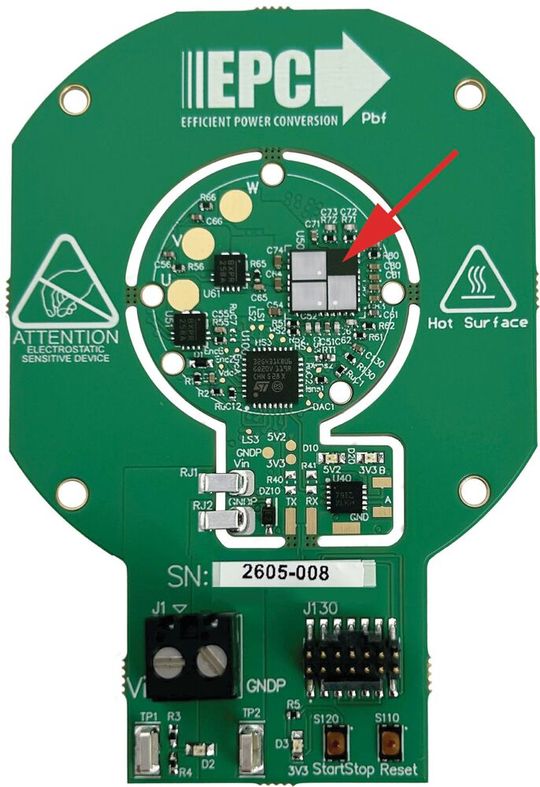
The inverter has integrated control electronics, auxiliary regulated power supplies, current sensing circuitry with overcurrent protection, monitoring of the DC bus voltage, and a magnetic encoder interface for rotor position feedback. A dedicated serial interface allows communication and real-time operation.
The platform mechanical structure was optimized to support multiple motor formats with the same core power stage. The inverter can be adapted for robotic joint actuators, or for compact drone propulsion systems, by changing the external PCB structure without changing the main electronic architecture (Figure 1).
Integrated GaN power module
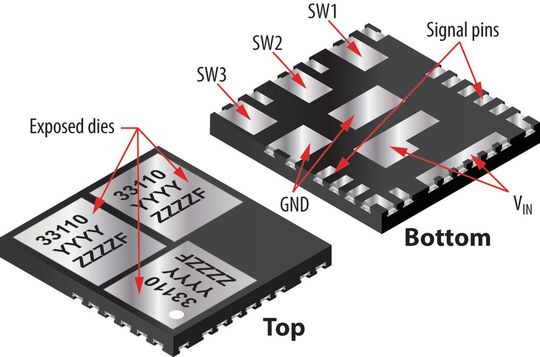
The power stage is implemented using a highly integrated three-phase GaN module based on three monolithic half-bridges in a compact QFN package. The GaN power transistors, gate drivers, bootstrap circuits and level-shifting circuitry are all integrated into each half-bridge (Figure 2).
The lateral device structure of GaN technology allows the integration of logic and power devices on the same substrate, thus facilitating implementation of monolithic half-bridge architectures. The integration of the gate-driving functions in the module reduces PCB parasitics, layout complexity and the number of required external components.
The compact packaging also helps to achieve a high power density while allowing effective thermal dissipation through exposed top side cooling surfaces.
The module supports operation up to 80 V from a single 5 V supply and is compatible with both 3.3 V and 5 V logic interfaces. The combination of high-frequency operation, compact dimensions, and integrated gate-driving functionality makes the platform suitable for miniature motion-control systems such as humanoid robot joints and lightweight drone propulsion systems.
:quality(80)/p7i.vogel.de/wcms/dc/38/dc389203f12a227b5b2ef526d94430dd/0131680875v2.jpeg "Cambridge GaN Devices introduces a 650 V ICeGaN device for automotive traction inverters — enabling smaller, lighter, and more efficient inverters to help increase EV range. (Source: © Curie - stock.adobe.com)")
AUTOMOTIVE GAN
New 650 V ICeGaN device for automotive applications helps increase EV range
Evaluation in robotic joint applications
The inverter platform was tested in a robotic joint motor application with a 48-VDC bus. Experimental characterization was carried out on a dynamometric test bench, under continuous load conditions up to 11 ARMS phase current.
The inverter was operated at PWM frequencies of 60, 80, and 100 kHz with a dead time of 20 ns. In steady-state conditions, continuous operation at 11 ARSM resulted in a temperature increase of approximately 70 °C without the use of forced-air cooling.
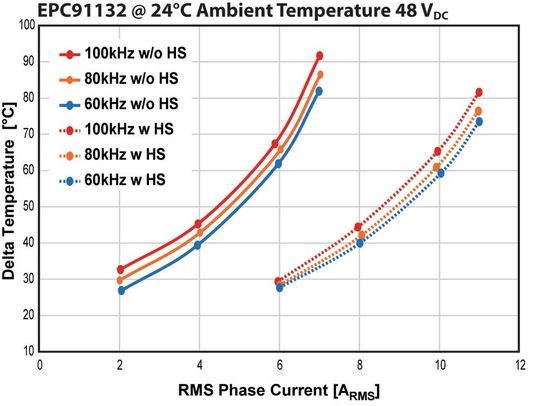
Thermal measurements were performed with and without the motor enclosure acting as a passive heatsink for the inverter assembly. After about ten minutes of operation the system had reached equilibrium. The motor was tested in the low rotational speed, high torque conditions typical of robotic joint applications.
The temperature was monitored using thermocouples located above the power module and through infrared thermal imaging measurements.
While in the case of humanoid robot joints, natural convection cooling is the only option, in drone applications, the propellers generate strong airflow, providing thrust and effective cooling for the entire system, thereby increasing the inverter's current capability.
Evaluation in drone propulsion applications
Similarly the same inverter architecture was tested in a drone propulsion configuration using a compact outrunner motor coupled to a 12 inch propeller and powered from a 24 V DC source. The motor was tested in a speed range of approximately 1000 RPM to 3400 RPM with the inverter running at a continuous PWM frequency of 100 kHz and a dead time of 20 ns.
For each speed, the device temperature was measured by attaching a thermocouple to the top of the EPC33110 module and waiting approximately 10 minutes until thermal equilibrium was reached. The average input power required at each speed was measured (Figure 4).
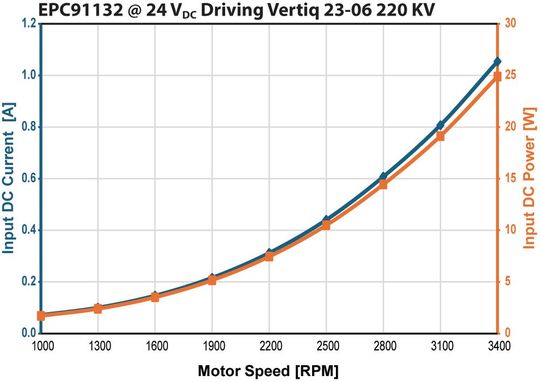
The drone motor was driven at a switching frequency of 100 kHz with a 20 ns dead time.
In this configuration the airflow produced by the propellers was effective to cool the motor and inverter assembly. Experimental measurements indicated a small increase in temperature above ambient during continuous operation. The inverter behavior under realistic propulsion loading conditions was characterized by measuring the input current, input power and propeller torque over the range of operation.
:quality(80)/p7i.vogel.de/wcms/b9/26/b9265548cf4e6fe7e45789b711d01f8f/0130098748v2.jpeg "Gallium nitride (GaN) power devices are increasingly challenging silicon MOSFETs in low-voltage power conversion by enabling higher efficiency and switching performance. (Source: AI-generated (OpenAI DALL·E))")
GAN VS. MOSFET
How GaN is killing the MOSFET
EMI reduction and guidelines for PCB design
High dv/dt and di/dt transitions in high-speed GaN switching can generate ringing and radiated emissions making it difficult to meet the electromagnetic interference (EMI) requirements especially in small motor drives for humanoid robots and drones. Mitigation begins with the reduction of parasitic inductance at package and PCB level.
Integrated GaN power stages integrate power devices and gate drivers into low-inductance packages to reduce parasitics. At the PCB level, the critical commutation loops should be routed as short, wide copper paths with tightly coupled return currents on adjacent layers. This reduces loop inductance, stored transient energy and the effective antenna area that contributes to radiated EMI.
High frequency decoupling capacitors have to be placed very close to the switching half bridges to suppress voltage overshoot and ringing. GaN devices are also free from reverse-recovery charge (QRR) and do not have the high energy transient oscillations usually associated with the commutation of silicon MOSFETs.
Conclusion
The growing use of compact motors in robotics and UAV systems is pushing the transition towards highly integrated GaN-based motor-drive architectures. Experimental tests in robotic joints and drone propulsion platforms show that the compact GaN inverters are capable of withstanding demanding operating conditions with acceptable thermal performance and manageable EMI behaviour, suitable for next generation robotic and aerial mobility applications.
References
- [1] GaN Power Devices for Efficient Power Conversion, Fourth Edition – by Alex Lidow, Michael de Rooij, John Glaser, Alejandro Pozo Arribas, Shengke Zhang, Marco Palma, David Reusch, Johan Strydom.
- [2] Three-Phase Module Based on Monolithic GaN Half-Bridge ICs, in Bodo’s Power Systems December 2025, pages 24-26, by Federico Unnia, Marco Palma.
(ID:50878234)
:quality(80)/p7i.vogel.de/wcms/2d/76/2d76891b5b6e80f1ffdb559371890554/0129698372v2.jpeg "Integrated GaN power stage with onboard control, sensing, and communication, delivering up to 20 ARMS in a 32 mm circular design for space-constrained robotic applications. (symbolic image) (Source: © aubriella - stock.adobe.com)")
:quality(80)/p7i.vogel.de/wcms/ff/a7/ffa79e39677b246aeb7c53f361fb5230/0127807677v2.jpeg "Symbolic picture: Driving the future of robotics with cutting-edge GaN power technology. (Source: © Svetlana - stock.adobe.com)")