


:quality(80)/p7i.vogel.de/wcms/99/dd/99dd64ae87c0855129bd405f61d81f81/0133290217v2.jpeg "Microchip’s new 1.2 V SY757xx clock buffers connect modern low-voltage SoCs, FPGAs and AI accelerators with higher-voltage clock components, supporting frequencies up to 250 MHz and additive jitter as low as 26 fs. (Source: Microchip)")
:quality(80)/p7i.vogel.de/wcms/83/d0/83d0b8ea52378c77f98358e29ceccfc0/0133339307v2.jpeg "Capacitors are a critical yet often overlooked component in AI data center power supplies, buffering energy and stabilizing voltage as racks scale toward the megawatt range. (Source: © Parilov - stock.adobe.com)")
:quality(80)/p7i.vogel.de/wcms/10/fc/10fcb98e44d61826e641bc8d3f20f616/0133193677v2.jpeg "The new AEVA and AEVB Series aluminum electrolytic capacitors are engineered for harsh industrial environments, delivering high-CV, long-lifetime performance in compact, surface-mount packages that reliably withstand up to 30g acceleration and operating temperatures extending from -55° to +125°C. (Source: Kyocera)")
:quality(80)/p7i.vogel.de/wcms/f7/42/f74208db9f5f87dca384b38b71c4782e/0133196365v2.jpeg "YAGEO’s EC Flat‑Series temperature sensors combine fast, accurate measurement with resistance to vibration, shock, moisture and dust for demanding automotive and industrial applications. (Source: Yageo)")
:quality(80)/p7i.vogel.de/wcms/57/b6/57b6d33cb929fa4408ad56803ed5f0bc/0133311998v2.jpeg "Elmos and SK keyfoundry are expanding their collaboration on 130 nm technology and have agreed on long-term wafer capacity through 2037 to support reliable automotive semiconductor production. (Source: © remake - stock.adobe.com)")
:quality(80)/p7i.vogel.de/wcms/b4/0a/b40a1de3c8fa631b2aff74ec436c43db/0133314066v2.jpeg "ZF Aftermarket expands its EV service portfolio with new repair kits and solutions for e‑motors, inverters, hybrid modules, mechatronics and electric drive units. (Source: ZF Aftermarket)")
:quality(80)/p7i.vogel.de/wcms/48/e1/48e107b92f976652532facf5ca1e0855/0133290826v2.jpeg "Infineon and SolarEdge are extending their collaboration to develop solid-state protection solutions for 800 VDC AI data centers, aiming to improve fault response, system reliability and power density. (Source: © Grispb - stock.adobe.com)")
:quality(80)/p7i.vogel.de/wcms/99/84/9984f5888ecc71c249f65cea3f0658d1/0133069650v2.jpeg "Yokogawa’s integrated measurement setup helps Vertiv analyse AI-driven pulsed loads, combining power, waveform and thermal data to validate UPS performance and input power smoothing. (Source: YOKOGAWA)")
:quality(80)/p7i.vogel.de/wcms/a4/29/a429b944eb0a69e268015f8300ba8940/0133311989v2.jpeg "Hitachi Energy and Daikin are establishing a German supply of C4‑FN, a specialty insulating gas used in SF₆‑free high‑voltage equipment for more sustainable power grids. (Source: © Ahmed - stock.adobe.com)")
:quality(80)/p7i.vogel.de/wcms/d5/32/d5326e4b05d5cd759e88062f1c0b097a/0133344193v2.jpeg "Co-packaged optics is the latest innovation in data centers where optical modules on silicon chips can assist in scaling megawatt AI infrastructure. (Source: © Rachakrit - stock.adobe.com)")
:quality(80)/p7i.vogel.de/wcms/76/a9/76a9333bc7c6abbf7e29d1b910edb5e2/0133335959v2.jpeg "This article explains PMBus in data center power supplies. (Source: © Gibster - stock.adobe.com)")
:quality(80)/p7i.vogel.de/wcms/35/9c/359cfb6c855204e4d114f88cf5b98b5f/0133078984v2.jpeg "Photonic integrated circuits are next-level chips that will dominate data centers in the upcoming years. (Source: © pier - stock.adobe.com)")
:quality(80)/p7i.vogel.de/wcms/7b/76/7b76005554b556df2a7a3794bdf69d44/0132365246v2.jpeg "Hioki’s ST5680A DC Hipot Tester combines CE/UKCA/CSA compliance, an integrated capacitance‑based contact check and time‑series waveform recording (voltage, leakage current, insulation resistance) to standardize hipot and insulation testing across EV cell, module and pack production lines. (Source: Hioki)")
:quality(80)/p7i.vogel.de/wcms/af/7f/af7f7b0fb7f29219fc991b1130f65477/0132241333v2.jpeg "Comprehensive laboratory testing regimens—combining thermal cycling, high‑current stress, EMC, and accelerated lifetime tests—are essential to validate advanced power designs and ensure reliability in real‑world applications. (Source: PRBX)")
:quality(80)/p7i.vogel.de/wcms/16/3d/163df69363f8125315a9826e13ea4b05/0131927425v2.jpeg "Solution will maximize data center and AI factory profitability while delivering engineering-grade insights to design and operations for more efficient, sustainable, and resilient infrastructure. (Source: Cadence)")
:quality(80)/p7i.vogel.de/wcms/85/b7/85b7e90733a2bd8f21515d8f7137f2fc/0131917677v2.jpeg "Renesas acquires Pictorus to integrate its embedded application software platform with Renesas’ MCU and MPU portfolio, helping developers shorten time‑to‑market and simplify system integration. (Source: © lucadp - stock.adobe.com)")
BASIC KNOWLEDGE What is a vacuum diode?
Related Vendors
:fill(fff,0)/p7i.vogel.de/companies/6a/20/6a202a4f89a62/mrs-white-on-blue-bg.png "mrs-white-on-blue-bg ()")
:fill(fff,0)/p7i.vogel.de/companies/5f/71/5f71d5f92a5f6/2000px-rogers-corporation-logo-svg.png "2000px-Rogers_Corporation_Logo.svg.png (rogers germany)")
:fill(fff,0)/p7i.vogel.de/companies/66/8b/668becd1c07eb/dowa-logo-word--1-.jpeg "dowa-logo-word--1- (DOWA)")
Semiconductor diodes originated from vacuum tubes. The functions of both devices are identical. They permit current flow in one direction while blocking it in the opposite. What is a vacuum diode? You can think of it as the world’s first diode. But it is not a solid-state device. This article explains vacuum diodes, their structure, working, benefits, limitations, and applications.
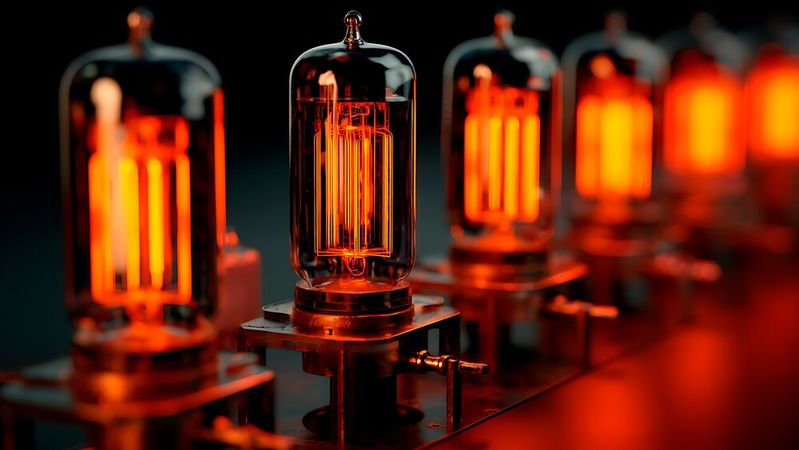
Vacuum diodes, as one of many diode types, are fundamental components in the history and development of electrical engineering. These devices, which consist of two electrodes within a vacuum-sealed tube, facilitate the flow of electric current in a single direction. By understanding the basic principles of vacuum diodes, including their operation and applications, one gains insight into the foundational technologies that paved the way for modern electronics.
1. What is a vacuum diode?
The 19th-century electronics relied heavily on vacuum-based tubes, also known as evacuated tubes. In 1904, English electrical engineer and physicist Sir John Ambrose Fleming invented the vacuum diode. It was originally named the Fleming valve or the thermionic valve. The device is now called the vacuum diode because it houses a vacuum-based environment between the two electrodes to facilitate unidirectional current flow.
Vacuum diode definition
A vacuum diode is a device that controls current flow in an air-tight area between two electrodes. It is made from a glass tube enclosure that houses a hot cathode surrounded by a metal anode. Historically, vacuum tube diodes were used in legacy electronics, radio transmitters, medical scanners, and high-power radio frequency applications.
Vacuum diode symbol
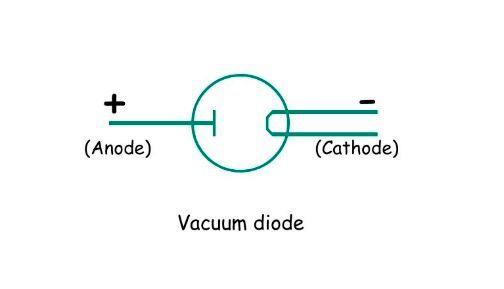
The vacuum diode symbol differs from that of the conventional diode. It is important to note that the vacuum diode symbol resembles a tube-like structure at the cathode.
2. Vacuum diode structure
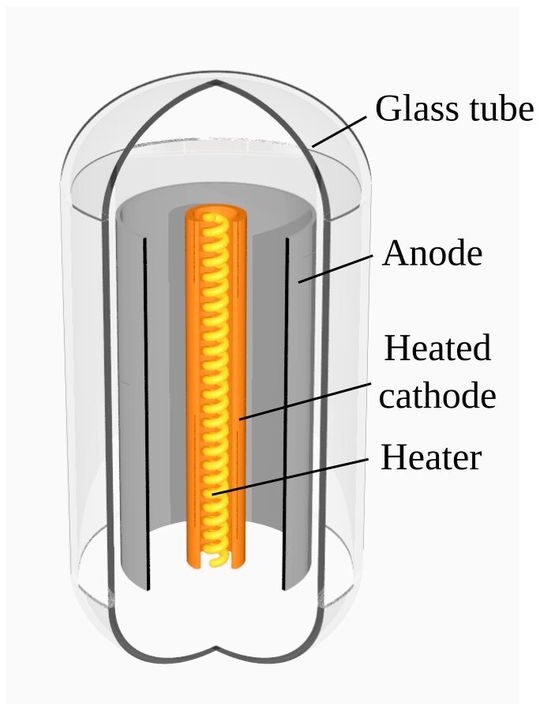
Physically, a vacuum tube diode is not the same as the common solid-state diode. The vacuum diode symbol shows that the device is a glass tube consisting of two electrodes: a positive anode and a negative cathode. Both anode and cathode are cylindrical and can be made from nickel.
Electrodes: The anode is a hollow cylinder made up of either nickel or molybdenum. The cathode is a cylinder covered with barium oxide and strontium.
Evacuated tube: An air-tight interelectrode space gives the current a passage to flow. In technical terms, air is evacuated from the tube space between the anode and cathode to prevent the collision of electrons and air molecules.
Cathode: The heating chamber contains the hot filament. In some designs, the hot filament is separated from the cathode. As a result, the cathode is indirectly heated for isolation and safety purposes.
3. How does a vacuum diode work?
Similar to conventional diodes, vacuum tube diodes could be forward or reverse-biased. It is because a varied voltage is applied to the cathode and anode. The voltage creates a potential difference between the two. The cathode functions as the “emitter” and the anode functions as a “collector”.
Vacuum diode operation is similar to that of conventional diodes, but they involve heating. The cathode must be heated directly or indirectly to enable the current flow. Vacuum diodes cannot work if the cathode is not heated. High current flows when the cathode is heated more. Similarly, there is a lesser current flow if the cathode is slightly heated.
Vacuum tube diode operation is based on the thermionic effect. It is the process where a heated material starts to emit electrons. Engineers could control the current flow by controlling the anode voltage and the cathode temperature.
Zero-biased vacuum diodes: When no voltage is applied across the cathode or anode, vacuum diodes do not operate.
Forward-biased vacuum diodes: The anode is more positive with respect to the cathode. In broader terms, electrodes are metallic. All metals consist of a large amount of free electrons. Hence, metals are called pools of electrons. These electrons are loosely bound to the metal. When the negatively charged cathode is heated, electrons gradually gain energy.
If the positive voltage applied to the anode is not strong enough, electrons do not experience a strong attractive force. As a result, electrons accumulate in the air-tight space near the cathode. They form a negatively charged cloud, known as the space charge region. It functions as a barrier to prevent electrons from escaping the metallic bonds of the cathode.
When high voltage is applied to the anode, the attractive force becomes stronger. The thermal energy of electrons soon overcomes the work function. An electron emission, known as thermionic emission, occurs. The electrons leave the hot surface of the cathode. They move through the vacuum area to get collected at the anode.
Gradually, the anode voltage neutralizes the space charge region. Now, no barrier tries to stop the thermionic emission. The beam of electrons can be seen through the glass vacuum tube. The current flows at its maximum value and no longer depends upon the anode voltage. The vacuum diode enters the saturation mode. The current now fully depends upon cathode temperature.
Reverse-biased vacuum diodes: The anode is more negative with respect to the cathode. The positively charged cathode releases free electrons. These electrons form a negatively charged cloud - the space charge region. The anode, being negatively charged, repels these electrons. As like-like charges repel, no current flows through the vacuum tube diode.
:quality(80)/p7i.vogel.de/wcms/21/7f/217fcc66cf062b3e3212dcb6c2d53992/0124480366v4.jpeg "Discover the DIAC, a bidirectional semiconductor device blending diode and thyristor properties, revolutionizing AC circuits with its unique structure, operation, and applications. (Source: © Hseyin - stock.adobe.com)")
DIODES
DIAC: The bidirectional diode
4. Vacuum diode advantages
Diodes provide essential benefits in electronic circuits, ensuring efficient current directionality. Their versatility allows them to perform crucial roles in various applications, from rectification to signal processing.
- The anode is larger in size compared to the cathode. It allows easy heat dissipation without temperature elevation.
- Cooling fins in the anode enable quick heat dissipation.
- A vacuum diode is made from low-work-function metals. Such metals do not require more heat to emit electrons. Examples include tungsten.
- The vacuum diode symbol shows that the cathode is coated with oxide to facilitate quick thermionic emission.
- Vacuum tube diodes are capable of high-temperature operation without damage.
- Vacuum diodes are simpler in design compared to modern diodes.
- Vacuum diodes show less capacitance variation.
- Vacuum diodes are not prone to parasitic capacitances and inductances.
- Vacuum diodes show higher dynamic voltage ranges.
- Vacuum diodes exhibit high emission efficiency.
5. Vacuum diode disadvantages
Semiconductor diodes win due to their small size, speed, efficiency, and safety. The section explains why the electronics industry relies less on vacuum tubes.
- No scalability: Compared to semiconductor diodes, vacuum diodes are not scalable. They are heavier, bulkier, and incompatible with standard EDA tools and fabrication procedures. As a result, vacuum diodes cannot fit into portables.
- Fragility and cost: All tubes are known for their low component life. Vacuum tube diodes are delicate due to the presence of the glass. In addition, vacuum diodes are costly as they are historic.
- Uncomfortable temperatures: Vacuum diodes cannot generate outputs with cold cathodes. As mentioned above, vacuum diodes cannot operate if the cathode is not heated. They require higher operating voltages up to thousands of volts, which is unsafe.
- Low safety: Due to the involvement of the hot cathode, vacuum diodes are unsafe. Conventional diodes are a better replacement.
- Complex power supplies: Vacuum diodes consume more power to operate. They must require multiple isolated high-voltage rails, like heaters.
6. Applications: What is a vacuum diode used for?
The vacuum diode symbol shows that the device falls into the category of tubes. Some examples of tubes are triodes, cathode ray tubes, tetrodes, pentodes, and many more. All vacuum diodes are vacuum tubes, but not all vacuum tubes are vacuum diodes. Vacuum diodes can be operated at radio or microwave frequencies. They can be tailored to handle low or high power levels. Some applications of vacuum diodes are listed below.
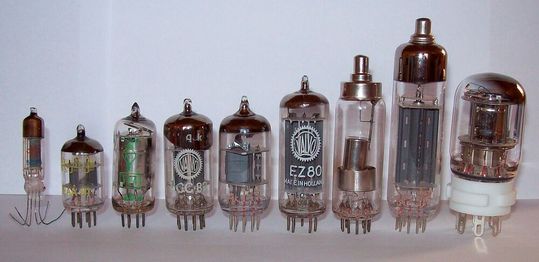
- 1. Basic diode functions: Vacuum diodes are used in place of rectifier diodes, zener diodes, varactor diodes, Schottky diodes, detector diodes, LED diodes, and many more.
- 2. High-power RF applications: Due to their high-temperature operation, vacuum diodes are applicable in RF high-power devices such as radar systems, ovens, TVs, radio transmitters, satellite communication devices, and industrial heating.
- 3. Vacuum tubes: Vacuum diodes are used in other vacuum-based devices, such as klystron tubes, photomultiplier tubes, magnetrons, traveling wave tubes, cathode ray tubes, and many more.
- 4. Thermal applications: As vacuum tube diodes involve heating, they are applicable in thermal applications, including thermionic diodes, converters, and plasma generation in nuclear systems.
- 5. Audio systems: Audio amplifiers actively rely on semiconductors. Historically, vacuum diodes were used in guitar amplifiers, speakers, and legacy audio systems.
Conclusion
Vacuum diodes are not semiconductor diodes, but they can function like one. Vacuum diodes are old school. They were used until the 1950s. Semiconductor diodes replaced them. Hence, vacuum diodes are not actively used in modern applications. However, vacuum diodes survive the battle of miniaturization through niche and high-power RF applications. Some systems do not use semiconductor diodes but rely on vacuum tubes for operation, including microwave ovens, magnetrons, klystrons, photomultipliers, musical instruments, and many more.
(ID:50596902)
:quality(80)/p7i.vogel.de/wcms/8d/93/8d935dcd0623d224abf032aa1d73a5e2/0128635105v2.jpeg "Heat pipes efficiently transfer heat in compact electronic systems, enabling reliable thermal management for high-power components. (Source: © Pete - stock.adobe.com)")
:quality(80)/p7i.vogel.de/wcms/bf/a2/bfa277a5c1330e67e3ba50d9da823970/0127853966v2.jpeg "Historically, capacitors were named as condensers. But the condenser was another device, not even similar to the capacitor. In the 20th century, the term \"capacitor\" replaced the term \"condenser.\" The industry took a considerable time to accept the new name. (Source: © Kuzmick - stock.adobe.com)")