


:quality(80)/p7i.vogel.de/wcms/99/dd/99dd64ae87c0855129bd405f61d81f81/0133290217v2.jpeg "Microchip’s new 1.2 V SY757xx clock buffers connect modern low-voltage SoCs, FPGAs and AI accelerators with higher-voltage clock components, supporting frequencies up to 250 MHz and additive jitter as low as 26 fs. (Source: Microchip)")
:quality(80)/p7i.vogel.de/wcms/83/d0/83d0b8ea52378c77f98358e29ceccfc0/0133339307v2.jpeg "Capacitors are a critical yet often overlooked component in AI data center power supplies, buffering energy and stabilizing voltage as racks scale toward the megawatt range. (Source: © Parilov - stock.adobe.com)")
:quality(80)/p7i.vogel.de/wcms/10/fc/10fcb98e44d61826e641bc8d3f20f616/0133193677v2.jpeg "The new AEVA and AEVB Series aluminum electrolytic capacitors are engineered for harsh industrial environments, delivering high-CV, long-lifetime performance in compact, surface-mount packages that reliably withstand up to 30g acceleration and operating temperatures extending from -55° to +125°C. (Source: Kyocera)")
:quality(80)/p7i.vogel.de/wcms/f7/42/f74208db9f5f87dca384b38b71c4782e/0133196365v2.jpeg "YAGEO’s EC Flat‑Series temperature sensors combine fast, accurate measurement with resistance to vibration, shock, moisture and dust for demanding automotive and industrial applications. (Source: Yageo)")
:quality(80)/p7i.vogel.de/wcms/57/b6/57b6d33cb929fa4408ad56803ed5f0bc/0133311998v2.jpeg "Elmos and SK keyfoundry are expanding their collaboration on 130 nm technology and have agreed on long-term wafer capacity through 2037 to support reliable automotive semiconductor production. (Source: © remake - stock.adobe.com)")
:quality(80)/p7i.vogel.de/wcms/b4/0a/b40a1de3c8fa631b2aff74ec436c43db/0133314066v2.jpeg "ZF Aftermarket expands its EV service portfolio with new repair kits and solutions for e‑motors, inverters, hybrid modules, mechatronics and electric drive units. (Source: ZF Aftermarket)")
:quality(80)/p7i.vogel.de/wcms/48/e1/48e107b92f976652532facf5ca1e0855/0133290826v2.jpeg "Infineon and SolarEdge are extending their collaboration to develop solid-state protection solutions for 800 VDC AI data centers, aiming to improve fault response, system reliability and power density. (Source: © Grispb - stock.adobe.com)")
:quality(80)/p7i.vogel.de/wcms/99/84/9984f5888ecc71c249f65cea3f0658d1/0133069650v2.jpeg "Yokogawa’s integrated measurement setup helps Vertiv analyse AI-driven pulsed loads, combining power, waveform and thermal data to validate UPS performance and input power smoothing. (Source: YOKOGAWA)")
:quality(80)/p7i.vogel.de/wcms/a4/29/a429b944eb0a69e268015f8300ba8940/0133311989v2.jpeg "Hitachi Energy and Daikin are establishing a German supply of C4‑FN, a specialty insulating gas used in SF₆‑free high‑voltage equipment for more sustainable power grids. (Source: © Ahmed - stock.adobe.com)")
:quality(80)/p7i.vogel.de/wcms/d5/32/d5326e4b05d5cd759e88062f1c0b097a/0133344193v2.jpeg "Co-packaged optics is the latest innovation in data centers where optical modules on silicon chips can assist in scaling megawatt AI infrastructure. (Source: © Rachakrit - stock.adobe.com)")
:quality(80)/p7i.vogel.de/wcms/76/a9/76a9333bc7c6abbf7e29d1b910edb5e2/0133335959v2.jpeg "This article explains PMBus in data center power supplies. (Source: © Gibster - stock.adobe.com)")
:quality(80)/p7i.vogel.de/wcms/35/9c/359cfb6c855204e4d114f88cf5b98b5f/0133078984v2.jpeg "Photonic integrated circuits are next-level chips that will dominate data centers in the upcoming years. (Source: © pier - stock.adobe.com)")
:quality(80)/p7i.vogel.de/wcms/7b/76/7b76005554b556df2a7a3794bdf69d44/0132365246v2.jpeg "Hioki’s ST5680A DC Hipot Tester combines CE/UKCA/CSA compliance, an integrated capacitance‑based contact check and time‑series waveform recording (voltage, leakage current, insulation resistance) to standardize hipot and insulation testing across EV cell, module and pack production lines. (Source: Hioki)")
:quality(80)/p7i.vogel.de/wcms/af/7f/af7f7b0fb7f29219fc991b1130f65477/0132241333v2.jpeg "Comprehensive laboratory testing regimens—combining thermal cycling, high‑current stress, EMC, and accelerated lifetime tests—are essential to validate advanced power designs and ensure reliability in real‑world applications. (Source: PRBX)")
:quality(80)/p7i.vogel.de/wcms/16/3d/163df69363f8125315a9826e13ea4b05/0131927425v2.jpeg "Solution will maximize data center and AI factory profitability while delivering engineering-grade insights to design and operations for more efficient, sustainable, and resilient infrastructure. (Source: Cadence)")
:quality(80)/p7i.vogel.de/wcms/85/b7/85b7e90733a2bd8f21515d8f7137f2fc/0131917677v2.jpeg "Renesas acquires Pictorus to integrate its embedded application software platform with Renesas’ MCU and MPU portfolio, helping developers shorten time‑to‑market and simplify system integration. (Source: © lucadp - stock.adobe.com)")
DIODES DIAC: The bidirectional diode
Related Vendors
:fill(fff,0)/p7i.vogel.de/companies/6a/20/6a202a4f89a62/mrs-white-on-blue-bg.png "mrs-white-on-blue-bg ()")
:fill(fff,0)/p7i.vogel.de/companies/63/c7/63c7da97be945/diotec.png "diotec (Diotec Semiconductor AG)")
:fill(fff,0)/p7i.vogel.de/companies/5f/71/5f71d5f92a5f6/2000px-rogers-corporation-logo-svg.png "2000px-Rogers_Corporation_Logo.svg.png (rogers germany)")
Did you know that a DIAC is a combination of a diode and a thyristor? Despite structural and operational differences, diodes and thyristors can be combined to make a different device. In popular media, DIAC is sometimes called the diode of AC circuits. The article explains DIACs and their structure, operation, and applications.

DIACs are not new on the Earth; they have been around since the late fifties. According to a source, DIACs were used in PSTN shared lines— telephone lines, before the mid-1960s. These days, DIACs are used in power electronics to trigger TRIACs (Triode For Alternating Current), SCRs (Silicon Controlled Rectifier), motor speed controls, AC lamp dimmers, and overvoltage protection circuits.
DIAC DEFINITION
A Diode For Alternating Current (DIAC) is a bidirectional semiconductor switch that remains fully operational in forward and reverse bias modes. A DIAC can be activated if the voltage between its two terminals exceeds the breakover voltage and deactivated by reducing it below the same.
DIAC symbol
DIACs have two terminals. Unlike thyristors, DIACs do not have a gate terminal. Current in DIACs flows irrespective of the polarity. One terminal cannot be differentiated as positive or negative. Neither of them is an anode or cathode like in diodes.
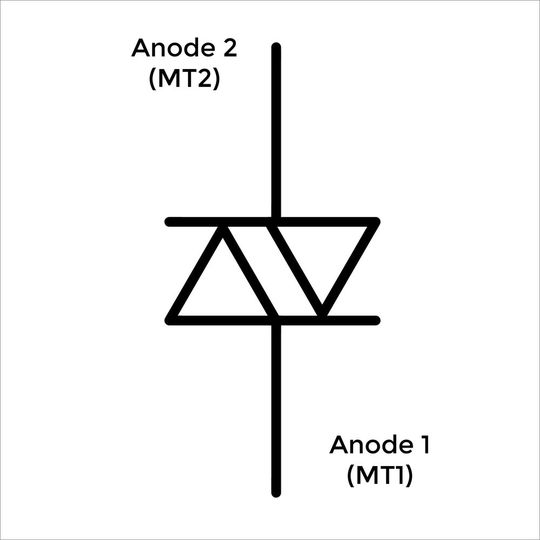
The two DIAC terminals are identical. The DIAC symbol resembles two diodes connected in an antiparallel configuration. The symbol showcases its two terminals, depicting no polarity. DIAC terminals are called A1 and A2, or Main Terminal 1 “MT1” and Main Terminal 2 “MT2”.
:quality(80)/p7i.vogel.de/wcms/f5/d5/f5d5285ddfc4d02f5279413129bbad71/0114199240.jpeg "A diode is an electronic component that allows current to flow in one direction and usually consists of a p-n junction. It is commonly used in electronic circuits to control current and create rectification effects. Diodes have many applications, such as in rectifiers, voltage regulators, and switches. (Source: KPixMining - stock.adobe.com)")
BASIC KNOWLEDGE - DIODES
All about diodes - One direction, many paths
DIAC structure
A DIAC is a five-layer NPNPN structure. Sometimes it can also be a three-layer structure.
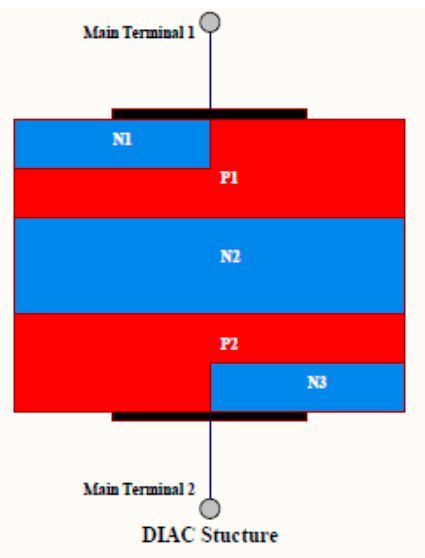
All these layers are doped in a similar fashion. Despite having a five-layer structure, a DIAC does not offer a controlling gate terminal.
DIAC working principles
DIACs do not need the gate terminal because voltage variations can turn the device on and off. The section explains DIAC operation when either of the terminals is positive with respect to the other.
MT1 Positive
When MT1 is made more positive with respect to MT2, the P1 layer activates and becomes more positive. Junctions P1N2 and P2N3 become forward-bias. Junction N2P2 becomes reverse-biased. As one of the two junctions is reverse-biased, a small leakage current flows through the circuit. However, the DIAC remains in the blocking state — it does not conduct.
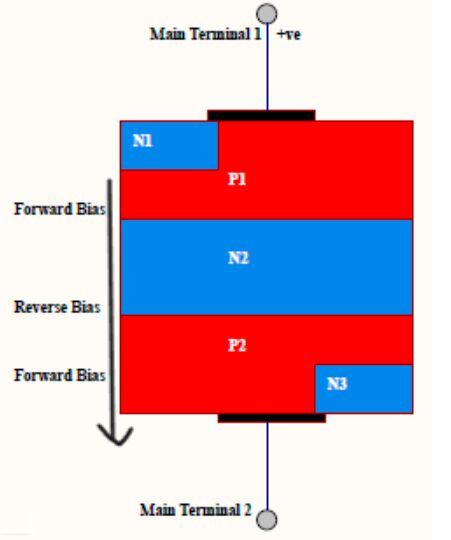
As soon as the voltage between the two terminals exceeds the breakover voltage value, the DIAC undergoes avalanche breakdown. Similar to thyristors and SCRs, DIACs contain internal NPN and PNP transistors. Once the breakdown occurs, internal positive feedback of the two transistors ensures that the DIAC enters a state of negative resistance.
Junction N2P2 starts to lose reverse bias characteristics. As a result, the current immediately increases across the DIAC, reducing the voltage drop. It looks as if voltage-current holds an inverse relationship, known as negative resistance. DIAC current flows from MT1 to MT2– P1 to N2 to P2 to N3.
MT2 Positive
When MT2 is made more positive with respect to MT1, the P2 layer activates and becomes more positive. Junctions P2N2 and P1N1 become forward-biased. Junction N2P1 becomes reverse-biased. As one of the two junctions is reverse-biased, a small leakage current flows through the circuit. However, DIAC remains in its high-resistance non-conducting “off-state”.
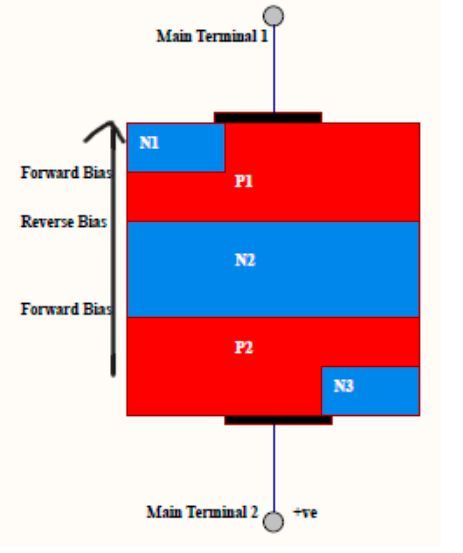
When the voltage between the two terminals exceeds the breakover voltage value, the DIAC undergoes avalanche breakdown. Carrier multiplication pushes junction N2P1 to lose reverse-bias properties. DIACs enter a state of negative resistance, in which the current increases sharply and the voltage drop decreases. DIAC current flows from MT2 to MT1– P2 to N2 to P1 to N1.
DIAC switching behavior
You can notice that the DIAC operation is similar in both cases. DIACs conduct in both directions, behaving like bidirectional diodes. As a result, DIACs deliver symmetrical switching properties in both polarities of the applied voltage. Hence, two terminals and bidirectional switching behavior for positive and negative half cycles make DIACs a diode for AC applications.
DIAC turn-off
DIAC remains in the conductive on-state till the magnitude of the current remains above a threshold known as the holding current. Once the DIAC current falls below the holding current— the DIAC turns off— Typical thyristor behavior! Hence, the structure, biasing conditions, avalanche breakdown, and holding current-based turn-off make DIACs a part of the thyristor family.
DIAC characteristics
The V-I characteristics of DIAC show similar behavior in the positive half-cycle (quadrant 1) and negative half-cycle (quadrant 4).
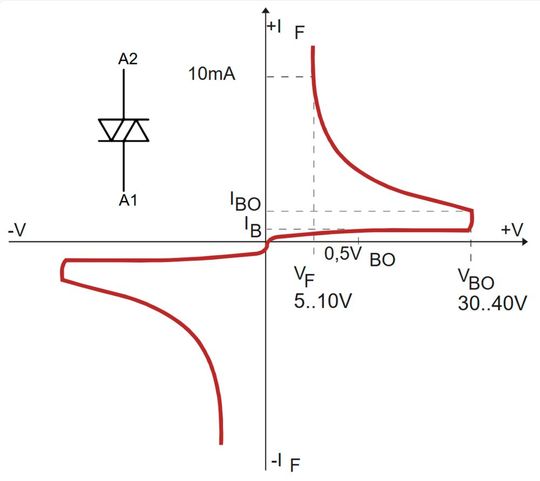
When the DIAC voltage exceeds the breakover voltage, the image showcases a sharp increase in current. However, the voltage drop decreases to showcase the negative resistance effect. V-I characteristics in quadrants 1 and 3 form an S-type curve. The s-type curve is a type of current-controlled negative resistance.
DIAC advantages
Explore how DIACs enhance AC applications with their efficient and symmetrical switching capabilities.
- DIAC is a full-wave bidirectional switch, suitable for AC applications.
- DIACs offer symmetrical switching characteristics, reducing harmonics in a system.
- DIACs can be controlled by increasing or decreasing the applied voltage.
- DIACs offer smooth power control when used with TRIACs, SCRs, and AC loads.
- DIACs exhibit a low on-state voltage drop.
- The DIAC voltage drop decreases when the current increases.
- DIAC turn on and off is simple— increase or decrease the supply voltage below or above the breakover voltage.
- DIACs are compact and cost-effective.
:quality(80):fill(efefef,0)/p7i.vogel.de/wcms/5f/fe/5ffedb2e0ffa6/listing.jpg "listing")
DIAC disadvantages
Understand the limitations of DIACs in handling high power and precision control.
- DIAC is a low-power device, sometimes incapable of being used in high-power applications.
- Due to low power handling capacity, DIACs have to follow TRIACs for better results.
- DIACs cannot block high voltages.
- DIAC is an uncontrolled device.
- DIACs cannot be triggered at any desired point. They can be triggered over a large preset value of breakover voltage.
- The breakover voltage for DIACs is typically 30 to 40 V— which is huge! It means that DIACs will remain off until the voltage crosses 30 to 40 V.
- DIAC output is pulsating DC— neither true DC nor AC.
DIAC applications
Historically, DIACs in lamp dimmers have been sold in the USA. Beyond triggering TRIACs, they do not have much use. Some DIAC applications are listed below.
TRIAC activation
DIACs are extensively used with thyristor families in power electronics. They can trigger TRIACs, SCRs, and many other power devices.
AC applications
DIACs are used in AC applications because of their full-wave bidirectional switching behavior. DIACs are reset to a non-conducting, highly resistive state each time the voltage lowers and the current falls below the holding current level.
Power electronics (AC power)
DIACs regulate the power supplied to the AC load. Examples include phase control circuits, motor speed control units, light dimmers, starter circuits for fluorescent lamps, domestic lighting, heat controls, and power pulse circuits.
Quadrac
DIACs, for their sole purpose of triggering TRIACs, are packaged into a special type of thyristor called “Quadrac”. In simple words, quadrac is a DIAC-TRIAC combination. It is a thyristor package that consists of built-in DIACs and TRIACs. The DIAC series triggers the gate terminal of the TRIAC. Quadracs are available up to 10 kV and 3 kA.
SIDAC
DIACs are called SIDACs in Japan. SIDAC “Silicon Diode For Alternating Current” is electronically similar to DIAC but exhibits a higher breakover voltage and better current handling capabilities.

SYDAC
SYDAC “Silicon Thyristor For Alternating Current” is a five-layer bilateral voltage trigger switch. They are directly used as switching devices, not just limited to TRIAC activation. SYDACs are used as Trisils “Thyristor Surge Protection Devices”.
SCR vs DIAC vs TRIAC
The table below compares all three thyristors: SCRs (Silicon-controlled Rectifiers), DIACs (Diode For Alternating Current), and TRIACs (Triode For Alternating Current).
| Feature | SCR | DIAC | TRIAC |
| Device type | Uncontrolled switch | Trigger diode | Controlled switch |
| Current conduction | Unidirectional | Bidirectional | Bidirectional |
| Terminals | 3 Anode, cathode, and gate | 2 Main terminal 1 and main terminal 2 | 3 Gate, main terminal 1, and main terminal 2 |
| Switching capabilities | One direction | Symmetrical | Symmetrical |
| Gate control | Requires gate triggering | No gate (self-triggered) | Requires gate triggering |
| Current ratings | High | Lowest | Low |
| dv/dt ratings | Moderate | Low | High |
| Characteristics | Two quadrants, but only one is used. Hence, one quadrant operation. | Two quadrants | All four quadrants |
| Reliability | High | Low | Low |
| Applications | High-power electronics | TRIAC triggering | AC power control, like light dimmers, motor controls, and fan regulators |
| Market share | Huge (Number 1 Thyristor) More than USD640 million | Second (Number 2 Thyristor) More than USD200 million | Third (Number 3 Thyristor) |
References
PCIM Expo 2025: Join the industry highlight

Position your company at the forefront of the power electronics industry! Exhibit at the PCIM Expo 2025 in Nuremberg, Germany to showcase your solutions and connect with top decision-makers and innovators driving the industry forward.
Learn more
(ID:50408082)
:quality(80)/p7i.vogel.de/wcms/22/40/224013bf325f1141738bff2310fb453f/0127480067v5.jpeg "Illustrating the advancements in power transmission, HVDC Light technology showcases its potential for efficient and sustainable energy delivery. This innovative approach promises enhanced stability and control in modern electrical grids.
(Source: © TebNad - stock.adobe.com)")
:quality(80)/p7i.vogel.de/wcms/4d/e0/4de02f76a37cbb3df30dd231de589c8e/0128866890v2.jpeg "Both legacy and vGaN show higher carrier mobility and band gap energies compared to other power semiconductors. (Source: © phonlamaiphoto - stock.adobe.com)")