


:quality(80)/p7i.vogel.de/wcms/2f/f3/2ff3221bf7665de2d0acf83760bfd1fa/0130031523v2.jpeg "Wolfspeed presents a 300 mm silicon carbide technology platform designed to support advanced packaging and high-efficiency power delivery for AI data center infrastructure. (Source: Wolfspeed)")
:quality(80)/p7i.vogel.de/wcms/c3/16/c316e955a97f5d72d9678297b237b9e5/0129932858v2.jpeg "Left: the single-phase version of the SENTRON ECPD with RCM, right: a model of the future three-phase version of the SENTRON ECPD. (Source: Siemens)")
:quality(80)/p7i.vogel.de/wcms/ef/0a/ef0adb0acf793fe147cc27c21f6a7a67/0129954238v2.jpeg "Empower Semiconductor introduces embedded silicon capacitors designed to improve power delivery and stability in AI and high-performance computing processors. (symbolic image) (Source: © IF.arc - stock.adobe.com)")
:quality(80)/p7i.vogel.de/wcms/53/f9/53f9301dfc9292d02960f7996c79cc6e/0129927601v2.jpeg "Wolfspeed’s new 10 kV SiC MOSFET enables high-voltage power conversion for grid and industrial applications. (symbolic image) (Source: © CREATIVE- 3.4 - stock.adobe.com)")
:quality(80)/p7i.vogel.de/wcms/6e/cd/6ecd41d095d5111cf4ed37b714844487/0129930878v2.jpeg "PCIM Asia Shenzhen provides a platform for industry experts to present new developments in power electronics and electrification technologies. (symbolic image) (Source: © killykoon - stock.adobe.com)")
:quality(80)/p7i.vogel.de/wcms/02/c0/02c0e9722f70b1134dbf96fb59a9c73d/0129655179v2.jpeg "The PCIM Conference 2026 will take place from June 9-11, featuring discussions on power electronics trends, including GaN technology and AI applications. (symbolic image) (Source: © Elmira - stock.adobe.com)")
:quality(80)/p7i.vogel.de/wcms/cc/67/cc670ea2029cd2af5c641af70e1bf734/0129816392v4.jpeg "Fraunhofer IAF coordinates the EU SUPREME project to accelerate GaN and SiC power semiconductor innovation in Europe. (Source: Fraunhofer IAF)")
:quality(80)/p7i.vogel.de/wcms/ea/e6/eae6aee30071e67a5627027974437134/0129544613v2.jpeg "GlobalFoundries and Renesas strengthen their collaboration to support U.S.-based semiconductor production and supply chain resilience. (Source: © ronstik - stock.adobe.com)")
:quality(80)/p7i.vogel.de/wcms/23/1a/231a97643aa7fc3adf2704a6273756c3/0130030642v2.jpeg "Gallium nitride (GaN) power devices are increasingly challenging silicon MOSFETs in low-voltage power conversion by enabling higher efficiency and switching performance. (Source: © Sheraz - stock.adobe.com)")
:quality(80)/p7i.vogel.de/wcms/3c/4b/3c4bbc68dda65c7071b4376fb57423b0/0130030465v2.jpeg "Faraday’s laws explain the fundamental behavior of magnetic fields and electronic devices in dynamic use cases. The operation of transformers, wireless chargers, induction cookers, induction motors, magnetic levitating trains (MAGLEV Trains), electric violin, and many others depends upon Faraday’s laws. (Source: © Sheraz - stock.adobe.com)")
:quality(80)/p7i.vogel.de/wcms/b1/5e/b15ee02b0ba02db70cf61e37d66ad1d3/0129349127v2.jpeg "Vehicle-to-grid (V2G) chargers enable bidirectional energy flow, allowing electric vehicles to act as mobile energy storage systems that can both draw power from and feed power back into the grid. (Source: © medienvirus - stock.adobe.com)")
:quality(80)/p7i.vogel.de/wcms/26/d5/26d591cc340077026eac56a0e7564faf/0129949603v2.jpeg "Flexible: The solid silicone-based electrolyte is elastic, thereby compensating for the voids that form in solid-state batteries during charging and discharging. (Source: Empa)")
:quality(80)/p7i.vogel.de/wcms/be/c8/bec8d43fc0ee73414274be44608b2970/0129748903v2.jpeg "The Infiniium XR804KA real-time oscilloscope delivers faster response time, improved stability, and streamlined workflows for high-speed digital and compliance testing. (Source: Keysight)")
:quality(80)/p7i.vogel.de/wcms/23/ee/23ee4a97790d6009dbfd7d9577ffa723/0129220424v2.jpeg "The R&S FPL1044 with the new RTSA option makes 40 MHz real-time frequency analysis available up to 44 GHz. (Source: Rohde & Schwarz )")
:quality(80)/p7i.vogel.de/wcms/3c/d1/3cd1cacbceb792ba63727199c61ca434/0127801860v2.jpeg "Thanks to cloud technology, users can collaborate on projects from anywhere and always have access to the latest planning data. (Source: SIEMENS)")
:quality(80)/p7i.vogel.de/wcms/5a/a0/5aa0436498af618297961fd54ab36cdf/0126290792v2.jpeg "Siemens accelerates student-led semiconductor innovation across Europe’s leading technical universities through Cre8Ventures’ Open Higher Education Program developed in collaboration with Arm and University of Southampton (Source: Siemens Digital Industries Software)")
SEMICONDUCTOR DESIGN VLSI: Very Large Scale Integration
Related Vendors
:fill(fff,0)/p7i.vogel.de/companies/63/c7/63c7da97be945/diotec.png "diotec (Diotec Semiconductor AG)")
:fill(fff,0)/p7i.vogel.de/companies/60/7e/607ec89d5d9b5/white-frame.jpg "white frame.jpg (www.rohm.com)")
:fill(fff,0)/p7i.vogel.de/companies/68/00/6800eb0040fb9/cobalt-vertical-aligned-bold.png "cobalt-vertical-aligned-bold (CISSOID SA)")
Very Large Scale Integration “VLSI” is a process that lays down the foundation for producing the smallest and most operational integrated circuits. Ever wondered how companies create a single chip with trillions of transistors?
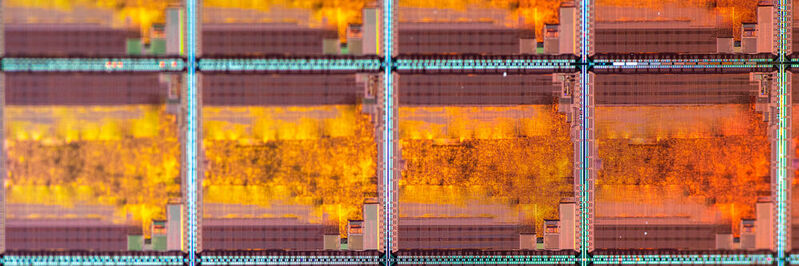
VLSI (Very Large Scale Integration) explained
Just like we explained PCB and PCB design in our article, the article talks about VLSI and VLSI design. Section 1 starts with an explanation of the difference between PCB and VLSI design.
PCB design vs VLSI design
PCB design is about creating a smart design in an EDA tool (Electronics Design Automation Software) to integrate multiple components on a single board and form conductive paths between them in a minimized manner. These components can be transistors, diodes, integrated circuits, resistors, capacitors, etc. VLSI design is another design process that enables the manufacturing of a functional integrated circuit (or chip) in the smallest possible way.
VLSI
VLSI stands for “Very Large Scale Integration”, pointing to the mass integration of transistors in an integrated circuit. Started in the early 1980s, VLSI enables manufacturing small integrated circuits with a large number of transistors to perform logic functions or store information.
VLSI design
VLSI design is the process that designs chips on a computer before the actual manufacturing process starts. In simple words, VLSI design is the process of creating a circuit design in an eCAD tool (Electronic Computer-Aided Design Software) to integrate millions, billions, or even trillions of transistors in a single small chip. The VLSI design process incorporates the accurate steps of designing and integrating small components in large numbers for the chip to be fully functional.
History of the VLSI era
The history of the VLSI era dates back to the decade of sixties when Jack Kilby and Robert Noyce invented the world’s first monolithic integrated circuit. The following few years in the late sixties marked the development of logic gates and functional chips. The number of logic gates per chip saw a drastic increase for complex application devices. Simply put, the number of transistors in a single chip is called transistor count.
MSI: 1967
Medium-scale integration (MSI) started 1967 from 100 to 1000 gates per chip.
LSI: 1972
Large-scale integration (LSI) started in 1972 with a range of 1000-20,000 gates per chip.
VLSI: 1978
In 1978, VLSI initially started with a range of gates per chip higher than 20,000. The minimum feature size of a transistor was 2 micrometers in 1980. The sizes 0.18 micrometers and 65 nanometers were available in the late 2000s decade. It must be noted that around the same time, the DRAM chip reached a 3 million transistor count.
Moore’s law predicted the exponential growth of transistor counts over the years. However, the actual growth was seen to be much faster than theoretical predictions. The scaling of memory-based chips is seen to be faster than logic chips. As of 2023, Micron’s Flash memory chip contains an integration of 5.3 trillion transistors!
:quality(80):fill(efefef,0)/p7i.vogel.de/wcms/65/5c/655c87f111972/202311-whitepaper-tektronix-coverbild.png "202311_Whitepaper Tektronix_Coverbild")
VLSI design cycle goals
The backbone of the VLSI design process is the digital CMOS IC. The ability to reduce the size of transistors to nanometers, even smaller than virus cells, is credited to the emergence of the latest technologies in the VLSI design life cycle. The advancement in VLSI design is a function of the miniaturization of components, efficient manufacturing techniques, CAD performance, and the need for complex functions. However, advancement can increase complexity in steps and physical implementation of the design.
The VLSI design cycle starts from the software and ends as a product. In simple words, the VLSI design cycle starts with multiple teams working on software and ends with the design file handed over to the fabrication unit (or foundry). A long VLSI design cycle time results in optimal chip performance. However, VLSI design cycle time must not exceed the technology window because it may trade off with the marketing budget.
The objective of the VLSI design cycle is to attain
- Performing the target chip function.
- Minimization in chip area and volume.
- Less power consumption.
- High performance, functionality, and reliability.
- High connectivity.
- Cost savings.
VLSI design flow
There is no fixed design flow cycle for the VLSI design process. A conventional VLSI design process flows in the following steps from top to bottom. However, the VLSI design hierarchy always starts digitally and ends with a physical product.
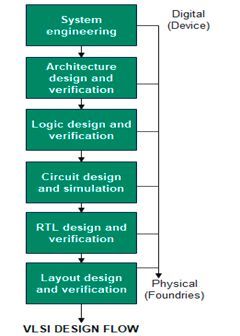
The two most critical procedures in VLSI design flow are “design” and “verify”. In every step, teams must carry out design rule checks (DRC), and verification regularly. Any failure in a design test to verify the functionality and behavior of the target chip can consume time and impact the VLSI end product.
Systems engineering
Step 0 of VLSI design is the system’s engineering. Teams work on system requirements for the target chip, both digital and physical requirements. System requirements are crucial for defining the chip’s dimensions, function, performance, power, connectivity, and packaging on the hardware level. The system requirements bind the VLSI design flow in a technological window with a set time and cost limit.
Architecture design and verification
The first step in the VLSI design process is to create an algorithm or improvise an existing algorithm that defines the high-level architecture of the final manufactured chip. Once an algorithm fixes an architecture, it must be tested for performance. The architecture defines the processing capabilities of the chip. The architecture is later mapped into the chip’s surface through a process called floor planning.
Logic design and verification
The second stage is to create functional modules in the IC that perform logic-level functions. These functional blocks include shift registers and arithmetic logic units. The modules are finite-state machines placed automatically onto the chip’s surface through the software. Following the module placement, the software performs routing to form a conductive path and reduce delays in signal transmission.
Circuit design and verification
The next step is to implement an individual functional unit simultaneously. The VLSI design process uses a common idea of “divide and conquer”. Each functional module is divided into a sub-module for implementation and continuous testing. These modules, now called leaf cells, must be interconnected by routing procedures. There are iterative adjustments to the routing and placement of the components.
RTL and verification
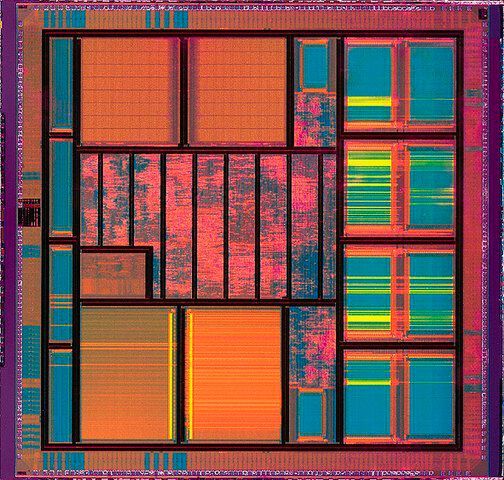
The next step is Boolean-level description through transistor-level logic to generate masks. In simple words, real-time logic (RTL) defines the functions and logic of IC through a hardware description language. Simulation models and tests verify the RTL to map it into the system requirements. RTL is converted into a gate-level netlist. A netlist is a representation of various components.
Layout design and verification
The end step of the VLSI design process is to generate the VLSI design file or a mask. The “mask” is described in our semiconductor manufacturing article part 3. A mask is the circuit design pattern that must be transferred into the chip’s surface. A fab produces multiple chips and sends them to inventories or markets. In conclusion, the final step of VLSI design directly leads to fabs.
:quality(80)/p7i.vogel.de/wcms/08/a1/08a16947ad9a9337ad5fb237f67413c8/0111010215.jpeg "Designing a transistor requires several steps which we explain in this article. (Source: bayurov - stock.adobe.com)")
TRANSISTOR DESIGN
How to design a transistor?
What after VLSI?
Sometimes new technologies after VLSI are addressed as ULSI (Ultra Large Scale Integration). Arrays of memory units and logical functional blocks are integrated into a single chip. The term ULSI is not used as frequently as VLSI. These technologies are sometimes referred to as “advanced VLSI”.
SoC: Late 1990s
System on Chip (SoC) integrates all the necessary devices for a computer on a single small chip. It uses analog and digital intellectual property (IP). SoC is an integration of multiple components on a chip.
SiP: Late 2000s
Another upgrade that took place in the late 2000s was System in Package (SiP). Multiple chips are integrated into a single package. SiP integrates multiple systems (or SoCs) on a single chip.
Relationship to VLSI
SoCs and SiPs are a natural progression of VLSI technology. Just like VLSI technology integrates trillions of transistors on a single memory or logic chip, VLSI for SoCs integrates multiple systems together. Similarly, advanced VLSI plays a big role in integrating multiple chips in SiPs.
What are the end-products of VLSI design?
VLSI design is used to produce integrated circuits or chips for performing logic functions and storing information. However, VLSI-designed chips function as various devices in a system:
- Microprocessors.
- Microcontrollers.
- Digital signal processors (DSP).
- Graphics processing units (GPU).
- Application Specific Integrated Circuit (ASIC).
- Field Programmable Gate Array (FPGA).
- ystem-on-Chip (SoC).
(ID:49843905)
:quality(80)/p7i.vogel.de/wcms/91/a9/91a96266933db5bca40352e42f9fba96/0124626305v2.jpeg "Power management integrated circuits provide comprehensive power optimization for electronics and computers, managing power in consumer electronics, embedded systems, power electronics, automotive, and more industries. (Source: © luchschenF - stock.adobe.com)")
:quality(80)/p7i.vogel.de/wcms/49/c9/49c9cfa2e9da5efbf51a7c9cfcbbfa7a/0124476308v2.jpeg "The tiniest power devices are not computer chips but tiny chargers found online. Unlike chips with billions of transistors, power chips are heavy and need more area to handle high power and dissipate heat. Therefore, miniaturization is less effective in the power industry. (Source: © Galeno - stock.adobe.com)")