


:quality(80)/p7i.vogel.de/wcms/2f/f3/2ff3221bf7665de2d0acf83760bfd1fa/0130031523v2.jpeg "Wolfspeed presents a 300 mm silicon carbide technology platform designed to support advanced packaging and high-efficiency power delivery for AI data center infrastructure. (Source: Wolfspeed)")
:quality(80)/p7i.vogel.de/wcms/c3/16/c316e955a97f5d72d9678297b237b9e5/0129932858v2.jpeg "Left: the single-phase version of the SENTRON ECPD with RCM, right: a model of the future three-phase version of the SENTRON ECPD. (Source: Siemens)")
:quality(80)/p7i.vogel.de/wcms/ef/0a/ef0adb0acf793fe147cc27c21f6a7a67/0129954238v2.jpeg "Empower Semiconductor introduces embedded silicon capacitors designed to improve power delivery and stability in AI and high-performance computing processors. (symbolic image) (Source: © IF.arc - stock.adobe.com)")
:quality(80)/p7i.vogel.de/wcms/53/f9/53f9301dfc9292d02960f7996c79cc6e/0129927601v2.jpeg "Wolfspeed’s new 10 kV SiC MOSFET enables high-voltage power conversion for grid and industrial applications. (symbolic image) (Source: © CREATIVE- 3.4 - stock.adobe.com)")
:quality(80)/p7i.vogel.de/wcms/6e/cd/6ecd41d095d5111cf4ed37b714844487/0129930878v2.jpeg "PCIM Asia Shenzhen provides a platform for industry experts to present new developments in power electronics and electrification technologies. (symbolic image) (Source: © killykoon - stock.adobe.com)")
:quality(80)/p7i.vogel.de/wcms/02/c0/02c0e9722f70b1134dbf96fb59a9c73d/0129655179v2.jpeg "The PCIM Conference 2026 will take place from June 9-11, featuring discussions on power electronics trends, including GaN technology and AI applications. (symbolic image) (Source: © Elmira - stock.adobe.com)")
:quality(80)/p7i.vogel.de/wcms/cc/67/cc670ea2029cd2af5c641af70e1bf734/0129816392v4.jpeg "Fraunhofer IAF coordinates the EU SUPREME project to accelerate GaN and SiC power semiconductor innovation in Europe. (Source: Fraunhofer IAF)")
:quality(80)/p7i.vogel.de/wcms/ea/e6/eae6aee30071e67a5627027974437134/0129544613v2.jpeg "GlobalFoundries and Renesas strengthen their collaboration to support U.S.-based semiconductor production and supply chain resilience. (Source: © ronstik - stock.adobe.com)")
:quality(80)/p7i.vogel.de/wcms/3c/4b/3c4bbc68dda65c7071b4376fb57423b0/0130030465v2.jpeg "Faraday’s laws explain the fundamental behavior of magnetic fields and electronic devices in dynamic use cases. The operation of transformers, wireless chargers, induction cookers, induction motors, magnetic levitating trains (MAGLEV Trains), electric violin, and many others depends upon Faraday’s laws. (Source: © Sheraz - stock.adobe.com)")
:quality(80)/p7i.vogel.de/wcms/b1/5e/b15ee02b0ba02db70cf61e37d66ad1d3/0129349127v2.jpeg "Vehicle-to-grid (V2G) chargers enable bidirectional energy flow, allowing electric vehicles to act as mobile energy storage systems that can both draw power from and feed power back into the grid. (Source: © medienvirus - stock.adobe.com)")
:quality(80)/p7i.vogel.de/wcms/26/d5/26d591cc340077026eac56a0e7564faf/0129949603v2.jpeg "Flexible: The solid silicone-based electrolyte is elastic, thereby compensating for the voids that form in solid-state batteries during charging and discharging. (Source: Empa)")
:quality(80)/p7i.vogel.de/wcms/4d/e0/4de02f76a37cbb3df30dd231de589c8e/0128866890v2.jpeg "Both legacy and vGaN show higher carrier mobility and band gap energies compared to other power semiconductors. (Source: © phonlamaiphoto - stock.adobe.com)")
:quality(80)/p7i.vogel.de/wcms/be/c8/bec8d43fc0ee73414274be44608b2970/0129748903v2.jpeg "The Infiniium XR804KA real-time oscilloscope delivers faster response time, improved stability, and streamlined workflows for high-speed digital and compliance testing. (Source: Keysight)")
:quality(80)/p7i.vogel.de/wcms/23/ee/23ee4a97790d6009dbfd7d9577ffa723/0129220424v2.jpeg "The R&S FPL1044 with the new RTSA option makes 40 MHz real-time frequency analysis available up to 44 GHz. (Source: Rohde & Schwarz )")
:quality(80)/p7i.vogel.de/wcms/3c/d1/3cd1cacbceb792ba63727199c61ca434/0127801860v2.jpeg "Thanks to cloud technology, users can collaborate on projects from anywhere and always have access to the latest planning data. (Source: SIEMENS)")
:quality(80)/p7i.vogel.de/wcms/5a/a0/5aa0436498af618297961fd54ab36cdf/0126290792v2.jpeg "Siemens accelerates student-led semiconductor innovation across Europe’s leading technical universities through Cre8Ventures’ Open Higher Education Program developed in collaboration with Arm and University of Southampton (Source: Siemens Digital Industries Software)")
INDUSTRY TRENDS Quantum tunneling: Post Moore’s Law
Related Vendors
:fill(fff,0)/p7i.vogel.de/companies/63/c7/63c7da97be945/diotec.png "diotec (Diotec Semiconductor AG)")
:fill(fff,0)/p7i.vogel.de/companies/60/7e/607ec89d5d9b5/white-frame.jpg "white frame.jpg (www.rohm.com)")
:fill(fff,0)/p7i.vogel.de/companies/5f/71/5f71d5f92a5f6/2000px-rogers-corporation-logo-svg.png "2000px-Rogers_Corporation_Logo.svg.png (rogers germany)")
The exponential growth of transistor count will one day narrow down due to a problem known as quantum tunneling. Researchers predict quantum tunneling may fail Moore’s law in the coming years. Some even call it “Moore’s Law Killer". The article talks about quantum tunneling and its future implications.

Quantum tunneling is a phenomenon based on the laws of quantum physics, rather than classical physics. In terms of functionality, quantum tunneling mimics teleportation. An electron existing at one side teleports to the other side under a set of conditions. Usually, this happens at incredibly small distances in the sub-nanometer range of about 1-3 nm.
Quantum tunneling emphasizes the wave-particle duality principle. Electrons can behave like particles or waves, depending upon experimental circumstances. Young’s double-slit experiment is a good example of electron behavior duality. In this experiment, electrons showcase two different output patterns as waves and particles. As a result, electrons exhibit wave-like behavior for transistors on a chip.
Quantum tunneling in a chip
Quantum tunneling enables an electron to cross a potential barrier even when it does not have enough energy. In a chip, a thin oxide layer behaves like a barrier to separate two conductive regions. As transistors get smaller and smaller, the separation between them also decreases. The separation between transistors in a chip is nothing but interconnected gates.
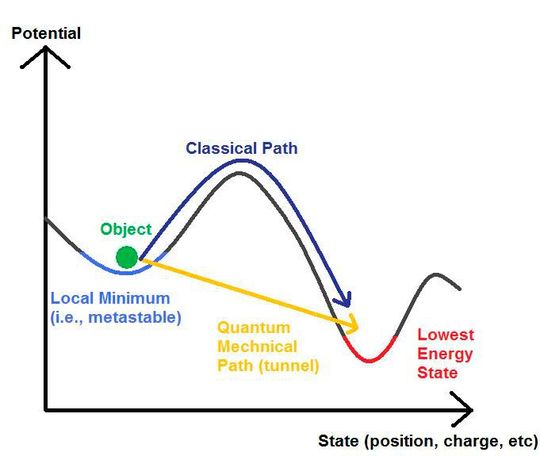
The wave functions of electrons slightly extend into the gate. In simple words, the probability of electrons being present on the other side of the gate is very low but not zero. When wave functions of two electrons from two transistor sides extend onto the gate, they overlap to initiate quantum tunneling. Electrons start to cross the barrier gate to enable current flow across the device.
For effective quantum tunneling, fermi levels of electrons must align. After an electron tunnels through the gate, current starts to flow. The gate functions like an insulator to control the current. Such a scenario would give rise to uncontrolled current flow - disrupting the transistor action. There would be no logic and storage operations, leading to device failure.
:quality(80)/p7i.vogel.de/wcms/7e/1a/7e1aef7dbda36fb926d0013566c1c3ef/0121954634v4.jpeg "Moore's Law, the driver of technological advancement through miniaturization, is nearing its end. As transistor sizes approach atomic limits, new technologies like 3D chip stacking, quantum computing, and neuromorphic computing are being explored to sustain progress. (Source: DALL-E)")
SEMICONDUCTORS
Moore's Law: You can't go smaller than an atom
Quantum tunneling: Practicality
The quantum tunneling effect executes at a microscopic level but is also observable on a macroscopic level. In real-world use cases, insulating transistors become difficult on a chip. If transistors are not insulated properly, leakage current flows— spoiling semiconductor action. As a result, quantum tunneling hinders the growth of the transistor count on a semiconducting chip.
As of 2025, the world has not reached a critical transistor count limit. Transistors are doubling in accordance with Moore’s law. However, experts believe the number of transistors on a chip would increase by a smaller quantity rather than doubling. Furthermore, the transistor count would reach a final number, beyond which scaling efforts would fail.
What to expect if quantum tunneling wins?
The real-world effect of quantum tunneling would be the inability to add more transistors on a chip. Failure of Moore’s law may suggest a paradigm shift in the VLSI industry. Some existing analog and power chips, SoCs (system on chips), and ASICs may not need miniaturization.
The computers and phones will still get better. There will be a limit beyond which they cannot improve. It will be a big blow to data centers and enterprises! The future of Moore’s law may be uncertain but transistor count is hitting new highs every year.
:quality(80):fill(efefef,0)/p7i.vogel.de/wcms/5f/fe/5ffedb2e0ffa6/listing.jpg "listing")
What could beat quantum tunneling?
New transistor innovations like FinFETs, FDSOI, and GAAFETs are critical solutions for quantum tunneling. 2nm and 1nm processes are expected to face quantum tunneling challenges. But they are likely to overcome them during commercialization. Other possible solutions could be high gate stacks and reduction of parasitic capacitance.
Beyond Moore’s Law
While quantum tunneling may be a problem for transistor scaling in the chip world, this phenomenon is applicable in various industries.
Power electronics
Quantum tunneling is used in some special semiconductor devices like high-frequency devices, tunnel diodes, TFETs, and quantum dots. A tunnel diode is a heavily doped PN junction diode used in rectification, oscillation, and amplification. TFETs (Tunnel FETs) are used in power conversion systems for low power losses. Quantum dots are used in solar cells, LEDs, and optics.
:quality(80)/p7i.vogel.de/wcms/ff/22/ff22163c256104c22639a24e8af3565b/0113258006.jpeg "Read more about different types of diodes in this article. (Source: Witold Krasowski - stock.adobe.com)")
TYPES OF DIODES - OVERVIEW
The different diode types explained
Quantum computing
Quantum tunneling plays a major role in the qubit handling and operation of quantum logic gates and sensors. In addition, the quantum annealing process also relies on quantum tunneling.
Superconductors
In devices like Josephson Junctions, quantum tunneling is renamed as superconductive tunneling because cooper pairs tunnel through the non-superconducting barrier for device operation. Quantum tunneling is applicable in cryogenic electronics, quantum computing, testing, measurement, and high-frequency applications.
Further
Quantum tunneling is also applicable in scanning tunneling microscopes, nuclear fusion, and DNA mutation in quantum biology.
References
https://papers.ssrn.com/sol3/papers.cfm?abstract_id=4915377
Power Electronics in the Energy Transition

The parameters for energy transition and climate protection solutions span education, research, industry, and society. In the new episode of "Sound On. Power On.", Frank Osterwald of the Society for Energy and Climate Protection Schleswig‐Holstein talks about the holistic guidance his organization can provide.
Listen now!
(ID:50286402)
:quality(80)/p7i.vogel.de/wcms/49/c9/49c9cfa2e9da5efbf51a7c9cfcbbfa7a/0124476308v2.jpeg "The tiniest power devices are not computer chips but tiny chargers found online. Unlike chips with billions of transistors, power chips are heavy and need more area to handle high power and dissipate heat. Therefore, miniaturization is less effective in the power industry. (Source: © Galeno - stock.adobe.com)")
:quality(80)/p7i.vogel.de/wcms/37/f0/37f0579b316150e010442b4d4f820171/0122207252v2.jpeg "The article discusses the significance of transistor count in the semiconductor industry, highlighting the current record-holding chips and exploring the future trends of miniaturization. (Source: nattapon - stock.adobe.com)")