


:quality(80)/p7i.vogel.de/wcms/10/fc/10fcb98e44d61826e641bc8d3f20f616/0133193677v2.jpeg "The new AEVA and AEVB Series aluminum electrolytic capacitors are engineered for harsh industrial environments, delivering high-CV, long-lifetime performance in compact, surface-mount packages that reliably withstand up to 30g acceleration and operating temperatures extending from -55° to +125°C. (Source: Kyocera)")
:quality(80)/p7i.vogel.de/wcms/f7/42/f74208db9f5f87dca384b38b71c4782e/0133196365v2.jpeg "YAGEO’s EC Flat‑Series temperature sensors combine fast, accurate measurement with resistance to vibration, shock, moisture and dust for demanding automotive and industrial applications. (Source: Yageo)")
:quality(80)/p7i.vogel.de/wcms/b2/82/b28212428745dd8a4634ad4f4912012f/0132902689v2.jpeg "New 15 V, 25 V and 40 V eGaN FETs deliver ultra-low on-resistance, high current capability, and exceptional radiation immunity for high-density space power conversion (Source: EPC Space)")
:quality(80)/p7i.vogel.de/wcms/7b/4f/7b4f433302c490cac22eee9c12499e65/0132780211v2.jpeg "Littelfuse introduces the TPSMD‑FL series of high‑power surface‑mount TVS diodes, designed to simplify ISO 7637 load‑dump protection and safeguard automotive electronics against severe voltage transients. (Source: Littlefuse)")
:quality(80)/p7i.vogel.de/wcms/78/38/783841efab284c1b4453777e7ebea26d/0133190419v2.jpeg "Diodes has completed its acquisition of Elevate Semiconductor, expanding its analog and mixed-signal portfolio and strengthening its presence in the high-growth automated test equipment market. (Source: © peopleimages.com - stock.adobe.com)")
:quality(80)/p7i.vogel.de/wcms/1f/79/1f79d69530465de26a832c742fc60319/0133117717v2.jpeg "With 30,000 sqm of exhibition space, 20,157 trade visitors, 271 exhibitors, and 131 expert presentations as part of the conference program, the event sent a strong message about the industry's innovative strength and dynamism. (Source: Mesago Messe Frankfurt GmbH)")
:quality(80)/p7i.vogel.de/wcms/43/4d/434db2291567e847e54332004942a225/0132958267v2.jpeg "GlobalWafers has joined the SEMI Taiwan Materials Alliance, with CEO Doris Hsu serving as co‑chair, to advance critical materials technologies, accelerate collaborative innovation and strengthen global semiconductor supply chain resilience. (Source: © jiwon - stock.adobe.com)")
:quality(80)/p7i.vogel.de/wcms/6f/72/6f72f93d1e4c5a248a97dd3b8f32a336/0132997898v2.jpeg "Infineon plans to acquire C2i Semiconductors to combine software‑defined multiphase control and smart power stages with its broad power‑semiconductor portfolio for intelligent, scalable AI data‑center power delivery. (Source: © Grispb - stock.adobe.com)")
:quality(80)/p7i.vogel.de/wcms/87/97/879728679e7010f81e53a86923cde74c/0133218625v2.jpeg "Conceptual illustration of polar wurtzite niobium aluminum nitride (NbAlN), a transition-metal-containing nitride semiconductor that preserves the crystal structure and polarity of GaN. (Source: Associate Professor Atsushi Kobayashi from Tokyo University of Science, Japan)")
:quality(80)/p7i.vogel.de/wcms/ac/31/ac31c9478d80894d725d02883ae7ed5d/0133176534v2.jpeg "Average models allow power designers to simulate DC‑DC converters and three‑phase PFC circuits quickly, analyse small‑signal behaviour and evaluate loop stability without modelling every switching event. (Source: © AI - stock.adobe.com)")
:quality(80)/p7i.vogel.de/wcms/96/80/9680b468d7f682c8b6c15b07300afbb0/0133177854v2.jpeg "Grid-forming inverters are also known as grid-forming resources and grid-forming IBR. This article explains grid-forming inverters in detail. (Bild: © only_kim - stock.adobe.com)")
:quality(80)/p7i.vogel.de/wcms/57/c6/57c6fa81922a9849a917bdfed82eddf7/0133052494v2.jpeg "Rising demand for high-end materials shifts production toward higher-margin products, reducing output of standard loss materials. (Source: NCAB)")
:quality(80)/p7i.vogel.de/wcms/7b/76/7b76005554b556df2a7a3794bdf69d44/0132365246v2.jpeg "Hioki’s ST5680A DC Hipot Tester combines CE/UKCA/CSA compliance, an integrated capacitance‑based contact check and time‑series waveform recording (voltage, leakage current, insulation resistance) to standardize hipot and insulation testing across EV cell, module and pack production lines. (Source: Hioki)")
:quality(80)/p7i.vogel.de/wcms/af/7f/af7f7b0fb7f29219fc991b1130f65477/0132241333v2.jpeg "Comprehensive laboratory testing regimens—combining thermal cycling, high‑current stress, EMC, and accelerated lifetime tests—are essential to validate advanced power designs and ensure reliability in real‑world applications. (Source: PRBX)")
:quality(80)/p7i.vogel.de/wcms/16/3d/163df69363f8125315a9826e13ea4b05/0131927425v2.jpeg "Solution will maximize data center and AI factory profitability while delivering engineering-grade insights to design and operations for more efficient, sustainable, and resilient infrastructure. (Source: Cadence)")
:quality(80)/p7i.vogel.de/wcms/85/b7/85b7e90733a2bd8f21515d8f7137f2fc/0131917677v2.jpeg "Renesas acquires Pictorus to integrate its embedded application software platform with Renesas’ MCU and MPU portfolio, helping developers shorten time‑to‑market and simplify system integration. (Source: © lucadp - stock.adobe.com)")
SEMICONDUCTORS Moore's Law: You can't go smaller than an atom
Related Vendors
:fill(fff,0)/p7i.vogel.de/companies/63/c7/63c7da97be945/diotec.png "diotec (Diotec Semiconductor AG)")
:fill(fff,0)/p7i.vogel.de/companies/68/08/6808a2b3b6595/het-logo.jpeg "het-logo (Heraeus Electronics)")
Moore’s Law has been one of the guiding principles behind the acceleration of technology for 60 years. But as we reach the limits of miniaturization, it seems that Moore’s Law is becoming – or already is – obsolete. Will the speed of technological advancement grind to a halt with the end of Moore’s Law? Or are there other avenues we can explore to enhance computing power?
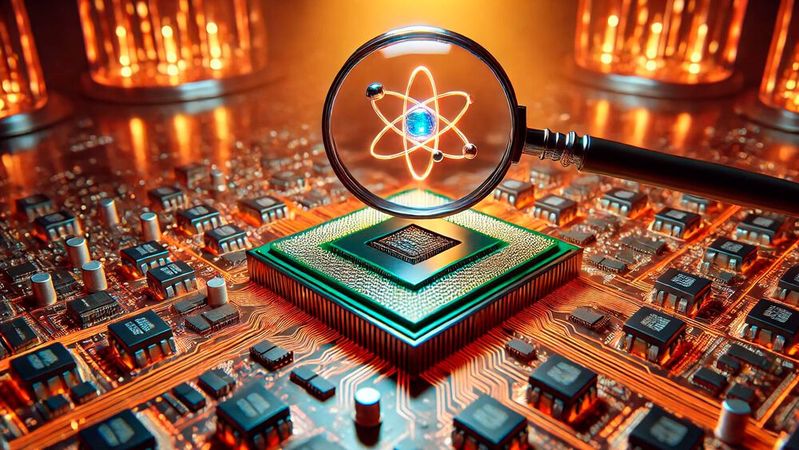
For almost half a century the pace of technological innovation has been linked to advances in miniaturization. Intel co-founder Gordon Moore was the first person to identify the link between miniaturization and processing power.
In 1965, Moore developed a theory that the number of transistors in an integrated circuit would double every two years. His prediction was proven right ten years later in 1975. We now refer to this theory as ‘Moore’s Law’. It’s one of the defining principles behind the rate of technological advancement in the 20th and 21st centuries.
However, Moore’s Law has run up against an inevitable physical barrier – the atom. The laws of physics dictate that we are reaching the limits of how small we can reliably manufacture semiconductor transistors using existing materials and processes.
According to many experts, we are reaching, or may have already come to, the end of Moore's Law. This has significant implications for the continued development of technology which could have severe detrimental impacts on the world economy and the environment.
Moore’s Law and the journey to the subatomic
It all starts with the transistor.
Transistors were invented in 1947 by Bell Labs physicists William Bradford Shockley, John Bardeen, and Walter Houser Brattain. 11 years later, Jack Kilby of Texas Instruments designed the world’s first integrated circuit. Then in 1959, independently of Kilby, Robert Noyce at Fairchild Semiconductor developed an integrated circuit using aluminum interconnects on a silicon dioxide layer. The world was on its way to the digital age.
The earliest transistors were roughly a centimeter long. By the 1990s, advances in lithographic technology enabled the production of transistors on a nanometer scale.
One nanometer is equal to one billionth of a meter. In the semiconductor industry, the term nanometer is frequently used to refer to the size of the transistors on a chip. The average size of a semiconductor transistor typically ranges from seven to ten nanometers - 500,000 times smaller than a millimeter. That’s smaller than a red blood cell, smaller than a single piece of pollen, and smaller than most bacteria. At around 300 nanometers, virus particles are significantly larger than most semiconductor transistors.
It does seem that the progress of semiconductor technology has been advancing in lockstep with Moore’s Law. Roughly every two years the number of transistors that have been able to fit on a chip has indeed doubled. Chips such as Apple’s M3 can have up to 25 billion transistors. The IBM 2-nm node chip can hold double that amount. Industry giants like TSMC and Intel have announced that they are on track to release one-nanometer nodes in 2027 featuring one trillion transistors.
For the next few years, at least, it appears that Moore’s Law will continue to be in effect.
:quality(80):fill(efefef,0)/p7i.vogel.de/wcms/5f/fe/5ffedb2e0ffa6/listing.jpg "listing")
Have we reached the end of Moore’s Law?
Appearances, however, can be deceptive. Practically speaking, Moore’s Law could not last forever. There are physical constraints that limit how small a transistor can be. Information cannot travel faster than the speed of light, which naturally limits computational speed. It’s not possible to make a transistor smaller than an atom. Indeed, significant issues arise even at the two nm to 3nm size.
Inevitably, miniaturization will run up against reliability issues determined by Heisenberg’s uncertainty principle. Various effects like quantum tunneling erode reliability and performance. Quantum tunneling causes electrons to jump unpredictably between barriers. This results in current leakage and reduced efficiency. Quantum tunneling makes it more difficult to control and isolate electrons within each transistor. This degrades the transistor's ability to switch states (from 0 to 1) accurately.
And there’s also the issue of overheating. Transistors generate intense heat in confined spaces. As the node sizes decrease, heat dissipation and energy efficiency become less effective.
These atomic and physical constraints limit the further miniaturization of transistors and may signal the end of Moore’s Law. In fact, some experts argue that Moore’s Law has been over for some time.
Professor Charles Leiserson of MIT believes Moore’s law ended in 2016. The professor makes the point that it took Intel five years to go from a 10-nanometer chip to a 14-nanometer chip (2014-2019). Although miniaturization has continued, the industry no longer operates according to the standards of Moore’s law.
In a Medium article, biochemist Matt Traverso writes that the industry definition of transistor scales isn’t accurate. A 3 nm transistor isn’t actually three nanometers wide. Manufacturers have adhered to the spirit of Moore’s Law by improving performance and efficiency, not the actual size of the transistor itself. Traverso points out that in terms of feature sizes and transistor densities, Intel’s 7 nm node was the same as its 10 nm node. As far as Traverso is concerned, titles such as 3nm are just marketing gimmicks. For him and other experts like him, Moore’s Law lost its meaning when semiconductor production shifted to different chip sizes designed for targeted applications.
If we believe experts like Leiserson or Traverso, Moore’s Law is ending soon, or it’s already come to an end. Where do we go from here?
:quality(80)/p7i.vogel.de/wcms/26/bb/26bbdf6d1fb03727189bad6e58ddba9d/0111179776.jpeg "The beginning of Silicon Valley as an epicenter of innovation began in 1955 with the arrival of the Shockley Semiconductors Laboratory. However, the wild days of Silicon Valley’s boom years are gone - this article explains why. (Source: Nicolas - stock.adobe.com)")
SEMICONDUCTOR HISTORY
The story of Silicon Valley – How it began, how it boomed, and where it’s headed
Overcoming Moore’s Law – Science fact or science fiction?
It’s not possible to overcome the physical barriers that signal the end of Moore’s Law using traditional semiconductor materials and technology. We need to transform how we build semiconductors and move into entirely new dimensions of computing. Some of which sound like they belong in a science fiction novel.
The first steps in going past Moore’s Law involve taking a different approach to building computers. Instead of flat miniaturization, companies are now looking at ways of using 3D-stacked chips to increase performance.
The basic concept is simple enough: chips are stacked on top of each other and connected using special vertical links called through-silicon vias (TSVs). 3D-stacked chips are smaller than side-by-side chip layouts, allow data to travel faster, and reduce power consumption. Known as a three-dimensional integrated circuit (3D-IC), this new die-stacking technology is already being used by industry leaders such as Apple, TSMC, Samsung, and Intel. It’s expected that products incorporating 3D chip stacking technology will be on the market in 2025.
Going past Moore’s Law could also mean going beyond the boundaries of space and time with quantum computing. Quantum computing leverages the strange properties of space and time at the quantum level, where particles can exist in multiple states simultaneously. It’s a mind-bending concept, to say the least.
Traditionally, we measure computation using a unit called a bit. Bits can be either 0 or 1. An electronic component in either of these two states holds one bit of information. In quantum computing, the unit measurement is called a qubit.
Qubits can be 0 and 1 simultaneously due to a property known as superposition. Qubits also have a property called entanglement. When qubits are entangled changing one qubits state will change all the others. Quantum entanglement allows qubits to connect even at massive distances. Stacking qubits enables a computer to calculate every possible outcome of an algorithm in one iteration.
The possibilities of quantum computing can read like science fiction. Qubits operating in multiple dimensions across huge distances of time and space to provide unimaginable computing power. But, as one might expect, developing quantum computing is exceptionally challenging.
Our brains might provide an answer. Research is now being conducted to develop neuromorphic chips. Neuromorphic chips mimic the structure and functioning of the human brain. Instead of the linear, clock-driven architecture of traditional processors, artificial neurons and synapses will process information simultaneously.
In theory, neuromorphic computers will be more efficient than traditional computers, so they can be massively scaled up without a corresponding increase in power use. Just like quantum computing, developing neuromorphic chips is incredibly complex and challenging. Neuromorphic computing is a promising area of research, and progress is being made, but we are still a long way from creating a computer that thinks as we do.
Overcoming Moore’s Law could produce another seismic shift in computing and propel human civilization into a new era. But we’re not there just yet. Multidimensional computing and cyborg-like laptops aren’t going to be ready for the market any time soon. So, what might happen in the meantime?
:quality(80)/p7i.vogel.de/wcms/c2/af/c2af97f38b9e7250331a7bfce252b291/0111441830.jpeg "From lifespan to the number of units produced annually worldwide: this article provides ten interesting facts worth knowing about semicondutors. (Source: blende11.photo - stock.adobe.com)")
SEMICONDUCTORS
10 Facts About the Semiconductor Industry
The implications of the end of Moore’s Law
Reaching the end of Moore’s Law is a serious problem for the tech industry. Continuing to chase ever-greater levels of miniaturization massively increases design and manufacturing costs. Only the very largest companies can afford to miniaturize chips to the atomic level and beyond. Smaller companies are being pushed out of the market. Competition and innovation are being stifled.
There is the risk that advances in computing technology will slow down for the first time in decades. New technology like AI and machine learning models require massive computational resources. Slower rates of miniaturization will make it harder to meet these demands.
The environment might also suffer because of our need to continuously scale up computing power. Larger and more power-hungry data centers will be needed. The demand for raw materials like silicon, rare earth metals, and other elements used in semiconductor manufacturing will increase. And so will the amount of e-waste that we produce.
However, the end of Moore’s law might have some positive impacts. A slowdown in miniaturization could force industries to focus on more sustainable solutions. Developing energy-efficient architectures and software to reduce energy consumption may become a priority. As consumers, we may have to use our devices for longer periods, which could lead to a reduction in waste.
Reaching the next stage of human development depends on our ability to advance our technology. While going past the physical limit of the atom isn’t possible, overcoming the end of Moore’s Law might be achievable. Quantum mechanics, neuromorphic chips, and advanced materials could open up new frontiers in computing and lead us into a new stage of civilization.
How we respond to the end of Moore’s Law will shape the future of our civilization and our planet. The problems of miniaturization are perhaps bigger than we ever imagined.
As we go past the constraints of Moore’s Law, we might find solutions to critical global challenges and the path to a more sustainable future. Or, we may struggle to sustain technological growth and become increasingly mired in resource scarcity, escalating energy consumption, and environmental degradation.
It all depends on how big our thinking is when it comes to getting smaller.
Sources
Power Electronics in the Energy Transition

The parameters for energy transition and climate protection solutions span education, research, industry, and society. In the new episode of "Sound On. Power On.", Frank Osterwald of the Society for Energy and Climate Protection Schleswig‐Holstein talks about the holistic guidance his organization can provide.
Listen now!
(ID:50247560)
:quality(80)/p7i.vogel.de/wcms/37/f0/37f0579b316150e010442b4d4f820171/0122207252v2.jpeg "The article discusses the significance of transistor count in the semiconductor industry, highlighting the current record-holding chips and exploring the future trends of miniaturization. (Source: nattapon - stock.adobe.com)")
:quality(80)/p7i.vogel.de/wcms/ba/48/ba480e85eb43f1969086dfa5b5b75a5b/0130186853v2.jpeg "Before this experiment, the reality of magnetism-based semiconductors did not match the theoretical expectation. Most magnetic semiconductors create a weak magnetic field and show no current variations. However, the new magnetic transistor might change the game… (Source: © Mahmood - stock.adobe.com)")