


:quality(80)/p7i.vogel.de/wcms/10/fc/10fcb98e44d61826e641bc8d3f20f616/0133193677v2.jpeg "The new AEVA and AEVB Series aluminum electrolytic capacitors are engineered for harsh industrial environments, delivering high-CV, long-lifetime performance in compact, surface-mount packages that reliably withstand up to 30g acceleration and operating temperatures extending from -55° to +125°C. (Source: Kyocera)")
:quality(80)/p7i.vogel.de/wcms/f7/42/f74208db9f5f87dca384b38b71c4782e/0133196365v2.jpeg "YAGEO’s EC Flat‑Series temperature sensors combine fast, accurate measurement with resistance to vibration, shock, moisture and dust for demanding automotive and industrial applications. (Source: Yageo)")
:quality(80)/p7i.vogel.de/wcms/b2/82/b28212428745dd8a4634ad4f4912012f/0132902689v2.jpeg "New 15 V, 25 V and 40 V eGaN FETs deliver ultra-low on-resistance, high current capability, and exceptional radiation immunity for high-density space power conversion (Source: EPC Space)")
:quality(80)/p7i.vogel.de/wcms/7b/4f/7b4f433302c490cac22eee9c12499e65/0132780211v2.jpeg "Littelfuse introduces the TPSMD‑FL series of high‑power surface‑mount TVS diodes, designed to simplify ISO 7637 load‑dump protection and safeguard automotive electronics against severe voltage transients. (Source: Littlefuse)")
:quality(80)/p7i.vogel.de/wcms/78/38/783841efab284c1b4453777e7ebea26d/0133190419v2.jpeg "Diodes has completed its acquisition of Elevate Semiconductor, expanding its analog and mixed-signal portfolio and strengthening its presence in the high-growth automated test equipment market. (Source: © peopleimages.com - stock.adobe.com)")
:quality(80)/p7i.vogel.de/wcms/1f/79/1f79d69530465de26a832c742fc60319/0133117717v2.jpeg "With 30,000 sqm of exhibition space, 20,157 trade visitors, 271 exhibitors, and 131 expert presentations as part of the conference program, the event sent a strong message about the industry's innovative strength and dynamism. (Source: Mesago Messe Frankfurt GmbH)")
:quality(80)/p7i.vogel.de/wcms/43/4d/434db2291567e847e54332004942a225/0132958267v2.jpeg "GlobalWafers has joined the SEMI Taiwan Materials Alliance, with CEO Doris Hsu serving as co‑chair, to advance critical materials technologies, accelerate collaborative innovation and strengthen global semiconductor supply chain resilience. (Source: © jiwon - stock.adobe.com)")
:quality(80)/p7i.vogel.de/wcms/6f/72/6f72f93d1e4c5a248a97dd3b8f32a336/0132997898v2.jpeg "Infineon plans to acquire C2i Semiconductors to combine software‑defined multiphase control and smart power stages with its broad power‑semiconductor portfolio for intelligent, scalable AI data‑center power delivery. (Source: © Grispb - stock.adobe.com)")
:quality(80)/p7i.vogel.de/wcms/87/97/879728679e7010f81e53a86923cde74c/0133218625v2.jpeg "Conceptual illustration of polar wurtzite niobium aluminum nitride (NbAlN), a transition-metal-containing nitride semiconductor that preserves the crystal structure and polarity of GaN. (Source: Associate Professor Atsushi Kobayashi from Tokyo University of Science, Japan)")
:quality(80)/p7i.vogel.de/wcms/ac/31/ac31c9478d80894d725d02883ae7ed5d/0133176534v2.jpeg "Average models allow power designers to simulate DC‑DC converters and three‑phase PFC circuits quickly, analyse small‑signal behaviour and evaluate loop stability without modelling every switching event. (Source: © AI - stock.adobe.com)")
:quality(80)/p7i.vogel.de/wcms/96/80/9680b468d7f682c8b6c15b07300afbb0/0133177854v2.jpeg "Grid-forming inverters are also known as grid-forming resources and grid-forming IBR. This article explains grid-forming inverters in detail. (Bild: © only_kim - stock.adobe.com)")
:quality(80)/p7i.vogel.de/wcms/57/c6/57c6fa81922a9849a917bdfed82eddf7/0133052494v2.jpeg "Rising demand for high-end materials shifts production toward higher-margin products, reducing output of standard loss materials. (Source: NCAB)")
:quality(80)/p7i.vogel.de/wcms/7b/76/7b76005554b556df2a7a3794bdf69d44/0132365246v2.jpeg "Hioki’s ST5680A DC Hipot Tester combines CE/UKCA/CSA compliance, an integrated capacitance‑based contact check and time‑series waveform recording (voltage, leakage current, insulation resistance) to standardize hipot and insulation testing across EV cell, module and pack production lines. (Source: Hioki)")
:quality(80)/p7i.vogel.de/wcms/af/7f/af7f7b0fb7f29219fc991b1130f65477/0132241333v2.jpeg "Comprehensive laboratory testing regimens—combining thermal cycling, high‑current stress, EMC, and accelerated lifetime tests—are essential to validate advanced power designs and ensure reliability in real‑world applications. (Source: PRBX)")
:quality(80)/p7i.vogel.de/wcms/16/3d/163df69363f8125315a9826e13ea4b05/0131927425v2.jpeg "Solution will maximize data center and AI factory profitability while delivering engineering-grade insights to design and operations for more efficient, sustainable, and resilient infrastructure. (Source: Cadence)")
:quality(80)/p7i.vogel.de/wcms/85/b7/85b7e90733a2bd8f21515d8f7137f2fc/0131917677v2.jpeg "Renesas acquires Pictorus to integrate its embedded application software platform with Renesas’ MCU and MPU portfolio, helping developers shorten time‑to‑market and simplify system integration. (Source: © lucadp - stock.adobe.com)")
QUANTUM TECHNOLOGY Nanomaterials under tension: Advancing quantum technology innovations
Related Vendors
:fill(fff,0)/p7i.vogel.de/companies/6a/20/6a202a4f89a62/mrs-white-on-blue-bg.png "mrs-white-on-blue-bg ()")
:fill(fff,0)/p7i.vogel.de/companies/62/b9/62b980cddf5d6/ceramtec.png "ceramtec (www.ceramtec-group.com)")
:fill(fff,0)/p7i.vogel.de/companies/5f/71/5f71d5f92a5f6/2000px-rogers-corporation-logo-svg.png "2000px-Rogers_Corporation_Logo.svg.png (rogers germany)")
Researchers at Empa and ETH Zurich are creating an electromechanical system to apply tension to nanomaterials, potentially enabling novel electronic components for quantum technologies like IT, communication, sensors, and energy conversion. Empa's Peter Lendway won first prize in the SNSF video competition for showcasing this system in action.
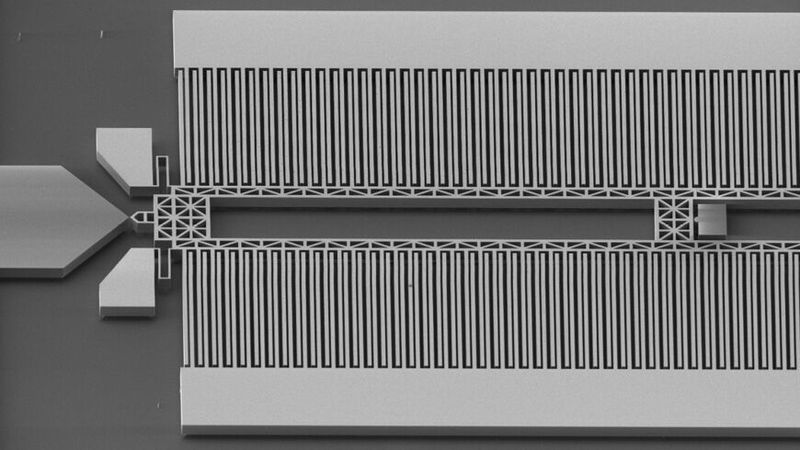
The silicon comb moves for 200 nanometers before getting pushed back into its original position by the built-in spring. This movement cannot be seen with the naked eye nor with an optical microscope, so Peter Lendway, doctoral student at Empa's Transport at Nanoscale Interfaces laboratory and at ETH Zurich, used a scanning electron microscope to record it. For the resulting video, the researcher was awarded first prize in the video category of the SNSF scientific image competition.
Lendway is developing a silicon actuator that is able to generate motion of just a few nanometers. This is achieved using an electrostatic comb drive that is suspended and held in position using several built-in springs. The structures in the video form what is known as an electromechanical system, which converts electrical signals into mechanical movement in a similar way to a conventional electric motor. Unlike motors, however, which are primarily used to transmit power, miniaturized versions of electromechanical systems are often used as high-precision sensors – for example in vehicles to measure acceleration, rotation or position. Their strength lies less in the generation of large movements and more in the fine control and detection of the smallest changes. Lendway's system works with movements at the lower limit of what is possible, with precision and control down to individual nanometers. The researcher wants to use this to apply mechanical tension to quantum materials such as graphene, graphene nanoribbons (GNRs) and carbon nanotubes (CNTs).
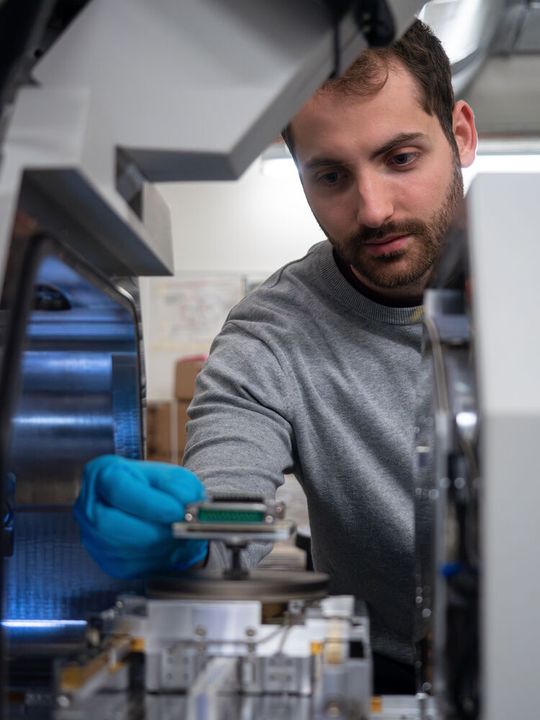
"Calculations and simulations in theoretical physics show that, under mechanical stress, these carbon-based nanomaterials could acquire novel electronic, optical and mechanical properties," explains Lendway. "However, so far hardly anyone has succeeded in demonstrating these effects experimentally – especially under cryogenic conditions. Measurements at very low temperatures are an essential prerequisite for most applications in quantum technology." Deforming quantum materials just a few nanometres in size in a controlled manner without damaging them, and measuring their properties at the same time is no easy task. As part of his doctorate at the Department of Information Technology and Electrical Engineering (D-ITET) of ETH Zurich, Lendway is developing a platform that will make this possible. His work is supported by the Swiss National Science Foundation (SNSF) and the State Secretariat for Education, Research and Innovation (SERI).
With high precision
The system in the video is one of several systems Lendway has developed for different types of nanomaterials. All systems use an electrostatic actuator in which capacitors are arranged in several rows like the teeth of a comb. Two of these comb-like structures interlock without touching each other. Voltage is applied to one of the combs – visible in the video as a dark discoloration. This causes the charged and uncharged combs to attract each other. A stopper at one end of the actuator ensures that the movement does not exceed 200 nanometers. As soon as the voltage is reduced, a springs return the actuator to its starting position. The system in the video is designed to contact individual molecules. For this purpose, there is a fine bridge of pure gold at the left end of the structure that can be broken to form atomically sharp electrodes.
The high-precision manufacturing of the tiny electromechanical systems is demanding. A single speck of dust, a hair – and the entire system is out of order. This is why Lendway fabricates the electromechanical devices in the clean room at the Binnig and Rohrer Nanotechnology Center (BRNC) of IBM, ETH Zurich and Empa in Rüschlikon. They are then transported to Empa under a protective atmosphere to carry out the experiments. It takes around ten days to produce a chip, which can hold between 54 and 74 such systems.
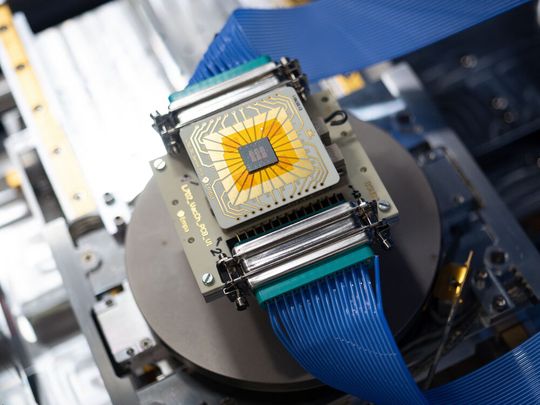
Lendway's project is not yet complete. "We have successfully developed various platforms, each of which is suitable for a different nanomaterial. Now we are starting to investigate their properties," says the researcher. Their findings could one day contribute to the development of nanoscale electronic components with new characteristics, which would open up possibilities in the fields of quantum technologies and more efficient energy use and help us better understand materials at a fundamental level.
Power Electronics in the Energy Transition

The parameters for energy transition and climate protection solutions span education, research, industry, and society. In the new episode of "Sound On. Power On.", Frank Osterwald of the Society for Energy and Climate Protection Schleswig‐Holstein talks about the holistic guidance his organization can provide.
Listen now!
(ID:50416957)
:quality(80)/p7i.vogel.de/wcms/59/29/59299106ab669d72894f37dbd44d310f/0126697082v2.jpeg "Empa researchers working with the Aurora robotic platform, which enables fully automated battery experiments. (Source: Empa)")
:quality(80)/p7i.vogel.de/wcms/4d/39/4d390c935fec4cd94dab8d1ec43fc67d/0128521086v2.jpeg "Symbolic image: A retrofitted EV charges wirelessly via the ground-embedded coil, with the charging process starting automatically once the vehicle is positioned correctly. (Source: © Johnnii - stock.adobe.com)")