


:quality(80)/p7i.vogel.de/wcms/2f/f3/2ff3221bf7665de2d0acf83760bfd1fa/0130031523v2.jpeg "Wolfspeed presents a 300 mm silicon carbide technology platform designed to support advanced packaging and high-efficiency power delivery for AI data center infrastructure. (Source: Wolfspeed)")
:quality(80)/p7i.vogel.de/wcms/c3/16/c316e955a97f5d72d9678297b237b9e5/0129932858v2.jpeg "Left: the single-phase version of the SENTRON ECPD with RCM, right: a model of the future three-phase version of the SENTRON ECPD. (Source: Siemens)")
:quality(80)/p7i.vogel.de/wcms/ef/0a/ef0adb0acf793fe147cc27c21f6a7a67/0129954238v2.jpeg "Empower Semiconductor introduces embedded silicon capacitors designed to improve power delivery and stability in AI and high-performance computing processors. (symbolic image) (Source: © IF.arc - stock.adobe.com)")
:quality(80)/p7i.vogel.de/wcms/53/f9/53f9301dfc9292d02960f7996c79cc6e/0129927601v2.jpeg "Wolfspeed’s new 10 kV SiC MOSFET enables high-voltage power conversion for grid and industrial applications. (symbolic image) (Source: © CREATIVE- 3.4 - stock.adobe.com)")
:quality(80)/p7i.vogel.de/wcms/6e/cd/6ecd41d095d5111cf4ed37b714844487/0129930878v2.jpeg "PCIM Asia Shenzhen provides a platform for industry experts to present new developments in power electronics and electrification technologies. (symbolic image) (Source: © killykoon - stock.adobe.com)")
:quality(80)/p7i.vogel.de/wcms/02/c0/02c0e9722f70b1134dbf96fb59a9c73d/0129655179v2.jpeg "The PCIM Conference 2026 will take place from June 9-11, featuring discussions on power electronics trends, including GaN technology and AI applications. (symbolic image) (Source: © Elmira - stock.adobe.com)")
:quality(80)/p7i.vogel.de/wcms/cc/67/cc670ea2029cd2af5c641af70e1bf734/0129816392v4.jpeg "Fraunhofer IAF coordinates the EU SUPREME project to accelerate GaN and SiC power semiconductor innovation in Europe. (Source: Fraunhofer IAF)")
:quality(80)/p7i.vogel.de/wcms/ea/e6/eae6aee30071e67a5627027974437134/0129544613v2.jpeg "GlobalFoundries and Renesas strengthen their collaboration to support U.S.-based semiconductor production and supply chain resilience. (Source: © ronstik - stock.adobe.com)")
:quality(80)/p7i.vogel.de/wcms/3c/4b/3c4bbc68dda65c7071b4376fb57423b0/0130030465v2.jpeg "Faraday’s laws explain the fundamental behavior of magnetic fields and electronic devices in dynamic use cases. The operation of transformers, wireless chargers, induction cookers, induction motors, magnetic levitating trains (MAGLEV Trains), electric violin, and many others depends upon Faraday’s laws. (Source: © Sheraz - stock.adobe.com)")
:quality(80)/p7i.vogel.de/wcms/b1/5e/b15ee02b0ba02db70cf61e37d66ad1d3/0129349127v2.jpeg "Vehicle-to-grid (V2G) chargers enable bidirectional energy flow, allowing electric vehicles to act as mobile energy storage systems that can both draw power from and feed power back into the grid. (Source: © medienvirus - stock.adobe.com)")
:quality(80)/p7i.vogel.de/wcms/26/d5/26d591cc340077026eac56a0e7564faf/0129949603v2.jpeg "Flexible: The solid silicone-based electrolyte is elastic, thereby compensating for the voids that form in solid-state batteries during charging and discharging. (Source: Empa)")
:quality(80)/p7i.vogel.de/wcms/4d/e0/4de02f76a37cbb3df30dd231de589c8e/0128866890v2.jpeg "Both legacy and vGaN show higher carrier mobility and band gap energies compared to other power semiconductors. (Source: © phonlamaiphoto - stock.adobe.com)")
:quality(80)/p7i.vogel.de/wcms/be/c8/bec8d43fc0ee73414274be44608b2970/0129748903v2.jpeg "The Infiniium XR804KA real-time oscilloscope delivers faster response time, improved stability, and streamlined workflows for high-speed digital and compliance testing. (Source: Keysight)")
:quality(80)/p7i.vogel.de/wcms/23/ee/23ee4a97790d6009dbfd7d9577ffa723/0129220424v2.jpeg "The R&S FPL1044 with the new RTSA option makes 40 MHz real-time frequency analysis available up to 44 GHz. (Source: Rohde & Schwarz )")
:quality(80)/p7i.vogel.de/wcms/3c/d1/3cd1cacbceb792ba63727199c61ca434/0127801860v2.jpeg "Thanks to cloud technology, users can collaborate on projects from anywhere and always have access to the latest planning data. (Source: SIEMENS)")
:quality(80)/p7i.vogel.de/wcms/5a/a0/5aa0436498af618297961fd54ab36cdf/0126290792v2.jpeg "Siemens accelerates student-led semiconductor innovation across Europe’s leading technical universities through Cre8Ventures’ Open Higher Education Program developed in collaboration with Arm and University of Southampton (Source: Siemens Digital Industries Software)")
ENERGY STORAGE Microcapacitors to offer on-chip power supply
Related Vendors
:fill(fff,0)/p7i.vogel.de/companies/60/7e/607ec89d5d9b5/white-frame.jpg "white frame.jpg (www.rohm.com)")
:fill(fff,0)/p7i.vogel.de/companies/62/a0/62a0a0de7d56a/aic-europe-logo.jpeg "aic-europe-logo (AIC Europe)")
:fill(fff,0)/p7i.vogel.de/companies/5f/71/5f71d5f92a5f6/2000px-rogers-corporation-logo-svg.png "2000px-Rogers_Corporation_Logo.svg.png (rogers germany)")
Do you know that capacitors could become as small as a transistor integrated into a chip? Two scientists have fabricated “microcapacitors” on a chip with exceptional energy storage and power densities. Check out the article to learn about the record-breaking technology expected to offer on-chip power solutions and compete with lithium-ion batteries.
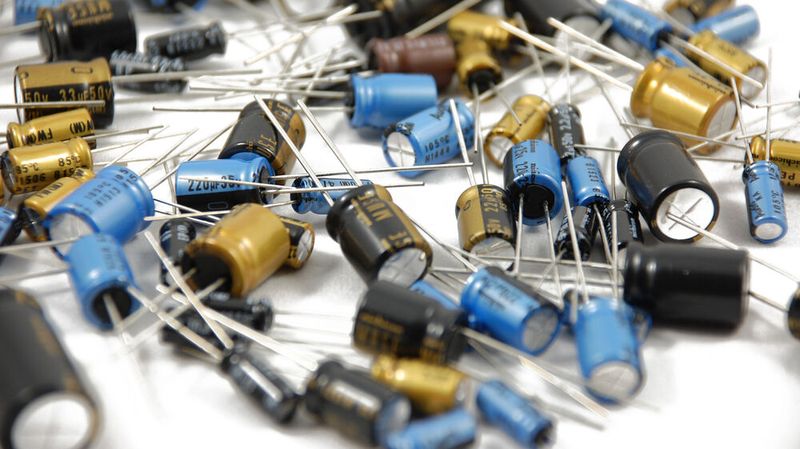
Scientists at Lawrence Berkeley National Laboratory (Berkeley Lab) and UC Berkeley published a nature study and called their experiment a “microcapacitor”. Most people think of capacitors as standalone small electronic components, mostly in cylindrical shape. However, capacitors can be integrated into a semiconductor chip. In such a case, a capacitor becomes a “microcapacitor”!
Capacitors use insulating dielectric materials to create electric fields and store energy through electrostatic charge instead of chemical energy in batteries. It enables capacitors to charge quickly. However, the energy storage density of capacitors is relatively lower than that of batteries. Smaller batteries store the same charge compared to bigger capacitors.
Conventionally, energy storage devices trade off energy storage density for power density. The amount of power a storage device can deliver relative to its physical size is called the power-to-size ratio. Ideally, the power-to-size ratio must be higher for capacitors or any energy storage device.
In simple words, increasing charge storage capacity decreases the speed of charge/discharge and vice versa. Microcapacitors solve this problem by showcasing a balanced approach with higher values of energy storage and power densities. As a result, microcapacitors have improved power-to-size ratio.
:quality(80)/p7i.vogel.de/wcms/90/1b/901be2f3de5787e00dcd5d7fafa59333/0119258051v2.jpeg "Find out more about the current chip shortage situation in this article. (Source: Mohsin - stock.adobe.com)")
CHIP SHORTAGE NEWS
The global semiconductor crisis: A review of Q2 2024
How were microcapacitors built?
The foundation of the microcapacitor lies in its thin film construction. This section explores the materials and techniques used to create this critical component.
Thin-films
Initially, there is a 2 nm ultra-thin film— it is exactly what they call a “microcapacitor”. The ultra-thin film consists of a composite material made from hafnium dioxide and zirconium dioxide. These two compounds are dielectric materials.
An amorphous aluminum oxide layer is added to maintain the crystal structure of the microcapacitor in between different layers. In addition, this layer is important to scale up storing capabilities. The final structure has a thickness of about 100 nm.
The thin film is integrated into a silicon-based chip using the ALD (Atomic Layer Deposition) method. The microcapacitor fabrication procedure is compatible with all classic fabrication methods. A similar method is used in DRAM memory as well.
The superlattice
The microcapacitor structure represents a ‘superlattice’- an alternating layer structure of thin materials. The alternating layer structure reduces overall capacitance. This superlattice structure reduces film-related thickness limitations and increases total energy storage more than a single-layer construction would.
Antiferroelectric to ferroelectric
The integrated thin film is antiferroelectric in nature. These layers are engineered close to the field-driven ferroelectric phase transition state. In simple words, the antiferroelectric layers are engineered to a point where they can turn into ferroelectric to enhance intrinsic energy storage.
Both antiferroelectric and ferroelectric materials are used in memories and capacitors. Antiferroelectric materials have aligned electric dipoles in opposite directions, resulting in no net polarization. On the other hand, ferroelectric materials exhibit spontaneous polarization in the absence of an electric field.
A ferroelectric material has a high dielectric constant to allow capacitors to store more charge. The phase change into a ferroelectric state enables the microcapacitor to exhibit a negative capacitance effect. A negative capacitance effect is a phenomenon where reduced applied voltage can store substantial amounts of charge.
Antiferroelectric materials are compatible with manufacturing processes. The antiferroelectric to ferroelectric phase transition is possible by adjusting the hafnium dioxide and zirconium dioxide ratio in the composite film. Simply put, the antiferroelectric phase transition to ferroelectric amplifies the charge storage capacity and energy storage density of the microcapacitor.
:quality(80)/images.vogel.de/vogelonline/bdb/1942500/1942590/original.jpg "Researchers at the University of Bremen are focusing on overcoming the challenges to make aqueous zinc-ion batteries market-ready. (©deepagopi2011 - stock.adobe.com)")
BATTERY TECHNOLOGY
On the path to the next generation of energy storage systems
3D trench structures
The antiferroelectric superlattices are engineered into 3D trench capacitor structures to increase energy storage per footprint. The thin films grow in the deep trenches cut into silicon- A process used in modern DRAM cells. The shape of the energy storing area becomes a three-dimensional structure instead of planar.
Result
Energy storage density = 80 mJ/cm2
Power density = 300 kW/cm2
Boosting the area-specific and volumetric energy storage density with power density capabilities does not mean taking up more space on a chip. As a result, microcapacitors become more efficient and compact.
These microcapacitors were able to achieve area-specific energy storage density about nine times that of traditional capacitors. Similarly, microcapacitors achieved a record-breaking power density of about 170 times that of best-known traditional capacitors.
How can microcapacitors shape the energy storage industry?
The energy stored by a microcapacitor on a chip is called on-chip energy. Unlike “big” energy storage systems, on-chip energy needs to deliver power over a small area. The on-chip power supply gives hope for lesser losses and faster charging solutions for applications. In addition, there is no risk of chemical leakage like batteries.
Applications
Beyond their impressive performance on a chip, microcapacitors hold immense promise for a wide range of applications. These applications span various sectors, from powering miniature electronics and boosting memory performance to potentially revolutionizing energy storage in electric vehicles and enabling advanced Internet of Things (IoT) functionalities.
- Micro supercapacitors and micro batteries in EVs.
- On-chip power supply to FPGAs, processors, and peripherals.
- As mentioned above, DRAM already uses capacitors. Integrating microcapacitors could improve DRAM performance.
- Consumer electronics: smartphones, laptops, tablets, wearables, and home appliances.
- Medical devices: Pacemakers, insulin pumps, and health monitors.
- IoT (Internet of Things): Remote sensors and actuators
- 5G Telecommunications.
- Robotics, especially miniature robots.
- Industrial power electronics applications: UPS (Uninterrupted Power Supply), energy management systems, motor drivers, power equipment, etc.
:quality(80):fill(efefef,0)/p7i.vogel.de/wcms/5f/fe/5ffedb2e0ffa6/listing.jpg "listing")
Experiment Summary
Scientists meticulously crafted these groundbreaking microcapacitors through a series of innovative steps.
- Scientists used a 2 nm ultra-thin film made from a composite material consisting of hafnium dioxide and zirconium dioxide.
- An additional amorphous aluminum oxide layer was added to increase the thickness to 100 nm.
- The alternating layers of hafnium dioxide and zirconium dioxide created a structure called a “superlattice”.
- Superlattice eliminates thickness limitations and improves the total energy storage capacity of the microcapacitor.
- The integrated thin film is antiferroelectric.
- Thin film is engineered close to the ferroelectric phase transition state.
- Phase transition increases intrinsic energy storage capacity and negative capacitance.
- The most important point in summarizing the whole experiment is negative capacitance.
- Negative capacitance is a counterintuitive effect that stores a greater amount of charge at a lower voltage.
- The thin film is engineered into 3D trench capacitor structures to increase energy storage per footprint.
- Microcapacitors were able to achieve area-specific energy storage density of about nine times and a power density of about 170 times that of traditional capacitors.
References
(ID:50106319)
:quality(80)/p7i.vogel.de/wcms/bf/a2/bfa277a5c1330e67e3ba50d9da823970/0127853966v2.jpeg "Historically, capacitors were named as condensers. But the condenser was another device, not even similar to the capacitor. In the 20th century, the term \"capacitor\" replaced the term \"condenser.\" The industry took a considerable time to accept the new name. (Source: © Kuzmick - stock.adobe.com)")
:quality(80)/p7i.vogel.de/wcms/8b/ed/8bed230f3f9de9859f94928062984cec/0124637555v2.jpeg "Varactor diodes offer voltage-driven control over the transition capacitance of the junction and provide electrically controllable capacitance in microwave applications. Instead of capacitors, varicaps store charge at high radio frequencies. (Exemplary picture showing various types of diodes) (Source: © Thomas N. - stock.adobe.com)")