


:quality(80)/p7i.vogel.de/wcms/b8/13/b8139abf82c98aa04248a4a119d28c13/0129194616v2.jpeg "A 600V super junction MOSFET platform supports efficient switching and reduced losses in high-voltage power conversion designs. (Source: Aplha & Omega Semiconductor)")
:quality(80)/p7i.vogel.de/wcms/62/80/6280da00d591873bf8f0b2a70e5986e0/0129064771v4.jpeg "High-efficiency IGBTs support power conversion in solar inverters and energy storage systems by reducing losses and improving system performance. (Source: Magnachip)")
:quality(80)/p7i.vogel.de/wcms/60/f6/60f60a22a65f51b4f3603fd1bf64401a/0129067839v2.jpeg "Designed for high-voltage applications, 600V gate drivers enable faster, more reliable switching while supporting system efficiency and robustness. (symbolic image) (Source: © Muttaqin - stock.adobe.com)")
:quality(80)/p7i.vogel.de/wcms/bc/97/bc97cce107109a551f26fb8076ae1da8/0129190430v2.jpeg "A 200V BCD process enables efficient and reliable high-voltage power ICs for automotive electronics and data center power systems. (Source: © ModernFiles - stock.adobe.com)")
:quality(80)/p7i.vogel.de/wcms/b3/13/b313941dbf7adc57c6d144966106d82b/0129219607v2.jpeg "CFIUS approval allows Wolfspeed to complete an equity issuance to Renesas as part of its court-approved restructuring process. (Source: © tippapatt - stock.adobe.com)")
:quality(80)/p7i.vogel.de/wcms/56/a4/56a4d9b6ee131a7a00b8b89dabf108f9/0128979281v2.jpeg "Thsi acquisition expands access to processor IP solutions and strengthens the foundry’s platform for building advanced chips. (symbolic image) (Source: © Shoaib - stock.adobe.com)")
:quality(80)/p7i.vogel.de/wcms/67/62/676279913d77e1db48eb5cbe9be4c767/0128937895v2.jpeg "(Bild: © WrightStudio - stock.adobe.com)")
:quality(80)/p7i.vogel.de/wcms/0f/a2/0fa2b5bdc21e408fd73e637d226d5210/0128681532v2.jpeg "Symbolic Image: Wind and solar power lead Germany’s electricity generation in 2025, marking a continued shift toward renewable energy. (Source: © koosy - stock.adobe.com)")
:quality(80)/p7i.vogel.de/wcms/7d/40/7d406bd959b3a9127c33a66157f9030a/0128339184v4.jpeg "The global digital infrastructure depends on the production of advanced semiconductor materials (Source: © uflypro - stock.adobe.com)")
:quality(80)/p7i.vogel.de/wcms/65/22/65223bc58811ced76adbfa7b5615d532/0129061536v2.jpeg "This article explains topological insulators and explores whether they can optimize electronic systems. (Source: © Rick - stock.adobe.com)")
:quality(80)/p7i.vogel.de/wcms/ea/20/ea20c0beb93f34ab43b28750644bbdca/0128983445v2.jpeg "A Cycloconverter is an AC-AC converter that directly converts successive segments of a constant amplitude AC waveform at a higher frequency to another AC waveform at another lower frequency, without a DC link. (Source: © wpw - stock.adobe.com)")
:quality(80)/p7i.vogel.de/wcms/b1/0a/b10a283cdf3e5f156781a7273c71a7e0/0129107484v2.jpeg "Circular design strategies are increasingly shaping how power electronics are designed, reused, and recovered across their life cycle. (Source: © Enrique - stock.adobe.com)")
:quality(80)/p7i.vogel.de/wcms/23/ee/23ee4a97790d6009dbfd7d9577ffa723/0129220424v2.jpeg "The R&S FPL1044 with the new RTSA option makes 40 MHz real-time frequency analysis available up to 44 GHz. (Source: Rohde & Schwarz )")
:quality(80)/p7i.vogel.de/wcms/3c/d1/3cd1cacbceb792ba63727199c61ca434/0127801860v2.jpeg "Thanks to cloud technology, users can collaborate on projects from anywhere and always have access to the latest planning data. (Source: SIEMENS)")
:quality(80)/p7i.vogel.de/wcms/5a/a0/5aa0436498af618297961fd54ab36cdf/0126290792v2.jpeg "Siemens accelerates student-led semiconductor innovation across Europe’s leading technical universities through Cre8Ventures’ Open Higher Education Program developed in collaboration with Arm and University of Southampton (Source: Siemens Digital Industries Software)")
:quality(80)/p7i.vogel.de/wcms/cb/30/cb30ebdca7fcaea281749cb396654eb3/0124716339v2.jpeg "Rolls-Royce unveils Battery Analytics for its mtu EnergyPack, offering real-time insights, predictive maintenance, and enhanced cybersecurity to boost performance and longevity. (Source: Rolls-Royce plc)")
Basic Knowledge- Josephson Junction Josephson Junction: The “Transistor” of Superconductors
Related Vendors
:fill(fff,0)/p7i.vogel.de/companies/60/7e/607ec89d5d9b5/white-frame.jpg "white frame.jpg (www.rohm.com)")
:fill(fff,0)/p7i.vogel.de/companies/5f/71/5f71d5f92a5f6/2000px-rogers-corporation-logo-svg.png "2000px-Rogers_Corporation_Logo.svg.png (rogers germany)")
:fill(fff,0)/p7i.vogel.de/companies/60/76/607651ea5d461/logo-sq.jpg "logo sq.jpg (KOKI)")
“Josephson Junctions” are to “Superconductors” what “Transistors” are to “Semiconductors”! Built on a superconductive phenomenon called the Josephson Effect, Josephson Junctions revolutionize high-precision measurement and quantum computing. The article describes Josephson Junctions with their working principles, types, measurement capabilities, applications, technical challenges, and future scope.

Josephson Effect is a superconductivity phenomenon that occurs through quantum tunneling. This effect is observed in a quantum mechanical macro-device called Josephson Junction. Both the effect and the device are named after its discoverer British Physicist Brian D. Josephson.
Josephson Effect and quantum tunneling are critical concepts of superconductivity and quantum mechanics. These contributions led Brian D. Josephson and two other physicists Leo Esaki and Ivar Giaever to win the 1973 Nobel Prize in Physics.
Josephson Junction
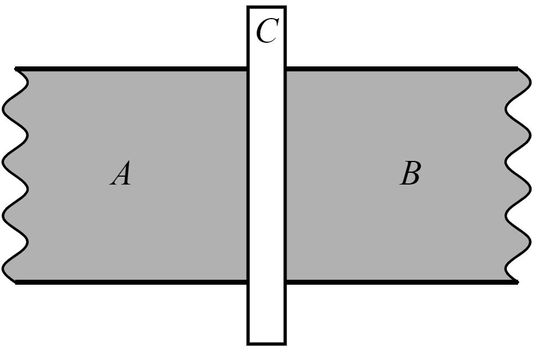
Josephson Junction is a device made by sandwiching a thin strip of non-superconducting material between two superconducting materials. Just like any other superconductive material, Josephson Junction operates only when the temperature approaches absolute zero (-273.15 degrees Celsius or 0 Kelvin). Depending upon the choice of superconductive materials, the temperature ranges from -263 to -196 degrees Celsius (4 to 77 Kelvin) for the normal phase to transition into the superconducting phase.
Similarity between Josephson Junctions and transistors
The structure of Josephson Junctions resembles transistors. In comparison to semiconductors, Josephson Junctions operate analogously to transistors but with a high precision. Series or parallel connected Josephson Junctions can be a part of a stand-alone device or a chip.
A hundred thousand or millions of Josephson Junctions are integrated on a chip. Similar to traditional semiconductor ICs, the Josephson Junction IC is available in both types: logic and memory chips. However, every Josephson Junction IC requires cryogenic refrigeration.

How does Josephson Junction work? (DC Josephson Effect)
The Josephson Junction working is explained through the DC Josephson Effect. It is because the DC Josephson Effect is called the “classical” Josephson Junction. See section 3 ahead for types of Josephson Effects.
Barrier potential
The non-superconducting material can be an insulator with a thickness lesser than or equal to 30 angstroms. It can also be several micrometers-thick metal (conductor). Another method is to use a physical constriction (S-c-S) that weakens superconductivity at the point of contact.
:quality(80)/p7i.vogel.de/wcms/47/dd/47ddb73b4e9064b40fdacdfec7ba51da/0117317544.jpeg "The experiment gave rise to a new quantum state that hasn’t yet been discovered or understood. (Source: schab - stock.adobe.com)")
MATERIAL SCIENCE
Switching between superconductors and insulators
If an insulator is used as the non-superconducting layer in the Josephson Junction, the device is called a superconducting tunnel junction or STJ. Simply put, STJ is a type of superconductor-insulator-superconductor junction (S-I-S). However, not all STJs fall into the category of Josephson Junction.
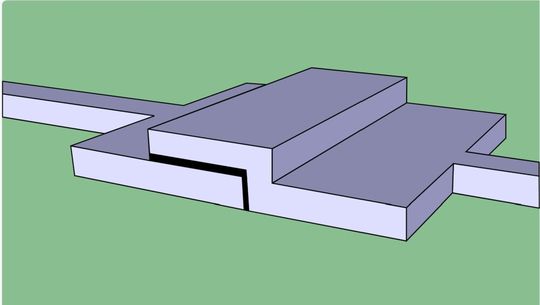
In practice, YBCO, niobium, or aluminum are common choices for the superconductive material in Josephson Junctions. If aluminum is chosen, the oxide formation process becomes relatively simple. The barrier layer is mostly made from insulating amorphous aluminum oxide, which is natively grown on aluminum.
The non-superconductive layer is a weak link between two superconductors. It functions as the potential barrier to prevent the flow of charge carriers. In classical physics, without the application of input voltage, electrons do not exhibit enough energy to cross the potential barrier and diffuse across the junction.
Quantum behavior of electrons
It is important to know about the dual nature of electrons. Electrons exhibit both wave-like and particle-like behavior. This concept is known as wave-particle duality. It means that electrons can function like a wave and a particle in a quantum field at the same time.
Heisenberg's uncertainty principle suggests that it is impossible to accurately calculate the position and momentum of a particle in a system. This principle suggests that quantum mechanics can only calculate the probability of a particle existing at a point in space-time.
The wave function () is a mathematical entity that describes the quantum state of a particle. In reality, the entangled quantum state must be reduced to a single quantity. The born rule determines the probability of finding a particle at a point ‘x’ by squaring the amplitude of the wave function [(x)2].
Quantum tunneling
Quantum tunneling is defined as the phenomenon that enables an electron to cross a potential barrier even when it does not have enough energy to do so. In Josephson Junction, electrons tunnel through the non-superconducting barrier from one superconductor to another.
As two superconductors are placed close enough in Josephson Junction, the wave functions of electrons slightly extend into the non-superconducting barrier. In simple words, the probability of electrons being present near the non-superconducting barrier is very low but not zero.
When wave functions of two electrons from both superconductive sides extend onto the barrier and overlap, quantum tunneling starts to take place. Fermi levels of these two electrons in both superconductive sides must be aligned for effective quantum tunneling.
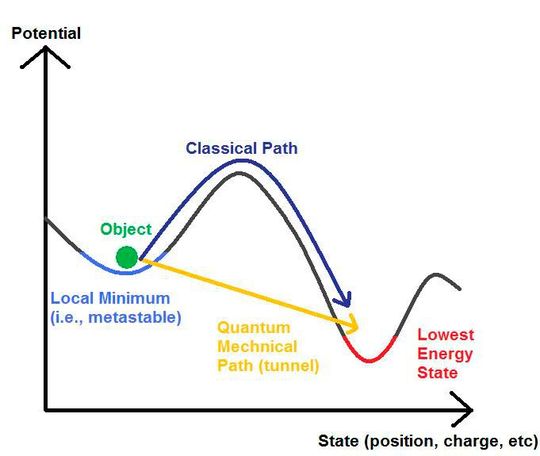
Quantum tunneling defies the laws of classical physics. In superconductors like Josephson Junction, quantum tunneling is usually called superconductive tunneling. Both quantum tunneling and superconductive tunneling are nearly the same thing. However, cooper pairs tunnel through the potential barrier in superconductive tunneling.
Cooper pairs
All metals contain a pool of positively charged atoms (cations). All these atoms in the lattice vibrate at normal or high temperatures. When the temperature approaches absolute zero, the atom vibration ceases. In addition, a superconductor expels weak magnetic fields (Meissner’s effect).
In this superconductive state, electrons move freely without collision. As an electron moves through the metal, it draws the positive charge attraction. The region around the moving electrons becomes slightly positive. It looks as if the positive charge is moving instead of the electron.
Another electron gets attracted to the same electron. In other words, we can say that an attractive force binds the electron pair. Due to attractive interaction between the electrons, their energy levels drop to lower-energy states below the fermi levels. Such an energy level binds them together.
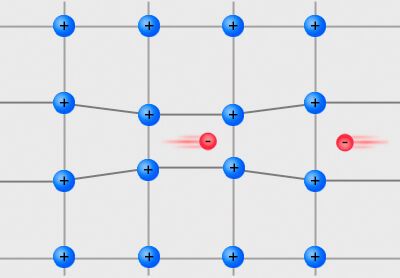
The electron pair that exhibits attraction and moves together is known as a "cooper pair”. This phenomenon is unusual as like-charges always repel. Two electrons with opposite spin and momentum form this pair. As there is no collision between atoms and electrons, the electrical resistance reduces to zero.
Supercurrent

Due to the presence of attractive force, cooper pairs do not collide with atoms in the lattice. No energy is lost. Simply put, Josephson Junction offers no resistance to current flow. The flow of cooper pairs across the Josephson Junction without dissipation is called supercurrent.
Dissipationless supercurrent flows in the Josephson Junction up to a maximum critical value called critical current. Beyond this critical value, the kinetic energy of cooper pairs increases. When kinetic energy overcomes the binding energy, bound electrons break the pairs and scatter. In addition, quantum tunneling stops.
:quality(80)/p7i.vogel.de/wcms/b2/4f/b24f4455e347520465f1d2d37769666c/0117181551.jpeg "Both AC and DC describe types of current flow in a circuit. In direct current (DC), the electric charge (current) only flows in one direction. Electric charge in alternating current (AC), on the other hand, changes direction periodically. (Source: ATKWORK888 - stock.adobe.com)")
BASIC KNOWLEDGE - AC VS. DC
What's the difference between AC and DC power?
Josephson Junction loses its superconducting properties and transitions back to a normal resistive material. An AC voltage develops across the junction. Critical current is defined as the maximum supercurrent a Josephson Junction can carry while maintaining superconductive characteristics. The critical current depends on barrier thickness, temperature, and magnetic fields.
Types of Josephson Effect
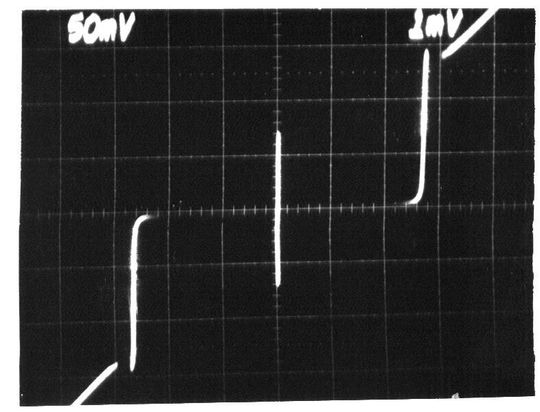
DC Josephson Effect
DC Josephson Effect is the phenomenon where supercurrent flows across the Josephson Junction in the absence of applied voltage. This happens due to quantum tunneling. The magnitude of this supercurrent is dependent upon the phase difference between the superconducting wave functions on either side of the junction.
AC Josephson Effect
When a fixed voltage (DC voltage) is applied across the Josephson Junction, an alternating current flows through the device. The frequency of this AC current is directly proportional to the applied voltage. The AC Josephson Effect enables the device to operate as a perfect voltage-to-frequency converter.
Inverse AC Josephson Junction
When an alternating current (AC) is applied across the Josephson Junction, a DC voltage is induced. In such a device, microwave radiation of a single angular frequency can induce a DC voltage.
The magnitude of this quantized DC voltage is proportional to the frequency of AC. The inverse AC Josephson Effect enables the device to operate as a perfect frequency-to-voltage converter used in precision, measurement, and quantum mechanical-based devices.
Precision measurement and metrology
Voltage standards
Josephson voltage standards are based on Josephson DC and AC Effects. When no voltage is applied across the Josephson Junction, a supercurrent still flows through it. As the supercurrent exceeds the value of the critical current, an AC voltage can be measured across the junction.
Arrays containing thousands of Josephson Junctions are integrated into a superconducting chip. The IC is subjected to microwave radiation at a precise frequency ‘f’ and a temperature of -272.15 degrees Celsius (4 Kelvin). The complex system generates precise voltages that are considered to be standard reference.
The magnitude of quantum-generated voltage is directly proportional to the frequency of microwave radiation. Josephson Junctions tend to produce highly precise quantum-mechanically defined standard voltages called JVS (Josephson Voltage Standard). The quantum JVS has been internationally recognized as the most accurate way to measure voltages.
New-age fabrication processes have enabled manufacturing arrays containing a large number of integrated Josephson Junctions. Conventional Josephson Junction arrays, available in the market, generate stable quantum-based DC voltages to set accurate voltage standards. On the other hand, programmable pulse-driven arrays generate stable quantum-based AC voltage for standard measurement.
To create a stable standard voltage of 1 volt, NIST uses 20,208 Josephson Junctions. Similarly, the 10-volt Josephson voltage standard uses approximately 200,000 Josephson Junctions. Setting high-voltage Josephson standards is challenging because existing technology has a limited number of Josephson Junction integrations on a chip.
Accurate voltage reference is necessary for electrical metrology, calibration, and testing of all types of electronic components. Precise calibration, testing, and comparison enable smart design through successful system simulations. If there are no accurate voltage standards, component datasheets will become inaccurate or misleading.
Measurement: SQUIDs
A SQUID (Superconducting Quantum Interference Device) is a type of magnetometer that can accurately detect extremely weak magnetic fields. This device is so sensitive that it can detect weak magnetic fields up to 50 femtotesla with an ultra-low inaccuracy or noise level.
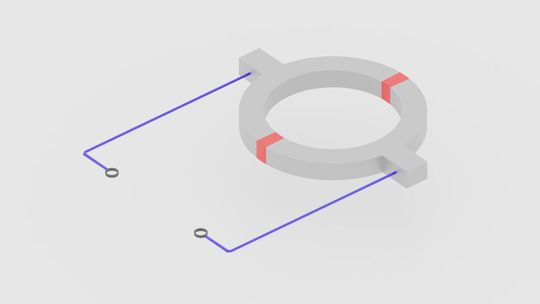
A SQUID consists of a superconducting loop with one or two Josephson Junctions. Pure niobium or lead with 10% gold or indium is cooled with liquid helium to manufacture low-temperature SQUIDs. YBCO is cooled with liquid nitrogen to manufacture high-temperature SQUIDs. However, all SQUIDs require cryogenic refrigeration.
SQUIDs are used to build extremely sensitive sensors, magnetometers, voltmeters, susceptometers, gradiometers, antennas, and RF amplifiers. Applications include metrology, magnetoencephalography, magnetogastrography, magnetocardiography, microscopy, satellite-based testing, astronomy, geophysics, submarines, superparamagnetic relaxometry, non-disruptive testing, quantum computing, cold dark matter, and research. There are two types of SQUIDs: DC and RF.
DC SQUID
A DC SQUID, based on the DC Josephson Effect, consists of two parallel-connected Josephson Junctions in a superconducting loop. A small DC current is applied to the device. The current splits into two parts and flows through the superconducting loop. An external magnetic field is applied to the circuit.
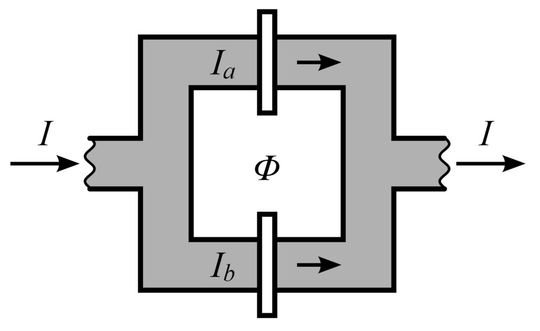
The external magnetic flux alters the phase of superconducting wave functions of both junctions. The supercurrent counter interactively generates a screening current to maintain the state of superconductivity. This screening current generates a magnetic field that opposes and partially cancels external flux in the loop.
Screening current alters supercurrent distribution in the loop. When the supercurrent value exceeds the critical current value, an AC voltage appears across the junctions. The resulting phase difference and supercurrent change create periodic variations in the device’s voltage that help to detect even the smallest magnetic fields.
RF SQUID
An RF SQUID, based on the AC Josephson Effect, consists of a single Josephson Junction inductively coupled to an external resonant tank circuit. The resonant tank circuit is tuned to a certain resonant frequency ‘f’. The non-superconducting layer in this device is made from an insulating material.
When an RF current is applied to the device, oscillations are generated in the circuit. RF SQUID operates in a resistive mode based on the application of an external magnetic field. This alters the inductance of the tank circuit, which in turn changes the resonant frequency.
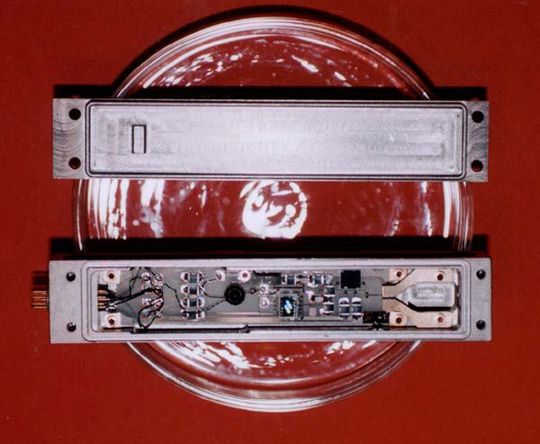
The changes in the resonant frequency enable detection of the amount of magnetic fields. An RF SQUID is cheaper to manufacture because it contains only one Josephson Junction. However, a DC SQUID performs better than an RF SQUID in terms of sensitivity and magnetic field detection.
:quality(80)/p7i.vogel.de/wcms/45/0b/450b9860c0a10141866ffe8cda14353f/0117358393.jpeg "Power electronics are essential to modern industrial processes – but which type should you choose for any given application? (Source: andranik123 - stock.adobe.com)")
POWER SWITCHING SEMICONDUCTORS
How to choose the right power switching device
Applications
This section explores the applications of Josephson Junctions in areas like superconductive switches, single-electron transistors, logic chips, memory, and quantum computing.
Superconducting switches
Josephson Junctions are extensively used to build superconducting switches. Josephson Junction switches can operate at ultra-high switching frequencies about 770 GHz. In comparison with traditional semiconductor switches, these switches have small switching periods in the order of a few picoseconds: one trillionth of a second!
Josephson Junction switches do not dissipate heat like conventional semiconductor switches. Studies show that these switches offer very low power dissipation about 1 micro Watts. Applications include quantum computing, timed inverters, latches, high-speed data processing, energy storage, material science research, and many more.
Researchers at Princeton University have developed a unique superconductive switch made from tungsten ditelluride. In an experiment called the “Nernst Experiment”, physicists varied temperatures on both sides of tungsten ditelluride and confirmed the Josephson Effect. The superconductive switch would abruptly switch between the superconducting and insulating state.
Single-electron transistor
SET or single-electron transistor is a highly sensitive device used in electrometers, quantum computing, ultra-low power electronics, metrology, DC current standards, and logic. SETs are analogous to FETs in terms of terminals: drain, source, and gate. However, the channel between the gate and the source remains insulated throughout the operation.
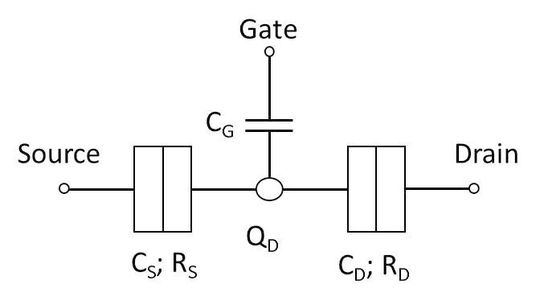
Josephson Junctions in the form of SQUIDs are used to build SETs. The source and drain are called the “mainland” and a quantum nanodot is called the “island”. Josephson Junction connects the “mainland” to the “island”. Here, quantum nanodots are used to control single electron flow.
When the charging energy of quantum nanodots is too high, cooper pairs are blocked from tunneling, known as the “blockade effect”. When the gate electrode is given sufficient voltage, cooper pairs overcome the charging energy of the quantum nanodot to tunnel through the junction. As a result, supercurrent flows in the device.
Superconducting chips
Similar to traditional digital logic families that implement semiconductor circuits, superconducting logic families also exist to implement superconductive circuits. Superconducting logic chips integrate thousands and millions of Josephson Junctions. At present, D-Wave’s qubit processor holds the record for integrating 1,030,000 Josephson Junctions on a single logic chip.
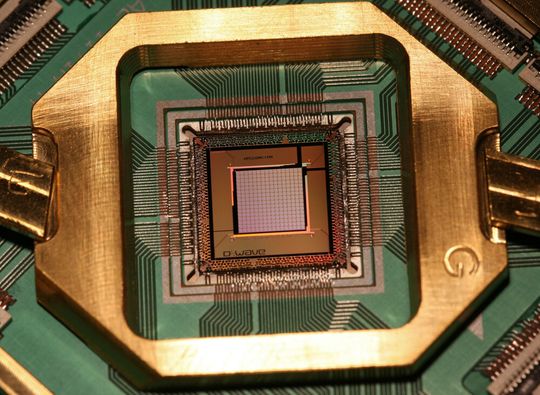
In addition to the active element of Josephson Junctions, these logic families use secondary/passive components like zero-resistance wires, switches, inductors, resistors, capacitors, and transformers with DC or AC power supply. However, superconducting logic chips are functional only in cryogenic environments.
Superconducting logic
A superconducting logic chip is based on a logic called “superconducting logic”. Superconducting logic simulations and programs are run on a complete set of new tools. Such tools implement new algorithms and provide a hybrid environment and compatibility with existing CMOS architectures.
The basic function of a superconducting logic circuit is to perform logical operations and transmit data using the quantum behavior of magnetic flux. Data is transmitted over the interconnects made from superconducting transmission lines. Some examples of superconducting logic families are listed below.
RSFQ
Rapid Single Flux Quantum or simply RSFQ is a widely used logic family that uses two parallel Josephson Junctions. Josephson Junctions produce voltage pulses in picoseconds to encode and transfer digital information across a channel. Approximately 10 to 10,000 Josephson Junctions are found per circuit.
SFQ
Single Flux Quantum or simply SFQ circuits use quantized flux pulses. A single flux quantum is the smallest amount of flux that can be used in a superconducting circuit. At present, small densely-packed SFQ microprocessors run at clock speeds of 120 GHz with low power consumption.
ERSFQ
ERSFQ (Energy Efficient Rapid Single Flux Quantum) operates at GHz frequencies with low power consumption in nanowatts. The logic family uses several methods to achieve energy efficiency like reducing the value of the resistor and adding an inductor in series, reducing bias voltage, and using current-limiting Josephson Junctions.
:quality(80):fill(efefef,0)/p7i.vogel.de/wcms/5f/fe/5ffedb2e0ffa6/listing.jpg "listing")
RQL
Reciprocal Quantum Logic or simply RQL offers an enhanced clock speed over the RSFQ logic. Reciprocal pairs of high-speed and low-power SFQ voltage pulses are used to encode and process the information. RQL logic is implemented with the CMOS design style to perform logic operations like AND, OR, and NOT.
Cryogenic memory
A cryogenic memory chip is a type of storage solution that stores information at temperatures near absolute zero. Using Josephson Junctions offers high precision, extra-large storage capacity, and ultra-high-speed processing. SQUID-based memory solution provides ultra-fast memory read/write times in picoseconds.
Another Josephson Junction storage device is JMRAM: Josephson Magnetoresistive Random Access Memory. This type of memory cell integrates the speed of Josephson Junction with the storage capabilities of MRAM (Magnetoresistive Random Access Memory). JMRAM stores information in the form of magnetic flux quanta.
A hybrid memory integration of Josephson Junction and CMOS memory is a type of low-temperature RAM cell. The highest number of Josephson Junctions on a memory chip currently stands at 23,488. Fast memory operations improve the storage efficiency of data centers and the cloud.
Superconducting quantum computing
A field of solid-state quantum computing that uses devices or processes built on superconductors is called superconducting quantum computing (SQC). Simply put, superconductors help to store and manipulate quantum information in the form of qubits. Josephson Junctions are used to make “superconducting qubits”. Flux qubits are a form of superconductive qubits that store information in magnetic flux quanta.

Superconducting logic like RSFQ and SFQ performs quantum gate operations just like the classical logic gate operations. At present, superconductors are extensively used in quantum computing to accelerate the speed of quantum operations and measurements. However, superconducting quantum computing is challenging to implement because the state of superconducting qubits persists only for microseconds.
High-frequency applications
As mentioned above, Josephson Junction-based logic runs on GHz frequencies in practical applications in accordance with current standards. Josephson Junctions are capable of generating and detecting terahertz (THz) frequencies. THz frequencies are used in telecommunication, optical communication, microwave engineering, and high-frequency signal processing.
Oscillators using phase-locked arrays of Josephson Junctions are capable of synthesizing THz frequencies. Hundreds of integrated Josephson Junctions made from high-temperature superconductors like YBaCuO and Niobium are voltage tunable with THz frequency generation. However, this technology has yet to be commercialized.
Technical challenges
This section outlines the significant technical hurdles associated with Josephson Junctions, including the need for cryogenic conditions, complex design requirements, and limitations in power consumption, signal transmission, and scalability.
Cryogenic freezing
To witness superconductive behavior, a material must be cooled near absolute zero. Cryogenic freezing is a method used in the industry to preserve superconductive operation. Such material processing is used in laboratories. Components like resistors, capacitors, inductors, and many more are not designed to operate in such environments.
Tough design
Josephson Junction superconducting design process is complex due to high static power consumption, fan-out limitation, signal attenuation, sensitivity, clocking, and synchronization. As of 2024, very few software tools can run superconducting logic. Many organizations and research institutes are currently developing CAD tools for effective superconducting simulations.
Static power consumption
Josephson Junction indeed incurs a very small amount of switching loss. However, passive components like resistors and inductors in Josephson Junctions circuits consume significant static power. Implementing energy-efficient superconducting logic families like ERSFQ is an optimal solution to reduce static power consumption.
Fan-out of one
“Fan-out” is a measure of the number of times an output signal can drive an input without signal degradation. Superconducting logic circuits have a fan-out of one to drive only one gate. As a result, pulse splitters are used to replicate and regenerate voltage pulses.
Magnetic sensitivity
Josephson Junctions are highly sensitive to magnetic fields. The presence of unnecessary small magnetic fields can degrade signal quality and output. Shielding the Josephson junction device is an optimal solution to ignore magnetic fields. Another method is to use a feedback system that tends to cancel external flux.
Signal reflections
When voltage pulses carrying data travel over the superconducting interconnects, signals can be reflected from vias or attenuated. Implementing signal isolation techniques, using current limiters, optimizing biasing conditions, and adding compensating networks are some ways to deal with on-chip signal reflections.
Scaling challenge
The semiconductor fabrication industry is an ever-growing billion-dollar business compared to the million-dollar superconductor market. The highest Josephson Junction count lags much behind the highest transistor count. Integrating billions or trillions of Josephson Junctions, just like transistors in chips, would take years and skyrocket the fabrication cost.
Power electronics integration
Power electronic devices made from Josephson Junction will have to operate in cryogenic conditions. Hypothetically, power devices using Josephson Junctions won’t generate heat due to cryogenic conditions. At present, power devices use air-cooling and liquid-cooling mechanisms to manage heat. No cryogenic cooling mechanism has ever been implemented.
Future developments
Josephson Junctions are extensively used in quantum computing, measurement, industry, voltage standards, and advanced communication systems. In hybrid environments, Josephson Junction logic offers isolation and enhances a system’s overall gain. In the near future, Josephson Junction-based technology is expected to scale up to the next milestone in supercomputing- ZetaFLOPs!
ZetaFLOP supercomputers
A supercomputer, not to be confused with a quantum computer, processes large volumes of information and performs complex computations in seconds. Approximately 500 supercomputers are there in the world and each country possesses numerous. Compared to a conventional computer, supercomputers dissipate large amounts of heat.
A supercomputer capable of executing quintillion FLOPs (Floating Point Operations Per Second) is termed an exaFLOP computer. This type of technology is currently the world’s fastest. Computers made from superconductors could outperform silicon-based “supercomputers'' in terms of shorter time frames.
The next supercomputing race is to reach 1 zetaFLOP performance (1000 exaFLOPS). A study predicts that Josephson Junction switches are capable of operating at 100 BIPS (100 Billion Instructions Per Second). Going for a higher Josephson Junction count could build the next zetaFLOP supercomputers.
Conclusion
The Josephson Effect describes supercurrent flow in a superconductor-insulator-superconductor junction without the application of input voltage. All of this happens due to the quantum tunneling of cooper pairs. In addition, the Josephson Effect explains Josephson Junctions under the application of constant voltage or microwave radiation.
Josephson Junctions are macroscopic realizations of quantum mechanics that are taking over the superconductor industry in the form of SQUIDs, switches, chips, logic circuits, and memory units. In modern computing, Josephson Junctions are unlocking high levels of quantum computing with their ultra-high switching frequency and small switching periods.
Josephson Junctions are also paving the way for microwave and RF engineering with terahertz frequency generation and detection. While ultra-fast frozen computers for HPC (High-Performance Computing) are near in the foreseeable future, Josephson Junctions are also expected to empower the grid, lossless transmission lines, renewables, and whatnot!
References
(ID:50115133)
:quality(80)/p7i.vogel.de/wcms/0c/07/0c07df7a5dbd70fd5d3c5e3276ff2d9f/0127824058v2.jpeg "Graphene’s atomic lattice reveals new clues about the nature of superconductivity. (Source: MIT)")
:quality(80)/p7i.vogel.de/wcms/75/dd/75ddaf5c84ba98cec125e56e461693b4/0127051074v2.jpeg "Power electronics are crucial for research facilities, supporting devices such as black hole simulators, particle accelerators, nuclear fusion reactors, and data centers, ensuring safety, high-temperature compliance, and efficiency. (Source: © pengedarseni - stock.adobe.com)")