


:quality(80)/p7i.vogel.de/wcms/7f/4b/7f4b97757cea82c0675209630577dc22/0133974130v2.jpeg "Vox Power’s EIRE600 delivers up to 600 W in a compact 5 × 3-inch package, with forced-air or conduction cooling options for industrial and medical equipment. (Source: Vox Power)")
:quality(80)/p7i.vogel.de/wcms/55/97/5597c3436e3bc92ee7ba23b6f9d289e9/0134032539v2.jpeg "Littelfuse’s TP7.0SMD-XC automotive TVS diode series uses foldback technology to provide low clamping voltage for protecting sensitive vehicle electronics. (Bild: Littelfuse)")
:quality(80)/p7i.vogel.de/wcms/51/f8/51f84448e666230bb11a02566abd1177/0133958187v3.jpeg "Microchip’s radiation-tolerant GaN point-of-load converter supplies up to 20 A for space-based processors, FPGAs, microcontrollers and ASICs. (Source: Microchip)")
:quality(80)/p7i.vogel.de/wcms/0a/7c/0a7c08f368ae1d91f758dd18d2a32e88/0133978423v2.jpeg "EPFL researchers have demonstrated a GaN transistor that withstands nearly 4 kV, using an intrinsic polarization superjunction design to distribute electric fields more evenly. (Source: EPFL)")
:quality(80)/p7i.vogel.de/wcms/5b/94/5b94232ca4183d6fcc2dccc7394d7544/0134041114v4.jpeg "Siemens and NVIDIA are testing AI applications at Siemens’ Erlangen electronics factory, using digital twins to support production planning and prepare inspection systems before physical prototypes are available. (Bild: Siemens)")
:quality(80)/p7i.vogel.de/wcms/b4/1f/b41f2731a07b608e60eca3663e280301/0133980549v2.jpeg "Multi-year agreement with Wolfspeed supports Infineon’s conversion from 150-millimeter to 200-millimeter silicon carbide (SiC) manufacturing (Source: © Ada - stock.adobe.com)")
:quality(80)/p7i.vogel.de/wcms/e3/0a/e30a8813bcf44b16f0dceb63a0747d29/0133984094v2.jpeg "The semiconductor is only one part of the design. Higher voltage, frequency and power density also increase the demands on electronic packaging materials such as die attach, substrates, top-side interconnects and module attach. (Source: Generated by AI)")
:quality(80)/p7i.vogel.de/wcms/5d/fb/5dfba5e5f38daf2b8597b05656af29c0/0133956337v2.jpeg "Wolfspeed has received a conditional commitment for a loan of up to $1.5 billion from the U.S. Department of War to support its domestic wide-bandgap semiconductor supply chain. (Source: © AspctStyle - stock.adobe.com)")
:quality(80)/p7i.vogel.de/wcms/bf/b6/bfb6ac295759be32d567df9849b6767e/0134094495v2.jpeg "Fraunhofer ISE reports that 25 Ah pouch cells with silicon-rich anodes retained more than 83% of their initial capacity after 1,000 cycles when tested under 1,000 kPa axial pressure. (Bild: Fraunhofer ISE)")
:quality(80)/p7i.vogel.de/wcms/16/dc/16dca55e6ef80e6b5da68bc628da2dcc/0133844782v2.jpeg "This article explains virtual power plants in modern renewable-heavy grids. (Source: © M@rketVisualsStudio - stock.adobe.com)")
:quality(80)/p7i.vogel.de/wcms/e8/33/e8330aae4bea3578b98ec2c1403d367a/0133980001v2.jpeg "IRENA’s 2026 World Energy Transition Outlook identifies faster electrification powered by renewables as central to meeting future global energy needs. (Source: Irena)")
:quality(80)/p7i.vogel.de/wcms/6c/b4/6cb405f47d25035e256ae90fe3a66ee6/0134032112v2.jpeg "Sungrow’s PowerTitan 3.0 energy storage platform uses onsemi EliteSiC hybrid power modules, with the companies reporting peak inverter efficiency above 99.3%. (Bild: onsemi)")
:quality(80)/p7i.vogel.de/wcms/7b/76/7b76005554b556df2a7a3794bdf69d44/0132365246v2.jpeg "Hioki’s ST5680A DC Hipot Tester combines CE/UKCA/CSA compliance, an integrated capacitance‑based contact check and time‑series waveform recording (voltage, leakage current, insulation resistance) to standardize hipot and insulation testing across EV cell, module and pack production lines. (Source: Hioki)")
:quality(80)/p7i.vogel.de/wcms/af/7f/af7f7b0fb7f29219fc991b1130f65477/0132241333v2.jpeg "Comprehensive laboratory testing regimens—combining thermal cycling, high‑current stress, EMC, and accelerated lifetime tests—are essential to validate advanced power designs and ensure reliability in real‑world applications. (Source: PRBX)")
:quality(80)/p7i.vogel.de/wcms/16/3d/163df69363f8125315a9826e13ea4b05/0131927425v2.jpeg "Solution will maximize data center and AI factory profitability while delivering engineering-grade insights to design and operations for more efficient, sustainable, and resilient infrastructure. (Source: Cadence)")
:quality(80)/p7i.vogel.de/wcms/85/b7/85b7e90733a2bd8f21515d8f7137f2fc/0131917677v2.jpeg "Renesas acquires Pictorus to integrate its embedded application software platform with Renesas’ MCU and MPU portfolio, helping developers shorten time‑to‑market and simplify system integration. (Source: © lucadp - stock.adobe.com)")
:quality(80)/p7i.vogel.de/wcms/f8/34/f834240d434a0c265a2ccafe614c8cd7/0134032109v4.jpeg "Hard- and soft-switching techniques shape voltage and current during device transitions, influencing switching losses, EMI and thermal performance in power converters. (Bild: © Mrthullab - stock.adobe.com)")
:quality(80)/p7i.vogel.de/wcms/27/07/2707280c807689b437baed3660257404/0133626052v2.jpeg "The quantum behavior of electrons shapes semiconductor devices—and the power converters that deliver electricity to modern computing systems. (Source: © Celt Studio - stock.adobe.com)")
SPACE TECHNOLOGY Black hole simulators and particle accelerators backed by power electronics
Related Vendors
:fill(fff,0)/p7i.vogel.de/companies/62/a0/62a0a0de7d56a/aic-europe-logo.jpeg "aic-europe-logo (AIC Europe)")
:fill(fff,0)/p7i.vogel.de/companies/68/2c/682c3e2e9a195/logotype-rvb.jpeg "logotype-rvb (MERSEN France)")
:fill(fff,0)/p7i.vogel.de/companies/66/9a/669a2816c84be/pcim-logo.png "pcim-logo (PCIM)")
The popularity of power electronics revolves only around electricity distribution facilities, industries, factories, the grid, renewable energy plants, electric vehicles, and many more. Little does anyone know that power electronics function as the backbone of black hole simulators, particle accelerators, and fusion reactors. The article describes the role of power electronics in high-tech research facilities.

Power electronics play a foundational role in high-tech research facilities through power conversion, control, delivery, and management. Facilities that implement physical infrastructure for research, for example, particle accelerators, need large amounts of power to support chemical reactions. On the other hand, digital research facilities require large-scale power delivery and management for computing.
Power Electronics x Research Facilities: Use Cases
Research facilities contract power electronic companies to build large-scale in-house power supply systems, converter units, and switching networks for their accelerators. Power companies ensure multi-stage deployment of power electronic systems, following industrial safety standards. The overall power electronics system should be so efficient that researchers, usually non-power electronics specialists, must be able to handle gigawatt-scale transient power. The section lists some power electronics use cases in research facilities.
Terrestrial black hole simulators
Black hole simulators are software that generate virtual black hole-like conditions. Black holes, as seen in the movie “Interstellar”— are the infinitesimal points of heavy mass in space, something that even light cannot escape from. Terrestrial black hole simulations include high-tech software in combination with some physics-based experiments to mimic the accretion disk of a black hole. Various universities and research institutes generate black hole-like conditions in laboratories through the approximation between black holes and optics in dielectric media. These experiments are heavily dependent upon electronics, acoustics, and piezoelectricity.
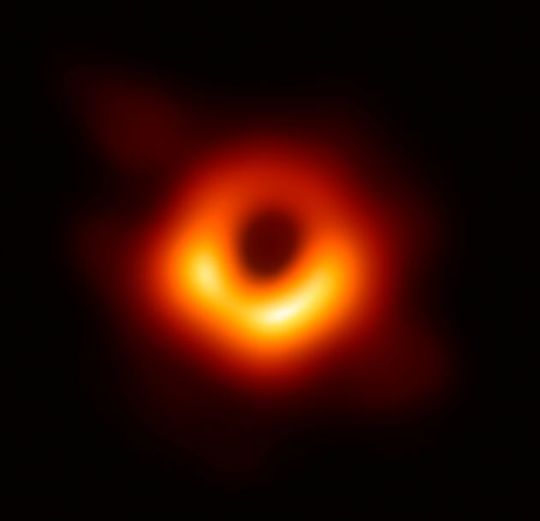
Black hole simulators rely on real-time black hole data from telescopes or satellites. In addition to using space-grade semiconductors in satellites and telescopes, NASA carries out these computer experiments. In fact, NASA released the closest image of a black hole in 2019. Such black hole images are not captured by cameras but are constructed using radio wave signals. Supercomputers need high computational power to run such simulations. Power electronics are used to build efficient power delivery and management networks for cryogenic supercomputers and advanced AI-based GPUs.
Particle accelerators
A particle accelerator is a large-scale machine that uses electromagnetic fields to accelerate sub-atomic and bosonic particles. These particles are accelerated at a very high speed for particle research and quantum physics. As particle accelerators rely on electromagnetic fields, their components and systems need a high amount of current in the order of kilo amperes and radio frequencies up to 3000 MHz!
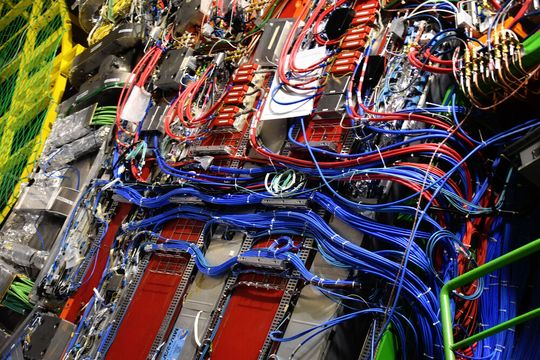
Particle accelerators deploy a large number of high-power converters in each subsystem. The total number of power converters depends on the size of the particle accelerator. Such high-power converters rely on advanced control algorithms and current measurement systems. For example, one of the most popular particle accelerators– the Large Hadron Collider (LHC) in Switzerland-houses 1614 power circuits, 1708 power converters, and 9994 power magnets!
Fusion reactors
Tokamak is a powerful magnetic fusion machine that uses large amounts of magnetic field to confine plasma in the shape of an axially symmetrical torus (a donut-shaped structure). Only 50 countries have such machines and house such research facilities. Surprisingly, nuclear fusion is “greener” than traditional nuclear power. The traditional nuclear-fission-based power results in chain reactions and hazardous toxicity. Once commercialized, nuclear fusion power plants will use heat to generate electricity.
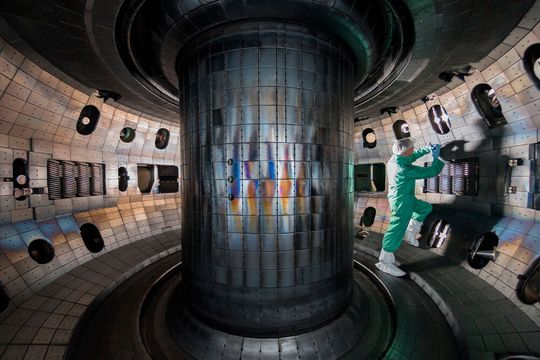
A very high voltage is required to switch the plasma current. Researchers at Princeton University are developing pulsed-power systems to ignite plasma. Fusion reactors contain a series of superconducting solenoid coils to carry on the process. An advanced control system, known as SPARC, is currently in development to reach a desirable fusion energy gain factor (Q > 1). Examples include JT-60SA in Japan, DIII-D in the USA, HT-7U (EAST) in China, and ITER in France.
Digital research facilities
Data centers and some high-tech research facilities rely on data, rather than physical experiments, to perform complex calculations. They use either large numbers of computers or advanced computers such as quantum computers and supercomputers. As a result, net power expenditure increases even more due to the maintenance of the cryogenic environment.
Some special laboratories and data centers tend to rely on AI chips for large-scale computations. They do not rely on cryogenic environments. However, increased use of AI chips, processors, and accelerators consumes a lot of power. At present, a single NVIDIA GPU chip draws 5.4 KW of power. In the near future, AI chips are expected to draw 3x the current power consumption. Such a scenario would push power stations and the grid, skyrocketing power budgets.
Conclusion
Contrary to popular belief, power electronics are the backbone of all research facilities. Power electronics use is not just limited to electricity used in our homes and commercial spaces. In fact, the world relies on the billion-dollar power electronics industry for power supply, conversion, management, and much more. The job of power electronics continues forever. After all, the digital world does not exist without power.
References
(ID:50573008)
:quality(80)/p7i.vogel.de/wcms/83/ae/83ae0b00e573da9977ce19195d28c6b0/0132366058v2.jpeg "Researchers from EPC, The University of Hong Kong and Virginia Tech demonstrated a fully integrated GaN boost converter operating entirely at 4 K, achieving 91.6% efficiency at 7.6 W by combining monolithic GaN power ICs, on‑chip gate drivers and cryo‑qualified passive components. (Source: © Maurizio Di Paolo Emilio)")
:quality(80)/p7i.vogel.de/wcms/c9/5f/c95fd082477eb5f3ddafbb76b2f36c47/0129660958v4.jpeg "Due to the presence of superconducting material, SMES shows a high efficiency of more than 95%. (Source: © Faizer - stock.adobe.com)")