


:quality(80)/p7i.vogel.de/wcms/7f/4b/7f4b97757cea82c0675209630577dc22/0133974130v2.jpeg "Vox Power’s EIRE600 delivers up to 600 W in a compact 5 × 3-inch package, with forced-air or conduction cooling options for industrial and medical equipment. (Source: Vox Power)")
:quality(80)/p7i.vogel.de/wcms/55/97/5597c3436e3bc92ee7ba23b6f9d289e9/0134032539v2.jpeg "Littelfuse’s TP7.0SMD-XC automotive TVS diode series uses foldback technology to provide low clamping voltage for protecting sensitive vehicle electronics. (Bild: Littelfuse)")
:quality(80)/p7i.vogel.de/wcms/51/f8/51f84448e666230bb11a02566abd1177/0133958187v3.jpeg "Microchip’s radiation-tolerant GaN point-of-load converter supplies up to 20 A for space-based processors, FPGAs, microcontrollers and ASICs. (Source: Microchip)")
:quality(80)/p7i.vogel.de/wcms/0a/7c/0a7c08f368ae1d91f758dd18d2a32e88/0133978423v2.jpeg "EPFL researchers have demonstrated a GaN transistor that withstands nearly 4 kV, using an intrinsic polarization superjunction design to distribute electric fields more evenly. (Source: EPFL)")
:quality(80)/p7i.vogel.de/wcms/5b/94/5b94232ca4183d6fcc2dccc7394d7544/0134041114v4.jpeg "Siemens and NVIDIA are testing AI applications at Siemens’ Erlangen electronics factory, using digital twins to support production planning and prepare inspection systems before physical prototypes are available. (Bild: Siemens)")
:quality(80)/p7i.vogel.de/wcms/b4/1f/b41f2731a07b608e60eca3663e280301/0133980549v2.jpeg "Multi-year agreement with Wolfspeed supports Infineon’s conversion from 150-millimeter to 200-millimeter silicon carbide (SiC) manufacturing (Source: © Ada - stock.adobe.com)")
:quality(80)/p7i.vogel.de/wcms/e3/0a/e30a8813bcf44b16f0dceb63a0747d29/0133984094v2.jpeg "The semiconductor is only one part of the design. Higher voltage, frequency and power density also increase the demands on electronic packaging materials such as die attach, substrates, top-side interconnects and module attach. (Source: Generated by AI)")
:quality(80)/p7i.vogel.de/wcms/5d/fb/5dfba5e5f38daf2b8597b05656af29c0/0133956337v2.jpeg "Wolfspeed has received a conditional commitment for a loan of up to $1.5 billion from the U.S. Department of War to support its domestic wide-bandgap semiconductor supply chain. (Source: © AspctStyle - stock.adobe.com)")
:quality(80)/p7i.vogel.de/wcms/bf/b6/bfb6ac295759be32d567df9849b6767e/0134094495v2.jpeg "Fraunhofer ISE reports that 25 Ah pouch cells with silicon-rich anodes retained more than 83% of their initial capacity after 1,000 cycles when tested under 1,000 kPa axial pressure. (Bild: Fraunhofer ISE)")
:quality(80)/p7i.vogel.de/wcms/16/dc/16dca55e6ef80e6b5da68bc628da2dcc/0133844782v2.jpeg "This article explains virtual power plants in modern renewable-heavy grids. (Source: © M@rketVisualsStudio - stock.adobe.com)")
:quality(80)/p7i.vogel.de/wcms/e8/33/e8330aae4bea3578b98ec2c1403d367a/0133980001v2.jpeg "IRENA’s 2026 World Energy Transition Outlook identifies faster electrification powered by renewables as central to meeting future global energy needs. (Source: Irena)")
:quality(80)/p7i.vogel.de/wcms/6c/b4/6cb405f47d25035e256ae90fe3a66ee6/0134032112v2.jpeg "Sungrow’s PowerTitan 3.0 energy storage platform uses onsemi EliteSiC hybrid power modules, with the companies reporting peak inverter efficiency above 99.3%. (Bild: onsemi)")
:quality(80)/p7i.vogel.de/wcms/7b/76/7b76005554b556df2a7a3794bdf69d44/0132365246v2.jpeg "Hioki’s ST5680A DC Hipot Tester combines CE/UKCA/CSA compliance, an integrated capacitance‑based contact check and time‑series waveform recording (voltage, leakage current, insulation resistance) to standardize hipot and insulation testing across EV cell, module and pack production lines. (Source: Hioki)")
:quality(80)/p7i.vogel.de/wcms/af/7f/af7f7b0fb7f29219fc991b1130f65477/0132241333v2.jpeg "Comprehensive laboratory testing regimens—combining thermal cycling, high‑current stress, EMC, and accelerated lifetime tests—are essential to validate advanced power designs and ensure reliability in real‑world applications. (Source: PRBX)")
:quality(80)/p7i.vogel.de/wcms/16/3d/163df69363f8125315a9826e13ea4b05/0131927425v2.jpeg "Solution will maximize data center and AI factory profitability while delivering engineering-grade insights to design and operations for more efficient, sustainable, and resilient infrastructure. (Source: Cadence)")
:quality(80)/p7i.vogel.de/wcms/85/b7/85b7e90733a2bd8f21515d8f7137f2fc/0131917677v2.jpeg "Renesas acquires Pictorus to integrate its embedded application software platform with Renesas’ MCU and MPU portfolio, helping developers shorten time‑to‑market and simplify system integration. (Source: © lucadp - stock.adobe.com)")
:quality(80)/p7i.vogel.de/wcms/f8/34/f834240d434a0c265a2ccafe614c8cd7/0134032109v4.jpeg "Hard- and soft-switching techniques shape voltage and current during device transitions, influencing switching losses, EMI and thermal performance in power converters. (Bild: © Mrthullab - stock.adobe.com)")
:quality(80)/p7i.vogel.de/wcms/27/07/2707280c807689b437baed3660257404/0133626052v2.jpeg "The quantum behavior of electrons shapes semiconductor devices—and the power converters that deliver electricity to modern computing systems. (Source: © Celt Studio - stock.adobe.com)")
:quality(80)/thumbor.vogel.de/f3g2ouosszYDI6Qcyea5EqIzON0=/500x500/p7i.vogel.de/wcms/68/83/6883a88b8c321/ole-gerkensmeyer.jpeg "Ole Gerkensmeyer")
CIRCULAR VALUE Financial efforts in re-using power electronics components — maximizing value through subsystem recovery
Related Vendors
:fill(fff,0)/p7i.vogel.de/companies/6a/20/6a202a4f89a62/mrs-white-on-blue-bg.png "mrs-white-on-blue-bg ()")
:fill(fff,0)/p7i.vogel.de/companies/60/21/60214fbbcc5e0/index.png "index.png (Kundenwebsite)")
:fill(fff,0)/p7i.vogel.de/companies/68/08/6808a2b3b6595/het-logo.jpeg "het-logo (Heraeus Electronics)")
Financial and practical aspects of reusing power electronics components are increasingly important in sustainable manufacturing. Subsystem recovery offers the highest value by reducing extraction costs and minimizing lifetime penalties. Metrics such as Extraction Cost Ratio (ECR) and Lifetime Penalty Factor (LPF) provide a clear framework to identify the most cost-effective and reliable reuse strategies.
Circular economy principles in power electronics are no longer fringe concepts — they are entering mainstream manufacturing and supply chain strategies [Smith, 2023]. The environmental logic is strong: fewer raw materials, less waste, and reduced energy consumption in manufacturing. But for industry decision-makers, the key metric is cost versus benefit.
In re-use scenarios, cost drivers are shaped by component value, accessibility, degradation, and yield. Physical wear mechanisms — thermal cycling, corrosion, electromigration, and dielectric aging — reduce a part’s residual lifetime [Müller, 2021]. This introduces economic entropy: even if extraction is cheap, a shortened lifetime erodes the net value recovered.
To address this, we propose the two KPIs:
- Extraction Cost Ratio (ECR): which is the total extraction cost over the new purchase price. An ECR below 0.2 generally indicates competitive re-use potential, particularly when yield-adjusted for degradation.
- Lifetime Penalty Factor (LPF): which is the expected lifetime reduction over full expected lifetime. For reused semiconductors, typical LPF vary between 0.02 - 0.10
This article will show that higher integrated sub-systems typically have lowest ECR as well as LPF values. As such, highest economical value is more likely with re-use of of sub-systems.
1. Main Cost Factors in Re-Use
The main cost drivers in component re-use arise from access, extraction, testing, and reconditioning, highlighting how handling, equipment, and process steps directly impact both yield and residual lifetime.
1.1 Access to components — collection and initial extraction
The process begins with collecting, inspecting, and preparing hardware for component or subsystem extraction. Costs arise from both per-unit handling and capital investment in the necessary tooling.
Process Steps:
- 1. Collection & Reverse Logistics — product retrieval, transportation, sorting by type.
- 2. Preliminary Assessment — rapid screening to identify units with re-use potential.
- 3. Disassembly — opening enclosures, removing heatsinks and shielding to expose boards.
- 4. Surface Preparation — cleaning debris, oils, and coatings for safe handling
Equipment Examples & Capex:
- Manual tools (€1k–€3k for full ESD-compliant bench setup)
- Automated screwdriving stations (€15k–€40k)
- Ultrasonic cleaners (€5k–€20k)
- Conformal coating removal (laser, €30k–€80k)
Cost Range: €0.50–€2.00 per board manually; €0.10–€0.50 with automation [Lee, 2020].
Physical Consideration: During access, thermal and mechanical stress should be minimized — unnecessary flexing or heating accelerates solder joint fatigue and microcrack formation, reducing residual life by up to 10–20% [Müller, 2021].
1.2 Extraction of subsystems / components
Extraction is the key differentiator for cost and yield — and the point where subsystem recovery shines.
Semiconductors:
- 2. New: €5–€200+, extraction: €0.50–€2.00, yield: 70–90%
- 3. Sensitive to heat history — prior exposure can cut expected lifetime by 15–30%.
- 4. B) Auxiliary Function (gate drivers, small micros, ADC/DAC, DC/DC, LDO)
- 5. New: €0.50–€15, extraction: €0.20–€0.80, yield: 60–85%
- 6. C) Commodity Logic (level shifters, glue logic, ESD)
- 7. New: €0.05–€1, extraction: €0.10–€0.50, yield: 50–80%
Other Components:
- Passives (inductors, capacitors, resistors): €0.05–€0.30 each, >90% yield.
- Interconnects (connectors, headers): €0.05–€0.15/contact pair, ~90% yield.
- Power Distribution (cables, bus bars): €0.50–€2.00 each, ~95% yield.
- Isolation (films, sleeves): low value, occasional re-use for specialized refurbish.
Subsystem Extraction:
- Examples: Gate drive boards, DC/DC bricks, sensor modules, cooling assemblies.
- Extraction: €0.50–€3.00 per module, yields >95%.
- ECR: typically 0.03–0.08 — well within competitive range.
- Physical advantage: No high-temp rework → minimal additional lifetime penalty.
1.3 Testing and quality assurance
Testing validates functionality but consumes both time and budget, and may contribute to yield loss.
Methods:
- Optical Inspection (AOI) — €0.10–€0.50, 1–5 sec/unit, yield loss 1–3%.
- Parametric Testing — €0.05–€1.00, 5–30 sec/unit, yield loss 2–4%.
- Functional Testing — €0.50–€3.00, 30–120 sec/unit, yield loss 2–5%.
- Burn-In / Stress — €0.20–€1.50, hours–days/batch, yield loss 1–2%.
Equipment Capex:
- AOI systems (€15k–€80k)
- Curve tracers, LCR meters (€2k–€10k)
- Programmable load testers (€5k–€50k)
- Thermal chambers (€20k–€100k)
Physical Consideration: Every powered test cycle marginally contributes to wear-out mechanisms; stress tests, while essential for safety, may consume 1–5% of remaining component lifetime [Lee, 2020]. This can be modelled as a Lifetime Penalty Factor (LPF):
Adjusted Value = Nominal Value * (1 - LPF)
Or: LFP = (expected lifetime reduction) / full expected lifetime
Typical LPF: 0.02–0.10 for reused semiconductors.
1.4 Re-equipping / reconditioning
These steps restore interfaces, surfaces, and contacts for reintegration into assemblies.
Processes:
- Re-Balling BGA: €0.20–€0.80, 2–5 min/device.
- Lead Straightening / Re-Tinning: €0.05–€0.20, 1–3 min/device.
- Connector Contact Refurb: €0.05–€0.15/contact pair, 10–30 sec.
- Surface Cleaning (oxidation removal): €0.05–€0.15.
- Firmware Reset: €0.05–€0.50, 1–2 min.
Equipment Capex:
- Rework stations (€10k–€40k)
- Semi-automatic lead formers (€500–€5k)
- Plasma cleaners (€5k–€30k)
- Programmer interfaces (€2k–€15k)
Physical Consideration: Multiple heat cycles during re-balling or re-tinning can induce additional intermetallic growth, marginally reducing remaining solder joint life [Müller, 2021].
This Table Compares Costs and Key Performance Indicators Across Re-Use Processes
| Item Type | New (€) | Total Re-Use Cost (€) | ECR | Yield-Adjusted Cost (€) | LPF | Effective Saving (€) |
| MOSFET/IGBT (A) | 50.00 | 3.40 | 0.068 | 3.78 | 0.10 | 41.22 |
| Gate Driver (B) | 5.00 | 1.50 | 0.30 | 1.58 | 0.05 | 3.17 |
| Glue Logic (C) | 0.50 | 0.50 | 1.00 | 0.55 | 0.05 | -0.05 |
| Inductor/Capacitor | 0.20 | 0.30 | 1.50 | 0.31 | 0.03 | -0.11 |
| Connector (pair) | 0.50 | 0.20 | 0.40 | 0.21 | 0.03 | 0.29 |
| DC/DC Brick (Subsystem) | 100.00 | 5.00 | 0.05 | 5.10 | 0.02 | 94.90 |
Key Observations:
- Subsystem extraction achieves the lowest ECR (<0.08) and minimal lifetime penalty, delivering maximum effective savings.
- High-value semiconductors in Group A also perform strongly (ECR <0.1).
- Low-value logic and most passives are uneconomical to extract.
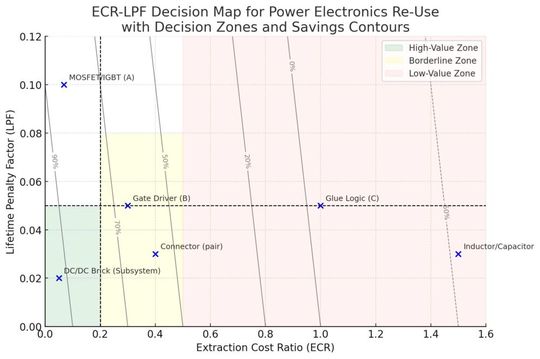
- Green zone = High-value re-use (low cost, low penalty)
- Yellow zone = Borderline viability (requires case-by-case analysis)
- Red zone = Likely uneconomic
- Grey contours = % savings after adjusting for lifetime penalty
2. Conclusion
In financial and physical terms, subsystem-level recovery is the most effective re-use strategy. It combines low relative cost (ECR well below 0.1), high yields (>95%), minimal handling damage, and negligible lifetime penalty.
High-value semiconductors can also deliver strong returns, but require careful testing and lifetime assessment to avoid hidden degradation costs. Auxiliary devices and commodity parts often fail to meet economic thresholds unless recovered in automated, high-volume contexts.
The ECR metric, combined with a Lifetime Penalty Factor, provides a clear decision framework for prioritizing recovery targets and ensuring that re-use strategies are not only sustainable, but financially sound.
References
- [Lee, 2020] Lee, H. Electronics Recovery Economics in Manufacturing. Journal of Sustainable Manufacturing, 2020.
- [Müller, 2021] Müller, P. Capex Considerations for Electronics Refurbishment Lines. Power Electronics Review, 2021.
- [Smith, 2023] Smith, R. Circular Economy in Power Electronics: Strategic and Financial Perspectives. Industrial Electronics Journal, 2023.
(ID:50629198)
:quality(80)/p7i.vogel.de/wcms/b1/0a/b10a283cdf3e5f156781a7273c71a7e0/0129107484v2.jpeg "Circular design strategies are increasingly shaping how power electronics are designed, reused, and recovered across their life cycle. (Source: © Enrique - stock.adobe.com)")
:quality(80)/p7i.vogel.de/wcms/f0/d8/f0d82f06ed1b7abb3245dfc4c317cb55/0127949994v2.jpeg "Visual representation of component ageing in power electronics, highlighting thermal and material stress effects across the system (Bild: © Surya16 - stock.adobe.com)")