


:quality(80)/p7i.vogel.de/wcms/e9/5b/e95bc9c43c57018499c83a2c91ff9764/0132237640v2.jpeg "Yageo’s KH‑AT series automotive‑grade MOVs deliver robust surge absorption and stable electrical performance for demanding vehicle environments, protecting ECUs and power rails from transients. (Source: Yageo)")
:quality(80)/p7i.vogel.de/wcms/f4/61/f461d1f6bf3a6030877d90efced438f2/0132110372v2.jpeg "Taiyo Yuden’s new HVX and HTX hybrid conductive‑polymer capacitors offer AEC‑Q200 qualification, 80 V rating and high ripple capability at 135°C for noise suppression and power smoothing in automotive systems such as ADAS and power steering. (Source: Taiyo Yuden)")
:quality(80)/p7i.vogel.de/wcms/a4/b6/a4b6256bef45368325659f926c268ebe/0132104622v2.jpeg "Toshiba’s new 80 V N‑channel power MOSFET, built on the company’s latest process, improves conduction and switching efficiency for AI server power supplies and high‑frequency data‑center converters. (Source: Toshiba)")
:quality(80)/p7i.vogel.de/wcms/c0/c5/c0c5bdbaf6df6fdd0fecc97c419ea9b4/0132022612v2.jpeg "Magnachip’s 6th‑generation 600 V super‑junction MOSFETs deliver improved efficiency and thermal performance for AI server power supplies and EV fast‑charging systems. (Source: © AntonKhrupinArt - stock.adobe.com)")
:quality(80)/p7i.vogel.de/wcms/51/72/51726a890dc35d74f494908b29681028/0132478976v2.jpeg "Bosch intends to start U.S. based commercial manufacturing in 2026 – just three years after acquiring the Roseville site. (Source: Bosch)")
:quality(80)/p7i.vogel.de/wcms/cc/f5/ccf52ac525f49330b780868db8f9565c/0132364990v2.jpeg "Infineon and LS ELECTRIC sign a memorandum to co‑develop high‑efficiency DC power infrastructure for AI data centers and next‑generation grids, targeting power conversion, energy storage integration, solid‑state transformers and semiconductor circuit breakers. (Source: © Yuliia - stock.adobe.com)")
:quality(80)/p7i.vogel.de/wcms/c6/16/c616f00139ce1575d3292524579868ed/0132241890v2.jpeg "GlobalWafers and Micron announce a strategic collaboration—including proposed financing support and a long‑term wafer supply agreement—to strengthen U.S. wafer manufacturing capacity and shore up the semiconductor supply chain for AI and data‑center demand. (Source: © Fervix Neon - stock.adobe.com)")
:quality(80)/p7i.vogel.de/wcms/ef/6d/ef6da8753871e0ea5c7b7203d31b2c9c/0132144857v2.jpeg "Keysight and WIN Semiconductor partner to reduce design risk for high‑frequency RF components by combining advanced measurement and modeling workflows with foundry‑level device validation for mmWave and high‑frequency applications. (symbolic image) (Source: © Mahmuda - stock.adobe.com)")
:quality(80)/p7i.vogel.de/wcms/83/ae/83ae0b00e573da9977ce19195d28c6b0/0132366058v2.jpeg "Researchers from EPC, The University of Hong Kong and Virginia Tech demonstrated a fully integrated GaN boost converter operating entirely at 4 K, achieving 91.6% efficiency at 7.6 W by combining monolithic GaN power ICs, on‑chip gate drivers and cryo‑qualified passive components. (Source: © Maurizio Di Paolo Emilio)")
:quality(80)/p7i.vogel.de/wcms/3c/a1/3ca1e2527a00068eb37f1db220c5463a/0132042920v2.jpeg "Energy harvesting removes the need for periodic battery swaps in hard‑to‑reach sensors — economically and regulatorily attractive as EU battery rules raise compliance and lifecycle costs. (Source: © Plaifah - stock.adobe.com)")
:quality(80)/p7i.vogel.de/wcms/81/04/8104b7c9a2ce5645d844ca4a1b9a736f/0132261940v2.jpeg "At The Smarter E 2026 Huawei launched LUTERRA, its next‑generation grid‑forming ESS platform, and showcased the award‑winning SUN2000‑506KTL 506 kW smart string inverter — technologies aimed at 1000 Vac architectures and plant‑level grid‑forming functionality. (Source: © Thares2020 - stock.adobe.com)")
:quality(80)/p7i.vogel.de/wcms/76/27/7627729494f2cddf62d276e5d6cd0aa1/0132245568v2.jpeg "Aluminum nitride crystal with a diameter of 2 inches – grown in the Joint Lab of Fraunhofer IISB and PVA TePla. (Source: Jennifer Reißig / Fraunhofer IISB)")
:quality(80)/p7i.vogel.de/wcms/7b/76/7b76005554b556df2a7a3794bdf69d44/0132365246v2.jpeg "Hioki’s ST5680A DC Hipot Tester combines CE/UKCA/CSA compliance, an integrated capacitance‑based contact check and time‑series waveform recording (voltage, leakage current, insulation resistance) to standardize hipot and insulation testing across EV cell, module and pack production lines. (Source: Hioki)")
:quality(80)/p7i.vogel.de/wcms/af/7f/af7f7b0fb7f29219fc991b1130f65477/0132241333v2.jpeg "Comprehensive laboratory testing regimens—combining thermal cycling, high‑current stress, EMC, and accelerated lifetime tests—are essential to validate advanced power designs and ensure reliability in real‑world applications. (Source: PRBX)")
:quality(80)/p7i.vogel.de/wcms/16/3d/163df69363f8125315a9826e13ea4b05/0131927425v2.jpeg "Solution will maximize data center and AI factory profitability while delivering engineering-grade insights to design and operations for more efficient, sustainable, and resilient infrastructure. (Source: Cadence)")
:quality(80)/p7i.vogel.de/wcms/85/b7/85b7e90733a2bd8f21515d8f7137f2fc/0131917677v2.jpeg "Renesas acquires Pictorus to integrate its embedded application software platform with Renesas’ MCU and MPU portfolio, helping developers shorten time‑to‑market and simplify system integration. (Source: © lucadp - stock.adobe.com)")
INSULATORS The “Wrong Superconductor”: LK-99
Related Vendors
:fill(fff,0)/p7i.vogel.de/companies/6a/20/6a202a4f89a62/mrs-white-on-blue-bg.png "mrs-white-on-blue-bg ()")
:fill(fff,0)/p7i.vogel.de/companies/5f/71/5f71d5f92a5f6/2000px-rogers-corporation-logo-svg.png "2000px-Rogers_Corporation_Logo.svg.png (rogers germany)")
:fill(fff,0)/p7i.vogel.de/companies/66/da/66dae94b3cb90/tetranes-logo.png "tetranes-logo (tetranes)")
The recent buzz in the world of science and technology, the room-temperature superconductor “LK-99”, is not a superconductor anymore. The overhyped copper-doped lead apatite named LK-99 seems to be a room-temperature superconductor only in the inventor's research paper.
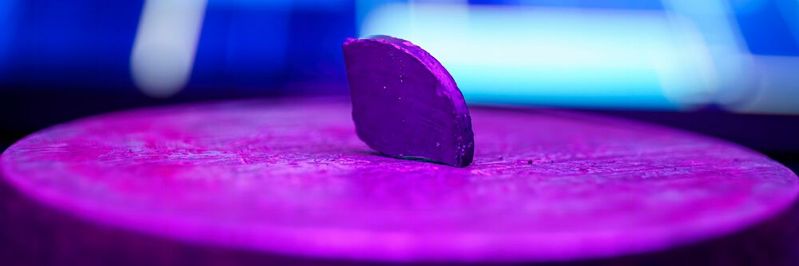
What is LK-99 exactly?
LK-99 took the internet by storm in late July/early August 2023. The compound (copper-doped lead apatite) is made from oxygen, phosphorus, lead, and copper-doped ions. LK-99 was said to exhibit superconductivity at temperatures high as 126 degrees, under normal pressure. You can find details about LK-99 and the surrounding hype around it in our detailed article.
Post-research
All these months, the theories about LK-99 remained the talk of the scientific and tech community. Many news channels, publishing houses, and reputed websites called LK-99 the “holy grail of superconductors”. A video of LK-99 was heavily circulated on social media platforms like X (formerly Twitter), and YouTube. However, unfortunately, the practical results to verify the superconducting properties of LK-99 have failed. Studies about LK-99 claim that it is not a superconductor. Many reputed scientists and researchers name LK-99 an “anti-superconductor”.
How did science reject LK-99?
The scientific community has always treated “LK-99” as controversial. Scientists, researchers, enthusiasts, techies, and DIY makers, tried to replicate LK-99. The attempts to mimic LK-99 have shown no signs of superconductivity.
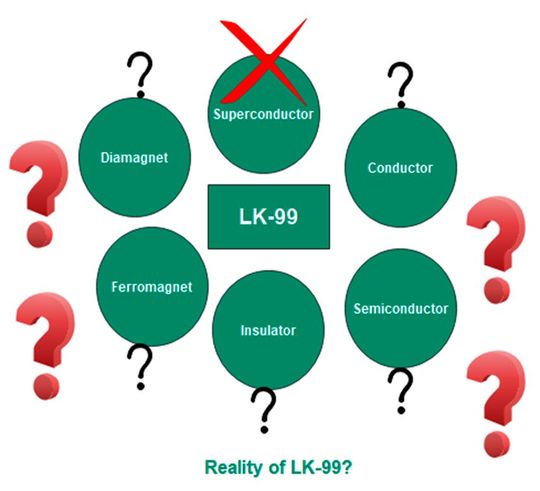
In reality, LK-99 is not even a good conductor of electricity. Instead, LK-99 is said to be an “insulator” in its purest form. An insulator is a material that exhibits zero to very low electrical conductivity and high (to infinite) resistivity. The insulating property of LK-99 is observable at the critical “superconducting” temperature (126 degrees Celsius) in ambient pressure.
:quality(80):fill(efefef,0)/p7i.vogel.de/wcms/65/40/6540aa7ec3a0b/whitepaper-littelfuse-coverbild.png "Whitepaper Littelfuse Coverbild")
Sources that prove LK-99 is not a superconductor
Various studies and test papers (listed below) show that LK-99 can either be an insulator or semiconductor, along with ferromagnetic or diamagnetic properties. The following sources claim that LK-99 is not a room-temperature and ambient-pressure superconductor.
- A team of scientists from Iowa State University, United States, studied the behavior of LK-99 using quantum mechanics-based modular dynamics (QM-MD). The results show that the base compounds of lead and oxygen in LK-99 have significant large band gaps, making LK-99 a poor conductor of electricity. But copper dopants make LK-99 exhibit semiconducting properties.
- The Condensed Matter Theory Center (CMTC) at the University of Maryland, USA, slammed LK-99 in a series of tweets and accused it of being a “poor quality” material with high resistivity about a billion times higher than copper. The same study claims that LK-99 did not exhibit superconductivity even at low temperatures about minus hundred to two hundred degrees Celsius.
- A National Taiwan University (NTU) physics professor conducted various tests on LK-99 in August 2023. The results do not show LK-99 to exhibit zero electrical resistance at any temperature.
- National Physical Laboratory of India finds the absence of superconductivity in LK-99. The scientists even state that LK-99 does not even levitate in their findings.
- A paper published in China reports traces of ferromagnetism half levitation in LK-99. Another similar experiment suggests that LK-99 has diamagnetic properties.
- The paper demonstrates an experiment to synthesize LK-99. The results show a drastic decrease in electrical resistivity, but it does not reach zero. Another similar study of drop in electrical resistivity suggests LK-99 to have semiconducting properties.
The most credible source can be the words of the inventors themselves. According to a Korean news source, one of the inventors, Dr. Kim recently admitted that their paper about LK-99 had “flaws” and was published without the consent of all the authors”!
If not LK-99, which is the world’s hottest superconductor?
Scientifically, it is tougher to correlate words like “superconductivity” and “high temperature”. Superconductivity is a phenomenon that belongs to temperatures low in the order of hundred or two hundred degrees Celsius. Science terms the superconductors at less cold temperatures as “high-temperature superconductors”. The pressure conditions supporting superconductivity at less colder temperatures are quite high. The following superconductors are “hot”:
| Temperature (Celsius) | Pressure (Pascal) | Material | Chemical Formula |
|---|---|---|---|
| -23 | 170 GPa | Lanthanum Decahydride | LaH10 |
| -70 | 155 GPa | Hydrogen Sulphide | H2S |
As of 2023, Lanthanum Decahydride stands as the hottest superconductor under dense atmospheric pressure and temperature conditions. In conclusion, as the studies suggest, LK-99 is not a hot superconductor.
:quality(80):fill(efefef,0)/p7i.vogel.de/wcms/64/f1/64f1b1b92cd2e/whitepaper-tektronix-coverbild.png "Whitepaper Tektronix Coverbild")
So, has the scientific race to room-temperature superconductivity really ended?
No, the scientific race to achieve superconductivity under manageable temperatures, and pressure has not ended. Scientists continue to conduct various experiments and publish papers to study superconductivity and associated technologies.
Recently, MIT Physicists have developed the world's first 3D electronic flat band. The presence of a flat band structure boosts cooper-pair formation, leading to superconductive character. Coincidentally, some scientists believed that LK-99 may possess superconductive behavior as an effect of a flat band structure. However, LK-99 does not have a flat band structure.
The fact that LK-99 is not a room-temperature superconductor but an insulator (or semiconductor) shatters dreams of scaling energy production, storage, electricity transmission, and consumer electronics. In conclusion, not LK-99 but some other material can open doors for normal temperature superconductivity to make superconductors inexpensive, and common as semiconductors.
(ID:49799451)
:quality(80)/p7i.vogel.de/wcms/0c/07/0c07df7a5dbd70fd5d3c5e3276ff2d9f/0127824058v2.jpeg "Graphene’s atomic lattice reveals new clues about the nature of superconductivity. (Source: MIT)")
:quality(80)/p7i.vogel.de/wcms/65/22/65223bc58811ced76adbfa7b5615d532/0129061536v2.jpeg "This article explains topological insulators and explores whether they can optimize electronic systems. (Source: © Rick - stock.adobe.com)")