


:quality(80)/p7i.vogel.de/wcms/40/62/4062c2d596e53b038e0f05f6c3182509/0133843963v2.jpeg "Littelfuse introduces ultra-low-capacitance TVS diode arrays with a 6.5 V clamping voltage for transient protection in automotive and consumer electronics. (Source: Littelfuse)")
:quality(80)/p7i.vogel.de/wcms/e5/9e/e59ecc43d3c278aece316be4209113c9/0133732079v2.jpeg "Renesas introduces its first low-voltage GaN FET family, with 100 V devices for power conversion in AI data centers, robotics and industrial systems. (Source: Renesas)")
:quality(80)/p7i.vogel.de/wcms/c4/a7/c4a7243caa7c26af5fe5108f7894050a/0133626683v2.jpeg "Wolfspeed’s new premium 200 mm SiC substrates are designed to provide more consistent starting material for power semiconductor manufacturing. (Source: © Marina - stock.adobe.com)")
:quality(80)/p7i.vogel.de/wcms/91/8b/918b533161e7327075370338d7af97af/0133589801v2.jpeg "Acbel will present scalable DC charging power modules and an 11kW passively cooled 2-in-1 on-board power solution at New Mobility Congress 2026 in Katowice, covering both charging infrastructure and vehicle applications. (Source: Acbel)")
:quality(80)/p7i.vogel.de/wcms/4f/47/4f473b006be95fb33ec3d8e3fd727b06/0133732443v2.jpeg "SEMI Europe joins the European Commission’s STEAM Executive Panel, bringing the semiconductor industry’s skills needs into discussions on education, training and workforce development. (Source: © phonlamaiphoto - stock.adobe.com)")
:quality(80)/p7i.vogel.de/wcms/c4/59/c459b75bff747399a7a7fd58381f3983/0133731182v2.jpeg "Infineon has completed its acquisition of C2i Semiconductors, adding expertise in software-defined power management and multiphase control for AI data-center power systems. (Source: © InfiniteFlow - stock.adobe.com)")
:quality(80)/p7i.vogel.de/wcms/fd/2c/fd2c2388e7985cd4c75cff39f07f6361/0133676222v2.jpeg "Greenconn expands its connector portfolio with the compact WF28 wire-to-board series and new 25 mm and 30 mm stacking-height options for its GC01 floating connectors. (Source: © Greenconn)")
:quality(80)/p7i.vogel.de/wcms/69/06/6906b5f22bfbb3f8b874ba9e459c7d26/0133675448v2.jpeg "New backend manufacturing hub strengthens and further diversifies Infineon's global production network. (Source: © Apriew - stock.adobe.com)")
:quality(80)/p7i.vogel.de/wcms/b4/93/b493d5ce620cf7eb558ca6bcd9852a1e/0133811655v2.jpeg "The massive integration of utility-scale solar photovoltaics demands BESS platforms equipped with high-power-density inverters to mitigate generation intermittency. (Source: Pixabay)")
:quality(80)/p7i.vogel.de/wcms/f8/cb/f8cbf79cc21d48d7cad08e2b620218f7/0133738515v2.jpeg "Microchip and Navitas are demonstrating a 20 kW reference design that converts an 800 VDC data-center bus to a 6 V server rail, combining GaN power devices with digital control. (Source: © Formoney - stock.adobe.com)")
:quality(80)/p7i.vogel.de/wcms/ee/de/eedef7055c094757eb208a9d181e85dc/0133371000v2.jpeg "Resonac has developed 300 mm SiC single-crystal substrates, advancing larger-diameter wafer technology for next-generation power electronics and other high-performance semiconductor applications. (Source: © Resonac)")
:quality(80)/p7i.vogel.de/wcms/7b/76/7b76005554b556df2a7a3794bdf69d44/0132365246v2.jpeg "Hioki’s ST5680A DC Hipot Tester combines CE/UKCA/CSA compliance, an integrated capacitance‑based contact check and time‑series waveform recording (voltage, leakage current, insulation resistance) to standardize hipot and insulation testing across EV cell, module and pack production lines. (Source: Hioki)")
:quality(80)/p7i.vogel.de/wcms/af/7f/af7f7b0fb7f29219fc991b1130f65477/0132241333v2.jpeg "Comprehensive laboratory testing regimens—combining thermal cycling, high‑current stress, EMC, and accelerated lifetime tests—are essential to validate advanced power designs and ensure reliability in real‑world applications. (Source: PRBX)")
:quality(80)/p7i.vogel.de/wcms/16/3d/163df69363f8125315a9826e13ea4b05/0131927425v2.jpeg "Solution will maximize data center and AI factory profitability while delivering engineering-grade insights to design and operations for more efficient, sustainable, and resilient infrastructure. (Source: Cadence)")
:quality(80)/p7i.vogel.de/wcms/85/b7/85b7e90733a2bd8f21515d8f7137f2fc/0131917677v2.jpeg "Renesas acquires Pictorus to integrate its embedded application software platform with Renesas’ MCU and MPU portfolio, helping developers shorten time‑to‑market and simplify system integration. (Source: © lucadp - stock.adobe.com)")
:quality(80)/p7i.vogel.de/wcms/27/07/2707280c807689b437baed3660257404/0133626052v2.jpeg "The quantum behavior of electrons shapes semiconductor devices—and the power converters that deliver electricity to modern computing systems. (Source: © Celt Studio - stock.adobe.com)")
RENEWABLE ENERGY The challenge of electricity abundance in the renewable era
Related Vendors
:fill(fff,0)/p7i.vogel.de/companies/62/a0/62a0a0de7d56a/aic-europe-logo.jpeg "aic-europe-logo (AIC Europe)")
:fill(fff,0)/p7i.vogel.de/companies/5f/71/5f71d5f92a5f6/2000px-rogers-corporation-logo-svg.png "2000px-Rogers_Corporation_Logo.svg.png (rogers germany)")
:fill(fff,0)/p7i.vogel.de/companies/68/2c/682c3e2e9a195/logotype-rvb.jpeg "logotype-rvb (MERSEN France)")
Global electricity supply is reaching new highs, driven in large part by the rapid expansion of wind and solar energy. The acceleration of the transition to green energy is reshaping the fundamentals of the power system. The central constraint is no longer a lack of generation capacity. Instead, electricity systems are increasingly defined by periods of excess supply. Ageing grids are struggling to cope with highly variable, geographically dispersed supply. Maintaining the pace of the renewable revolution requires major upgrades to electricity grids and new approaches to storing and distributing power.
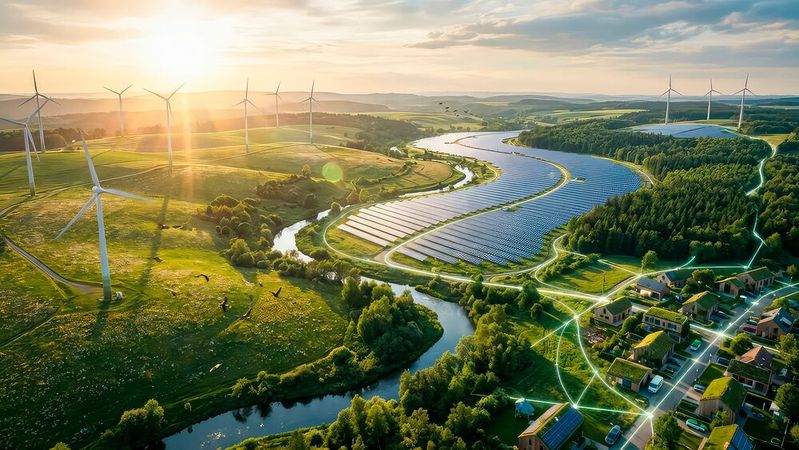
Welcome to the Age of Electricity.
Electricity is becoming the defining resource of the 21st century. The electrification of transport and industry, together with the rise of AI and digital infrastructure, is putting electrical power at the very centre of the global economy.
But the rapid expansion of wind and solar energy production has exposed the main barrier to the transition to clean energy: the power grid itself.
The shocking truth is that the main challenge in transitioning to renewables isn’t a lack of green energy. It’s that renewable generation often exceeds what our ageing grids can transmit, store or absorb.
The end of energy scarcity
There’s more electricity being produced right now than at any other period in history. At the time of writing, global energy production is forecast to reach between 30,000 TWh (terawatt-hours) and 34,000 TWh by the end of 2026, according to the International Energy Agency (IEA).1 By 2030, the IEA estimates that Total Global Electricity Generation will reach or exceed 38,000 TWh.2
The same analysis predicts that global energy produced by renewables will increase by 1,050 TWh annually.3 While the IEA believes that renewables will still not be the majority global electricity source by 2030, it does believe that renewables will account for almost all incremental growth in this period and make up to 38% of global electricity production, with wind and solar being the dominant sources.4
The acceleration of global electricity demand
The IEA expects electricity demand growth over the next five years to accelerate by around 50% compared with the previous decade and grow roughly 2.5 times faster than overall energy demand.5,6
With every passing year, global electricity demand increases by the equivalent of the annual consumption of a major economy. But what’s causing the massive surge in demand?
:quality(80)/p7i.vogel.de/wcms/f5/b4/f5b498c35b52c552abe2da62e5627d4c/0130737471v2.jpeg "New IRENA policy advisory shows strategic role of renewables for energy security and resilience; recommends actions for policy makers to address today’s energy crisis: (Source: IRENA)")
RENEWABLE ENERGY
Moving from energy crisis to energy security with renewables
What’s driving demand in the age of electricity?
The main drivers of the significant growth in electricity demand are the continued electrification of economies worldwide and the expansion of artificial intelligence and its supporting infrastructure.
The rapid consumer and commercial uptake of Electric Vehicles (EVs) has doubled the load growth of the transportation sector.7 China, India, the US, and the EU are increasing the rate of industrial electrification. Industry already accounts for approximately 42% of global electricity consumption, which is roughly 12,000 TWh.8 By 2050, industrial electricity demand is projected to rise to over 16,000 TWh.9 The electrification of the construction sector is expected to increase additional global electricity demand by as much as 49% by 2030.10
Artificial intelligence (AI) is also set to be a major contributor to the continuing surge in electricity demand. The data centres that provide the supporting infrastructure for AI and cloud computing already account for 400 TWh of annual global electricity usage, which is about one to two per cent.11 This figure may not seem like that much now, but the electricity demands of data centres are increasing by 15% every year, four times the rate of any other industry.12 By 2030, data centres could require up to 800 TWh annually and might even reach 1,700 TWh under a high-growth scenario.13
At the lower end, this is roughly equivalent to the annual electricity consumption of a major economy such as the United Kingdom. At the upper end, it exceeds it several times over. Even at conservative estimates, AI’s projected electricity needs are more than the combined annual use of countries such as Austria, Belgium, and Denmark.
So, while we are generating more electricity than ever and sourcing a growing share from renewables, keeping pace with rapidly rising demand and continuing the clean energy transition is becoming increasingly difficult. Ageing grids that weren’t designed to handle large volumes of variable renewable energy are proving to be a major obstacle.
:quality(80)/p7i.vogel.de/wcms/a3/30/a330337e234ac2000bb8829ce34ce001/0130871678v2.jpeg "Green transition in power electronics: Ecodesign and modular systems close the material loop. (Source: © DigiArtStudio - stock.adobe.com)")
ECODESIGN
Sustainability and the Circular Economy in Power Electronics
Our ageing grids are slowing the energy transition
As a popular internet cliché puts it: modern problems require modern solutions. But when it comes to renewable energy, the problem is that much of the global electrical infrastructure isn’t modern at all.
Most of the world's primary electrical grid infrastructure was built in the mid-20th century following World War II. Although Europe’s electrical grid is one of the largest in the world, 40% of European power distribution grids are over 40 years old.14 More than 70% of the U.S. power grid is more than 25 years old.15 The UK’s grid is almost 100 years old and still has infrastructure in place that has been operating for 50 and even sometimes 70 years.16,17 India’s power grid is in much the same state, as are grids in many other nations throughout Africa, Asia, and Latin America.
Some countries are, however, making a huge effort to modernise their grids. China has seen most of its high-voltage transmission system built or extensively upgraded over the past 25 years.18 Although Australia’s grid was mostly built in the mid-20th-century, it’s now being hastily retrofitted for a 21st-century energy mix.19
The issue is simple and stark: energy grids built in the mid-20th century were designed for a constant, reliable supply of energy from oil, coal, and gas. They simply cannot cope with the huge demands of the 21st century and the intermittent nature of renewable energy.
Before the rise of renewables, electricity grids relied primarily on large power stations that generated predictable, controllable output. These synchronous generators also provided the rotational inertia needed to help keep grid frequency stable. Grid operators could dispatch generation to closely match demand, making it easier to maintain a constant frequency and reduce the risk of blackouts.
Electricity generated from wind and solar must be converted to alternating current before it can be fed into the grid. But since they don’t have massive rotating mechanical turbines to create inertia, electronic inverters can’t provide the same level of stability as nuclear or fossil fuel power plants.
Unlike conventional power stations, the output of wind and solar generation varies with the weather. A passing cloud or a drop in wind speeds can rapidly reduce electricity production. Often, renewable generation falls just as electricity demand peaks. Grid operators must compensate for these fluctuations in supply almost immediately by bringing backup generation online, discharging stored electricity, importing power from elsewhere, or reducing demand. All of which places extra strain on an already overloaded grid system.
What’s easier to dance to: a steady, predictable beat or a rhythm that constantly changes tempo? As renewable generation grows, grid operators must continually change their footwork to the staccato rhythm of renewables to keep the system stable.
Geography adds another layer of complexity to integrating renewables into grids designed around fossil fuels. The best wind and solar resources are often located far from major demand centres. Large-scale solar farms are usually placed in remote or semi-rural areas. Rooftop solar systems are dispersed across millions of buildings. Wind farms are concentrated in rural regions or offshore.
Transmitting electricity from remote locations to demand centres via outdated infrastructure is a significant challenge. Older transmission lines have lower capacity limits and can’t safely carry high volumes of electricity during periods of peak renewable generation.
Transmission lines are also constrained by thermal limits, so they can overheat if too much power flows through them. To avoid damage and maintain system stability, operators must reroute electricity across alternative paths or curtail renewable generation.
In a world that is desperate for ever-increasing amounts of energy, it seems incredibly counterintuitive to be effectively throwing away large amounts of electricity produced by renewable sources. But, right now, that’s just what we’re doing.
:quality(80)/p7i.vogel.de/wcms/6e/e5/6ee5ad1dc45fd69a5a5718147605850a/0129347492v2.jpeg "This article introduces the concept of megawatt-hour battery storage systems. (Source: © malp - stock.adobe.com)")
BATTERY STORAGE
MWh battery energy storage: Redefining modern power infrastructure
The world is wasting clean energy
Right across the globe, the curtailment of renewable energy is becoming an all too common occurrence. And it’s entirely to do with inflexible, outdated grid infrastructure.
When ageing grid infrastructure can’t cope with the excess energy load produced by renewables, operators are left with no choice but to switch off supply or discharge into the earth. This can involve taxpayer-funded curtailment payments or complicated and hazardous discharging procedures. Curtailment means that clean electricity never gets delivered to consumers and that generators never receive revenue.
There’s no single global figure for renewable energy curtailment because it is managed and reported by individual grid operators rather than aggregated into one worldwide total. But we do know that a huge amount of energy is wasted.
A report issued in 2025 by Beyond Fossil Fuels, E3G, Ember and the Institute for Energy Economics and Financial Analysis revealed some staggering figures. An analysis of the operating procedures of 32 electricity transmission system operators across 28 countries found that many were still basing operations on outdated government targets and incorrect market assumptions.20
The report found that in 2024, approximately US $8.22 billion in renewable electricity was curtailed across seven countries.21 Spain saw a curtailment rate of 11% by July 2025.22 Brazil curtailed 20.6% of renewable energy in 2025, twice the amount as the previous year.23 China also doubled its curtailment rate in 2025 compared to 2024.24 The figures for Australia and India are not quite as dire, but they are still significant.
According to the U.S. Energy Information Administration, 3.4 million megawatt-hours of utility-scale wind and solar were curtailed in 2024 by the California Independent System Operator (CAISO).25 Germany curtailed an incredible 97% of renewables in 2024, leading to compensation costs of US $632.6 million.26 For its part, the UK curtailed 10 TWh of wind power in 2025, 22% more than in 2024 and enough electricity to power every residential household in London.27
A recent study proved that the curtailment of renewable energy forces operators to return to fossil fuels to maintain grid stability. The study also found that curtailment resulted in higher CO2 emissions and caused high economic costs and environmental damage.28 By 2030, the study estimates that worldwide renewable energy curtailment could be between 500 and 3000 GWh.29
At the time of writing, there are an estimated 375 GW of renewable energy projects and 455 GW of battery storage projects across eight European countries that are stalled due to grid bottlenecks.30 Over two-thirds of new European wind and large-scale solar development projects, as well as 16GW of planned rooftop solar installations, are at risk because of insufficient grid capacity.31 Worldwide, the IEA estimates that 3000 GW of renewable projects are currently sitting idle in grid connection queues.32
Our outdated grid infrastructure is stalling the renewable energy revolution and causing massive amounts of clean energy to go to waste. The costs to corporations and taxpayers are going up, as are greenhouse gas emissions. Although there’s more renewable energy than ever before, we’re still not making enough progress towards the net-zero levels we need to achieve to slow global warming.
It’s an entirely ridiculous, almost Kafkaesque situation. But what can be done?
:quality(80)/p7i.vogel.de/wcms/94/c0/94c0221bedb88a883b9d451560a8dd95/0130559763v2.jpeg "The Humpback Creek hydroelectric facility in Cordova, Alaska, was the site of an edge data center pilot project. (Source: Chelsea Haisman via NLR)")
COMPUTE INFRASTRUCTURE
The grid can't keep up with AI: Data centers are bringing their own power plants
Rebuilding the grid for an age of energy abundance
In terms of creating a renewables-ready grid, expanding high-voltage transmission networks remains the single most important priority. In the report Electricity Grids and Secure Energy Transitions, the IEA estimates that the global grid network must be expanded to 166.4 million kilometres by 2050, an increase of 116%.32 To reach decarbonisation targets, 80 million kilometres of transmission lines throughout the globe will need to be replaced or upgraded by 2040.34 That’s equal to the entire global grid at present.
Building entirely new transmission infrastructure is expensive and slow. Replacing ageing transmission wires with advanced high-capacity conductors, known as reconductoring, can significantly increase the amount of electricity existing corridors can carry without the need for new towers or additional land.
Smart grid-enhancing technologies (GET) can improve the efficiency of existing infrastructure. Real-time sensors, advanced forecasting, automated controls and dynamic line ratings can assist in identifying spare capacity, managing congestion and helping operators respond more quickly to changes in electricity supply and demand.
Efforts are also needed to improve energy storage and demand-side flexibility. Battery energy storage systems (BESS) are already helping to balance electricity grids by providing services such as frequency regulation, peak shaving and short-term energy storage.
The problem is that most commercial BESS are not suitable for long-duration or seasonal energy storage. Researchers are working to develop new storage technologies to extend BESS capabilities. Sodium-ion batteries and flow batteries based on materials such as vanadium, zinc and iron could extend BESS operating lifetimes and improve scalability for grid applications. These types of advances in battery technology will help operators integrate larger shares of renewable energy while reducing curtailment and improving system reliability.
But there’s a high price tag attached to rebuilding the grid for a renewable future. According to the IEA, annual grid investment needs to double to over US $600 billion by 2030.35 The IEA also makes the point that improving the energy efficiency of existing grids is less than half the cost of building new infrastructure.36 IEA research estimates that improving grid efficiency in emerging economies would require an investment of between US $30 and $110 million and an investment of up to US $150 million in advanced economies.37
Action is being taken to improve the grid. Global grid investment has increased by US $180 billion over the last five years.38 Within the next decade, US $5.8 trillion is forecast to be spent on grid upgrades across the globe.39
The electricity grid is hailed as one of humanity’s greatest inventions. The process of building grids around the world began in the late 19th century and continued throughout the 20th century. Just as creating these systems was a monumental undertaking, so too will be modernising them for a world increasingly powered by renewable energy.
References
1,2,3,4 https://www.iea.org/reports/electricity-2026/supply
5,6,7,10 https://www.iea.org/reports/electricity-2026/demand
8 https://www.globalelectricity.org/electricity-consumption-by-type/
9 https://www.statista.com/statistics/263471/industrial-energy-consumption-worldwide/<
11 https://www.globalelectricity.org/data-centers-energy-consumption/
12,13 https://www.iea.org/reports/energy-and-ai/energy-demand-from-ai
14 https://energy.ec.europa.eu/topics/infrastructure/european-grids_en
15 https://www.cnbc.com/2023/02/17/why-americas-outdated-energy-grid-is-a-climate-problem.html
16 https://zevonenergy.com/blog/the-national-grid-the-past-the-present-and-the-future/
17 https://britishprogress.org/reports/speeding-up-grid-connections-to-lower-bills-and-de
18 https://www.iea.org/reports/china-power-system-transformation
19 https://www.aemo.com.au/energy-systems/major-publications/integrated-system-plan-isp
20,21,22,23,24,26 https://beyondfossilfuels.org/2025/05/13/outdated-grid-planning-and-weak-governance-stalling-europes-transition-away-from-fossil-fuels/
25 https://www.eia.gov/todayinenergy/detail.php?id=65364
27 https://eandt.theiet.org/2026/01/22/record-wasted-wind-power-2025-could-have-powered-every-home-london
28,29 https://www.sciencedirect.com/science/article/pii/S2590123025010011#sec0020
30 https://www.cleanenergywire.org/news/distribution-grid-access-major-bottleneck-european-renewable-energy-and-storage-projects-report
31 https://ember-energy.org/latest-insights/crossed-wires-grid-capacity-could-block-eu-energy-security/
32,35 https://www.iea.org/reports/electricity-grids-and-secure-energy-transitions/executive-summary
33,34 https://www.iea.org/reports/electricity-grids-and-secure-energy-transitions
36,37 https://www.iea.org/reports/grid-investments
38 https://www.jpmorgan.com/insights/sustainability/climate/grid-resilience-neglected-no-more
(ID:50892054)
:quality(80)/p7i.vogel.de/wcms/20/fe/20fec76961cdc9c09857d03b6d20c030/0132804783v2.jpeg "Smart grids combine digital sensors, two‑way smart meters, automation and artificial intelligence to manage decentralized renewable energy and prosumer flows in real time, transforming passive power networks into intelligent systems. (Source: © Snide12 - stock.adobe.com)")
:quality(80)/p7i.vogel.de/wcms/a7/a7/a7a7ed73783669efc310d1fc51e1bb34/0132155496v2.jpeg "Fragile semiconductor supply chains — from concentrated fabs and toolmakers to constrained raw‑material suppliers — risk delaying renewable deployments and slowing the energy transition unless resilience measures are adopted. (Source: © Fotografos - stock.adobe.com)")