


:quality(80)/p7i.vogel.de/wcms/7f/4b/7f4b97757cea82c0675209630577dc22/0133974130v2.jpeg "Vox Power’s EIRE600 delivers up to 600 W in a compact 5 × 3-inch package, with forced-air or conduction cooling options for industrial and medical equipment. (Source: Vox Power)")
:quality(80)/p7i.vogel.de/wcms/55/97/5597c3436e3bc92ee7ba23b6f9d289e9/0134032539v2.jpeg "Littelfuse’s TP7.0SMD-XC automotive TVS diode series uses foldback technology to provide low clamping voltage for protecting sensitive vehicle electronics. (Bild: Littelfuse)")
:quality(80)/p7i.vogel.de/wcms/51/f8/51f84448e666230bb11a02566abd1177/0133958187v3.jpeg "Microchip’s radiation-tolerant GaN point-of-load converter supplies up to 20 A for space-based processors, FPGAs, microcontrollers and ASICs. (Source: Microchip)")
:quality(80)/p7i.vogel.de/wcms/0a/7c/0a7c08f368ae1d91f758dd18d2a32e88/0133978423v2.jpeg "EPFL researchers have demonstrated a GaN transistor that withstands nearly 4 kV, using an intrinsic polarization superjunction design to distribute electric fields more evenly. (Source: EPFL)")
:quality(80)/p7i.vogel.de/wcms/5b/94/5b94232ca4183d6fcc2dccc7394d7544/0134041114v4.jpeg "Siemens and NVIDIA are testing AI applications at Siemens’ Erlangen electronics factory, using digital twins to support production planning and prepare inspection systems before physical prototypes are available. (Bild: Siemens)")
:quality(80)/p7i.vogel.de/wcms/b4/1f/b41f2731a07b608e60eca3663e280301/0133980549v2.jpeg "Multi-year agreement with Wolfspeed supports Infineon’s conversion from 150-millimeter to 200-millimeter silicon carbide (SiC) manufacturing (Source: © Ada - stock.adobe.com)")
:quality(80)/p7i.vogel.de/wcms/e3/0a/e30a8813bcf44b16f0dceb63a0747d29/0133984094v2.jpeg "The semiconductor is only one part of the design. Higher voltage, frequency and power density also increase the demands on electronic packaging materials such as die attach, substrates, top-side interconnects and module attach. (Source: Generated by AI)")
:quality(80)/p7i.vogel.de/wcms/5d/fb/5dfba5e5f38daf2b8597b05656af29c0/0133956337v2.jpeg "Wolfspeed has received a conditional commitment for a loan of up to $1.5 billion from the U.S. Department of War to support its domestic wide-bandgap semiconductor supply chain. (Source: © AspctStyle - stock.adobe.com)")
:quality(80)/p7i.vogel.de/wcms/bf/b6/bfb6ac295759be32d567df9849b6767e/0134094495v2.jpeg "Fraunhofer ISE reports that 25 Ah pouch cells with silicon-rich anodes retained more than 83% of their initial capacity after 1,000 cycles when tested under 1,000 kPa axial pressure. (Bild: Fraunhofer ISE)")
:quality(80)/p7i.vogel.de/wcms/16/dc/16dca55e6ef80e6b5da68bc628da2dcc/0133844782v2.jpeg "This article explains virtual power plants in modern renewable-heavy grids. (Source: © M@rketVisualsStudio - stock.adobe.com)")
:quality(80)/p7i.vogel.de/wcms/e8/33/e8330aae4bea3578b98ec2c1403d367a/0133980001v2.jpeg "IRENA’s 2026 World Energy Transition Outlook identifies faster electrification powered by renewables as central to meeting future global energy needs. (Source: Irena)")
:quality(80)/p7i.vogel.de/wcms/6c/b4/6cb405f47d25035e256ae90fe3a66ee6/0134032112v2.jpeg "Sungrow’s PowerTitan 3.0 energy storage platform uses onsemi EliteSiC hybrid power modules, with the companies reporting peak inverter efficiency above 99.3%. (Bild: onsemi)")
:quality(80)/p7i.vogel.de/wcms/7b/76/7b76005554b556df2a7a3794bdf69d44/0132365246v2.jpeg "Hioki’s ST5680A DC Hipot Tester combines CE/UKCA/CSA compliance, an integrated capacitance‑based contact check and time‑series waveform recording (voltage, leakage current, insulation resistance) to standardize hipot and insulation testing across EV cell, module and pack production lines. (Source: Hioki)")
:quality(80)/p7i.vogel.de/wcms/af/7f/af7f7b0fb7f29219fc991b1130f65477/0132241333v2.jpeg "Comprehensive laboratory testing regimens—combining thermal cycling, high‑current stress, EMC, and accelerated lifetime tests—are essential to validate advanced power designs and ensure reliability in real‑world applications. (Source: PRBX)")
:quality(80)/p7i.vogel.de/wcms/16/3d/163df69363f8125315a9826e13ea4b05/0131927425v2.jpeg "Solution will maximize data center and AI factory profitability while delivering engineering-grade insights to design and operations for more efficient, sustainable, and resilient infrastructure. (Source: Cadence)")
:quality(80)/p7i.vogel.de/wcms/85/b7/85b7e90733a2bd8f21515d8f7137f2fc/0131917677v2.jpeg "Renesas acquires Pictorus to integrate its embedded application software platform with Renesas’ MCU and MPU portfolio, helping developers shorten time‑to‑market and simplify system integration. (Source: © lucadp - stock.adobe.com)")
:quality(80)/p7i.vogel.de/wcms/f8/34/f834240d434a0c265a2ccafe614c8cd7/0134032109v4.jpeg "Hard- and soft-switching techniques shape voltage and current during device transitions, influencing switching losses, EMI and thermal performance in power converters. (Bild: © Mrthullab - stock.adobe.com)")
:quality(80)/p7i.vogel.de/wcms/27/07/2707280c807689b437baed3660257404/0133626052v2.jpeg "The quantum behavior of electrons shapes semiconductor devices—and the power converters that deliver electricity to modern computing systems. (Source: © Celt Studio - stock.adobe.com)")
AI SERVER POWER SUPPLIES ROHM’s SiC MOSFET Adopted in BBU for AI Servers as HVDC Architectures Advance
Sponsored by
:fill(fff,0)/p7i.vogel.de/companies/60/7e/607ec89d5d9b5/white-frame.jpg "white frame.jpg (www.rohm.com)")
ROHM has announced that its 750 V SiC MOSFET has been adopted in a BBU (Battery Backup Unit) for AI server power supplies. With the rise of generative AI, AI server power systems are shifting to higher voltages and rapidly transitioning to HVDC (high-voltage direct current) architectures. In this environment, ROHM’s device was selected as a SiC power device that supports next-generation power supply systems.

As GPUs continue to deliver higher performance and generative AI adoption expands, data center power consumption is increasing rapidly. To address this issue, the industry is moving toward HVDC architectures to reduce power transmission losses. In these high-power, high-voltage environments, BBUs and CUs (Capacitor Units), which compensate power at the server-rack level, are playing an increasingly important role in protecting systems and massive volumes of data in the event of abnormalities such as power outages or momentary interruptions.
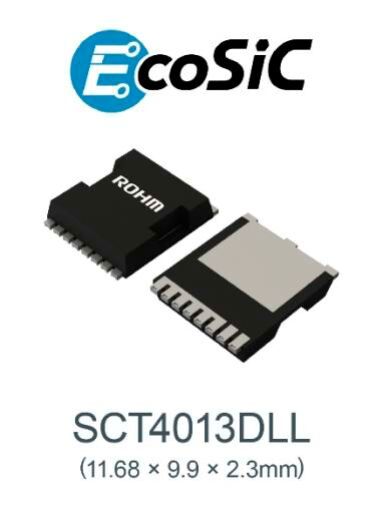
The adopted product is the SCT4013DLL, a 750 V SiC MOSFET that is installed in the power supply section of a ±400 V power architecture for AI servers. Leveraging the characteristics of SiC, this product offers high-temperature tolerance with a maximum junction temperature (Tj) of 175 °C, enabling stable operation even in BBUs where heat generation increases as voltages and power density rise.
In next-generation 800 VDC power architectures, the supply voltage delivered to the battery pack inside the BBU is approximately 560 V. For this reason, ROHM’s 750 V rated SiC MOSFETs can also be used in these systems. HVDC power supplies for next-generation AI servers require backup systems capable of controlling high voltages and large currents instantly, with minimal power loss in the event of an abnormality. To meet these demanding requirements, SiC power devices that combine high voltage capability, low loss, and high-temperature tolerance are expected to serve as key devices at the core of power control.
Looking ahead to continued growth in the AI server and data center markets, ROHM will further strengthen the development and supply of power devices using SiC, GaN, and silicon. ROHM will also contribute to higher power efficiency and the realization of a sustainable society by proposing solutions that combine these power devices with analog ICs and other technologies.
EcoSiCTM Brand
EcoSiCTM is a brand of devices that utilize silicon carbide (SiC), which is attracting attention in the power device field for performance that surpasses silicon (Si). ROHM independently develops technologies essential for the evolution of SiC, from wafer fabrication and production processes to packaging, and quality control methods. At the same time, we have established an integrated production system throughout the manufacturing process, solidifying our position as a leading SiC supplier.
*EcoSiCTM is a trademark or registered trademark of ROHM Co., Ltd.
Related Information
ROHM provides information on SiC power devices on ROHM’s website, including a convenient “Easy Part Finder” feature for selecting products based on specified conditions, as well as design models that support evaluation and implementation. Please refer to the following for technical materials and related resources.
- Application Note: 4th Generation SiC MOSFETs Discrete Package: Characteristics and Precautions for Circuit Design
- Application Note: Application Benefits of Using 4th Generation SiC MOSFETs
- White Paper: ROHM’s 800 VDC Architecture Solutions for AI Servers
- Special Dialogue: Data Center Power Constraints Intensify Why Delta and ROHM Are Doubling Down on High Voltage Direct Current (HVDC)
(ID:50862539)
:quality(80)/p7i.vogel.de/wcms/8c/c3/8cc3f77472b8af8ca61b5bf8cb7ee8f0/0131704631v2.jpeg "ROHM launches New Top-Side Cooling Package for SiC MOSFETs, Combining High Heat Dissipation with High Voltage Support (Source: ROHM)")
:quality(80)/p7i.vogel.de/wcms/93/00/930039fb8c34dcec1448cd8b2c19d9ba/0131245485v2.jpeg "ROHM’s 5th‑generation EcoSiC MOSFETs deliver ~30% lower on‑resistance at high temperatures, enabling smaller, higher‑power inverters for xEVs and industrial power supplies. (Source: ROHM)")