


:quality(80)/p7i.vogel.de/wcms/2f/f3/2ff3221bf7665de2d0acf83760bfd1fa/0130031523v2.jpeg "Wolfspeed presents a 300 mm silicon carbide technology platform designed to support advanced packaging and high-efficiency power delivery for AI data center infrastructure. (Source: Wolfspeed)")
:quality(80)/p7i.vogel.de/wcms/c3/16/c316e955a97f5d72d9678297b237b9e5/0129932858v2.jpeg "Left: the single-phase version of the SENTRON ECPD with RCM, right: a model of the future three-phase version of the SENTRON ECPD. (Source: Siemens)")
:quality(80)/p7i.vogel.de/wcms/ef/0a/ef0adb0acf793fe147cc27c21f6a7a67/0129954238v2.jpeg "Empower Semiconductor introduces embedded silicon capacitors designed to improve power delivery and stability in AI and high-performance computing processors. (symbolic image) (Source: © IF.arc - stock.adobe.com)")
:quality(80)/p7i.vogel.de/wcms/53/f9/53f9301dfc9292d02960f7996c79cc6e/0129927601v2.jpeg "Wolfspeed’s new 10 kV SiC MOSFET enables high-voltage power conversion for grid and industrial applications. (symbolic image) (Source: © CREATIVE- 3.4 - stock.adobe.com)")
:quality(80)/p7i.vogel.de/wcms/6e/cd/6ecd41d095d5111cf4ed37b714844487/0129930878v2.jpeg "PCIM Asia Shenzhen provides a platform for industry experts to present new developments in power electronics and electrification technologies. (symbolic image) (Source: © killykoon - stock.adobe.com)")
:quality(80)/p7i.vogel.de/wcms/02/c0/02c0e9722f70b1134dbf96fb59a9c73d/0129655179v2.jpeg "The PCIM Conference 2026 will take place from June 9-11, featuring discussions on power electronics trends, including GaN technology and AI applications. (symbolic image) (Source: © Elmira - stock.adobe.com)")
:quality(80)/p7i.vogel.de/wcms/cc/67/cc670ea2029cd2af5c641af70e1bf734/0129816392v4.jpeg "Fraunhofer IAF coordinates the EU SUPREME project to accelerate GaN and SiC power semiconductor innovation in Europe. (Source: Fraunhofer IAF)")
:quality(80)/p7i.vogel.de/wcms/ea/e6/eae6aee30071e67a5627027974437134/0129544613v2.jpeg "GlobalFoundries and Renesas strengthen their collaboration to support U.S.-based semiconductor production and supply chain resilience. (Source: © ronstik - stock.adobe.com)")
:quality(80)/p7i.vogel.de/wcms/b1/5e/b15ee02b0ba02db70cf61e37d66ad1d3/0129349127v2.jpeg "Vehicle-to-grid (V2G) chargers enable bidirectional energy flow, allowing electric vehicles to act as mobile energy storage systems that can both draw power from and feed power back into the grid. (Source: © medienvirus - stock.adobe.com)")
:quality(80)/p7i.vogel.de/wcms/26/d5/26d591cc340077026eac56a0e7564faf/0129949603v2.jpeg "Flexible: The solid silicone-based electrolyte is elastic, thereby compensating for the voids that form in solid-state batteries during charging and discharging. (Source: Empa)")
:quality(80)/p7i.vogel.de/wcms/4d/e0/4de02f76a37cbb3df30dd231de589c8e/0128866890v2.jpeg "Both legacy and vGaN show higher carrier mobility and band gap energies compared to other power semiconductors. (Source: © phonlamaiphoto - stock.adobe.com)")
:quality(80)/p7i.vogel.de/wcms/18/0b/180b7b63afc91e523592d8a5ce161c96/0129847487v2.jpeg "InGaAs-based photodetectors enable sensitive and fast detection in the short-wave infrared spectrum for modern sensing and communication applications. (Source: © VITALII - stock.adobe.com)")
:quality(80)/p7i.vogel.de/wcms/be/c8/bec8d43fc0ee73414274be44608b2970/0129748903v2.jpeg "The Infiniium XR804KA real-time oscilloscope delivers faster response time, improved stability, and streamlined workflows for high-speed digital and compliance testing. (Source: Keysight)")
:quality(80)/p7i.vogel.de/wcms/23/ee/23ee4a97790d6009dbfd7d9577ffa723/0129220424v2.jpeg "The R&S FPL1044 with the new RTSA option makes 40 MHz real-time frequency analysis available up to 44 GHz. (Source: Rohde & Schwarz )")
:quality(80)/p7i.vogel.de/wcms/3c/d1/3cd1cacbceb792ba63727199c61ca434/0127801860v2.jpeg "Thanks to cloud technology, users can collaborate on projects from anywhere and always have access to the latest planning data. (Source: SIEMENS)")
:quality(80)/p7i.vogel.de/wcms/5a/a0/5aa0436498af618297961fd54ab36cdf/0126290792v2.jpeg "Siemens accelerates student-led semiconductor innovation across Europe’s leading technical universities through Cre8Ventures’ Open Higher Education Program developed in collaboration with Arm and University of Southampton (Source: Siemens Digital Industries Software)")
:quality(80)/thumbor.vogel.de/f3g2ouosszYDI6Qcyea5EqIzON0=/500x500/p7i.vogel.de/wcms/68/83/6883a88b8c321/ole-gerkensmeyer.jpeg "Ole Gerkensmeyer")
ELECTRONIC WASTE Recycling and urban mining in electronics: Turning e-waste into opportunity
Related Vendors
:fill(fff,0)/p7i.vogel.de/companies/66/9a/669a2816c84be/pcim-logo.png "pcim-logo (PCIM)")
:fill(fff,0)/p7i.vogel.de/companies/66/8b/668becd1c07eb/dowa-logo-word--1-.jpeg "dowa-logo-word--1- (DOWA)")
:fill(fff,0)/p7i.vogel.de/companies/68/08/6808a2b3b6595/het-logo.jpeg "het-logo (Heraeus Electronics)")
E-waste is skyrocketing, with over 62 million metric tons produced in 2023, driven by digitalization and electric vehicles. Recycling faces challenges due to complex electronics. While urban mining offers a solution for precious metal recovery, effective management demands better design, innovative recycling, and comprehensive regulations.
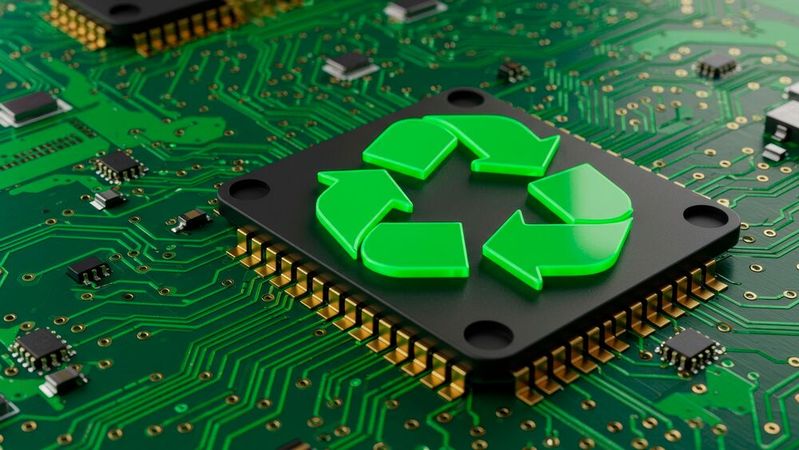
Electronic waste, or e-waste, is the fastest-growing waste stream on the planet. In 2023, the world generated more than 62 million metric tons of e-waste1 — a number projected to rise sharply with the increasing digitization of society and the rapid electrification of transportation. This category of waste includes everything from smartphones and laptops to industrial servers and embedded systems in vehicles and infrastructure.
One of the most significant — and still under-acknowledged — sources of future e-waste will be electric vehicles (EVs). By the 2030s, the first wave of mass-market EVs will reach end-of-life, contributing a flood of highly integrated electronics: battery management systems, power electronics, high-performance semiconductors, sensors, connectivity modules, and infotainment hardware. These components are rich in precious metals and rare elements, but their compact, sealed designs make them extremely difficult to disassemble or recycle2.
Governments around the world have begun taking regulatory action to mitigate the growing e-waste crisis. In China, the Regulations on the Administration of the Recovery and Disposal of Waste Electrical and Electronic Products (first enacted in 2009, updated in 2021) mandate producer-funded collection and recycling schemes, enforce hazardous substance restrictions, and establish minimum recovery targets3. These are supported by China’s expanding Extended Producer Responsibility (EPR) framework, which increasingly covers EV batteries and electronic modules.
The European Union leads with its Waste Electrical and Electronic Equipment (WEEE) Directive (Directive 2012/19/EU), which enforces strict recovery and recycling quotas, restricts hazardous materials under the RoHS Directive (Directive 2011/65/EU), and obligates manufacturers to fund collection and treatment infrastructure4. The WEEE2 update has added pressure on producers to design for disassembly and material recovery.
:quality(80)/p7i.vogel.de/wcms/8d/3d/8d3d8943c4ea211a64cabb24f7404944/0125827250v2.jpeg "The European Green Deal drives the electronics sector toward climate neutrality by 2050, emphasizing circular economy principles to enhance sustainability and competitiveness. Find out more about this here. (Source: © Vanessa - stock.adobe.com)")
CLIMATE NEUTRAL
The EU Green Deal and the electronics sector: A strategic imperative for circularity
Japan, under its Home Appliance Recycling Law (Act No. 97 of 1998), requires consumers to return end-of-life electronics to manufacturers or designated collection centers, with disassembly and recycling handled at specialized facilities5.
In the United States, regulation is fragmented. While no federal e-waste law exists, 25 U.S. states have enacted legislation, most notably California’s Electronic Waste Recycling Act (SB20/SB50, 2003), which mandates consumer fees to fund the proper disposal of covered electronics6.
The global regulatory landscape makes one thing clear: electronics must be diverted from landfills, recovered responsibly, and reintegrated into supply chains. Yet while policy frameworks are expanding, the technological and economic realities of recycling — especially in the case of semiconductors and highly integrated systems — remain deeply challenging.
The challenge of electronics and semiconductor recycling
Unlike paper, glass, or even some plastics, electronics recycling is far from straightforward. The difficulties stem from:
- Material Complexity – Electronics contain dozens of different materials, including metals, ceramics, plastics, and rare elements, often bonded at microscopic scales. A single smartphone might contain over 60 elements from the periodic table7.
- Miniaturization & High Integration – Modern semiconductors are incredibly small, with features measured in nanometers. This makes mechanical separation nearly impossible without destroying much of the recovered material8.
- Hazardous Substances – Many older electronics contain lead, cadmium, mercury, brominated flame retardants, and other harmful chemicals9. These complicate safe disassembly and require costly handling.
- Economic Viability – The cost of extracting small quantities of valuable metals from electronics often exceeds the market value of those metals10.
- Contamination & Loss – Shredding and smelting electronics for material recovery often results in cross-contamination, making high-purity recovery of metals — essential for semiconductor manufacturing — technically challenging11.
- Throw-Away-Design Mentality – Electronics today are rarely designed for reuse. Most hardware solutions are engineered with a single application purpose in mind, optimized for performance rather than modularity or repurposability 12. This design philosophy severely limits opportunities for extending product lifecycles or repurposing functional modules.
Urban mining: Extracting value from the city’s “Ore”
Urban mining is the concept of treating discarded products and infrastructure as ore deposits, rich in metals and materials that can be recovered and reused13. For electronics, this means recovering precious and rare metals from discarded devices rather than from traditional mining operations.
What’s realistically possible
Urban mining of electronics focuses primarily on metals that have high concentrations and high market value:
- Gold (Au) – connectors, bonding wires, and circuit boards.
- Palladium (Pd) – multilayer ceramic capacitors and connectors.
- Silver (Ag) – solder, contacts, and traces.
- Copper (Cu) – wiring, PCB traces, inductors.
- Tin (Sn) – solder alloys.
Other materials like rare earth elements (neodymium, yttrium, terbium) are technically recoverable from hard drives, magnets, and display phosphors, but low volumes and high separation costs limit feasibility14.
:quality(80):fill(efefef,0)/p7i.vogel.de/wcms/5f/fe/5ffedb2e0ffa6/listing.jpg "listing")
Energy needs compared to virgin mining
Urban mining often uses pyrometallurgical (smelting) or hydrometallurgical (chemical leaching) processes. Studies show major energy advantages:
| Metal | Energy to Mine from Ore (MJ/kg) | Energy from Urban Mining (MJ/kg) | Reduction (%) |
| Gold | ~500,000 | ~50,000 | ~90% |
| Copper | ~30–50 | ~5–10 | ~80% |
| Aluminum | ~200 | ~10–15 | ~90% |
| Palladium | ~1,500,000 | ~150,000 | ~90% |
Table Footnotes:
- 15: UNEP International Resource Panel (2013). Environmental Risks and Challenges of Anthropogenic Metals Flows and Cycles.
- 16: Chancerel, P., & Rotter, V. S. (2009). Waste Management, 29(8), 2336–2348.
- 17: Nuss, P., & Eckelman, M. J. (2014). PLOS ONE, 9(7): e101298.
- 18: UNEP IRP (2011). Recycling Rates of Metals – A Status Report.
- 19: European Aluminium Association (2013). Environmental Profile Report for the European Aluminium Industry.
- 20: Das, S., & Ting, Y.-P. (2017). Journal of Cleaner Production, 158, 119–129.
- 21: Ciacci, L., Nuss, P., Reck, B. K., & Graedel, T. E. (2015). Nature Geoscience, 8(8), 561–567.
- 22: Hagelüken, C. (2012). Platinum Metals Review, 56(1), 29–35.
In other words, urban mining is generally far less energy-intensive than extracting metals from the earth, especially for precious metals. However, the processing infrastructure, collection logistics, and labor involved in urban mining remain costly.
What is lost in the process
Urban mining effectively recovers metals but often destroys valuable non-metallic components due to harsh recycling processes, leading to significant losses in functional and commercial value.
Current technical overview
While urban mining excels at recovering metals, other valuable components and materials are destroyed due to the nature of the recycling methods. High-temperature pyrometallurgical processes and aggressive hydrometallurgical leaching inevitably degrade or destroy non-metallic, functional components:
- Semiconductors and Chips – Destroyed during shredding and melting, making refurbishment impossible.
- Ceramic Capacitors – Palladium-containing MLCCs are chemically dissolved or broken apart.
- High-Performance Polymers – PCB substrates and housings are incinerated or degraded.
- Rare Earth Magnets – Lose crystal alignment after heating, destroying magnetic properties23.
These losses occur because urban mining prioritizes elemental recovery over preservation of complex, high-value assemblies.
:quality(80)/p7i.vogel.de/wcms/1a/04/1a04b182f5d202ebe3e14d5dcdb7974a/0120151794v2.jpeg "MIT's innovative chip foundation paves the way for a greener tomorrow. Learn more about this here! (Source: Studios - stock.adobe.com)")
ELECTRONIC WASTE
A new greener substrate to tackle e-waste
Lost commercial value of the respective components
| Component Type | Potential Reuse Value (Functional) | Recovery Value as Scrap Metal | Loss in Commercial Value |
| High-Performance Processor (CPU / GPU) | $50–$500[^24] | <$0.50 | ~99% |
| Semiconductor Memory (DRAM / NAND) | $5–$100[^25] | <$0.10 | ~99% |
| Rare Earth Permanent Magnets | $10–$50 | <$2 | 80–95% |
| Ceramic Capacitors (MLCC) | $0.05–$0.50 each | <$0.01 | 80–90% |
| High-Performance Polymers (PCB substrates) | $3–$10/kg | $0 | 100% |
Conclusion
Electronics and semiconductor recycling is both a technological necessity and an industrial challenge. Governments have set mandates to curb e-waste and recover valuable resources, but the complexity of modern electronics — combined with a prevailing throw-away-design mentality — makes complete recycling economically and technically difficult24.
Urban mining offers a pragmatic approach: focus on recovering the most valuable and accessible metals with far less environmental impact than virgin mining. However, it is not a silver bullet.
A sustainable path forward requires:
- Design for Disassembly – Easier dismantling and recycling.
- Extended Product Life – Refurbishment and reuse.
- Selective Urban Mining – High-yield materials with innovative low-energy processes.
Only by addressing both the material recovery and component preservation challenge can society move toward a truly sustainable electronics lifecycle.
References
- 1 Forti, V., et al. (2024). The Global E-waste Monitor 2024. United Nations University (UNU), United Nations Institute for Training and Research (UNITAR), International Telecommunication Union (ITU), and International Solid Waste Association (ISWA).
- 2 UNEP IRP (2013). Environmental Risks and Challenges of Anthropogenic Metals Flows and Cycles. International Resource Panel, United Nations Environment Programme.
- 3 Ministry of Ecology and Environment of the People’s Republic of China (2009, revised 2021). Regulations on the Administration of the Recovery and Disposal of Waste Electrical and Electronic Products.
- 4 European Union (2012). Directive 2012/19/EU of the European Parliament and of the Council on Waste Electrical and Electronic Equipment (WEEE).
- 5 European Union (2011). Directive 2011/65/EU on the Restriction of the Use of Certain Hazardous Substances in Electrical and Electronic Equipment (RoHS).
- 6 Government of Japan (1998). Act No. 97 of 1998: Home Appliance Recycling Law. Ministry of Economy, Trade, and Industry (METI).
- 7 California State Legislature (2003). Electronic Waste Recycling Act of 2003 (SB20/SB50). State of California.
- 8 Chancerel, P., & Rotter, V. S. (2009). Assessing the Management of Small Waste Electrical and Electronic Equipment through Substance Flow Analysis. Waste Management, 29(8), 2336–2348.
- 9 Nuss, P., & Eckelman, M. J. (2014). Life Cycle Assessment of Metals: A Scientific Synthesis. PLOS ONE, 9(7): e101298. https://doi.org/10.1371/journal.pone.0101298
- 10 Ciacci, L., Nuss, P., Reck, B. K., & Graedel, T. E. (2015). Metals for a Low-Carbon Society. Nature Geoscience, 8(8), 561–567. https://doi.org/10.1038/ngeo2480
- 11 European Aluminium Association (2013). Environmental Profile Report for the European Aluminium Industry. Brussels, Belgium.
- 12 Das, S., & Ting, Y.-P. (2017). Evaluation of LCA of Aluminium Production and Recycling Processes. Journal of Cleaner Production, 158, 119–129.
- 13Hagelüken, C. (2012). Recycling the Platinum Group Metals: A European Perspective. Platinum Metals Review, 56(1), 29–35.
- 14 Kahhat, R., et al. (2008). Exploring E-Waste Management Systems in the United States. Environmental Science & Technology, 42(17), 6456–6462.
- 15 Ingo, M., et al. (2013). Materials Recovery from Wastes Generated by Electronics Industry: A Chemical Review of Metal Recovery Processes. Journal of Electronic Materials, 42, 2291–2303.
- 16 UNEP IRP (2011). Recycling Rates of Metals – A Status Report. International Resource Panel, United Nations Environment Programme.
- 17 Zeng, X., et al. (2017). Urban Mining of E-Waste is Becoming More Cost-Effective Than Virgin Mining. Environmental Science & Technology, 51(18), 10786–10793.
- 18 Baldé, C. P., et al. (2017). E-waste Statistics: Guidelines on Classification, Reporting and Indicators. United Nations University.
- 19 Geyer, R., & Doctori Blass, V. (2010). The Economics of Cell Phone Reuse and Recycling. International Journal of Advanced Manufacturing Technology, 47, 515–525.
- 20 Ongondo, F. O., Williams, I. D., & Cherrett, T. J. (2011). How Are WEEE Doing? A Global Review of the Management of Electrical and Electronic Wastes. Waste Management, 31(4), 714–730.
- 21 Zhao, W., et al. (2016). Rare Earth Element Recovery from End-of-Life Products: A Review. Journal of Cleaner Production, 139, 1223–1235.
- 22 Baldé, C. P., et al. (2015). The Global E-Waste Monitor 2015. United Nations University.
- 23 Graedel, T. E., et al. (2011). What Do We Know About Metal Recycling Rates? Journal of Industrial Ecology, 15(3), 355–366.
- 24 IT Asset Disposition (ITAD) Market Reports (2021–2024). Resale pricing data aggregated from eBay, Alibaba wholesale, and professional refurbishing market reports.
PCIM Expo 2026: Join the leading exhibition!
Lead the future of power electronics! Exhibit your latest solutions, connect with key players, and elevate your brand visibility worldwide at the PCIM Expo from 9 – 11 June 2026 in Nuremberg, Germany. Benefit from our Early Bird discount by 30 June 2025.
Secure your spot now
(ID:50508344)
:quality(80)/p7i.vogel.de/wcms/99/e7/99e713ba9dc419691f57166a045897b1/0126690706v2.jpeg "Discover how the circular economy is transforming electronics by extending product life, reducing waste, and optimizing resource use through strategic frameworks and innovative approaches. (Source: © Andy - stock.adobe.com)")
:quality(80)/p7i.vogel.de/wcms/3f/8a/3f8a509fe74fbd8f221e9a0530516b64/0126938143v2.jpeg "A shift to a circular electronics economy is essential to address the growing e-waste problem and harness economic opportunities through enhanced reuse, refurbishment, and recycling practices, thereby achieving sustainability and economic growth. (Source: © malp - stock.adobe.com)")