


:quality(80)/p7i.vogel.de/wcms/10/fc/10fcb98e44d61826e641bc8d3f20f616/0133193677v2.jpeg "The new AEVA and AEVB Series aluminum electrolytic capacitors are engineered for harsh industrial environments, delivering high-CV, long-lifetime performance in compact, surface-mount packages that reliably withstand up to 30g acceleration and operating temperatures extending from -55° to +125°C. (Source: Kyocera)")
:quality(80)/p7i.vogel.de/wcms/f7/42/f74208db9f5f87dca384b38b71c4782e/0133196365v2.jpeg "YAGEO’s EC Flat‑Series temperature sensors combine fast, accurate measurement with resistance to vibration, shock, moisture and dust for demanding automotive and industrial applications. (Source: Yageo)")
:quality(80)/p7i.vogel.de/wcms/b2/82/b28212428745dd8a4634ad4f4912012f/0132902689v2.jpeg "New 15 V, 25 V and 40 V eGaN FETs deliver ultra-low on-resistance, high current capability, and exceptional radiation immunity for high-density space power conversion (Source: EPC Space)")
:quality(80)/p7i.vogel.de/wcms/7b/4f/7b4f433302c490cac22eee9c12499e65/0132780211v2.jpeg "Littelfuse introduces the TPSMD‑FL series of high‑power surface‑mount TVS diodes, designed to simplify ISO 7637 load‑dump protection and safeguard automotive electronics against severe voltage transients. (Source: Littlefuse)")
:quality(80)/p7i.vogel.de/wcms/78/38/783841efab284c1b4453777e7ebea26d/0133190419v2.jpeg "Diodes has completed its acquisition of Elevate Semiconductor, expanding its analog and mixed-signal portfolio and strengthening its presence in the high-growth automated test equipment market. (Source: © peopleimages.com - stock.adobe.com)")
:quality(80)/p7i.vogel.de/wcms/1f/79/1f79d69530465de26a832c742fc60319/0133117717v2.jpeg "With 30,000 sqm of exhibition space, 20,157 trade visitors, 271 exhibitors, and 131 expert presentations as part of the conference program, the event sent a strong message about the industry's innovative strength and dynamism. (Source: Mesago Messe Frankfurt GmbH)")
:quality(80)/p7i.vogel.de/wcms/43/4d/434db2291567e847e54332004942a225/0132958267v2.jpeg "GlobalWafers has joined the SEMI Taiwan Materials Alliance, with CEO Doris Hsu serving as co‑chair, to advance critical materials technologies, accelerate collaborative innovation and strengthen global semiconductor supply chain resilience. (Source: © jiwon - stock.adobe.com)")
:quality(80)/p7i.vogel.de/wcms/6f/72/6f72f93d1e4c5a248a97dd3b8f32a336/0132997898v2.jpeg "Infineon plans to acquire C2i Semiconductors to combine software‑defined multiphase control and smart power stages with its broad power‑semiconductor portfolio for intelligent, scalable AI data‑center power delivery. (Source: © Grispb - stock.adobe.com)")
:quality(80)/p7i.vogel.de/wcms/87/97/879728679e7010f81e53a86923cde74c/0133218625v2.jpeg "Conceptual illustration of polar wurtzite niobium aluminum nitride (NbAlN), a transition-metal-containing nitride semiconductor that preserves the crystal structure and polarity of GaN. (Source: Associate Professor Atsushi Kobayashi from Tokyo University of Science, Japan)")
:quality(80)/p7i.vogel.de/wcms/ac/31/ac31c9478d80894d725d02883ae7ed5d/0133176534v2.jpeg "Average models allow power designers to simulate DC‑DC converters and three‑phase PFC circuits quickly, analyse small‑signal behaviour and evaluate loop stability without modelling every switching event. (Source: © AI - stock.adobe.com)")
:quality(80)/p7i.vogel.de/wcms/96/80/9680b468d7f682c8b6c15b07300afbb0/0133177854v2.jpeg "Grid-forming inverters are also known as grid-forming resources and grid-forming IBR. This article explains grid-forming inverters in detail. (Bild: © only_kim - stock.adobe.com)")
:quality(80)/p7i.vogel.de/wcms/57/c6/57c6fa81922a9849a917bdfed82eddf7/0133052494v2.jpeg "Rising demand for high-end materials shifts production toward higher-margin products, reducing output of standard loss materials. (Source: NCAB)")
:quality(80)/p7i.vogel.de/wcms/7b/76/7b76005554b556df2a7a3794bdf69d44/0132365246v2.jpeg "Hioki’s ST5680A DC Hipot Tester combines CE/UKCA/CSA compliance, an integrated capacitance‑based contact check and time‑series waveform recording (voltage, leakage current, insulation resistance) to standardize hipot and insulation testing across EV cell, module and pack production lines. (Source: Hioki)")
:quality(80)/p7i.vogel.de/wcms/af/7f/af7f7b0fb7f29219fc991b1130f65477/0132241333v2.jpeg "Comprehensive laboratory testing regimens—combining thermal cycling, high‑current stress, EMC, and accelerated lifetime tests—are essential to validate advanced power designs and ensure reliability in real‑world applications. (Source: PRBX)")
:quality(80)/p7i.vogel.de/wcms/16/3d/163df69363f8125315a9826e13ea4b05/0131927425v2.jpeg "Solution will maximize data center and AI factory profitability while delivering engineering-grade insights to design and operations for more efficient, sustainable, and resilient infrastructure. (Source: Cadence)")
:quality(80)/p7i.vogel.de/wcms/85/b7/85b7e90733a2bd8f21515d8f7137f2fc/0131917677v2.jpeg "Renesas acquires Pictorus to integrate its embedded application software platform with Renesas’ MCU and MPU portfolio, helping developers shorten time‑to‑market and simplify system integration. (Source: © lucadp - stock.adobe.com)")
ELECTRONIC WASTE A new greener substrate to tackle e-waste
Related Vendors
:fill(fff,0)/p7i.vogel.de/companies/6a/20/6a202a4f89a62/mrs-white-on-blue-bg.png "mrs-white-on-blue-bg ()")
:fill(fff,0)/p7i.vogel.de/companies/62/b9/62b980cddf5d6/ceramtec.png "ceramtec (www.ceramtec-group.com)")
:fill(fff,0)/p7i.vogel.de/companies/5f/71/5f71d5f92a5f6/2000px-rogers-corporation-logo-svg.png "2000px-Rogers_Corporation_Logo.svg.png (rogers germany)")
Growing consumption demand, IoT, and the release of new portable electronic devices drive the e-waste crisis. The semiconductor fabrication process generates a significant amount of e-waste. Researchers at MIT, the University of Utah and Meta have developed a flexible substrate material for multilayer semiconductor fabrication. The article talks about a new substrate material that can combat e-waste.
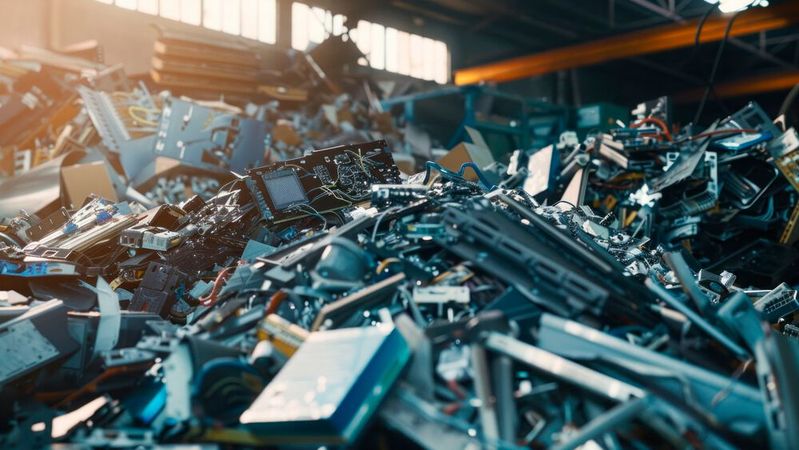
Electronic waste or e-waste comprises a wide range of discarded or used electronic devices, components, circuit boards, wires, etc. Such electronic devices and components are thrown away after years of use or at replacement time. Globally, e-waste is a major environmental issue because it contaminates soil, air and water with harmful chemical releases. International regulatory bodies have defined standards to manage, process, and recycle e-waste.
The processes involved in manufacturing the end product generate tonnes of e-waste. Historically, factories would throw this waste into water bodies. However, many countries have banned such practices. The year 2022 marked 62 million tonnes of e-waste. The amount is estimated to reach 82 million tonnes by 2030. The newly generated waste is accumulated with undisposed or unrecycled waste, making the situation even more critical.
E-waste from semiconductor fabrication
Fabrication units implement traditional methods to manufacture the substrate material for semiconductors. The traditional methods generate a significant amount of unwanted heat.
In addition, electronics manufacturing involves the use of expensive materials such as copper, nickel, and sometimes even silver and gold. As a result, recycling and reprocessing e-waste is an economical benefit for hardware manufacturers.
Several chip manufacturers have emerged as climate-change advocates with their R&D department focusing on creating reusable components.
:quality(80):fill(efefef,0)/p7i.vogel.de/wcms/5f/fe/5ffedb2e0ffa6/listing.jpg "listing")
MIT discovers a new substrate material
The researchers at MIT, the University of Utah and Meta have successfully created a new re-processable material for semiconductor substrates. The following section details the experiment and demonstrates potential benefits.
Problem with green materials
Unreliable devices: There are many problems associated with the use of green materials in semiconductor substrates. Historically, using green materials to build semiconductor substrates compromises the mechanical, thermal, and dielectric capabilities of the end-stage product. As a result, a greener substrate material tends to produce unreliable semiconductor devices.
Heat wastage: Polyamide (PI) is a polymer used to build greener substrates with exceptional mechanical, thermal, and dielectric properties. However, the internal PI bonds are strong enough to break at higher temperatures. High-temperature reprocessing wastes heat and deteriorates the ability to build a miniaturized circuit again.
Synthesizing polymers
Custom diallyl bisimide monomers were synthesized at high temperatures. The results confirmed that all the polymers were thermally, mechanically, and chemically stable with low dielectric losses. The experiment produced a flexible and optically clear thin film, which can be used in commercial-grade substrates to build a functional semiconductor circuit.
The new invention vs. legacy
Researchers compared the film to the legacy industrial aromatic polyimide film called “Kapton”. Kapton has been used for years in industries such as PCB, 3D printing, aerospace, automotive, and medical equipment manufacturing. But Kapton is limited to a one-time use, impractical to reprocess.
The experiment compared thin-film to Kapton in terms of thermal, mechanical, chemical, and dielectric properties. The polyamides showed better thermal conductivity with comparable thermal stability and dielectric losses to Kapton. Beyond comparable properties, the research explored depolymerization.
Depolymerization
If polymerization helps to build substrate, depolymerization enables extracting back meaningful elements from the material. Simply put, depolymerization recovers electric components from polymers for reuse.
Kapton cannot be depolymerised. The experiment used methanol and potassium carbonate to depolymerise the thin film. The entire process took a week. A revised method added 50 % dichloromethane to finish the entire process in 24 hours.
Real-world integration
The experiment was taken further to test a real-world circuit. Basic electronic components with simple routing circuits were added to the 100-micrometer thick film made from PI-ester resin. Shadow mask and PVD (Physical Vapor Deposition) created a thin circuit pattern.
The film was dipped into a liquid metal Eutectic gallium indium alloys (EGaIn) solution. Basic components like LED, resistor, and coin battery were assembled properly for the test. The assembled circuit was fully functional. Values of resistances, voltages, and current were noted for reference.
:quality(80)/p7i.vogel.de/wcms/ba/ef/baef3496e4ee9bf88468e08206e8e7e8/88323983.jpeg "The Internet of things (IoT) is a system of interrelated computing devices, mechanical and digital machines provided with unique identifiers (UIDs) and the ability to transfer data over a network without requiring human-to-human or human-to-computer interaction. (Bild: Stock Adobe)")
IoT
How to get power supply for IoT devices right
Results
The fully functional circuit was immersed in a solution of 50 % dichloromethane, 50 % methanol and 0.07 M potassium carbonate at room temperature. Within two hours, the PI-ester substrate was depolymerised. The same components were rinsed and tested again for functionality. Surprisingly, the values of the resistor and LED matched the previous ones.
Summarizing the experiment
Custom diallyl bisimide monomers were synthesized and used in thiol-ene photopolymerization to produce reprocessable polymer networks. The resulting polymer showcased exceptional and comparable properties to commercial aromatic polyimide Kapton in electronic substrate applications. The depolymerization processes involved selective removal of the substrate to recover fully functional electronic components. The experiment involved UV rays to process the new material. The room-temperature depolymerization process and recovery of fully functional components confirmed that the new development is reprocessable.
A step forward
Researchers have developed degradable photopolymerizable polyimide to build smooth-surface substrates that do not require high-temperature processing. The entire process can recover used electronic components like resistors and LEDs.
Researchers suggest creating multilayered circuits through the photopolymerization of selected areas and the removal of unnecessary resin. The new redistribution layer enables the proper current flow with the necessary insulation.
The internal chemistry of these polymers is compatible with modern fabrication workflows. The solution is effective and economically feasible. The University of Utah team has co-founded a new company to improve and commercialize greener technology to combat e-waste.
(ID:50133756)
:quality(80)/p7i.vogel.de/wcms/f0/d8/f0d82f06ed1b7abb3245dfc4c317cb55/0127949994v2.jpeg "Visual representation of component ageing in power electronics, highlighting thermal and material stress effects across the system (Bild: © Surya16 - stock.adobe.com)")
:quality(80)/p7i.vogel.de/wcms/b1/0a/b10a283cdf3e5f156781a7273c71a7e0/0129107484v2.jpeg "Circular design strategies are increasingly shaping how power electronics are designed, reused, and recovered across their life cycle. (Source: © Enrique - stock.adobe.com)")