


:quality(80)/p7i.vogel.de/wcms/53/f9/53f9301dfc9292d02960f7996c79cc6e/0129927601v2.jpeg "Wolfspeed’s new 10 kV SiC MOSFET enables high-voltage power conversion for grid and industrial applications. (symbolic image) (Source: © CREATIVE- 3.4 - stock.adobe.com)")
:quality(80)/p7i.vogel.de/wcms/e6/d7/e6d7579735e51c3854e77f83237ae515/0129755320v2.jpeg "Henkel expands its high-performance electronics protection portfolio with Loctite STYCAST US 8000 A/B. (Source: Henkel)")
:quality(80)/p7i.vogel.de/wcms/f7/29/f729bd8948948e6d9149cbc59983cab4/0129779015v2.jpeg "Bourns expands its surge protection portfolio with high-energy GDT devices in a compact package. (symbolic image) (Source: © Jack - stock.adobe.com)")
:quality(80)/p7i.vogel.de/wcms/be/c8/bec8d43fc0ee73414274be44608b2970/0129748903v2.jpeg "The Infiniium XR804KA real-time oscilloscope delivers faster response time, improved stability, and streamlined workflows for high-speed digital and compliance testing. (Source: Keysight)")
:quality(80)/p7i.vogel.de/wcms/02/c0/02c0e9722f70b1134dbf96fb59a9c73d/0129655179v2.jpeg "The PCIM Conference 2026 will take place from June 9-11, featuring discussions on power electronics trends, including GaN technology and AI applications. (symbolic image) (Source: © Elmira - stock.adobe.com)")
:quality(80)/p7i.vogel.de/wcms/cc/67/cc670ea2029cd2af5c641af70e1bf734/0129816392v4.jpeg "Fraunhofer IAF coordinates the EU SUPREME project to accelerate GaN and SiC power semiconductor innovation in Europe. (Source: Fraunhofer IAF)")
:quality(80)/p7i.vogel.de/wcms/ea/e6/eae6aee30071e67a5627027974437134/0129544613v2.jpeg "GlobalFoundries and Renesas strengthen their collaboration to support U.S.-based semiconductor production and supply chain resilience. (Source: © ronstik - stock.adobe.com)")
:quality(80)/p7i.vogel.de/wcms/60/40/6040b2e00aef20b4f9d92e8ac9f79c32/0129349725v2.jpeg "The acquisition integrates Micromax’s conductive pastes and inks into MacDermid Alpha’s electronics materials portfolio, expanding capabilities for advanced and high-reliability electronics manufacturing. (Source: © PixaMint - stock.adobe.com)")
:quality(80)/p7i.vogel.de/wcms/18/0b/180b7b63afc91e523592d8a5ce161c96/0129847487v2.jpeg "InGaAs-based photodetectors enable sensitive and fast detection in the short-wave infrared spectrum for modern sensing and communication applications. (Source: © VITALII - stock.adobe.com)")
:quality(80)/p7i.vogel.de/wcms/b2/3f/b23fc44a7d945deb40beaf7813a3f2a0/0129750408v2.jpeg "Collaboration with NVIDIA: Tested for AI/ML-based neural receiver as seen at MWC Barcelona. (Source: Rohde & Schwarz)")
:quality(80)/p7i.vogel.de/wcms/ff/de/ffde925ce91a3e34c39609e7c8344d17/0129759898v2.jpeg "Power electronics face simultaneous pressure from SiC overcapacity, rising AI-driven data center demand, and a reshaping global supply chain. (Source: © TommyNa - stock.adobe.com)")
:quality(80)/p7i.vogel.de/wcms/35/1e/351e0d83dee04c79d0c42b7b9dfb61f7/0129757960v2.jpeg "Hitachi Energy`s advanced semiconductor manufacturing facility. (Source: Hitachi Energy)")
:quality(80)/p7i.vogel.de/wcms/23/ee/23ee4a97790d6009dbfd7d9577ffa723/0129220424v2.jpeg "The R&S FPL1044 with the new RTSA option makes 40 MHz real-time frequency analysis available up to 44 GHz. (Source: Rohde & Schwarz )")
:quality(80)/p7i.vogel.de/wcms/3c/d1/3cd1cacbceb792ba63727199c61ca434/0127801860v2.jpeg "Thanks to cloud technology, users can collaborate on projects from anywhere and always have access to the latest planning data. (Source: SIEMENS)")
:quality(80)/p7i.vogel.de/wcms/5a/a0/5aa0436498af618297961fd54ab36cdf/0126290792v2.jpeg "Siemens accelerates student-led semiconductor innovation across Europe’s leading technical universities through Cre8Ventures’ Open Higher Education Program developed in collaboration with Arm and University of Southampton (Source: Siemens Digital Industries Software)")
:quality(80)/thumbor.vogel.de/eFG69EpuHKhuaAGzhO7BZfNp8Ns=/500x500/p7i.vogel.de/wcms/69/00/6900968a8c1d0/afs.jpeg "Antonio Fernandez Sanchez")
SWIR TECHNOLOGY InGaAs and Near-Infrared Optoelectronics
Related Vendors
:fill(fff,0)/p7i.vogel.de/companies/68/ba/68baa33f71e37/logo-pcim.png "logo-pcim (Self-Upload)")
:fill(fff,0)/p7i.vogel.de/companies/5f/71/5f71d5f92a5f6/2000px-rogers-corporation-logo-svg.png "2000px-Rogers_Corporation_Logo.svg.png (rogers germany)")
:fill(fff,0)/p7i.vogel.de/companies/68/00/6800eb0040fb9/cobalt-vertical-aligned-bold.png "cobalt-vertical-aligned-bold (CISSOID SA)")
Indium gallium arsenide (InGaAs) has become a cornerstone material for near-infrared optoelectronics, enabling applications from LIDAR and Raman spectroscopy to high-speed optical communication. This article explores why InGaAs is uniquely suited for the short-wave infrared spectrum and takes a closer look at its growing role in avalanche photodiodes (APDs).
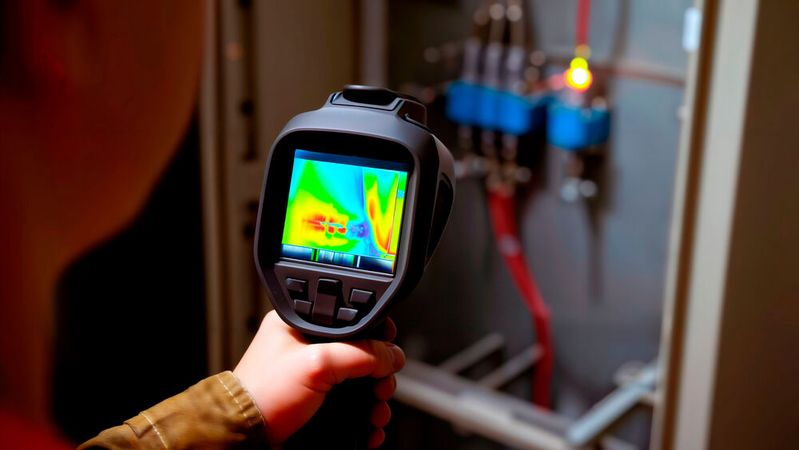
To understand the growing importance of InGaAs in near-infrared optoelectronics, it is essential to examine its material properties and the physical principles that make it uniquely suited for avalanche photodiodes and SWIR detection.
Indium gallium arsenide (InGaAs) plays a vital role both in modern power electronics and in optoelectronic devices. Nowadays we can find this III-V compound semiconductor as part of a wide range of devices such as:
- High speed pHEMT transistors (pseudomorphic high electron mobility transistors)3,6.
- Near-infrared optoelectronics (photodetectors in short-wave infrared cameras, avalanche photodiodes APDs).
- Optical communication receivers3.
- Raman spectroscopy19.
- LIDAR systems.
Particularly in this article, we shall put the focus on one of the most current applications of optoelectronics in which InGaAs is key: avalanche photodiodes (APDs). But before anything else, we should consider the following questions: Do we really understand why we use InGaAs? Why is it used in applications from this specific portion of the infrared spectrum?
Let’s start from the beginning.
The concept of photon wavelength or cutoff wavelength
In a semiconductor the forbidden energy gap (band gap or Eg) is directly related to the associated photon wavelength. Let’s remember that when an electron falls from an upper energy level to a lower energy level, a photon of energy E=hv is emitted (being h the Planck constant and v the frequency).
We can straightforwardly derive the photon energy in electronvolts, as well as the photon wavelength (λ), developing the previous expression and considering that E= h·v = h·c/λ (being c the speed of light), finally getting
Ephoton(eV)=1.24/λ (μm)
being Ephoton in electronvolts (eV) and λ in micrometers (μm)(*). This is an essential expression in optoelectronics to understand in which frequency range a certain semiconductor can work. Photon or cutoff wavelength (λc) allows us to know which wavelengths “passes through” the material and which are absorbed by the semiconductor.
Let’s take for example gallium arsenide, GaAs, a direct band gap semiconductor with an Eg=1.42eV (at 300K)12 ; its λc corresponds to 0.873μm (873nm). In the following picture we can place the λc of GaAs within the electromagnetic spectrum:
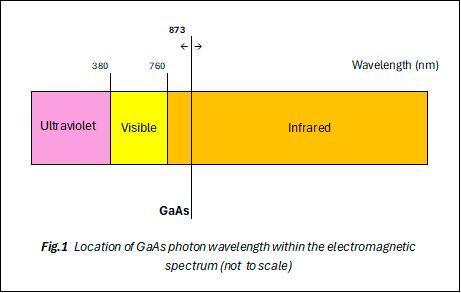
Therefore, a λc of 873nm means:
- GaAs can absorb wavelengths more energetic tan λc, those who fulfill λ< λc; so that GaAs can detect, for instance, all the visible range (from 380 to 750nm aprox.). In other words, it will detect every radiation with photon energies bigger than its band gap.
- GaAs is transparent to wavelengths bigger than λc, such as infrared (IR) since they are not energetic enough.
We can clearly understand this concept when we see pictures of clean-room technicians holding in their hands a practically transparent gallium nitride wafer (GaN)8. This wide band gap semiconductor with an Eg=3.4eV has a λc of 364nm, which is set just before the visible range, so it’s transparent to those wavelengths.
(*) Let’s remember that we can also find in bibliography the expression of photon energy in terms of the reduced Planck constant, ℏ (expression that physicists will probably prefer), thus
E=ℏ·ω, being ℏ=h/2π y ω=2π·f
:quality(80)/images.vogel.de/vogelonline/bdb/1846100/1846123/original.jpg "Technology for agriculture: TriEye partners with Trimble to explore the use of next-gen SWIR-based autonomous vision systems. (gemeinfrei)")
SHORT-WAVE INFRARED
Next-gen SWIR-based autonomous vision systems
What should we know about InGaAs?
InGaAs consist in an alloy of gallium arsenide, GaAs and indium arsenide, InAs; all these elements belong to group III of the periodic table (Ga and In) or to group V (As), so InGaAs is a III-V compound semiconductor15.
Typically, InGaAs alloy is called InxGa1-xAs, being x the proportion of InAs and 1-x the proportion of GaAs. Dependent upon the proportion of In and Ga we use, we shall get a “tunable Eg” semiconductor along with a different lattice constant. In figure 2 we can see a picture showing the relation between photon wavelength, λc and lattice constant for the four alloys of the cuaternary system InGaAsP, made up of the binary compounds InAs, GaAs, InP (indium phosphide) y GaP (gallium phosphide):
![Lattice constant versus cutoff wavelength of alloys in the InGaAsP family. (Source: Sensors Unlimited 2026, [15])](https://cdn1.vogel.de/P1V657Ttl3NUy8SkLGh_8O0DxFg=/fit-in/540x0/smart/p7i.vogel.de/wcms/68/24/682423565a055870902212c9b076fbb9/0129847197v1.jpeg "Lattice constant versus cutoff wavelength of alloys in the InGaAsP family. (Source: Sensors Unlimited 2026, [15])")
It has been shown that indium phosphide, InP, is the best substrate to grow layers of InGaAs because the match between their crystal lattices is excellent4. If we look at the above picture, we realize that the proportion that better fits the lattice constant of an InP substrate is the following: In0.53Ga0.47As.
In0.53Ga0.47As or In.53Ga.47As is usually known as “standard InGaAs”. It has a λc of 1.68μm which belongs to near-infrared spectrum, or more accurately, to short-wave infrared (SWIR). In case of detecting longer-wavelengths “light” (such as 1.9 or 2.6μm) we will have to use InxGa1-xAs with bigger λc; in these cases, we talk about “extended wavelength InGaAs”15 and to this end, a bigger concentration of indium20 is employed.
It is also important to highlight that the optimum match in crystal lattices of the InGaAs/InP system reduces the formation of dislocations and defects and facilitates the growth of high-quality epitaxial layers. In addition, this perfect match allows a low dark current (*) and high electron mobility3.
In0.53Ga0.47As electronic mobility depends on temperature and it can reach values in the order of 10000cm2/Vs (at 300K) and higher (much larger than gallium arsenide mobility, for instance). Its electronic mobility is higher the higher the indium proportion is. For this reason, In0.53Ga0.47As is the semiconductor of choice in optoelectronics as a fast response time photodetector (detection and high-speed image processing)4.
(*) In a photodetector, dark current is a small electric current (in the order of nanoamperes, nA) which flows even in the absence of light, and it is caused by thermal generation of charge carriers inside the device. Minimizing dark current is fundamental to achieving high performance and good sensitivity devices, since this is a factor that contributes to photodetector noise14
:quality(80)/p7i.vogel.de/wcms/35/f2/35f243dd4bd4d57587bd7e4f7a85d6fa/0117752002v2.jpeg "This article covers the basics of the photodiode. (Source: mat - stock.adobe.com)")
BASIC KNOWLEDGE
Photodiode: Definition, applications, and more
Entering the near-infrared range
To put things in context, let us review in detail this portion of the electromagnetic spectrum that concerns us. As we can appreciate in figure 3, we talk about visible range (from 380/400 to 750nm aprox.), near-infrared, near-IR or NIR (from 750 to 1000nm) and short-wave infrared, SWIR (typically from 1000 to 1700nm, although it can also be extended to 2500nm)5 :
![Electromagnetic Spectrum illustrating SWIR Wavelength Range. (Source: Edmund Optics 2026, [5])](https://cdn1.vogel.de/K4Lv0yrM8hhPp9PUUD7b6L-sG0E=/fit-in/540x0/smart/p7i.vogel.de/wcms/df/75/df7522f99541b4f79f91cf3fdc0d50eb/0129847200v1.jpeg "Electromagnetic Spectrum illustrating SWIR Wavelength Range. (Source: Edmund Optics 2026, [5])")
Given that InGaAs cutoff wavelength is 1.68μm it can detect visible light, NIR and SWIR. Additionally, due to its high quantum efficiency at room temperature in the range from 920 to 1700nm11, is definitely ideal as a SWIR photodetector. The next figure helps us to understand this in a visual way, since it shows the graph of InGaAs responsivity (*) versus temperature for different wavelenghts13:
![Typical Spectral Response versus Temperature for InGaAs. (Source: OSI Optoelectronics 2026, [13])](https://cdn1.vogel.de/_97ZAlK_iqKvb5w-ULyT4VdgVG4=/fit-in/540x0/smart/p7i.vogel.de/wcms/f6/da/f6da1f263f577c87401c1e6100768b34/0129847454v1.jpeg "Typical Spectral Response versus Temperature for InGaAs. (Source: OSI Optoelectronics 2026, [13])")
(*) Responsivity in a photodetector is a measure of the sensitivity to light, the efficiency of the conversion of incident light into electric current. It varies with incident light wavelength, with applied reverse voltage and with temperature.13Responsivity can be defined as:
Rph=(IL/A)/Pop
being IL the photocurrent generated in a device of section A and Pop the incident optical power. We can find typical values1 of Rph in the order of 0.95A/W. On the other hand, the quantum efficiency, ηQ , tells us about how many charge carriers we obtain for each incident photon, and it is defined as17:
ηQ= Rph(ℏ·ω/e)
But then, which features make it interesting to employ short-wave infrared (SWIR) combined with InGaAs-based devices? Let’s review some of them below:
- High resolution and sensitivity: to some extent, SWIR wavelengths behave in a similar way to visible light because they are reflected in the same manner; a SWIR image does not have color, but it shows in detail shades and contrasts that allow us to recognize objects clearly16.
- Objects and people identification: a SWIR image represents an ideal complement to thermal cameras. An IR thermal camera detects the heat generated by objects, people or animals (in general terms, in the LWIR range), but it does not have the resolution of a SWIR image.
- Night light detection: the so-called night glow emits mostly in SWIR wavelengths, so a SWIR camera can detect objects with good resolution in dark/moonless nights).
- Detection at room temperature: contrary to what happens with detectors based on other types of semiconductors, which require refrigeration to cryogenic temperatures, with InGaAs we can detect SWIR wavelengths at room temperatures, thus using small-sized devices4.
- Fast response in image processing and detection: given InGaAs high electron mobility, as we have stated before.
- Laser light detection at 1550nm (fiber optics).
After all the above seen, we can retain the following statement: an InGaAs-based photodetector is known for its high gain, high sensitivity, low noise and fast response times.
:quality(80)/p7i.vogel.de/wcms/65/22/65223bc58811ced76adbfa7b5615d532/0129061536v2.jpeg "This article explains topological insulators and explores whether they can optimize electronic systems. (Source: © Rick - stock.adobe.com)")
INSULATORS
Groundbreaking discovery of Topological Insulators
Inside an avalanche photodetector
An avalanche photodetector is a kind of light detector (visible, infrared or any other wavelength) that operates under reverse bias (for instance, between 33 and 57V for certain models of APDs)1.
In an avalanche photodetector we can distinguish two operating zones: an absorption zone and an avalanche zone. The operation is as follows: an incident photon generates an electron-hole pair (e-h) in the absorption zone and this electron is accelerated by a strong electric field in the avalanche zone. This high energy electron collides with another electron in the valence band; in order to supply enough energy to send it to the conduction band, the first electron needs to have a kinetic energy slightly larger than the band gap17.
This initial collision in turn generates an e-h pair, thus getting 2 electrons in the conduction band and a hole in the valence band. After this first impact ionization, the process repeats so more e-h pairs are generated, giving rise to an avalanche process where the number of charge carriers is multiplied. Hence, we get a current amplification (internal multiplication gain). This feature makes an APD suitable to detect very low photon currents, extremely low levels of optical signals; that’s why its use as fiber optics communication detectors, medical image processing or environmental monitoring, among others14.
For the process of avalanche to happen a strong electric field is required (typically >=105 V/cm). Figure 5 shows us this last; we can see the impact ionization rates (*) versus electric field for different kinds of semiconductors, such as InGaAs:
![Impact ionization coefficients of electrons and holes versus electric field for different types of semiconductors. (Source: Singh 1996, [17])](https://cdn1.vogel.de/a1YUXaeRqtTFIOT9P029ZzKaH0k=/fit-in/540x0/smart/p7i.vogel.de/wcms/1f/15/1f159531086e5dff5ec629933d46dc7d/0129847457v1.jpeg "Impact ionization coefficients of electrons and holes versus electric field for different types of semiconductors. (Source: Singh 1996, [17])")
At first sight we see that the values of the electric field are lower in low band gap semiconductors than in other materials (such is the case of standard InGaAs, with Eg=0.75eV), and the same applies to the ionization coefficients.
(*) In the avalanche or impact ionization process, we can express the device current as17:
dI(z)/dz = αz·I
where αz is the average ionization rate per unit of distance. This αz refers to electron ionization coefficients (αimp) and hole ionization coefficients (βimp), of which more information can be obtained in references [10] and [17].
Now let’s focus on the internal structure of an APD. As we have stated before, we shall find two well-defined areas: absorption zone and avalanche zone. In the following picture we get the cross-section of a basic In.53Ga.47As/InP avalanche photodiode, used in applications within 1.3-1.55μm13range:
![Cross-section of a basic InGaAs/InP APD.(Source: Singh 1996, [17])](https://cdn1.vogel.de/oL5EPylu4qm6Jyt__YjYstFFuc0=/fit-in/540x0/smart/p7i.vogel.de/wcms/4f/9d/4f9d06048ec0aaa5c2a335c8552b15f8/0129847460v1.jpeg "Cross-section of a basic InGaAs/InP APD.(Source: Singh 1996, [17])")
In this structure photon absorption occurs in the narrow band gap semiconductor (InGaAs) and multiplication takes place in the largest band gap semiconductor (InP). Now let’s discuss in detail why the different layers we can find inside this device (from top to bottom):
- a) An antireflective (AR) coating (not shown in the figure): it consists of a thin layer or layers of dielectric material (for instance, SiO2 or Si3N4) whose purpose is to minimize the reflection of incident light in the APD, and which allows to increase the quantum efficiency of the device18. This AR coating is custom designed for the specific wavelength range to detect (target wavelengths)2.
- b) A strongly doped indium phosphide (InP) p-n junction (p+-n), where the avalanche process takes place. It is also called multiplication layer, M-layer10 as well as window layer, since it allows photons to enter inside the device18. InP has a band gap of 1.35eV (at 300K) and a λc of 918nm (0.918μm); in other words, it only permits wavelengths larger than 918nm11 to enter the absorption zone (InGaAs), as we can view in figure 7:
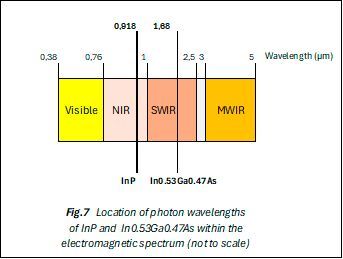
- c) Photon absorption zone or absorber, corresponding to the low band gap In0.53Ga0.47As layer. In the case of direct band gap semiconductors, absorption and avalanche areas can become very thin layers.
Given the strong electric field inside the avalanche zone, a high leakage current can take place by the effect of band-to-band tunneling (*) and, for this reason, we employ a separating layer between InP and In0.53Ga0.47As. We call this structure SAM APD (separate absorption and multiplication APD)17, SACM APD (separate absorption, charge and multiplication APD) as well as SAGCM APD (separate absorption, grading, charge and multiplication APD).
(*) The effect of band-to-band tunneling or Zener tunneling occurs in p-n junctions with a strongly reverse bias, and it is remarkable in low band gap semiconductors. As we can watch in figure 8, electrons in the conduction band can cross the junction by tunnel effect and thus occupy empty states in the valence band, and vice versa.
![Energy band diagram E-x y E-k for a p-n junction with a strongly reverse bias.(Source: Singh 1996, [17])](https://cdn1.vogel.de/BRzSexivn8ziSK5NhUGenF-GXEg=/fit-in/540x0/smart/p7i.vogel.de/wcms/7f/c3/7fc3cef566831475bc542152c6e55257/0129847470v1.jpeg "Energy band diagram E-x y E-k for a p-n junction with a strongly reverse bias.(Source: Singh 1996, [17])")
In addition to the use of In0.53Ga0.47As, we can also find absorbers made of other types of compound semiconductors (which are specific to other wavelengths). For example, the use of super-lattices comprised of thin and alternating layers of In0.53Ga0.47As/GaAs0.51Sb0.49 of nanometric thickness (for a cutoff wavelength of 2400 nm)20.
- d) Finally, and getting back to figure 6, we have an InP buffer layer and substrate. Crystal lattices of the layers described above must be lattice-match to the host substrate just to prevent strain-induced defects. For that reason, InP substrates are typically used10.
:quality(80)/p7i.vogel.de/wcms/73/8d/738da6a85ec1b13cc0ae0c99e0a910a2/0118216103.jpeg "This article will give an in-depth insight about phototransistors. (Source: DALL · E)")
BASIC KNOWLEDGE - TRANSISTOR TECHNOLOGY
Phototransistor: Definition, applications, and more
SAGCM architecture within an APD: grading & charging layers
For a better understanding of the SAGCM concept in an APD (separate absorption, grading, charge and multiplication APD), let’s first look carefully at figure 9, where the energy band diagram at equilibrium of a heterojunction InP-InGaAs APD is shown.
On the left side we have the p+-n junction of the avalanche or multiplication region (InP) followed by the InGaAs absorption layer on the right. Because of the band gap difference between both materials there is a clear discontinuity in the valence bands of InGaAs and InP; it may happen that holes generated in InGaAs get trapped within this discontinuity17:
![Energy band diagram at equilibrium of a heterojunction InP-InGaAs APD. (Source: Sze 1981, [18])](https://cdn1.vogel.de/fWiaePoA9hyZi7IC9LmhA765sYw=/fit-in/540x0/smart/p7i.vogel.de/wcms/bb/3c/bb3c8dbee2412d804491bf509be6e670/0129847473v1.jpeg "Energy band diagram at equilibrium of a heterojunction InP-InGaAs APD. (Source: Sze 1981, [18])")
To prevent this, a “grading layer”17 is used (see figure 6). It consists of an intermediate band gap layer (for example, InGaAsP) with a band gap between InGaAs and InP. This grading layer helps to soften the discontinuity between bands and to decrease the trapping of carriers7. In other words, it reduces the accumulation of electrons and holes in the heterojunctions9.
In contrast, in figure 9 we can also see a small offset between the conduction bands of InGaAs and InP. This is actually an advantage, since it allows an optimal injection of carriers into the multiplication zone. The choice of the right material for this layer is important to prevent high offsets or discontinuities.
On the other hand, the “charging layer” is employed to control and optimize the distribution of the electric field inside the APD7,9, being the doping of this layer a key factor in the device design. Figure 10 shows us an example of an APD which includes both described layers:
![Schematic of guard-ring typed SAM APD’ structure.(Source: Y.Gu 2008, [7])](https://cdn1.vogel.de/Fxaxbl-UUPV0VzzvpoDp-ABSpKM=/fit-in/540x0/smart/p7i.vogel.de/wcms/6a/18/6a18600baac6d3f56baeddf4c3edf213/0129847476v1.jpeg "Schematic of guard-ring typed SAM APD’ structure.(Source: Y.Gu 2008, [7])")
:quality(80)/p7i.vogel.de/wcms/30/1a/301a67e9c76bf2a178b66978f9d0fefd/0127356631v2.jpeg "Reneses is powering the 800V data center architecture with NVIDIA from grid to core. (Source: © .shock - stock.adobe.com)")
POWER SEMICONDUCTORS
Renesas powers 800 V DC AI data center architecture
Conclusion
The aim of this article is to provide insight into these fascinating near-infrared optoelectronic devices. Even though it constitutes just an introduction to this technology, the idea is to give a profound and clear vision of InGaAs APDs.
Currently some companies manufacture advanced avalanche photodiodes which are much more sensitive than other APDs available commercially14 and we can find an overwhelming number of applications. Let’s mention, for instance, the case of LIDAR used in today’s advanced driver assistance systems (ADAS). The use of eye-safe low-power 1550nm lasers has become a reality thanks to the high sensitivity of modern APDs and their ability to detect low level signals above noise.
Readers can anyway go deeper into other aspects of device design and expand information in the references used in this text, which are shown below.
References
- 1. Advanced Photonix/Photodetectors/InGaAs APD/APX-NG000XAPD Series, 1000 to 1700nm InGaAs Avalanche Photodiode Datasheet.
- 2. Albis Optoelectronics/Product lines/Custom design.
- 3. Chaeyoun K., Yunsu J., Hyun S., Byungha S., Intrinsic Transport Properties of Si-Doped In0.53Ga0.47As Revealed by Variable-Temperature Parallel Dipole Line Hall Measurements, Springer - Electronic Materials Letters, November 2025.
- 4. Dong T., Li B., Zhao X., Du J., Duan X., Su J., Zhang F., Lin H., Ren Y., Miao Y. and Radamson H., Boosting the performance of In0.53Ga0.47As/InP photodetectors with Al2O3/SiNx bilayer passivation technology, Elsevier - Materials Science in Semiconductor Processing, Volume 202, February 2026.
- 5. Edmund Optics Inc., Knowledge Center/Application Notes/Imaging Application Notes/What is SWIR?, 2026.
- 6. Fernández A., Understanding HEMTs. 24 questions you should know about high electron mobility transistors… and you never dared to ask, 2025.
- 7. Gu Y., Choa F., Feng Y., Wu X., Wu S., Guan B., Su P. and Krainak M., Single-photon avalanche photodiode with improved structure using an innovative current bias scheme. Optical Components and Materials V, SPIE Digital Library, 2008.
- 8. Hindle P., Lerude G. and Mumford R., Get Your GaN Here: RF GaN Foundry Survey, Microwave Journal Magazine, June 2016.
- 9. Kleinow P., Rutz F., Aidam R., Bronner W., Heussen H. and Walther M., Charge-layer design considerations in SAGCM InGaAs/InAlAs avalanche photodiodes, Physica Status Solidi A - Applications and materials science, December 2015.
- 10. Lee S., Winslow M., Grein C.H., Kodati S.H., Jones A.H., Fink D.R., Das P., Hayat M.M., Ronningen T.J., Campbell J.C. and Krishna S., Engineering of impact ionization characteristics in ¬In0.53Ga0.47As/ Al0.48In0.52As superlattice avalanche photodiodes on InP substrate, Nature.com/Scientific Reports, October 2020.
- 11. Martin T. and Dixon P., InGaAs sees infrared and visible light, Laser Focus World, November 2004.
- 12. Orton, John. Semiconductors and the Information Revolution: Magic Crystals that made IT Happen. Elsevier, 2009.
- 13. OSI Optoelectronics/World Class Products-Light Sensing Solutions/ApplicationsNotes/an-optical-communication-photodiodes-and-receivers.pdf
- 14. Phlux Technology Ltd. - Technology Guides/A brief guide to APD terminology, May 2024
- 15. Sensors Unlimited - A Raytheon Company, Technology/What is InGaAs?, 2026.
- 16. Sensors Unlimited - A Raytheon Company, Technology/Why SWIR?, 2026.
- 17. Singh, J. Optoelectronics. An Introduction to Materials and Devices. McGraw-Hill International Editions. Electrical Engineering Series, 1996.
- 18. Sze, S.M., Physics of Semiconductor Devices, 2nd Edition. John Wiley & Sons, 1981.
- 19. Teledyne Vision Solutions, InGaAs Detectors, A Guide to InGaAs and Extended InGaAs Detectors.pdf
- 20. Uliel Y., Cohen-Elias D., Sicron N., Grimberg I., Snapi N., Paltiel Y. and Katz M., InGaAs/GaAsSb Type-II superlattice based photodiodes for short wave infrared detection, Elsevier / Infrared Physics & Technology, February 2017.
(ID:50772027)
:quality(80)/p7i.vogel.de/wcms/35/f2/35f243dd4bd4d57587bd7e4f7a85d6fa/0117752002v2.jpeg "This article covers the basics of the photodiode. (Source: mat - stock.adobe.com)")
:quality(80)/p7i.vogel.de/wcms/28/32/2832667c414aee61854700a7db3f2213/0127626188v2.jpeg "High electron mobility transistors enable faster, more efficient electronic devices. (Source: © Yultoms95 - stock.adobe.com)")