


:quality(80)/p7i.vogel.de/wcms/53/61/53619895ee4ec91e216ceab62918f8f4/0131724438v2.jpeg "The new MX series by GES High Voltage: Handling up to 20 kV DC and supporting up to 9 poles. (Source: GES High Voltage)")
:quality(80)/p7i.vogel.de/wcms/8c/c3/8cc3f77472b8af8ca61b5bf8cb7ee8f0/0131704631v2.jpeg "ROHM launches New Top-Side Cooling Package for SiC MOSFETs, Combining High Heat Dissipation with High Voltage Support (Source: ROHM)")
:quality(80)/p7i.vogel.de/wcms/d8/ff/d8ffb208c8b62dca4424e25cf8493e00/0131667998v4.jpeg "Integrated, thermally optimized line reactor for power electronics applications. (Source: Block)")
:quality(80)/p7i.vogel.de/wcms/93/fa/93fac0d35290aa5065c18e0a132517c1/0131665788v2.jpeg "The new high performance fuses from Mersen combine the best AC/DC electrical characteristics in a single compact housing (Source: Mersen)")
:quality(80)/p7i.vogel.de/wcms/c7/05/c7057930a5fbf4e7ce7b63feecdad91c/0131786248v2.jpeg "PCIM 2026 award winners recognised for innovative, application‑focused power‑electronics research — Best Paper, Young Engineer and Young Researcher awards presented during the conference ceremony. (Source: Mesago Messe Frankfurt GmbH / Arturo Rivas Gonzalez)")
:quality(80)/p7i.vogel.de/wcms/b5/58/b55874104bf128af36ab420983a1a74f/0131625728v2.jpeg "GC01 (0.5 mm pitch) delivers floating, tolerance‑compensating board‑to‑board performance for high‑speed applications; GB05 provides secure wire‑to‑board connections for automotive and industrial systems. (Source: © WrightStudio - stock.adobe.com)")
:quality(80)/p7i.vogel.de/wcms/e3/a2/e3a2c363179aa46339ba27d0a1785217/0131622335v2.jpeg "At PCIM 2026 Mersen presents new electrical protection solutions for data centers. (Source: © nerminmuminovic - stock.adobe.com)")
:quality(80)/p7i.vogel.de/wcms/df/de/dfde53ac2f23feddfb142593b89981ed/0131617862v2.jpeg "Advanced die‑attach and solder preform solutions from MacDermid Alpha enable more repeatable manufacturing and higher reliability for automotive, industrial and AI data‑center power modules. (Source: MacDermid Alpha)")
:quality(80)/p7i.vogel.de/wcms/5c/f5/5cf53b6db2706b86ac6eb5c407704d27/0131699647v2.jpeg "This article explains inductors in electrical and electronics engineering. (Source: © Iurii - stock.adobe.com)")
:quality(80)/p7i.vogel.de/wcms/e8/b1/e8b1b3c2722724a07ec9835292cf568e/0131681282v2.jpeg "STMicroelectronics expands its PowerGaN portfolio with 700 V HEMTs (6–29 A, 53–270 mΩ typ.), delivering lower switching and conduction losses to increase efficiency and power density for AI servers, robotics and industrial power supplies. (Source: STMicroelectronics)")
:quality(80)/p7i.vogel.de/wcms/3f/77/3f77be835f67d66c9c7bbf179577577a/0131631955v2.jpeg "Inspector examination of photovoltaic modules using a thermal imaging camera (Source: © kanpisut - stock.adobe.com)")
:quality(80)/p7i.vogel.de/wcms/84/1f/841f6921da6203c30dac2963c7a0df81/0131601493v2.jpeg "New multi‑chemistry systems from CATL target fast charging, higher energy density and lightweight flexible applications, with sodium‑ion mass‑production plans announced for 2026. (Source: CATL)")
:quality(80)/p7i.vogel.de/wcms/34/4a/344a3dc5a19429cf6726b7f8f7e2ee32/0130109719v2.jpeg "Hioki’s new measurement solutions enable precise analysis of power electronics systems and energy efficiency. (Source: Hioki)")
:quality(80)/p7i.vogel.de/wcms/be/c8/bec8d43fc0ee73414274be44608b2970/0129748903v2.jpeg "The Infiniium XR804KA real-time oscilloscope delivers faster response time, improved stability, and streamlined workflows for high-speed digital and compliance testing. (Source: Keysight)")
:quality(80)/p7i.vogel.de/wcms/23/ee/23ee4a97790d6009dbfd7d9577ffa723/0129220424v2.jpeg "The R&S FPL1044 with the new RTSA option makes 40 MHz real-time frequency analysis available up to 44 GHz. (Source: Rohde & Schwarz )")
:quality(80)/p7i.vogel.de/wcms/3c/d1/3cd1cacbceb792ba63727199c61ca434/0127801860v2.jpeg "Thanks to cloud technology, users can collaborate on projects from anywhere and always have access to the latest planning data. (Source: SIEMENS)")
TRANSISTORS Imec sets new standard in RF GaN-on-Si transistor performance for 6G amplifiers
Related Vendors
:fill(fff,0)/p7i.vogel.de/companies/6a/20/6a202a4f89a62/mrs-white-on-blue-bg.png "mrs-white-on-blue-bg ()")
:fill(fff,0)/p7i.vogel.de/companies/5f/71/5f71d5f92a5f6/2000px-rogers-corporation-logo-svg.png "2000px-Rogers_Corporation_Logo.svg.png (rogers germany)")
:fill(fff,0)/p7i.vogel.de/companies/68/08/6808a2b3b6595/het-logo.jpeg "het-logo (Heraeus Electronics)")
Imec has set a new benchmark in RF transistor performance for mobile applications. They present a GaN MOSHEMT on silicon that achieves both record efficiency and output power for an enhancement-mode device operating at low supply voltage. These advancements are poised to revolutionize the capabilities of next-gen mobile technology.

In parallel, imec also demonstrated a record-low contact resistance of 0.024Ω· mm which is essential to further boost output power in future designs. The results mark a crucial step toward integrating GaN technology into next-gen mobile devices, particularly those targeting the 6G FR3 band between 7 and 24GHz. The results will be presented at the 2025 Symposium on VLSI Technology and Circuits in Kyoto, Japan.
Today’s mobile networks largely operate below 6GHz, but to meet the data rate demands of future 6G systems, a shift to higher frequencies is needed. In these bands, current mobile solutions based on gallium arsenide (GaAs) HBTs (heterojunction bipolar transistor) struggle to maintain performance. Their efficiency and gain degrade significantly above 10 to 15GHz, leading to fast battery drain and poor energy use in user equipment. GaN is widely recognized as a promising alternative because of its higher power density and breakdown voltage. While GaN transistors on silicon carbide (SiC) have shown strong RF performance in high-frequency base station applications, the cost and limited wafer scalability of SiC remain barriers for the mobile market.
:quality(80)/p7i.vogel.de/wcms/37/7a/377aab497346d9d03e468bb1f6270173/0112287122.jpeg "Mitsubishi Electric's new GaN power amplifier will help to realize radio-unit sharing and power-efficient base stations. (Source: Fascino Crafts - stock.adobe.com)")
AMPLIFIER
World’s first wideband operation of 4G, 5G and beyond 5G/6G systems with single GaN power amplifier achieved
Silicon is a more scalable and cost-effective platform but building high-efficiency GaN transistors on it has been challenging due to the lattice and thermal mismatch between the two materials, which can compromise material quality and device reliability. The challenge is even greater for E-mode designs –which are preferred in mobile for their fail-safe operation and low power consumption – because it typically requires thinning the transistor barrier and channel under the gate. This limits the on-current and increases the off-state leakage, making it harder to achieve the power, efficiency, and gain needed for 6G.
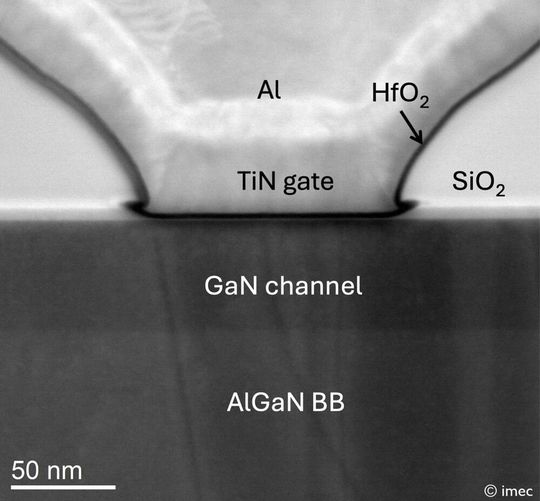
Imec now demonstrates a GaN-on-Si E-mode MOSHEMT metal-oxide-semiconductor high-electron-mobility transistor) that reaches a record 27.8dBm (1W/mm). output power and 66 % power-added efficiency (PAE) at 13GHz and 5V. The result was obtained in a single device with an 8-finger gate layout, providing the gate width needed for high output power without requiring the combined power of multiple transistors. The excellent performance was enabled by combining a gate recess technique, used to shift the device into E-mode, with an InAlN barrier layer that offsets the performance loss from the thinned channel.
:quality(80):fill(efefef,0)/p7i.vogel.de/wcms/5f/fe/5ffedb2e0ffa6/listing.jpg "listing")
In parallel to the device development, imec demonstrated a record-low contact resistance of 0.024Ω· mm using a regrown n⁺(In)GaN layer maximizing current flow and minimizing power loss. While the result was obtained in a separate module, it is fully compatible with the E-mode transistor architecture. Simulations indicate that integrating this contact module could improve the output power density by 70 %, meeting the performance target for 6G user equipment.
“Reducing contact resistance is crucial for pushing output power while keeping efficiency high,” said Alireza Alian, Principal Member of Technical Staff at imec. “Our next step is to integrate this contact module into the E-mode transistor and validate the expected gains in power and efficiency, bringing the device closer to real-world 6G applications.”
(ID:50454309)
:quality(80)/p7i.vogel.de/wcms/ea/f4/eaf4ed9f8eed646233fb8b45d66f8c9d/0126167501v2.jpeg "A breakthrough in diamond FET technology achieves +8.3 V threshold voltage, enhancing high-power device performance and safety. (Source: © cristianstorto - stock.adobe.com)")
:quality(80)/p7i.vogel.de/wcms/28/32/2832667c414aee61854700a7db3f2213/0127626188v2.jpeg "High electron mobility transistors enable faster, more efficient electronic devices. (Source: © Yultoms95 - stock.adobe.com)")