


:quality(80)/p7i.vogel.de/wcms/2f/f3/2ff3221bf7665de2d0acf83760bfd1fa/0130031523v2.jpeg "Wolfspeed presents a 300 mm silicon carbide technology platform designed to support advanced packaging and high-efficiency power delivery for AI data center infrastructure. (Source: Wolfspeed)")
:quality(80)/p7i.vogel.de/wcms/c3/16/c316e955a97f5d72d9678297b237b9e5/0129932858v2.jpeg "Left: the single-phase version of the SENTRON ECPD with RCM, right: a model of the future three-phase version of the SENTRON ECPD. (Source: Siemens)")
:quality(80)/p7i.vogel.de/wcms/ef/0a/ef0adb0acf793fe147cc27c21f6a7a67/0129954238v2.jpeg "Empower Semiconductor introduces embedded silicon capacitors designed to improve power delivery and stability in AI and high-performance computing processors. (symbolic image) (Source: © IF.arc - stock.adobe.com)")
:quality(80)/p7i.vogel.de/wcms/53/f9/53f9301dfc9292d02960f7996c79cc6e/0129927601v2.jpeg "Wolfspeed’s new 10 kV SiC MOSFET enables high-voltage power conversion for grid and industrial applications. (symbolic image) (Source: © CREATIVE- 3.4 - stock.adobe.com)")
:quality(80)/p7i.vogel.de/wcms/6e/cd/6ecd41d095d5111cf4ed37b714844487/0129930878v2.jpeg "PCIM Asia Shenzhen provides a platform for industry experts to present new developments in power electronics and electrification technologies. (symbolic image) (Source: © killykoon - stock.adobe.com)")
:quality(80)/p7i.vogel.de/wcms/02/c0/02c0e9722f70b1134dbf96fb59a9c73d/0129655179v2.jpeg "The PCIM Conference 2026 will take place from June 9-11, featuring discussions on power electronics trends, including GaN technology and AI applications. (symbolic image) (Source: © Elmira - stock.adobe.com)")
:quality(80)/p7i.vogel.de/wcms/cc/67/cc670ea2029cd2af5c641af70e1bf734/0129816392v4.jpeg "Fraunhofer IAF coordinates the EU SUPREME project to accelerate GaN and SiC power semiconductor innovation in Europe. (Source: Fraunhofer IAF)")
:quality(80)/p7i.vogel.de/wcms/ea/e6/eae6aee30071e67a5627027974437134/0129544613v2.jpeg "GlobalFoundries and Renesas strengthen their collaboration to support U.S.-based semiconductor production and supply chain resilience. (Source: © ronstik - stock.adobe.com)")
:quality(80)/p7i.vogel.de/wcms/23/1a/231a97643aa7fc3adf2704a6273756c3/0130030642v2.jpeg "Gallium nitride (GaN) power devices are increasingly challenging silicon MOSFETs in low-voltage power conversion by enabling higher efficiency and switching performance. (Source: © Sheraz - stock.adobe.com)")
:quality(80)/p7i.vogel.de/wcms/3c/4b/3c4bbc68dda65c7071b4376fb57423b0/0130030465v2.jpeg "Faraday’s laws explain the fundamental behavior of magnetic fields and electronic devices in dynamic use cases. The operation of transformers, wireless chargers, induction cookers, induction motors, magnetic levitating trains (MAGLEV Trains), electric violin, and many others depends upon Faraday’s laws. (Source: © Sheraz - stock.adobe.com)")
:quality(80)/p7i.vogel.de/wcms/b1/5e/b15ee02b0ba02db70cf61e37d66ad1d3/0129349127v2.jpeg "Vehicle-to-grid (V2G) chargers enable bidirectional energy flow, allowing electric vehicles to act as mobile energy storage systems that can both draw power from and feed power back into the grid. (Source: © medienvirus - stock.adobe.com)")
:quality(80)/p7i.vogel.de/wcms/26/d5/26d591cc340077026eac56a0e7564faf/0129949603v2.jpeg "Flexible: The solid silicone-based electrolyte is elastic, thereby compensating for the voids that form in solid-state batteries during charging and discharging. (Source: Empa)")
:quality(80)/p7i.vogel.de/wcms/be/c8/bec8d43fc0ee73414274be44608b2970/0129748903v2.jpeg "The Infiniium XR804KA real-time oscilloscope delivers faster response time, improved stability, and streamlined workflows for high-speed digital and compliance testing. (Source: Keysight)")
:quality(80)/p7i.vogel.de/wcms/23/ee/23ee4a97790d6009dbfd7d9577ffa723/0129220424v2.jpeg "The R&S FPL1044 with the new RTSA option makes 40 MHz real-time frequency analysis available up to 44 GHz. (Source: Rohde & Schwarz )")
:quality(80)/p7i.vogel.de/wcms/3c/d1/3cd1cacbceb792ba63727199c61ca434/0127801860v2.jpeg "Thanks to cloud technology, users can collaborate on projects from anywhere and always have access to the latest planning data. (Source: SIEMENS)")
:quality(80)/p7i.vogel.de/wcms/5a/a0/5aa0436498af618297961fd54ab36cdf/0126290792v2.jpeg "Siemens accelerates student-led semiconductor innovation across Europe’s leading technical universities through Cre8Ventures’ Open Higher Education Program developed in collaboration with Arm and University of Southampton (Source: Siemens Digital Industries Software)")
INVERTER TECHNOLOGY How to improve inverter design?
Related Vendors
:fill(fff,0)/p7i.vogel.de/companies/63/c7/63c7da97be945/diotec.png "diotec (Diotec Semiconductor AG)")
:fill(fff,0)/p7i.vogel.de/companies/60/7e/607ec89d5d9b5/white-frame.jpg "white frame.jpg (www.rohm.com)")
:fill(fff,0)/p7i.vogel.de/companies/68/00/6800eb0040fb9/cobalt-vertical-aligned-bold.png "cobalt-vertical-aligned-bold (CISSOID SA)")
Inverters are essential devices that allow us to utilize electricity generated through renewable sources. Designing an inverter depends upon its ratings, requirements, application, and some other factors. However, certain strategies must be followed before designing an inverter. This article covers all the basic strategies you need to remember while designing an efficient inverter.
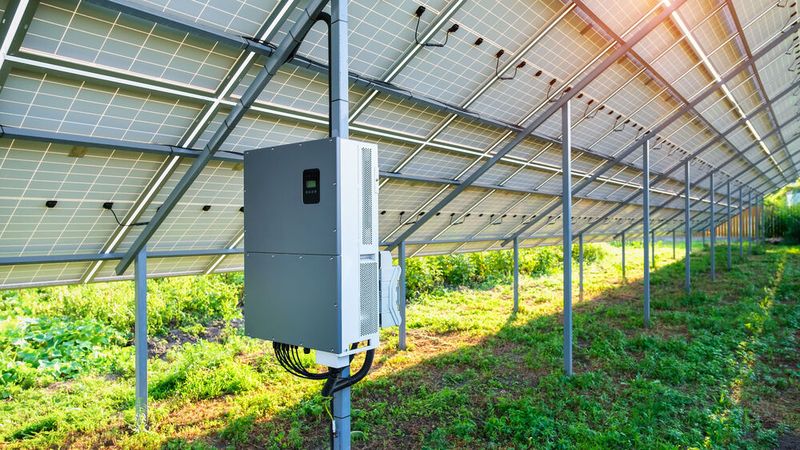
An inverter converts DC electricity to AC electricity. Simply put, an inverter is a type of DC-AC converter. Inverters are designed in the laboratory using special test equipment, methods, and CAD software. Following design rules, regulatory compliance with standards, and choosing appropriate equipment are some basic strategies for designing any power electronic device. However, there are some strategies that every engineer should follow to design inverters. This section lists 11 important concepts to consider before designing your new inverter.
1. Use WBG
Using components made from WBG (Wide Band Gap) semiconductors like SiC (Silicon Carbide) and GaN (Gallium Nitride) reduces inverter losses and improves efficiency. WBG semiconductors have high power density and heat resistance compared to traditional silicon-based components. It means that components made from WBG semiconductors can withstand high temperatures without deterioration or failure.
In addition to high-temperature operation, WBG semiconductors have lower impedance per unit area than silicon. Simply put, WBG semiconductors have low on-state resistance that results in lower power dissipation.
2. Choose appropriate switches
Power losses should be as low as possible. Each switch produces various types of losses but the most important ones are conduction and switching losses.
- Conduction losses occur when the switch remains on. High conduction losses result in heat loss.
- Switching losses occur when a switch transitions between the on-and-off states which leads to voltage spikes.
Choosing a switch in an inverter depends upon its ratings, frequency, and speed. Various types of semiconductor switches used in power electronics are - for example - MOSFET, IGBT, SCR, thyristors, GTO (Gate Turn-off Thyristor), or BJT.
3. Use filters
A filter is an electronic component that blocks certain frequencies but passes others. Filters are simple combinations of resistors (R), inductors (L), and capacitors (C). LC, LCL, and LCR are some filter types typically used in inverters. These filters smooth out the inverter voltage and current waveforms to improve efficiency.
Filters are placed on the input and output sides of the inverter. In contrast, filters remove THD (Total Harmonic Distortion), EMI, and noise from the output to improve the efficiency of an inverter.
4. Choose soft switching
In hard switching technique, a device itself turns on and off through its own capabilities. The switches are repeatedly turned on and off, creating voltage spikes and surges.
Soft switching, also known as ZVS (Zero Voltage Switching), uses an external component such as an LC resonant circuit, auxiliary inductor, or auxiliary switch to turn the device on and off at zero voltage or current. There is no intersection of current and voltage waveforms due to controlled switching. Choosing soft switching improves inverter efficiency and reduces losses.
5. Realize a multilevel topology
Choosing a multilevel inverter topology over a push-pull, sinewave, and other topologies offers improved inverter efficiency for high-power applications. Multilevel inverters generate output waveforms at multiple levels. For example, a three-level (a type of multilevel inverter) generates zero, negative, and positive levels in the output.
In addition, multilevel inverters operate on lower switching frequencies. Such a topology reduces voltage stress on components and energy losses to improve the inverter design efficiency. Multilevel inverter classes include three-level, five-level, seven-level, and nine-level inverters.
6. Implement advanced control algorithms
Control algorithms are a set of “smart” instructions that drive an inverter to perform a function, which eventually leads to improved power conversion capabilities. Droop control, MPC (Model predictive control), PSC (Power Synchronization Control), SPWM (Sinusoidal Pulse Width Modulation), IRP-based control, and SRF-based control are some advanced control algorithms used in inverter systems.
In the case of inverter design for renewable energy systems, the MPPT (Maximum Power Point Tracking) algorithm maximizes power extraction from the source during varying conditions and delivers it to the load.
7. Implement a modulation technique
A modulation technique reduces THD in inverters to ensure that the output is strictly a sine wave (AC). PWM (Pulse Width Modulation) is mainly used in inverters compared to square wave generators.
An efficient modulation technique SVPWM (Space Vector Pulse Width Modulation) must be implemented to control the switching of components with their sequences in the inverters. SVPWM uses low DC voltage to generate the same AC output. As a result, SVPWM increases the inverter efficiency and minimizes losses to generate a modulated output voltage to drive the load.
8. Reduce EMI
EMI (Electromagnetic Interference), also called noise, is a type of unwanted disturbance that deteriorates the quality of an electronic device or causes its complete failure. Some common ways of avoiding EMI are using twisted pair wiring, proper grounding, and shielding- placing sensitive components in a metal enclosure.
One of the most important strategies to mitigate EMI is to use an EMI filter. Some examples are RLC filters, three-phase EMI filters, ferrite choke, differential mode passive EMI filters, and common mode passive EMI filters.
9. Suppress voltage spikes
When switches are rapidly turned on and off, sudden changes in current flow can create an undesirable sharp voltage spike. Using snubber circuits “snubs” the voltage spike. A snubber circuit is a combination of R and C connected across a Thyristor.
Another method is to use a Flyback diode with an inductor to eliminate voltage spikes. A TVS diode (Transient Voltage Suppressor) dissipates high transient power surges. It is important to note that all these circuits do not alter inverter operation.
10. Eliminate current surges
A current surge (in-rush current) is an increase in the current that occurs suddenly when the inverter is turned on after a long time or is abruptly turned off. Current surges can exceed maximum inverter ratings to cause sharp voltage spikes and heat loss.
A traditional way to deal with current surges is to use current limiters, fuses, and circuit breakers. A clamper diode in parallel with a resonant capacitor is a great way to eliminate current surges in an inverter.
11. Manage heat
Proper thermal management is a key factor in maintaining any power electronics device or system. In the first step, choose the components that have high current ratings and are capable of withstanding high temperatures. Inverters, as a part of power electronic systems, should be kept in HVAC areas (Heating Ventilation Air Conditioning).
Proper heat sink design, effective watertight casing, and implementation of cooling mechanisms like ventilation, regular cleaning of equipment (fans), and temperature monitoring are some ways to manage heat.
References
- https://www.hitachi-ies.co.jp/english/products/inv/option/lcr.htm#:~:text=The%20LCR%20filter%20smoothes%20inverter,driving%20a%20400V%20class%20motor.
- https://toshiba.semicon-storage.com/ap-en/semiconductor/knowledge/faq/mosfet_igbt/igbt-012.html
- https://www.powerinverters.net/how-to-improve-efficiency-of-power-inverters
- https://www.iqsdirectory.com/articles/power-supply/emi-filters.html
- https://www.power-and-beyond.com/five-ways-to-deal-with-heat-in-pwm-a-d1b9b40273af7d7c50d50dbcf6b42f38/
(ID:50072524)
:quality(80)/p7i.vogel.de/wcms/37/b2/37b2a11a859c819e4752711ca71df724/0126628873v2.jpeg "Multi-level converters and inverters have been around since the late 1800s. Their job is to work in groups and provide high-power outputs over long distances. Now their use and efficiency have made them enter the aerospace industry. Learn more here. (Source: © frank peters - stock.adobe.com)")
:quality(80)/p7i.vogel.de/wcms/0e/13/0e132310ca94e4d27cfc167cbcf567f9/0128546543v2.jpeg "GaN, SiC, and AI are reshaping power electronics in 2025, responding to rising energy demand and the rapid expansion of data centers, EVs, and electrification. (Source: © Dreamy Shots - stock.adobe.com)")