


:quality(80)/p7i.vogel.de/wcms/2f/f3/2ff3221bf7665de2d0acf83760bfd1fa/0130031523v2.jpeg "Wolfspeed presents a 300 mm silicon carbide technology platform designed to support advanced packaging and high-efficiency power delivery for AI data center infrastructure. (Source: Wolfspeed)")
:quality(80)/p7i.vogel.de/wcms/c3/16/c316e955a97f5d72d9678297b237b9e5/0129932858v2.jpeg "Left: the single-phase version of the SENTRON ECPD with RCM, right: a model of the future three-phase version of the SENTRON ECPD. (Source: Siemens)")
:quality(80)/p7i.vogel.de/wcms/ef/0a/ef0adb0acf793fe147cc27c21f6a7a67/0129954238v2.jpeg "Empower Semiconductor introduces embedded silicon capacitors designed to improve power delivery and stability in AI and high-performance computing processors. (symbolic image) (Source: © IF.arc - stock.adobe.com)")
:quality(80)/p7i.vogel.de/wcms/53/f9/53f9301dfc9292d02960f7996c79cc6e/0129927601v2.jpeg "Wolfspeed’s new 10 kV SiC MOSFET enables high-voltage power conversion for grid and industrial applications. (symbolic image) (Source: © CREATIVE- 3.4 - stock.adobe.com)")
:quality(80)/p7i.vogel.de/wcms/6e/cd/6ecd41d095d5111cf4ed37b714844487/0129930878v2.jpeg "PCIM Asia Shenzhen provides a platform for industry experts to present new developments in power electronics and electrification technologies. (symbolic image) (Source: © killykoon - stock.adobe.com)")
:quality(80)/p7i.vogel.de/wcms/02/c0/02c0e9722f70b1134dbf96fb59a9c73d/0129655179v2.jpeg "The PCIM Conference 2026 will take place from June 9-11, featuring discussions on power electronics trends, including GaN technology and AI applications. (symbolic image) (Source: © Elmira - stock.adobe.com)")
:quality(80)/p7i.vogel.de/wcms/cc/67/cc670ea2029cd2af5c641af70e1bf734/0129816392v4.jpeg "Fraunhofer IAF coordinates the EU SUPREME project to accelerate GaN and SiC power semiconductor innovation in Europe. (Source: Fraunhofer IAF)")
:quality(80)/p7i.vogel.de/wcms/ea/e6/eae6aee30071e67a5627027974437134/0129544613v2.jpeg "GlobalFoundries and Renesas strengthen their collaboration to support U.S.-based semiconductor production and supply chain resilience. (Source: © ronstik - stock.adobe.com)")
:quality(80)/p7i.vogel.de/wcms/3c/4b/3c4bbc68dda65c7071b4376fb57423b0/0130030465v2.jpeg "Faraday’s laws explain the fundamental behavior of magnetic fields and electronic devices in dynamic use cases. The operation of transformers, wireless chargers, induction cookers, induction motors, magnetic levitating trains (MAGLEV Trains), electric violin, and many others depends upon Faraday’s laws. (Source: © Sheraz - stock.adobe.com)")
:quality(80)/p7i.vogel.de/wcms/b1/5e/b15ee02b0ba02db70cf61e37d66ad1d3/0129349127v2.jpeg "Vehicle-to-grid (V2G) chargers enable bidirectional energy flow, allowing electric vehicles to act as mobile energy storage systems that can both draw power from and feed power back into the grid. (Source: © medienvirus - stock.adobe.com)")
:quality(80)/p7i.vogel.de/wcms/26/d5/26d591cc340077026eac56a0e7564faf/0129949603v2.jpeg "Flexible: The solid silicone-based electrolyte is elastic, thereby compensating for the voids that form in solid-state batteries during charging and discharging. (Source: Empa)")
:quality(80)/p7i.vogel.de/wcms/4d/e0/4de02f76a37cbb3df30dd231de589c8e/0128866890v2.jpeg "Both legacy and vGaN show higher carrier mobility and band gap energies compared to other power semiconductors. (Source: © phonlamaiphoto - stock.adobe.com)")
:quality(80)/p7i.vogel.de/wcms/be/c8/bec8d43fc0ee73414274be44608b2970/0129748903v2.jpeg "The Infiniium XR804KA real-time oscilloscope delivers faster response time, improved stability, and streamlined workflows for high-speed digital and compliance testing. (Source: Keysight)")
:quality(80)/p7i.vogel.de/wcms/23/ee/23ee4a97790d6009dbfd7d9577ffa723/0129220424v2.jpeg "The R&S FPL1044 with the new RTSA option makes 40 MHz real-time frequency analysis available up to 44 GHz. (Source: Rohde & Schwarz )")
:quality(80)/p7i.vogel.de/wcms/3c/d1/3cd1cacbceb792ba63727199c61ca434/0127801860v2.jpeg "Thanks to cloud technology, users can collaborate on projects from anywhere and always have access to the latest planning data. (Source: SIEMENS)")
:quality(80)/p7i.vogel.de/wcms/5a/a0/5aa0436498af618297961fd54ab36cdf/0126290792v2.jpeg "Siemens accelerates student-led semiconductor innovation across Europe’s leading technical universities through Cre8Ventures’ Open Higher Education Program developed in collaboration with Arm and University of Southampton (Source: Siemens Digital Industries Software)")
POWER DISTRIBUTION How to deal with harmonic distortion in three-phase transformers?
Related Vendors
:fill(fff,0)/p7i.vogel.de/companies/67/e2/67e2a1ef13aba/logo-ab-rgb-1.jpeg "logo-ab-rgb-1 (http://www.arthurbehrens.biz/)")
:fill(fff,0)/p7i.vogel.de/companies/68/c2/68c2b622b43e1/logo.jpeg "logo (IQ Evolution GmbH)")
:fill(fff,0)/p7i.vogel.de/companies/69/30/693022b11e5db/logo.jpeg "logo (MBS-Hodde GmbH & Co. KG)")
Harmonic distortion is a common problem in any electrical/electronic device, affecting their operation and reliability. In the case of three-phase transformers, harmonics tend to de-rate or permanently degrade their performance. The article explains harmonic distortion, and what it results in, and explores ways to mitigate it.

IEEE 519 recommends a limit of 5 % on total harmonic voltage distortion in linear and non-linear loads, including computers and general electrical appliances. Such a hard limit ensures seamless operation of devices. Harmonic distortion is an unwanted effect seen in many electronic devices, including three-phase transformers. The word “harmonic” corresponds to output waveforms of voltages and currents. Harmonic distortion occurs in these waveforms as non-sinusoidal variations. It is usually a high-frequency component present in the waveform.
Harmonic components
For example, in a 60 Hz system, the first harmonic is 60 Hz. The first harmonic is the fundamental or reference frequency of the system. It is not harmful for operation. The rest of the harmonics are an integral multiple of the fundamental frequency.
The second harmonic is 120 Hz. This is usually acceptable and does not cause much harm. The third harmonic component is 180 Hz. It has been observed practically that the third harmonic component significantly causes more fluctuations compared to the second harmonic component. The harmonics in the order of 3x are called triplen harmonics.
Third, sixth, and ninth harmonics are some examples of triplen harmonics. While other harmonics like 4th, 5th, 7th and so on remain 120 degrees out of phase of each other, triplen harmonic components remain exactly in phase with each other.

To understand the combined effect of harmonics, the term “total harmonics” is taken into consideration. Total harmonic distortion or simply THD is the ratio of the sum of the powers of all harmonic components to the power of fundamental frequency.

Where, V2, V3, V4, … VN are RMS values of higher-order harmonic voltages
V1 is the RMS value of the fundamental voltage.

Where, I2, I3, I4, …. IN are RMS values of higher-order harmonic currents.
I1 is the RMS value of the fundamental current.
What contributes to harmonics in three-phase transformers?
In our article about three-phase transformers, the working is explained in detail. The article talks about the generation of alternating sinusoidal magnetic flux. Any deviation from sinusoidal magnetic flux gives rise to unwanted high-frequency components in the voltage and current waveforms.
Non-linear loads examples include bridge rectifiers, DC-AC inverters, UPS (Uninterrupted Power Supply), variable speed drives (VSDs), magnetic devices, LEDs, computers, printers, and TVs. These components or devices draw current from a load in the form of short pulses. As a result, the current waveform incurs harmonic distortion.
How can harmonic distortion affect three-phase transformers?
The presence of harmonic distortion is undesirable in three-phase transformers or any electronic device for that matter because it distorts the output current/voltage waveform and leads to power losses, thermal fatigue, and noise. Transformer losses- both core and copper losses, due to harmonic distortion leads to overheating of transformer windings. The resistive heating increases thermal and dielectric stresses on the insulating system. The efficiency and performance of three-phase transformers dropdown. As a result, three-phase transformers can significantly become de-rated.
Harmonic voltage distortion
Harmonic distortion in the form of current is more dangerous compared to voltage distortion. In fact, voltage distortion is an effect of current distortion. A small amount of voltage distortion is considered practical and is acceptable by many countries.
Harmonic current distortion
Current distortion can cause overheating of transformers, conduits, and wires and lead to de-rating of the three-phase transformer. It also excites resonant frequencies, which in turn gives rise to high unacceptable harmonic voltages that degrade the load.
How to deal with harmonic distortion in three-phase transformers?
IEEE has set various standards to control harmonics in transformers. There are several methods to mitigate harmonic distortion or reduce them to a tolerable level. Some of them are described below.
Use filters
In any electrical/electronics system, using filters is an effective method to deal with electromagnetic interference, noise, or harmonic distortion. There are two types of harmonic filters: passive harmonic filter (PHF) and active harmonic filter (AHF).
Using a passive harmonic filter reduces some amount of harmonics from three-phase transformers. A PHF is a low-cost LC resonant filter that is tuned to cancel out or trap low-order harmonic components. However, PHF affects the power factor and gives rise to a compensator network.
On the other hand, using an active harmonic filter significantly reduces all orders of the harmonic currents and improves the power factor. In practical applications, AHF takes down THD to about 5 % of its original value. However, active filters are expensive compared to common passive filters.
:quality(80):fill(efefef,0)/p7i.vogel.de/wcms/62/a0/62a0a876cd962/pcim-best-paper-awards-winner-nikolina-djekanovic.jpeg "PCIM Best Paper Awards Winner_Nikolina Djekanovic")
Reduce current harmonics
Using filters is an effective method to reduce total harmonic distortion in transformers. The addition of line chokes, line reactors, tertiary windings, and isolation transformers are some methods to deal with harmonic current distortion.
A simple method to avoid harmonic current distortion is to choose non-linear loads. Out of the total current drawn, harmonic current accounts for about 75 %. Choose 12-pulse or 18-pulse rectifier circuits to control harmonic current distortion.
Reduce voltage harmonics
As mentioned above, harmonic voltage distortion is an effect of harmonic current distortion. Reducing harmonic current distortion will automatically reduce harmonic voltage distortion. A common way is to reduce the impedance of insulation wiring and choose larger-size conductors.
Adding a tuned capacitor bank is an effective method to reduce harmonic voltage distortion. Capacitors are commonly used as harmonic voltage and current filters used in industrial settings to correct power factors. However, choosing the right capacitor is critical for the success of industrial equipment. Otherwise, capacitors can trigger voltage spikes and resonance.
Design optimization
As the order of components increases, harmonics lose their ability to cause losses. Most engineers consider 25 orders to design effective systems. Smart design includes careful designing of three-phase transformers to maintain a lower size.
The transformers are designed in such a way that they are energy-efficient. It also includes proper designing of insulation systems. Some special types of transformers like Delta-Wye, zig-zag, auto, k-rated, phase-shifting, harmonic mitigating, dual-output harmonic mitigating, and drive isolation transformers can effectively reduce harmonics.
Choose Delta-Delta configuration
In the Delta-Delta three-phase transformer configuration, third harmonic components are trapped to circulate within closed loops. These components do not interact with the transmission line. As you know, in Delta-based connections, the current in the lines connecting the transformer to the external circuit, known as line current, is more than the current flowing in each phase.
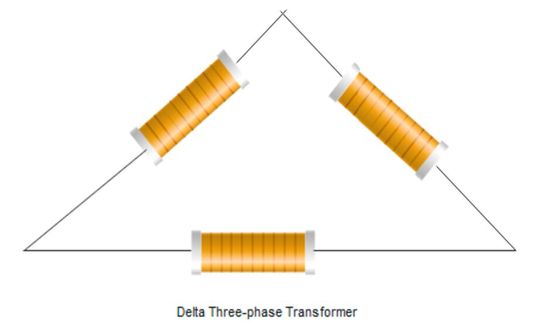
The third harmonic component is present in the magnetizing phase current but absent in the line current. This is because third harmonic components in line current are in phase with each other and cancel out. All Delta-based connections do not let the sinusoidal nature of magnetic flux turn into non-sinusoidal harmonics. In practice, Delta is always preferred to be used in three-phase transformers. All Delta types such as Delta-Delta, Wye-Delta, and Delta-Wye are commonly used.
Add a tertiary winding
As you know, in Wye-based connections, the current in the lines that connect the transformer to the external circuit, known as line current, is equal to the current flowing in each phase. In Wye-Wye connections, triplen harmonic components in phase currents are in-phase with each other. Third harmonic components do not cancel out, instead flow through the fourth wire (neutral). It causes voltage distortion in sinusoidal waveforms and leads to overheating. Sometimes high current distortion tends to burn neutral wiring.
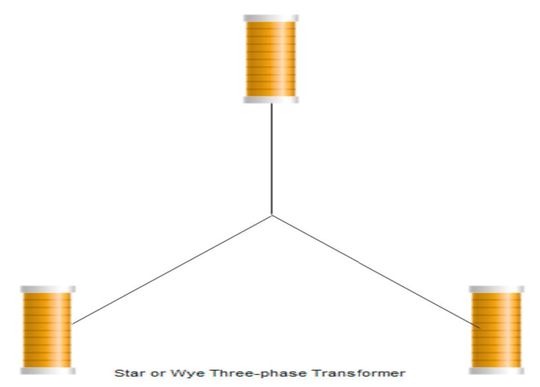
If the design requires a Wye-Wye configuration, the best practice is to implement a tertiary winding for carrying out third harmonic components. The tertiary winding carries out the unwanted third harmonic component and doesn’t let it interact with the transmission line. Another quick escape is to oversize the neutral wiring to prevent heat loss.
References
(ID:50240469)
:quality(80)/p7i.vogel.de/wcms/37/b2/37b2a11a859c819e4752711ca71df724/0126628873v2.jpeg "Multi-level converters and inverters have been around since the late 1800s. Their job is to work in groups and provide high-power outputs over long distances. Now their use and efficiency have made them enter the aerospace industry. Learn more here. (Source: © frank peters - stock.adobe.com)")
:quality(80)/p7i.vogel.de/wcms/ea/20/ea20c0beb93f34ab43b28750644bbdca/0128983445v2.jpeg "A Cycloconverter is an AC-AC converter that directly converts successive segments of a constant amplitude AC waveform at a higher frequency to another AC waveform at another lower frequency, without a DC link. (Source: © wpw - stock.adobe.com)")