


:quality(80)/p7i.vogel.de/wcms/7f/4b/7f4b97757cea82c0675209630577dc22/0133974130v2.jpeg "Vox Power’s EIRE600 delivers up to 600 W in a compact 5 × 3-inch package, with forced-air or conduction cooling options for industrial and medical equipment. (Source: Vox Power)")
:quality(80)/p7i.vogel.de/wcms/55/97/5597c3436e3bc92ee7ba23b6f9d289e9/0134032539v2.jpeg "Littelfuse’s TP7.0SMD-XC automotive TVS diode series uses foldback technology to provide low clamping voltage for protecting sensitive vehicle electronics. (Bild: Littelfuse)")
:quality(80)/p7i.vogel.de/wcms/51/f8/51f84448e666230bb11a02566abd1177/0133958187v3.jpeg "Microchip’s radiation-tolerant GaN point-of-load converter supplies up to 20 A for space-based processors, FPGAs, microcontrollers and ASICs. (Source: Microchip)")
:quality(80)/p7i.vogel.de/wcms/0a/7c/0a7c08f368ae1d91f758dd18d2a32e88/0133978423v2.jpeg "EPFL researchers have demonstrated a GaN transistor that withstands nearly 4 kV, using an intrinsic polarization superjunction design to distribute electric fields more evenly. (Source: EPFL)")
:quality(80)/p7i.vogel.de/wcms/5b/94/5b94232ca4183d6fcc2dccc7394d7544/0134041114v4.jpeg "Siemens and NVIDIA are testing AI applications at Siemens’ Erlangen electronics factory, using digital twins to support production planning and prepare inspection systems before physical prototypes are available. (Bild: Siemens)")
:quality(80)/p7i.vogel.de/wcms/b4/1f/b41f2731a07b608e60eca3663e280301/0133980549v2.jpeg "Multi-year agreement with Wolfspeed supports Infineon’s conversion from 150-millimeter to 200-millimeter silicon carbide (SiC) manufacturing (Source: © Ada - stock.adobe.com)")
:quality(80)/p7i.vogel.de/wcms/e3/0a/e30a8813bcf44b16f0dceb63a0747d29/0133984094v2.jpeg "The semiconductor is only one part of the design. Higher voltage, frequency and power density also increase the demands on electronic packaging materials such as die attach, substrates, top-side interconnects and module attach. (Source: Generated by AI)")
:quality(80)/p7i.vogel.de/wcms/5d/fb/5dfba5e5f38daf2b8597b05656af29c0/0133956337v2.jpeg "Wolfspeed has received a conditional commitment for a loan of up to $1.5 billion from the U.S. Department of War to support its domestic wide-bandgap semiconductor supply chain. (Source: © AspctStyle - stock.adobe.com)")
:quality(80)/p7i.vogel.de/wcms/bf/b6/bfb6ac295759be32d567df9849b6767e/0134094495v2.jpeg "Fraunhofer ISE reports that 25 Ah pouch cells with silicon-rich anodes retained more than 83% of their initial capacity after 1,000 cycles when tested under 1,000 kPa axial pressure. (Bild: Fraunhofer ISE)")
:quality(80)/p7i.vogel.de/wcms/16/dc/16dca55e6ef80e6b5da68bc628da2dcc/0133844782v2.jpeg "This article explains virtual power plants in modern renewable-heavy grids. (Source: © M@rketVisualsStudio - stock.adobe.com)")
:quality(80)/p7i.vogel.de/wcms/e8/33/e8330aae4bea3578b98ec2c1403d367a/0133980001v2.jpeg "IRENA’s 2026 World Energy Transition Outlook identifies faster electrification powered by renewables as central to meeting future global energy needs. (Source: Irena)")
:quality(80)/p7i.vogel.de/wcms/6c/b4/6cb405f47d25035e256ae90fe3a66ee6/0134032112v2.jpeg "Sungrow’s PowerTitan 3.0 energy storage platform uses onsemi EliteSiC hybrid power modules, with the companies reporting peak inverter efficiency above 99.3%. (Bild: onsemi)")
:quality(80)/p7i.vogel.de/wcms/7b/76/7b76005554b556df2a7a3794bdf69d44/0132365246v2.jpeg "Hioki’s ST5680A DC Hipot Tester combines CE/UKCA/CSA compliance, an integrated capacitance‑based contact check and time‑series waveform recording (voltage, leakage current, insulation resistance) to standardize hipot and insulation testing across EV cell, module and pack production lines. (Source: Hioki)")
:quality(80)/p7i.vogel.de/wcms/af/7f/af7f7b0fb7f29219fc991b1130f65477/0132241333v2.jpeg "Comprehensive laboratory testing regimens—combining thermal cycling, high‑current stress, EMC, and accelerated lifetime tests—are essential to validate advanced power designs and ensure reliability in real‑world applications. (Source: PRBX)")
:quality(80)/p7i.vogel.de/wcms/16/3d/163df69363f8125315a9826e13ea4b05/0131927425v2.jpeg "Solution will maximize data center and AI factory profitability while delivering engineering-grade insights to design and operations for more efficient, sustainable, and resilient infrastructure. (Source: Cadence)")
:quality(80)/p7i.vogel.de/wcms/85/b7/85b7e90733a2bd8f21515d8f7137f2fc/0131917677v2.jpeg "Renesas acquires Pictorus to integrate its embedded application software platform with Renesas’ MCU and MPU portfolio, helping developers shorten time‑to‑market and simplify system integration. (Source: © lucadp - stock.adobe.com)")
:quality(80)/p7i.vogel.de/wcms/f8/34/f834240d434a0c265a2ccafe614c8cd7/0134032109v4.jpeg "Hard- and soft-switching techniques shape voltage and current during device transitions, influencing switching losses, EMI and thermal performance in power converters. (Bild: © Mrthullab - stock.adobe.com)")
:quality(80)/p7i.vogel.de/wcms/27/07/2707280c807689b437baed3660257404/0133626052v2.jpeg "The quantum behavior of electrons shapes semiconductor devices—and the power converters that deliver electricity to modern computing systems. (Source: © Celt Studio - stock.adobe.com)")
BASIC KNOWLEDGE Cycloconverters in power electronics
Related Vendors
:fill(fff,0)/p7i.vogel.de/companies/69/a8/69a8093b1b5e1/hvp-png.png "hvp-png (HVP-Logo)")
:fill(fff,0)/p7i.vogel.de/companies/5f/71/5f71d5f92a5f6/2000px-rogers-corporation-logo-svg.png "2000px-Rogers_Corporation_Logo.svg.png (rogers germany)")
:fill(fff,0)/p7i.vogel.de/companies/68/2c/682c3e2e9a195/logotype-rvb.jpeg "logotype-rvb (MERSEN France)")
While buck and boost converters are popular for their mainstream DC-to-DC power conversion, AC-AC converters are less well-known. Cycloconverters are AC-to-AC converters that have been around the world before power transistors and thyristors. They are used in low-speed, high-power motor drivers and several power electronic applications. This article describes cycloconverters and their structure, operation, and applications in power electronics.
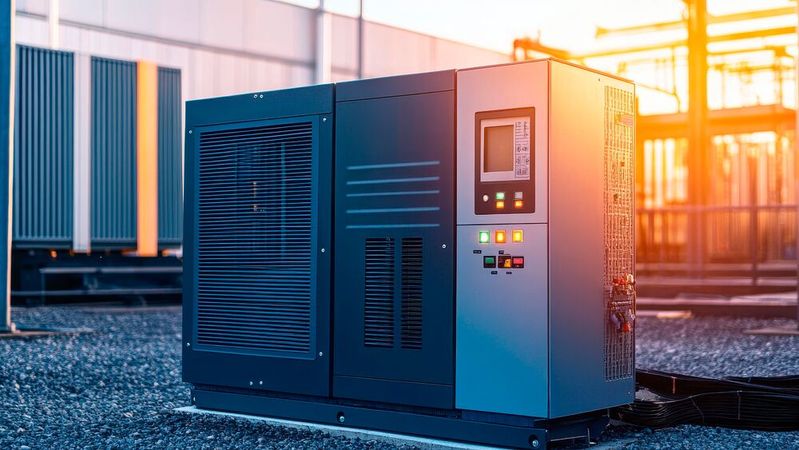
Cycloconverters are not new; they were invented sometime in the 1920s. The unique patented technology was first used in the 1930s in Germany to convert a 3-phase 50 Hz system into a single-phase supply of 16.6 Hz for a series of industrial AC traction motors. After the invention of SCRs in the 1960s, cycloconverters were upgraded and used even more.
Cycloconverter definition
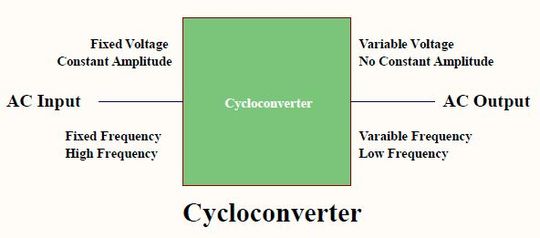
A cycloconverter is a direct AC-to-AC converter with an internal voltage control capability. It converts a high-frequency AC signal to another low-frequency AC signal by controlling the firing angles of interconnected bridges.
Cycloconverter symbol
There is no symbol for a cycloconverter; instead, cycloconverters are represented by connected SCRs and other power components. They contain a half-wave or full-wave bridge rectifier. Generally, cycloconverters use SCRs. However, cycloconverters connected to resistive loads use TRIACs.
1. How are cycloconverters different from conventional AC-AC converters?
Conventional AC-AC converters use an intermediary DC stage. In the first stage, AC-AC converters convert the input AC signal to DC. After this stage, it converts the obtained DC into an AC signal. Finally, the AC signal is fed to the load. Instead of an intermediary DC stage, a cycloconverter uses sets of converters to perform direct AC-to-AC conversion. These converter sets are made from thyristors. Both sets handle positive and negative cycles of the input AC signal.
Along with the converter sets, the cycloconverter implements control mechanisms through microprocessors or digital signal processors. The input AC signal is a high-frequency fixed voltage, but the output AC signal is of low-frequency variable voltage. As cycloconverters do not have a DC link but adjust the frequency for AC-to-AC conversion, they are called frequency changer devices. Cycloconverters (CCVs) are also known as cycloinverters.
2. Cycloconverter modes
Based on modes, cycloconverters are of two types: blocking and circulating current mode cycloconverters.
Blocking mode cycloconverters
In blocking mode, cycloconverters, only one converter set remains on during the operation. If one converter set is on, the other remains off, and vice versa. Commercial high-power implementation of cycloconverters takes place through blocking three-phase mode cycloconverters.
Circulating current mode cycloconverters
In circulating mode cycloconverters, both converter sets remain on throughout the operation. They switch between rectifying and inverting modes for effective AC-to-AC conversion. Circulating mode cycloconverters are less commercial and are limited to certain applications.
3. How does a Cycloconverter work?
There are two types of cycloconverters: single-phase cycloconverters and three-phase cycloconverters. Both of them can be constructed in both blocking and circulating modes.
Single-phase blocking mode cycloconverters
Although rarely used in modern times, single-phase to single-phase cycloconverters were historically in use. This type of cycloconverter uses either a half-wave or full-wave bridge-type dual converter system to implement AC-to-AC conversion. The dual converter design makes the cycloconverter exhibit an inherent capability of bidirectional power flow.
One bridge converter handles the positive half-cycle and the other handles the negative half-cycle of the input AC wave. The bridge converter that handles the positive half-cycle is called the P-converter. Similarly, the bridge converter that handles the negative half-cycle is called the N-converter.
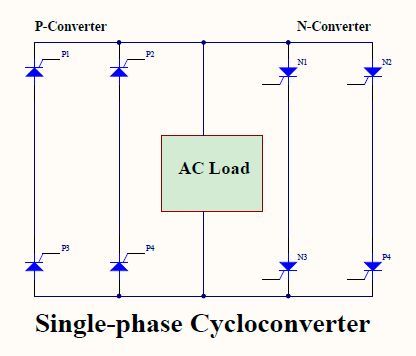
The firing angle is defined as the angle at which the gate terminal is triggered to conduct electricity within an AC cycle. The firing angle of the P-converter is “”. The P-converter is turned on before the N-converter during the operation. The firing angle of the N-converter is “- ”. The difference in the firing angles ensures that each converter conducts during a single cycle— one remains on and the other remains off. It also confirms that voltage levels produced in both cycles are equal and opposite.
During the positive half-cycle of the input AC signal, the P-converter turns on. The N-converter remains off. During the negative half-cycle of the input AC signal, the P-converter turns off and the N-converter turns on. As a result, single-phase to single-phase cycloconverters reduce the input frequency to ⅓ at the output. In simple words, three cycles of the input AC signal get reduced to a single AC cycle at the load.
Three-phase blocking mode cycloconverters
Three-phase three-pulse cycloconverters are widely used across the globe. Simply put, a three-phase cycloconverter converts a high-frequency three-phase AC wave to a low-frequency AC wave. The low-frequency AC wave can either be single-phase or three-phase. However, commercial applications use three-phase to three-phase cycloconverters.
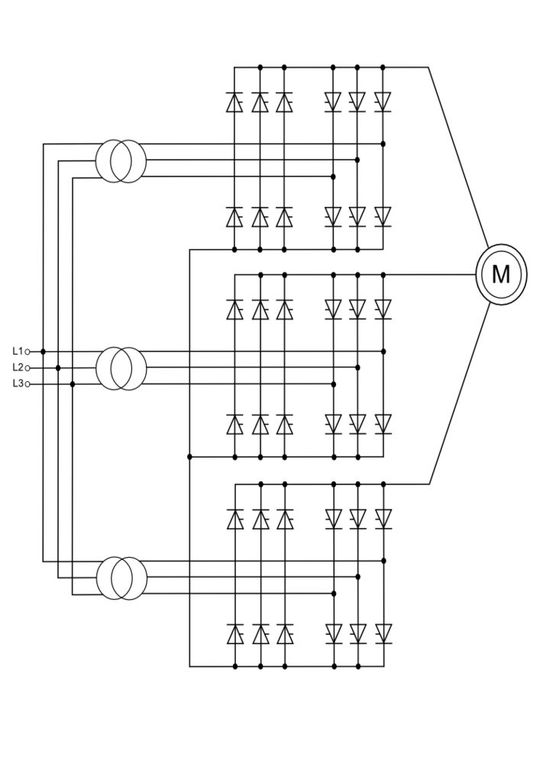
In three-phase cycloconverters output voltages stay 120 degrees apart in phase. They can be connected either in a Wye or a Delta configuration, based on their application and ratings. Similar to single-phase to single-phase cycloconverters, three-phase cycloconverters use two sets of converters. One set of converters handles conversion during the positive half-cycle, P-converters, and the other handles conversion during the negative half-cycle, N-converters.
The converters are turned on through a controlled mechanism such that a low-frequency, smooth AC waveform is obtained at the output. In inductive loads, current lags behind voltage. As a result, the current does not stop flowing in one direction even when another set of converters is turned on.
The converter set, which is supposed to operate, sends power back to the source for a short time. The process is called inversion. It allows controlled current flow and aids in voltage matching at the output waveform.
In simple words, three-phase cycloconverters operate in such a “smart way” that the output for the positive half-cycle of the input AC waveform matches the positive half-cycle of the output AC waveform and vice versa.
Three-phase circulating current mode cycloconverters
In three-phase circulating current mode cycloconverters, both P-converter and N-converter sets remain on throughout the operation.
During the positive half-cycle of the input AC signal, the P-converter enters the rectification mode. The N-converter remains in the inversion mode. During the negative half-cycle of the input AC signal, the N-converter enters rectification mode, and the P-converter goes into inversion mode.
The rectification-inversion operation eliminates ripples and does not let voltage lag behind the current. Additionally, a reactor coil, known as IGR (Intergroup Reactor) is placed between the converter sets to limit the unwanted circulating current. It acts like a voltage divider network and offers a highly resistive path to the circulating current.
4. Cycloconverter advantages
- Cycloconverters are not limited by their size, unlike other power devices.
- Cycloconverters do not undergo shocks during startup.
- Cycloconverters exhibit a smooth and variable speed.
- Cycloconverters offer reverse rotation.
- Cycloconverters are naturally commutated power electronic devices. They can naturally turn off, unlike SCRs.
- Cycloconverters offer bidirectional power flow.
- Cycloconverters exhibit low switching losses.
- Cycloconverters exhibit low harmonic and heating losses.
- Cycloconverters provide a nearly sinusoidal output waveform.
- By eliminating a DC stage, cycloconverters save time and power for efficient and quick conversion.
- Cycloconverters require less maintenance.
5. Cycloconverter disadvantages
- Cycloconverters are bulkier and more complicated.
- Cycloconverters operate for a limited frequency range.
- Cycloconverter outputs are not smooth due to oscillations (harmonics). They must use a high number of pulses to obtain a smooth output waveform.
- Cycloconverters lack efficiency.
- Cycloconverters exhibit low power factors.
- Cycloconverters are phase-controlled AC-AC converters. Matrix converters, using PWM-based (Pulse Width Modulation) self-controlled converters, are now used more.
6. Cycloconverter applications
Cycloconverters are still used in a variety of industrial-grade applications. Some of them are listed below.
- Practical converters in AC-AC applications.
- AC series traction motors.
- Low-speed variable voltage variable-frequency ”VVVF” AC drivers.
- Variable-speed constant-frequency “VSCF” systems.
- Auxiliary drivers in power stations.
The industries where cycloconverters are applicable:
- Power electronics— power stations.
- Aircraft systems: 400 Hz power generation.
- Naval ships as propulsion drivers.
- Cement and rolling mills.
- Water pumps and washing machine components.
- Mine hoists and winders.
- Bar mills (Ore processing).
References
(ID:50685122)
:quality(80)/p7i.vogel.de/wcms/ac/31/ac31c9478d80894d725d02883ae7ed5d/0133176534v2.jpeg "Average models allow power designers to simulate DC‑DC converters and three‑phase PFC circuits quickly, analyse small‑signal behaviour and evaluate loop stability without modelling every switching event. (Source: © AI - stock.adobe.com)")
:quality(80)/p7i.vogel.de/wcms/f8/34/f834240d434a0c265a2ccafe614c8cd7/0134032109v4.jpeg "Hard- and soft-switching techniques shape voltage and current during device transitions, influencing switching losses, EMI and thermal performance in power converters. (Bild: © Mrthullab - stock.adobe.com)")