


:quality(80)/p7i.vogel.de/wcms/7f/4b/7f4b97757cea82c0675209630577dc22/0133974130v2.jpeg "Vox Power’s EIRE600 delivers up to 600 W in a compact 5 × 3-inch package, with forced-air or conduction cooling options for industrial and medical equipment. (Source: Vox Power)")
:quality(80)/p7i.vogel.de/wcms/55/97/5597c3436e3bc92ee7ba23b6f9d289e9/0134032539v2.jpeg "Littelfuse’s TP7.0SMD-XC automotive TVS diode series uses foldback technology to provide low clamping voltage for protecting sensitive vehicle electronics. (Bild: Littelfuse)")
:quality(80)/p7i.vogel.de/wcms/51/f8/51f84448e666230bb11a02566abd1177/0133958187v3.jpeg "Microchip’s radiation-tolerant GaN point-of-load converter supplies up to 20 A for space-based processors, FPGAs, microcontrollers and ASICs. (Source: Microchip)")
:quality(80)/p7i.vogel.de/wcms/0a/7c/0a7c08f368ae1d91f758dd18d2a32e88/0133978423v2.jpeg "EPFL researchers have demonstrated a GaN transistor that withstands nearly 4 kV, using an intrinsic polarization superjunction design to distribute electric fields more evenly. (Source: EPFL)")
:quality(80)/p7i.vogel.de/wcms/5b/94/5b94232ca4183d6fcc2dccc7394d7544/0134041114v4.jpeg "Siemens and NVIDIA are testing AI applications at Siemens’ Erlangen electronics factory, using digital twins to support production planning and prepare inspection systems before physical prototypes are available. (Bild: Siemens)")
:quality(80)/p7i.vogel.de/wcms/b4/1f/b41f2731a07b608e60eca3663e280301/0133980549v2.jpeg "Multi-year agreement with Wolfspeed supports Infineon’s conversion from 150-millimeter to 200-millimeter silicon carbide (SiC) manufacturing (Source: © Ada - stock.adobe.com)")
:quality(80)/p7i.vogel.de/wcms/e3/0a/e30a8813bcf44b16f0dceb63a0747d29/0133984094v2.jpeg "The semiconductor is only one part of the design. Higher voltage, frequency and power density also increase the demands on electronic packaging materials such as die attach, substrates, top-side interconnects and module attach. (Source: Generated by AI)")
:quality(80)/p7i.vogel.de/wcms/5d/fb/5dfba5e5f38daf2b8597b05656af29c0/0133956337v2.jpeg "Wolfspeed has received a conditional commitment for a loan of up to $1.5 billion from the U.S. Department of War to support its domestic wide-bandgap semiconductor supply chain. (Source: © AspctStyle - stock.adobe.com)")
:quality(80)/p7i.vogel.de/wcms/bf/b6/bfb6ac295759be32d567df9849b6767e/0134094495v2.jpeg "Fraunhofer ISE reports that 25 Ah pouch cells with silicon-rich anodes retained more than 83% of their initial capacity after 1,000 cycles when tested under 1,000 kPa axial pressure. (Bild: Fraunhofer ISE)")
:quality(80)/p7i.vogel.de/wcms/16/dc/16dca55e6ef80e6b5da68bc628da2dcc/0133844782v2.jpeg "This article explains virtual power plants in modern renewable-heavy grids. (Source: © M@rketVisualsStudio - stock.adobe.com)")
:quality(80)/p7i.vogel.de/wcms/e8/33/e8330aae4bea3578b98ec2c1403d367a/0133980001v2.jpeg "IRENA’s 2026 World Energy Transition Outlook identifies faster electrification powered by renewables as central to meeting future global energy needs. (Source: Irena)")
:quality(80)/p7i.vogel.de/wcms/6c/b4/6cb405f47d25035e256ae90fe3a66ee6/0134032112v2.jpeg "Sungrow’s PowerTitan 3.0 energy storage platform uses onsemi EliteSiC hybrid power modules, with the companies reporting peak inverter efficiency above 99.3%. (Bild: onsemi)")
:quality(80)/p7i.vogel.de/wcms/7b/76/7b76005554b556df2a7a3794bdf69d44/0132365246v2.jpeg "Hioki’s ST5680A DC Hipot Tester combines CE/UKCA/CSA compliance, an integrated capacitance‑based contact check and time‑series waveform recording (voltage, leakage current, insulation resistance) to standardize hipot and insulation testing across EV cell, module and pack production lines. (Source: Hioki)")
:quality(80)/p7i.vogel.de/wcms/af/7f/af7f7b0fb7f29219fc991b1130f65477/0132241333v2.jpeg "Comprehensive laboratory testing regimens—combining thermal cycling, high‑current stress, EMC, and accelerated lifetime tests—are essential to validate advanced power designs and ensure reliability in real‑world applications. (Source: PRBX)")
:quality(80)/p7i.vogel.de/wcms/16/3d/163df69363f8125315a9826e13ea4b05/0131927425v2.jpeg "Solution will maximize data center and AI factory profitability while delivering engineering-grade insights to design and operations for more efficient, sustainable, and resilient infrastructure. (Source: Cadence)")
:quality(80)/p7i.vogel.de/wcms/85/b7/85b7e90733a2bd8f21515d8f7137f2fc/0131917677v2.jpeg "Renesas acquires Pictorus to integrate its embedded application software platform with Renesas’ MCU and MPU portfolio, helping developers shorten time‑to‑market and simplify system integration. (Source: © lucadp - stock.adobe.com)")
:quality(80)/p7i.vogel.de/wcms/f8/34/f834240d434a0c265a2ccafe614c8cd7/0134032109v4.jpeg "Hard- and soft-switching techniques shape voltage and current during device transitions, influencing switching losses, EMI and thermal performance in power converters. (Bild: © Mrthullab - stock.adobe.com)")
:quality(80)/p7i.vogel.de/wcms/27/07/2707280c807689b437baed3660257404/0133626052v2.jpeg "The quantum behavior of electrons shapes semiconductor devices—and the power converters that deliver electricity to modern computing systems. (Source: © Celt Studio - stock.adobe.com)")
RESISTOR CALCULATION How to calculate voltage drop across a resistor?
Related Vendors
:fill(fff,0)/p7i.vogel.de/companies/6a/20/6a202a4f89a62/mrs-white-on-blue-bg.png "mrs-white-on-blue-bg ()")
:fill(fff,0)/p7i.vogel.de/companies/62/a0/62a0a0de7d56a/aic-europe-logo.jpeg "aic-europe-logo (AIC Europe)")
:fill(fff,0)/p7i.vogel.de/companies/60/21/60214fbbcc5e0/index.png "index.png (Kundenwebsite)")
Voltage drop occurs between the source and load in a circuit. Engineers can calculate voltage drop from a simple formula. However, the voltage drop calculation varies for resistors in parallel vs series. This article shares examples in response to the question of how to calculate voltage drop across a resistor. In addition, the article explains how engineers minimize unwanted voltage drops in practical applications.

The word “voltage drop” itself suggests its meaning - a drop in voltage. Voltage drop refers to the reduction in electrical potential across a circuit when current flows through its elements. It occurs due to internal wire resistance, resistors in the network, conductors, metal contacts, connectors, and various other circuit components.
The primary function of a resistor is to block or reduce the flow of current. In performing its function, the resistor offers a predictable voltage drop across it. The electrical energy associated with the voltage drop is dissipated as heat across resistors.
In the case of capacitors and inductors, voltage drop occurs due to their opposition to changing voltages and currents, respectively. The electrical energy associated with inductors is stored as magnetic energy, and across capacitors as electric charge. However, the storage is temporary and can be returned to the circuit.
In diodes and transistors, voltage drop occurs due to internal semiconductor junctions. Silicon-based semiconductors exhibit a forward voltage drop of 0.7 V. This means that the semiconductor device won’t turn on until the threshold voltage crosses 0.7 V. The voltage drop is dissipated as heat during operation.
Electronic components or systems need the right amount of power in watts to operate. High amounts of power or insufficient power can result in inefficient operation or potential damage. Unnecessary voltage drop can degrade the performance of electronic systems. Engineers must calculate voltage drop and take preventive steps.
How to calculate voltage drop across a resistor in DC circuits?
Calculating voltage drop is relatively easy in DC circuits. Voltage drop in a resistor can be calculated with the help of Ohm’s law.
The formula for Ohm’s law shows how the product of current and resistance equals net voltage.
V = IR.
Where,
V stands for voltage in volts
I is the current flow in amps
R is the resistance in Ohms
Let us answer the question of how to calculate voltage drop across a resistor with a few examples.
Ohm’s law is applicable in calculating voltage drop, because voltage drop is specified in volts, like supply voltage.
Example (1): A resistor of 6 Ohms is connected in the circuit. The current flowing through it is 3 A. How to calculate voltage drop across a resistor?
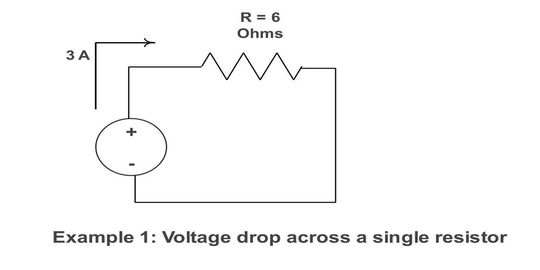
The voltage drop would be the product of 3 A current and 6 ohms of resistance.
V = 3 A x 6 Ohms
V = 18 V
The total voltage drop across the circuit is 18 V.
It is interesting to note that supply voltage and voltage drop are equal in this case. However, more resistors in parallel vs series connections would have different voltage drop values.
Example (2): Two resistors of 2 Ohms and 4 Ohms are connected in series in a circuit. A current of 2 A flows through the circuit. How to calculate voltage drop across a resistor? Calculate the voltage drop for each resistor and the total voltage drop across the circuit.
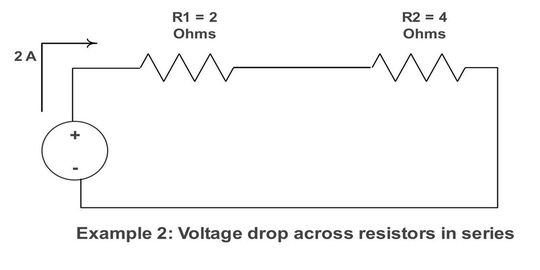
The example explains the voltage drop across series resistors in the circuit. In series, each resistance adds up to make the net resistance.
Total resistance = 2 Ohms + 4 Ohms
Total resistance = 6 Ohms
By Ohm’s law,
Total voltage drop = Current x Total resistance
V = 2 A x 6 Ohms
V = 12 V
The example in series is worth noting because the voltage drop of 12 V is not the same across both resistors. Different voltage drops appear across each resistor.
Voltage drop across resistor R1 = Current x Value of resistance R1
V1 = I x R1
V1 = 2 A x 2 Ohms
V1 = 4 V
Voltage drop across resistor R2 = Current x Value of resistance R2
V2 = I x R2
V2 = 2 A x 4 Ohms
V2 = 8 V
The sum of individual voltage drops equals the total voltage drop.
V = V1 + V2
V = 4 V + 8 V
V = 12 V
In a series connection, current remains the same, but voltages divide across the circuit.
Example (3): Two resistors of 2 Ohms and 4 Ohms are connected in parallel in a circuit. The current flowing through the 2 Ohms resistor is 6 A, and the current through the 4 Ohms resistor is 3 A. How to calculate voltage drop across a resistor - all these resistors in parallel?
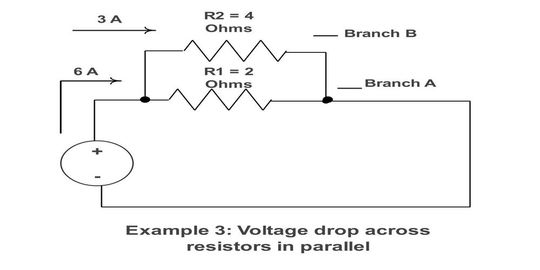
As it’s a parallel resistor calculator example, the current through each branch is different.
Total current across the circuit = 6 A + 3 A
Total current = 9 A
Let us calculate the total resistance from the parallel resistor formula. It’s not like the series connection.
1 Rnet = 1 R₁ + 1 R₂
The above equation is known as the parallel resistor formula.
1 Rnet = 1 2 + 1 4
1 Rnet = 4 + 2 2 × 4
1 Rnet = 6 8
Rnet = 8 6
Rnet = 4 3 Ohms or 1.33 Ohms
By Ohm’s law, the total voltage drop becomes as follows.
V = IR
V = 9 A × 43 Ohms
V = 12 V
Let us calculate the voltage drop across individual resistors.
Voltage drop across resistor R1 = Current in R1 x Value of resistance R1
V1 = I1 x R1
V1 = 6 A x 2 Ohms
V1 = 12 V
Voltage drop across resistor R2 = Current in R2 x Value of resistance R2
V2 = I2 x R2
V2 = 3 A x 4 Ohms
V2 = 12 V
However, the total voltage drop remains 12 V, the same as the voltage drop at each resistor.
Voltage drop across various resistors in parallel remains the same. We cannot add voltages, unlike series connections. It would be completely wrong to say that the total voltage drop is the sum of both drops, 24 V.
This is because all the resistors in parallel are connected across the same nodes. According to Kirchhoff’s voltage law, voltage drops add only along a single closed path (series loop), not across multiple paths in parallel.
:quality(80):fill(efefef,0)/p7i.vogel.de/wcms/68/88/6888add6d4cca/pcim-2025-best-paper-award-akiyama-coverbild.jpeg "PCIM 2025_Best Paper Award_Akiyama_Coverbild")
AC: How to calculate the voltage drop across a resistor in AC?
In AC circuits, we can calculate voltage drop by following the AC version of Ohm’s law.
E = IZ
Where,
E is the potential difference across the circuit
I is the current flowing through the circuit
Z is the impedance, the AC equivalent of resistance
Let us understand with the help of an example.
Example (4): In an AC circuit, the impedance is 5 Ohms, and the current flowing through the circuit is 0.2 A. How to calculate voltage drop across a resistor in this AC circuit?
E = IZ
E = 0.2 A x 5 Ohms
E = 1 V
The AC circuit calculations for resistors in parallel vs series have different formulae for inductive and capacitive reactance.
:quality(80):fill(efefef,0)/p7i.vogel.de/wcms/68/7e/687e48d7c3519/pcim-2025-best-paper-award-basler-coverbild.jpeg "PCIM 2025_Best Paper Award_Basler_Coverbild")
How to combat voltage drop?
Manufacturers follow codes to place a maximum limit on permissible voltage drop, which won’t hinder distribution and operation. For example, in the US and Europe, maximum permissible limits don't allow voltage drops to exceed 4 or 5%.
Choose rated components: Engineers cannot avoid voltage drop, but can minimize the impact with the help of low-resistance conductors and various other components. For example, large-size gauge conductors reduce resistance to lower voltage drop.
Load balancing: Longer distance between the source and the load increases voltage drops. Load balancing ensures low voltage drop. It refers to the process of evenly distributing loads in three-phase power electronic systems.
Use compensators: Heavy voltage drop occurs in open areas where long wires are a part of the larger electrical system. Placing voltage compensators at the end of long wires helps engineers to monitor and boost voltages.
Uninterrupted power supply (UPS): High currents are applicable in power electronics, which result in a high voltage drop. UPS provides a stable power supply to minimize voltage drops and ensure continuous operation.
Power conditioning system: Deploying a power conditioning system and voltage regulators smooths out output voltage waveforms, removes noise, and reduces sudden voltage spikes that might cause unwanted voltage drop.
Power delivery network (PDN) network design: Designers can avoid unwanted voltage drop in PDNs by optimizing low-resistance layouts. Proper power and ground placement, wide traces, short paths, fewer vias, thicker copper, and decoupling capacitors (Decaps) can lower voltage drops.
References
- https://www.iewc.com/resources/educational-resources/voltage-drop
- https://www.ansys.com/blog/minimizing-ir-drop-in-integrated-circuit-design#:~:text=Proper%20power%20and%20ground%20plane,IR%20drop%20in%20your%20chip.
(ID:50804920)
:quality(80)/p7i.vogel.de/wcms/ef/1c/ef1c6a123496f3c00da6ea8b85385de9/0130926273v2.jpeg "Resistors are among the three fundamental electronic components, along with inductors and capacitors. (Source: © Kan - stock.adobe.com)")
:quality(80)/p7i.vogel.de/wcms/5c/f5/5cf53b6db2706b86ac6eb5c407704d27/0131699647v2.jpeg "This article explains inductors in electrical and electronics engineering. (Source: © Iurii - stock.adobe.com)")