


:quality(80)/p7i.vogel.de/wcms/2f/f3/2ff3221bf7665de2d0acf83760bfd1fa/0130031523v2.jpeg "Wolfspeed presents a 300 mm silicon carbide technology platform designed to support advanced packaging and high-efficiency power delivery for AI data center infrastructure. (Source: Wolfspeed)")
:quality(80)/p7i.vogel.de/wcms/c3/16/c316e955a97f5d72d9678297b237b9e5/0129932858v2.jpeg "Left: the single-phase version of the SENTRON ECPD with RCM, right: a model of the future three-phase version of the SENTRON ECPD. (Source: Siemens)")
:quality(80)/p7i.vogel.de/wcms/ef/0a/ef0adb0acf793fe147cc27c21f6a7a67/0129954238v2.jpeg "Empower Semiconductor introduces embedded silicon capacitors designed to improve power delivery and stability in AI and high-performance computing processors. (symbolic image) (Source: © IF.arc - stock.adobe.com)")
:quality(80)/p7i.vogel.de/wcms/53/f9/53f9301dfc9292d02960f7996c79cc6e/0129927601v2.jpeg "Wolfspeed’s new 10 kV SiC MOSFET enables high-voltage power conversion for grid and industrial applications. (symbolic image) (Source: © CREATIVE- 3.4 - stock.adobe.com)")
:quality(80)/p7i.vogel.de/wcms/6e/cd/6ecd41d095d5111cf4ed37b714844487/0129930878v2.jpeg "PCIM Asia Shenzhen provides a platform for industry experts to present new developments in power electronics and electrification technologies. (symbolic image) (Source: © killykoon - stock.adobe.com)")
:quality(80)/p7i.vogel.de/wcms/02/c0/02c0e9722f70b1134dbf96fb59a9c73d/0129655179v2.jpeg "The PCIM Conference 2026 will take place from June 9-11, featuring discussions on power electronics trends, including GaN technology and AI applications. (symbolic image) (Source: © Elmira - stock.adobe.com)")
:quality(80)/p7i.vogel.de/wcms/cc/67/cc670ea2029cd2af5c641af70e1bf734/0129816392v4.jpeg "Fraunhofer IAF coordinates the EU SUPREME project to accelerate GaN and SiC power semiconductor innovation in Europe. (Source: Fraunhofer IAF)")
:quality(80)/p7i.vogel.de/wcms/ea/e6/eae6aee30071e67a5627027974437134/0129544613v2.jpeg "GlobalFoundries and Renesas strengthen their collaboration to support U.S.-based semiconductor production and supply chain resilience. (Source: © ronstik - stock.adobe.com)")
:quality(80)/p7i.vogel.de/wcms/b1/5e/b15ee02b0ba02db70cf61e37d66ad1d3/0129349127v2.jpeg "Vehicle-to-grid (V2G) chargers enable bidirectional energy flow, allowing electric vehicles to act as mobile energy storage systems that can both draw power from and feed power back into the grid. (Source: © medienvirus - stock.adobe.com)")
:quality(80)/p7i.vogel.de/wcms/26/d5/26d591cc340077026eac56a0e7564faf/0129949603v2.jpeg "Flexible: The solid silicone-based electrolyte is elastic, thereby compensating for the voids that form in solid-state batteries during charging and discharging. (Source: Empa)")
:quality(80)/p7i.vogel.de/wcms/4d/e0/4de02f76a37cbb3df30dd231de589c8e/0128866890v2.jpeg "Both legacy and vGaN show higher carrier mobility and band gap energies compared to other power semiconductors. (Source: © phonlamaiphoto - stock.adobe.com)")
:quality(80)/p7i.vogel.de/wcms/18/0b/180b7b63afc91e523592d8a5ce161c96/0129847487v2.jpeg "InGaAs-based photodetectors enable sensitive and fast detection in the short-wave infrared spectrum for modern sensing and communication applications. (Source: © VITALII - stock.adobe.com)")
:quality(80)/p7i.vogel.de/wcms/be/c8/bec8d43fc0ee73414274be44608b2970/0129748903v2.jpeg "The Infiniium XR804KA real-time oscilloscope delivers faster response time, improved stability, and streamlined workflows for high-speed digital and compliance testing. (Source: Keysight)")
:quality(80)/p7i.vogel.de/wcms/23/ee/23ee4a97790d6009dbfd7d9577ffa723/0129220424v2.jpeg "The R&S FPL1044 with the new RTSA option makes 40 MHz real-time frequency analysis available up to 44 GHz. (Source: Rohde & Schwarz )")
:quality(80)/p7i.vogel.de/wcms/3c/d1/3cd1cacbceb792ba63727199c61ca434/0127801860v2.jpeg "Thanks to cloud technology, users can collaborate on projects from anywhere and always have access to the latest planning data. (Source: SIEMENS)")
:quality(80)/p7i.vogel.de/wcms/5a/a0/5aa0436498af618297961fd54ab36cdf/0126290792v2.jpeg "Siemens accelerates student-led semiconductor innovation across Europe’s leading technical universities through Cre8Ventures’ Open Higher Education Program developed in collaboration with Arm and University of Southampton (Source: Siemens Digital Industries Software)")
OPTIMIZATION TECHNIQUES Heat management methods in power modules
Related Vendors
:fill(fff,0)/p7i.vogel.de/companies/60/7e/607ec89d5d9b5/white-frame.jpg "white frame.jpg (www.rohm.com)")
:fill(fff,0)/p7i.vogel.de/companies/5f/71/5f71d5f92a5f6/2000px-rogers-corporation-logo-svg.png "2000px-Rogers_Corporation_Logo.svg.png (rogers germany)")
:fill(fff,0)/p7i.vogel.de/companies/68/2c/682c3e2e9a195/logotype-rvb.jpeg "logotype-rvb (https://www.mersen.com/en)")
This article describes modern heat treatment methods such as direct liquid cooling and thermoelectric coolers, improving thermal conductivity and reliability for demanding applications. Without considering thermal stress aspects that stem issues or attempting to reduce thermal resistance through complex internal connections, these procedures are intended for applications where efficient heat management is essential for performance and longevity.

Heat management is key in power modules to maintain optimal operating temperatures, extend component life, prevent damage, and ensure consistent performance. Semiconductors can degrade, drastically reducing efficiency and shortening the lifespan of the entire system due to overheating caused by switching and conduction losses, ultimately leading to premature failures and higher costs.
The most notable applications are found across various sectors, including electric vehicles, smart factories, industrial automation, and general power electronics, to enhance device efficiency, reliability, and lifespan.
The following industries utilize heat management in their power modules: lighting, industrial automation, renewable energy (wind and solar), automotive (especially electric vehicles), aerospace, and consumer electronics.
Next, we'll cover advanced cooling techniques used in power modules that complement traditional approaches such as forced-air cooling with fans and heat sinks used on PCBs.
Direct Liquid Cooling
Direct Liquid Cooling (DLC) is an advanced cooling technology where a specialized liquid coolant circulates directly onto heat-generating components, like processors (CPUs and GPUs), to absorb and remove heat more efficiently than traditional air cooling, enabling devices to operate at optimal performance levels while reducing energy consumption.
If applied to a chip, it must be attached to a cold plate to achieve efficient heat management. This way, the coolant flows through its internal channels, absorbing heat from its surfaces.
To achieve continuous heat removal, a pump is responsible for circulating this coolant through the system. The cooling cycle is completed when the absorbed heat is transferred from the refrigerant to a radiator or cooling tower through the action of the heat exchanger.
In data center environments, this advanced form of liquid cooling benefits processor chips that may be prone to heat exposure. By requiring less energy to operate than air cooling systems, operating costs and the carbon footprint are reduced.
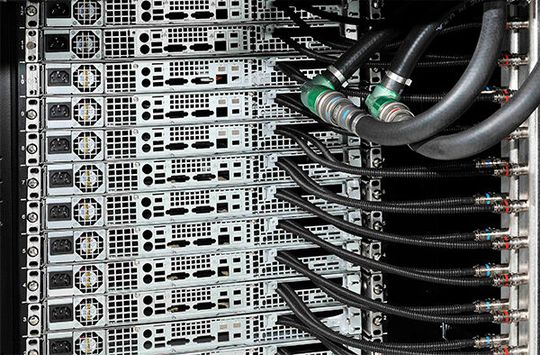
By keeping CPU temperatures lower for extended periods, they can run at extreme speeds for longer, avoiding thermal throttling1) and maintaining peak performance. It also achieves space optimization, allowing data centers to maximize their processing power in a smaller footprint.
Thermoelectric Cooler
A thermoelectric cooler (TEC) uses the Peltier effect2) through a solid-state heat pump to transfer heat from one side of a module to the other when an electrical current is applied. This process allows for precise and compact cooling without liquid refrigerants or moving parts, leading to high reliability and longer lifespan.
Battery management systems (BMS) are compact and efficient in electric vehicles, where TEC is integrated with highly conductive materials such as copper plates and heat sinks to enhance cooling efficiency. Acting as a heat pump, TEC absorbs heat from the battery and dissipates it to a heat sink or the surrounding environment, enabling precise, localized temperature regulation.
Applications in processors focus on the TEC's ability to cool specific critical points, improving reliability and performance in high-power-density systems such as graphics processing units (GPUs) and tensor processing units (TPUs).
By controlling the applied current, cooling intensity can be adjusted, enabling adaptation to varying thermal loads. For localized cooling on chips, microscale and film-based TECs can be integrated, attaching them directly to hot spots, minimizing thermal resistance and electrical losses.
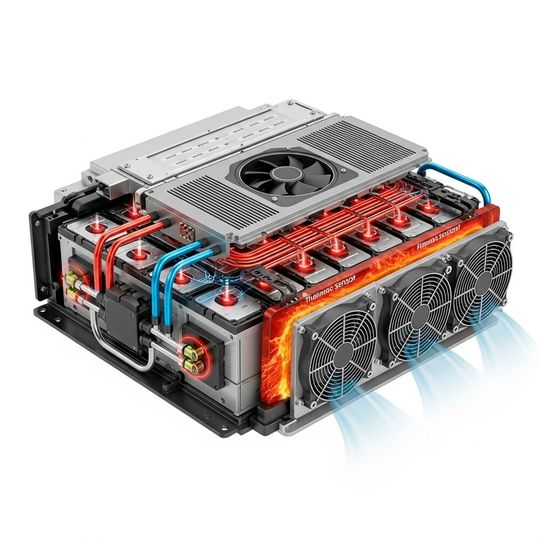
Microscale TECs are suitable for cooling microelectronic components, sensors, and optoelectronics in confined spaces, providing precise temperature control and rapid thermal response. Film-based thermoelectric coolers (TFTECs) remove heat directly, without using traditional coolants, making them ideal for cooling microchips, quantum cascade lasers, and other integrated circuits.
Considerations to keep in mind
Among the most common mistakes in heat management in power modules using traditional methods are underestimating heat generation, leading to insufficient cooling mechanisms, and improper thermal interface design, such as not including heatsinks or thermal vias and incorrectly applying thermal paste.
Other frequent errors that cause thermal imbalances include using unsuitable cooling solutions, ignoring the operating environment and ambient temperature, and poor PCB design, which leads to high power density and hot spots resulting from inefficient heat dissipation.
Among the solutions designers propose to address these issues are: minimizing thermal interfaces through component integration, reducing thermal resistance through improved internal connections, and utilizing advanced cooling techniques such as phase-change materials (PCMs) to facilitate heat transfer.
A solid understanding of how heat is generated in components, combined with a mastery of key concepts such as thermal throttling and the Peltier effect, ensure successful heat management. Starting with a detailed analysis of advanced cooling techniques, this article addresses its benefits and applications in real-world use cases.
The purpose of this study is not to forward a thermal management project on real equipment, as additional aspects affecting heat transfer, such as long-term reliability under high heat flux and semiconductor materials, are not taken into account. However, they serve as a starting point for heat treatment procedures on many components in power modules.
References
1) Thermal throttling is an automatic protective measure where a component, like a CPU or GPU, lowers its performance to prevent overheating and potential damage from high temperatures.
2) The Peltier effect occurs when a direct electric current creates a temperature difference between the two sides of the thermoelectric cooler, transporting heat from one surface to the other.
(ID:50561709)
:quality(80)/p7i.vogel.de/wcms/01/7f/017f6240f46d30fb41ba6b48f7f08ea9/0127334265v4.jpeg "The Peltier effect describes how, at the junction between two different conductors or semiconductors, heat is either absorbed or released when an electric current flows through — meaning that electricity can directly produce cooling or heating. (Source: © Meheraj Hosen Mahid - stock.adobe.com)")
:quality(80)/p7i.vogel.de/wcms/25/a5/25a5f03b687b18a3dbff3e43b16c9075/0126765129v2.jpeg "Data centers are shifting towards advanced cooling methods, including liquid cooling and AI, to efficiently manage escalating energy demands and heat from AI technologies. (Source: © ki - stock.adobe.com)")