


:quality(80)/p7i.vogel.de/wcms/7f/4b/7f4b97757cea82c0675209630577dc22/0133974130v2.jpeg "Vox Power’s EIRE600 delivers up to 600 W in a compact 5 × 3-inch package, with forced-air or conduction cooling options for industrial and medical equipment. (Source: Vox Power)")
:quality(80)/p7i.vogel.de/wcms/55/97/5597c3436e3bc92ee7ba23b6f9d289e9/0134032539v2.jpeg "Littelfuse’s TP7.0SMD-XC automotive TVS diode series uses foldback technology to provide low clamping voltage for protecting sensitive vehicle electronics. (Bild: Littelfuse)")
:quality(80)/p7i.vogel.de/wcms/51/f8/51f84448e666230bb11a02566abd1177/0133958187v3.jpeg "Microchip’s radiation-tolerant GaN point-of-load converter supplies up to 20 A for space-based processors, FPGAs, microcontrollers and ASICs. (Source: Microchip)")
:quality(80)/p7i.vogel.de/wcms/0a/7c/0a7c08f368ae1d91f758dd18d2a32e88/0133978423v2.jpeg "EPFL researchers have demonstrated a GaN transistor that withstands nearly 4 kV, using an intrinsic polarization superjunction design to distribute electric fields more evenly. (Source: EPFL)")
:quality(80)/p7i.vogel.de/wcms/5b/94/5b94232ca4183d6fcc2dccc7394d7544/0134041114v4.jpeg "Siemens and NVIDIA are testing AI applications at Siemens’ Erlangen electronics factory, using digital twins to support production planning and prepare inspection systems before physical prototypes are available. (Bild: Siemens)")
:quality(80)/p7i.vogel.de/wcms/b4/1f/b41f2731a07b608e60eca3663e280301/0133980549v2.jpeg "Multi-year agreement with Wolfspeed supports Infineon’s conversion from 150-millimeter to 200-millimeter silicon carbide (SiC) manufacturing (Source: © Ada - stock.adobe.com)")
:quality(80)/p7i.vogel.de/wcms/e3/0a/e30a8813bcf44b16f0dceb63a0747d29/0133984094v2.jpeg "The semiconductor is only one part of the design. Higher voltage, frequency and power density also increase the demands on electronic packaging materials such as die attach, substrates, top-side interconnects and module attach. (Source: Generated by AI)")
:quality(80)/p7i.vogel.de/wcms/5d/fb/5dfba5e5f38daf2b8597b05656af29c0/0133956337v2.jpeg "Wolfspeed has received a conditional commitment for a loan of up to $1.5 billion from the U.S. Department of War to support its domestic wide-bandgap semiconductor supply chain. (Source: © AspctStyle - stock.adobe.com)")
:quality(80)/p7i.vogel.de/wcms/bf/b6/bfb6ac295759be32d567df9849b6767e/0134094495v2.jpeg "Fraunhofer ISE reports that 25 Ah pouch cells with silicon-rich anodes retained more than 83% of their initial capacity after 1,000 cycles when tested under 1,000 kPa axial pressure. (Bild: Fraunhofer ISE)")
:quality(80)/p7i.vogel.de/wcms/16/dc/16dca55e6ef80e6b5da68bc628da2dcc/0133844782v2.jpeg "This article explains virtual power plants in modern renewable-heavy grids. (Source: © M@rketVisualsStudio - stock.adobe.com)")
:quality(80)/p7i.vogel.de/wcms/e8/33/e8330aae4bea3578b98ec2c1403d367a/0133980001v2.jpeg "IRENA’s 2026 World Energy Transition Outlook identifies faster electrification powered by renewables as central to meeting future global energy needs. (Source: Irena)")
:quality(80)/p7i.vogel.de/wcms/6c/b4/6cb405f47d25035e256ae90fe3a66ee6/0134032112v2.jpeg "Sungrow’s PowerTitan 3.0 energy storage platform uses onsemi EliteSiC hybrid power modules, with the companies reporting peak inverter efficiency above 99.3%. (Bild: onsemi)")
:quality(80)/p7i.vogel.de/wcms/7b/76/7b76005554b556df2a7a3794bdf69d44/0132365246v2.jpeg "Hioki’s ST5680A DC Hipot Tester combines CE/UKCA/CSA compliance, an integrated capacitance‑based contact check and time‑series waveform recording (voltage, leakage current, insulation resistance) to standardize hipot and insulation testing across EV cell, module and pack production lines. (Source: Hioki)")
:quality(80)/p7i.vogel.de/wcms/af/7f/af7f7b0fb7f29219fc991b1130f65477/0132241333v2.jpeg "Comprehensive laboratory testing regimens—combining thermal cycling, high‑current stress, EMC, and accelerated lifetime tests—are essential to validate advanced power designs and ensure reliability in real‑world applications. (Source: PRBX)")
:quality(80)/p7i.vogel.de/wcms/16/3d/163df69363f8125315a9826e13ea4b05/0131927425v2.jpeg "Solution will maximize data center and AI factory profitability while delivering engineering-grade insights to design and operations for more efficient, sustainable, and resilient infrastructure. (Source: Cadence)")
:quality(80)/p7i.vogel.de/wcms/85/b7/85b7e90733a2bd8f21515d8f7137f2fc/0131917677v2.jpeg "Renesas acquires Pictorus to integrate its embedded application software platform with Renesas’ MCU and MPU portfolio, helping developers shorten time‑to‑market and simplify system integration. (Source: © lucadp - stock.adobe.com)")
:quality(80)/p7i.vogel.de/wcms/f8/34/f834240d434a0c265a2ccafe614c8cd7/0134032109v4.jpeg "Hard- and soft-switching techniques shape voltage and current during device transitions, influencing switching losses, EMI and thermal performance in power converters. (Bild: © Mrthullab - stock.adobe.com)")
:quality(80)/p7i.vogel.de/wcms/27/07/2707280c807689b437baed3660257404/0133626052v2.jpeg "The quantum behavior of electrons shapes semiconductor devices—and the power converters that deliver electricity to modern computing systems. (Source: © Celt Studio - stock.adobe.com)")
ADVANCED PACKAGING Fraunhofer IPMS develops high-density chiplet systems at the wafer level
Related Vendors
:fill(fff,0)/p7i.vogel.de/companies/63/c7/63c7da97be945/diotec.png "diotec (Diotec Semiconductor AG)")
:fill(fff,0)/p7i.vogel.de/companies/68/2c/682c3e2e9a195/logotype-rvb.jpeg "logotype-rvb (MERSEN France)")
Breakthrough in chip manufacturing: As part of the European APECS pilot line, researchers at Fraunhofer Institute for Photonic Microsystems IPMS have developed a method that allows different chip components to be fused almost seamlessly into a single unit. By precisely embedding small chiplets into specially structured silicon pockets, Fraunhofer IPMS succeeded in combining the advantages of a compact single chip with the flexibility of modular systems for the first time. This achievement demonstrates the feasibility of quasi-monolithic integration (QMI) and bridges the gap between traditional chip packaging and cutting-edge semiconductor manufacturing.
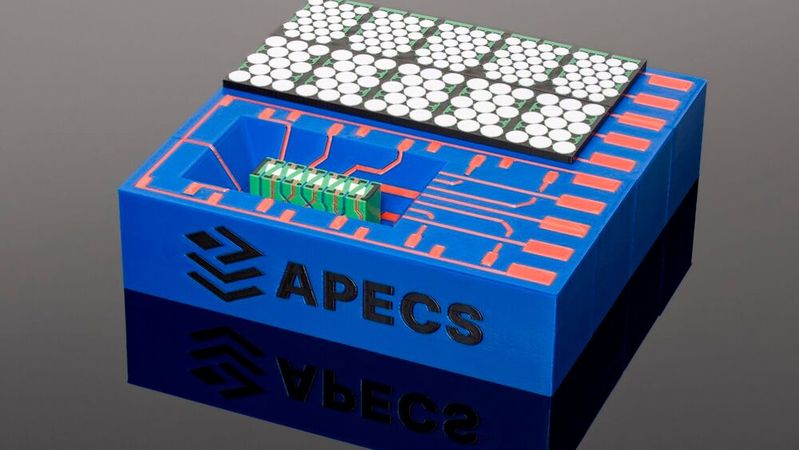
Growing demands for greater complexity, computing power and system compactness are calling for a radical rethink of semiconductor manufacturing. The vision for future-proof microelectronics is to create systems that are as powerful as a single chip yet offer the flexibility of modular building blocks. Within the APECS pilot line, which focuses on "Advanced Packaging and Heterogeneous Integration for Electronic Components and Systems", Fraunhofer IPMS is pursuing the quasi-monolithic integration (QMI) approach. The aim is to integrate various chip components, such as control electronics, sensors and microelectromechanical systems (MEMS), at the wafer level, while retaining the benefits of a compact single chip.
From theory to reality: pockets, placement and embedding
Researchers at Fraunhofer IPMS have successfully achieved the first critical milestone of the QMI roadmap. "The basis of QMI is silicon wafers with structured recesses, or pockets. For the first time, dummy chiplets have been inserted into these pocket wafers and the surface has been levelled with a passivation layer in preparation for subsequent back-end-of-line wiring," explains Dr. Lukas Lorenz, group leader at Fraunhofer IPMS. "This creates a nearly monolithic system architecture that combines the highest integration density with modular scalability." This success paves the way for the industrial maturity of the entire process chain for future applications.
Technological advantages: higher system performance with maximum compactness
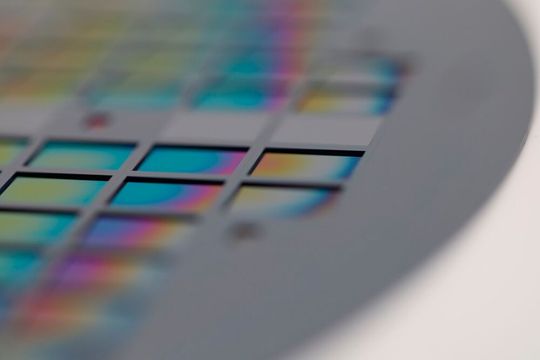
QMI technology offers significant advantages over conventional packaging processes. This is due to the way chiplets are arranged on an active or passive wafer substrate with a shared interconnect stack. Since the interconnects are formed in the front-end-of-line process, much higher connection densities can be achieved than with traditional methods. The following benefits result:
- Higher performance: Shorter signal paths reduce losses and latency, thereby increasing processing speed at the system level.
- Reliability: Reducing mechanical interfaces increases the robustness and operational lifetime of the systems.
- Compactness: QMI saves a significant amount of space because the elements are integrated in a nearly monolithic fashion.
- Cost-efficiency: Combining modular chiplet approaches enables highly cost-effective integration, short innovation cycles, and high scalability.
These advantages make quasi-monolithic integration ideal for innovations such as highly integrated system-on-chip (SoC) solutions for artificial intelligence (AI) applications and high-bandwidth smart transceivers.
Next steps toward industrial deployment
Dr. Lukas Lorenz emphasizes: "Although the current demonstrator is based on dummy structures, the process chain can be transferred to real-world customer applications. This enables a scalable integration architecture for future heterogeneous system solutions." Fraunhofer IPMS is targeting industrial partners whose products could benefit from the integration of different high-density technologies. The approaches developed within the APECS framework form the basis for quickly transferring QMI to production-oriented manufacturing environments.
(ID:50849466)
:quality(80)/p7i.vogel.de/wcms/0e/13/0e132310ca94e4d27cfc167cbcf567f9/0128546543v2.jpeg "GaN, SiC, and AI are reshaping power electronics in 2025, responding to rising energy demand and the rapid expansion of data centers, EVs, and electrification. (Source: © Dreamy Shots - stock.adobe.com)")
:quality(80)/p7i.vogel.de/wcms/63/09/6309df9835f3132935fb3e28945a8950/0128257234v6.jpeg "The Vanguard provides automated wet processing for 200 mm and 300 mm wafers. (Bild: Rena)")