


:quality(80)/p7i.vogel.de/wcms/7f/4b/7f4b97757cea82c0675209630577dc22/0133974130v2.jpeg "Vox Power’s EIRE600 delivers up to 600 W in a compact 5 × 3-inch package, with forced-air or conduction cooling options for industrial and medical equipment. (Source: Vox Power)")
:quality(80)/p7i.vogel.de/wcms/55/97/5597c3436e3bc92ee7ba23b6f9d289e9/0134032539v2.jpeg "Littelfuse’s TP7.0SMD-XC automotive TVS diode series uses foldback technology to provide low clamping voltage for protecting sensitive vehicle electronics. (Bild: Littelfuse)")
:quality(80)/p7i.vogel.de/wcms/51/f8/51f84448e666230bb11a02566abd1177/0133958187v3.jpeg "Microchip’s radiation-tolerant GaN point-of-load converter supplies up to 20 A for space-based processors, FPGAs, microcontrollers and ASICs. (Source: Microchip)")
:quality(80)/p7i.vogel.de/wcms/0a/7c/0a7c08f368ae1d91f758dd18d2a32e88/0133978423v2.jpeg "EPFL researchers have demonstrated a GaN transistor that withstands nearly 4 kV, using an intrinsic polarization superjunction design to distribute electric fields more evenly. (Source: EPFL)")
:quality(80)/p7i.vogel.de/wcms/5b/94/5b94232ca4183d6fcc2dccc7394d7544/0134041114v4.jpeg "Siemens and NVIDIA are testing AI applications at Siemens’ Erlangen electronics factory, using digital twins to support production planning and prepare inspection systems before physical prototypes are available. (Bild: Siemens)")
:quality(80)/p7i.vogel.de/wcms/b4/1f/b41f2731a07b608e60eca3663e280301/0133980549v2.jpeg "Multi-year agreement with Wolfspeed supports Infineon’s conversion from 150-millimeter to 200-millimeter silicon carbide (SiC) manufacturing (Source: © Ada - stock.adobe.com)")
:quality(80)/p7i.vogel.de/wcms/e3/0a/e30a8813bcf44b16f0dceb63a0747d29/0133984094v2.jpeg "The semiconductor is only one part of the design. Higher voltage, frequency and power density also increase the demands on electronic packaging materials such as die attach, substrates, top-side interconnects and module attach. (Source: Generated by AI)")
:quality(80)/p7i.vogel.de/wcms/5d/fb/5dfba5e5f38daf2b8597b05656af29c0/0133956337v2.jpeg "Wolfspeed has received a conditional commitment for a loan of up to $1.5 billion from the U.S. Department of War to support its domestic wide-bandgap semiconductor supply chain. (Source: © AspctStyle - stock.adobe.com)")
:quality(80)/p7i.vogel.de/wcms/bf/b6/bfb6ac295759be32d567df9849b6767e/0134094495v2.jpeg "Fraunhofer ISE reports that 25 Ah pouch cells with silicon-rich anodes retained more than 83% of their initial capacity after 1,000 cycles when tested under 1,000 kPa axial pressure. (Bild: Fraunhofer ISE)")
:quality(80)/p7i.vogel.de/wcms/16/dc/16dca55e6ef80e6b5da68bc628da2dcc/0133844782v2.jpeg "This article explains virtual power plants in modern renewable-heavy grids. (Source: © M@rketVisualsStudio - stock.adobe.com)")
:quality(80)/p7i.vogel.de/wcms/e8/33/e8330aae4bea3578b98ec2c1403d367a/0133980001v2.jpeg "IRENA’s 2026 World Energy Transition Outlook identifies faster electrification powered by renewables as central to meeting future global energy needs. (Source: Irena)")
:quality(80)/p7i.vogel.de/wcms/6c/b4/6cb405f47d25035e256ae90fe3a66ee6/0134032112v2.jpeg "Sungrow’s PowerTitan 3.0 energy storage platform uses onsemi EliteSiC hybrid power modules, with the companies reporting peak inverter efficiency above 99.3%. (Bild: onsemi)")
:quality(80)/p7i.vogel.de/wcms/7b/76/7b76005554b556df2a7a3794bdf69d44/0132365246v2.jpeg "Hioki’s ST5680A DC Hipot Tester combines CE/UKCA/CSA compliance, an integrated capacitance‑based contact check and time‑series waveform recording (voltage, leakage current, insulation resistance) to standardize hipot and insulation testing across EV cell, module and pack production lines. (Source: Hioki)")
:quality(80)/p7i.vogel.de/wcms/af/7f/af7f7b0fb7f29219fc991b1130f65477/0132241333v2.jpeg "Comprehensive laboratory testing regimens—combining thermal cycling, high‑current stress, EMC, and accelerated lifetime tests—are essential to validate advanced power designs and ensure reliability in real‑world applications. (Source: PRBX)")
:quality(80)/p7i.vogel.de/wcms/16/3d/163df69363f8125315a9826e13ea4b05/0131927425v2.jpeg "Solution will maximize data center and AI factory profitability while delivering engineering-grade insights to design and operations for more efficient, sustainable, and resilient infrastructure. (Source: Cadence)")
:quality(80)/p7i.vogel.de/wcms/85/b7/85b7e90733a2bd8f21515d8f7137f2fc/0131917677v2.jpeg "Renesas acquires Pictorus to integrate its embedded application software platform with Renesas’ MCU and MPU portfolio, helping developers shorten time‑to‑market and simplify system integration. (Source: © lucadp - stock.adobe.com)")
:quality(80)/p7i.vogel.de/wcms/f8/34/f834240d434a0c265a2ccafe614c8cd7/0134032109v4.jpeg "Hard- and soft-switching techniques shape voltage and current during device transitions, influencing switching losses, EMI and thermal performance in power converters. (Bild: © Mrthullab - stock.adobe.com)")
:quality(80)/p7i.vogel.de/wcms/27/07/2707280c807689b437baed3660257404/0133626052v2.jpeg "The quantum behavior of electrons shapes semiconductor devices—and the power converters that deliver electricity to modern computing systems. (Source: © Celt Studio - stock.adobe.com)")
EMERGING TECHNOLOGIES Software-defined power electronics
Related Vendors
:fill(fff,0)/p7i.vogel.de/companies/68/2c/682c3e2e9a195/logotype-rvb.jpeg "logotype-rvb (MERSEN France)")
:fill(fff,0)/p7i.vogel.de/companies/66/9a/669a2816c84be/pcim-logo.png "pcim-logo (PCIM)")
Future power electronics will integrate with IoT and depend on software-based control. Software-defined power electronics (SDPE) is the emerging technology that will replace single-function hardware devices. SDPE is in the proof-of-concept stages. Experts have written best-selling books and published promising research papers to explain software-defined power electronics. Academics emphasize theoretical knowledge to build top-notch applications in the future. As a result, the automotive industry is focusing on integrating software in vehicles using the same power electronics technology.
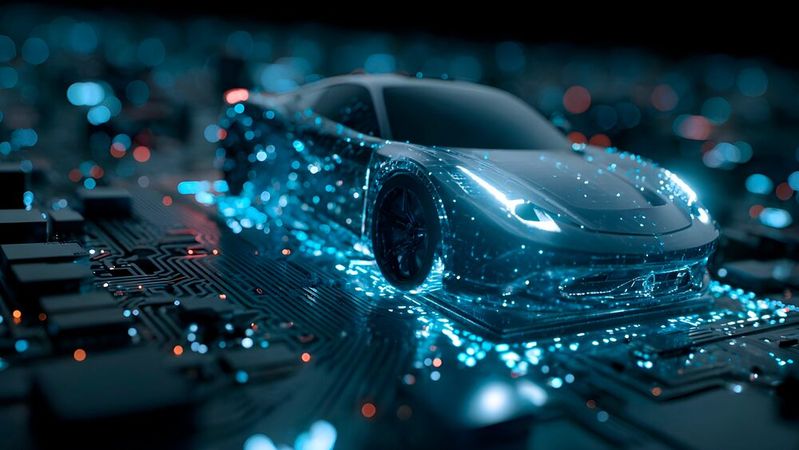
Software-defined power electronics supports the electrification missions to drive net-zero goals by the 2030s. Electrification is all about replacing combustion and oil in engines. Software-based power electronics builds such power converters to support electrification initiatives.
Traditional power electronics systems rely on digital control, which is based on digital signal processors (DSPs) and pulse-width modulation (PWM). All power converters are discrete and fixed hardware devices that perform a single function.
Software-defined power electronics is a flexible architectural approach in which hardware, including power converters, can be reconfigured through firmware to perform multiple power-related functions and updated like IoT devices throughout their deployment cycle.
In SDPE, the converter technology exists behind interconnected software interfaces. Wide bandgap materials, such as silicon carbide and gallium nitride, are improving the efficiency and response of converters. It is something that car companies need the most.
SiC and GaN are chosen for exceptional power densities, breakdown fields, electron mobilities, and thermal conductivities to enhance thermal and switching behavior. These materials enable manufacturing smaller components that switch faster and lose less energy than silicon.
What’s new about the modular approach?
SDPE is a modular approach. Power converters are built from standardized, self-contained building blocks of switches, gate drivers, and protective gear. Firmware, a low-level specialized code embedded into the software, manages and coordinates these blocks.
Instead of designing a monolithic power converter for an application, engineers can connect dozens of self-contained modular power blocks to perform specific functions in a coordinated fashion. SDPE is similar to a composable data center computing architecture.
In traditional data centers, a server would handle CPU, RAM/ROM, storage, and networking. Composable data computing placed CPUs, storage devices, network cards, and various hardware in interconnected physical pools. Virtualization enabled a single server to handle and extract resources when needed.
For example, multiple power modules are integrated and controlled via software to function as a traction inverter. Potential applications could be EV charging, motor traction, grid-tied inverters, DC-DC converters, solar cells, and wind power.
Is SDPE the easy way out?
Changing hardware is costly and time-consuming. The advent of software layers takes all the burden to replace components. The physical layer becomes generic, and missing functions result in updates, rather than replacement. Firmware helps reconfigure the device and optimize power.
Grid-code profiles on firmware can be reused by multiple users. All hardware components, ranging from converters to edge devices, coordinate. As a result, SDPE systems can reduce the need for users to visit (physically) the service center for updates.
SDPE enables repurposing power converters for different use cases with the help of configurable software. Repurposed power components allow engineers to reduce development time, thus reducing time-to-market.
:quality(80):fill(efefef,0)/p7i.vogel.de/wcms/6a/02/6a02d06fa2e86/wp-magnachip-sustainably-strong--mastering-the-reduction-of-oxides-coverbild.jpeg "WP_Magnachip_Optimizing 600V SJ MOSFETs for High-Density Server Design_Coverbild")
Trade-offs that can’t be ignored
Firmware over-the-top (OTA) software updates can lack certifications. In fact, lack of standardization is a major bottleneck to software-defined technologies. Only high-end EVs and modern trucks incorporate such features.
Another critical issue is electromagnetic compatibility (EMC). Each independent module may not pass the EMC test. Hardware lifecycle is longer, needing replacement after a decade or sometimes two. On the other hand, software needs continuous updates.
What’s already shipping in 2026?
Infineon recently announced its focus on DG matrix multi-port solid-state transformers (SST) and developing advanced software-defined vehicle architecture. A recent group interview shares how class 8 truck manufacturers, including Volvo, Mack, and Cummins, are pushing remote over-the-top (OTA) software updates to the drivetrain. Hence, SDPE is expected to grow in the coming years.
References
- https://www.truckinginfo.com/articles/over-the-air-updates-and-the-modern-powertrain-explained
- https://ieeexplore.ieee.org/document/10804246/authors#authors
- https://www.renewableenergyworld.com/power-grid/grid-modernization/what-is-software-defined-power-and-why-should-utilities-take-note/
- https://blog.equinix.com/blog/2023/04/28/what-are-modular-data-centers-and-how-can-they-help/
- https://powerontechnologies.co.za/exploring-software-defined-power-electronics/
(ID:50849257)
:quality(80)/p7i.vogel.de/wcms/a3/30/a330337e234ac2000bb8829ce34ce001/0130871678v2.jpeg "Green transition in power electronics: Ecodesign and modular systems close the material loop. (Source: © DigiArtStudio - stock.adobe.com)")
:quality(80)/p7i.vogel.de/wcms/ae/f8/aef812b9e9d135f80060a3c50b03d034/0130157717v2.jpeg "Solid-state transformers (SSTs) promise more flexible and efficient power conversion, but significant technical challenges still limit their large-scale commercial adoption. (Source: © Curie - stock.adobe.com)")