


:quality(80)/p7i.vogel.de/wcms/2f/f3/2ff3221bf7665de2d0acf83760bfd1fa/0130031523v2.jpeg "Wolfspeed presents a 300 mm silicon carbide technology platform designed to support advanced packaging and high-efficiency power delivery for AI data center infrastructure. (Source: Wolfspeed)")
:quality(80)/p7i.vogel.de/wcms/c3/16/c316e955a97f5d72d9678297b237b9e5/0129932858v2.jpeg "Left: the single-phase version of the SENTRON ECPD with RCM, right: a model of the future three-phase version of the SENTRON ECPD. (Source: Siemens)")
:quality(80)/p7i.vogel.de/wcms/ef/0a/ef0adb0acf793fe147cc27c21f6a7a67/0129954238v2.jpeg "Empower Semiconductor introduces embedded silicon capacitors designed to improve power delivery and stability in AI and high-performance computing processors. (symbolic image) (Source: © IF.arc - stock.adobe.com)")
:quality(80)/p7i.vogel.de/wcms/53/f9/53f9301dfc9292d02960f7996c79cc6e/0129927601v2.jpeg "Wolfspeed’s new 10 kV SiC MOSFET enables high-voltage power conversion for grid and industrial applications. (symbolic image) (Source: © CREATIVE- 3.4 - stock.adobe.com)")
:quality(80)/p7i.vogel.de/wcms/6e/cd/6ecd41d095d5111cf4ed37b714844487/0129930878v2.jpeg "PCIM Asia Shenzhen provides a platform for industry experts to present new developments in power electronics and electrification technologies. (symbolic image) (Source: © killykoon - stock.adobe.com)")
:quality(80)/p7i.vogel.de/wcms/02/c0/02c0e9722f70b1134dbf96fb59a9c73d/0129655179v2.jpeg "The PCIM Conference 2026 will take place from June 9-11, featuring discussions on power electronics trends, including GaN technology and AI applications. (symbolic image) (Source: © Elmira - stock.adobe.com)")
:quality(80)/p7i.vogel.de/wcms/cc/67/cc670ea2029cd2af5c641af70e1bf734/0129816392v4.jpeg "Fraunhofer IAF coordinates the EU SUPREME project to accelerate GaN and SiC power semiconductor innovation in Europe. (Source: Fraunhofer IAF)")
:quality(80)/p7i.vogel.de/wcms/ea/e6/eae6aee30071e67a5627027974437134/0129544613v2.jpeg "GlobalFoundries and Renesas strengthen their collaboration to support U.S.-based semiconductor production and supply chain resilience. (Source: © ronstik - stock.adobe.com)")
:quality(80)/p7i.vogel.de/wcms/23/1a/231a97643aa7fc3adf2704a6273756c3/0130030642v2.jpeg "Gallium nitride (GaN) power devices are increasingly challenging silicon MOSFETs in low-voltage power conversion by enabling higher efficiency and switching performance. (Source: © Sheraz - stock.adobe.com)")
:quality(80)/p7i.vogel.de/wcms/3c/4b/3c4bbc68dda65c7071b4376fb57423b0/0130030465v2.jpeg "Faraday’s laws explain the fundamental behavior of magnetic fields and electronic devices in dynamic use cases. The operation of transformers, wireless chargers, induction cookers, induction motors, magnetic levitating trains (MAGLEV Trains), electric violin, and many others depends upon Faraday’s laws. (Source: © Sheraz - stock.adobe.com)")
:quality(80)/p7i.vogel.de/wcms/b1/5e/b15ee02b0ba02db70cf61e37d66ad1d3/0129349127v2.jpeg "Vehicle-to-grid (V2G) chargers enable bidirectional energy flow, allowing electric vehicles to act as mobile energy storage systems that can both draw power from and feed power back into the grid. (Source: © medienvirus - stock.adobe.com)")
:quality(80)/p7i.vogel.de/wcms/26/d5/26d591cc340077026eac56a0e7564faf/0129949603v2.jpeg "Flexible: The solid silicone-based electrolyte is elastic, thereby compensating for the voids that form in solid-state batteries during charging and discharging. (Source: Empa)")
:quality(80)/p7i.vogel.de/wcms/be/c8/bec8d43fc0ee73414274be44608b2970/0129748903v2.jpeg "The Infiniium XR804KA real-time oscilloscope delivers faster response time, improved stability, and streamlined workflows for high-speed digital and compliance testing. (Source: Keysight)")
:quality(80)/p7i.vogel.de/wcms/23/ee/23ee4a97790d6009dbfd7d9577ffa723/0129220424v2.jpeg "The R&S FPL1044 with the new RTSA option makes 40 MHz real-time frequency analysis available up to 44 GHz. (Source: Rohde & Schwarz )")
:quality(80)/p7i.vogel.de/wcms/3c/d1/3cd1cacbceb792ba63727199c61ca434/0127801860v2.jpeg "Thanks to cloud technology, users can collaborate on projects from anywhere and always have access to the latest planning data. (Source: SIEMENS)")
:quality(80)/p7i.vogel.de/wcms/5a/a0/5aa0436498af618297961fd54ab36cdf/0126290792v2.jpeg "Siemens accelerates student-led semiconductor innovation across Europe’s leading technical universities through Cre8Ventures’ Open Higher Education Program developed in collaboration with Arm and University of Southampton (Source: Siemens Digital Industries Software)")
POWER CONVERTERS “Digital Twin” approach for three-phase power converters
Related Vendors
:fill(fff,0)/p7i.vogel.de/companies/62/b9/62b980cddf5d6/ceramtec.png "ceramtec (www.ceramtec-group.com)")
:fill(fff,0)/p7i.vogel.de/companies/63/c7/63c7da97be945/diotec.png "diotec (Diotec Semiconductor AG)")
:fill(fff,0)/p7i.vogel.de/companies/60/7e/607ec89d5d9b5/white-frame.jpg "white frame.jpg (www.rohm.com)")
DT (Digital Twin) “perfectly mimics” a physical object. When it comes to power electronics, such a technology could enhance the design, save production time, and cut down on costs for manufacturing units and engineers. The article discusses a recent experiment that implements the digital twin approach to monitor and improve the functionality of three-phase power converters.
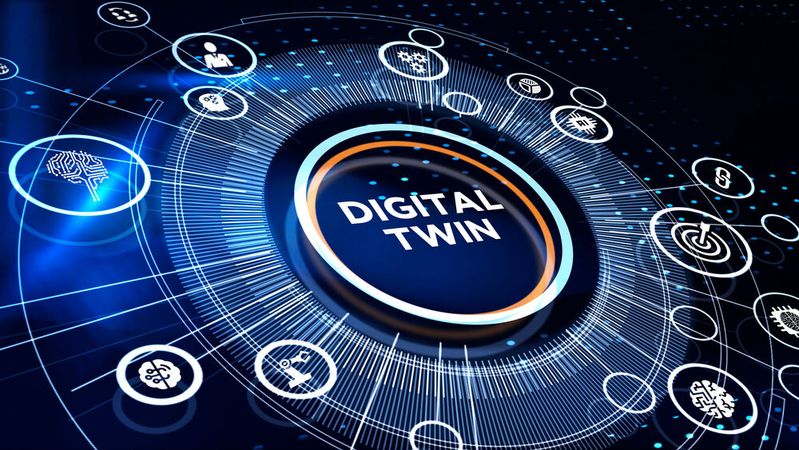
Digital Twin or simply DT is a virtual version of a real-time or intended object, place, system, process, or person. The digital twin follows the exact data required to function like the physical entity. The entity for which the DT has to be created is usually present in the physical world. However, the entire product lifecycle of conceptual projects and hypothetical models can also be replicated through the digital twin approach.
In the electrical and electronics industries, relevant data is extracted from advanced sets of sensors, IoT hardware, electronic devices, simulation software, and historical records of similar models. Modern CAD and data modeling software are used to interpret such data and create accurate digital twins. This process enables product engineering teams to monitor the conditions of the electronics circuit or device that exists in the physical world or is planned to be manufactured shortly.
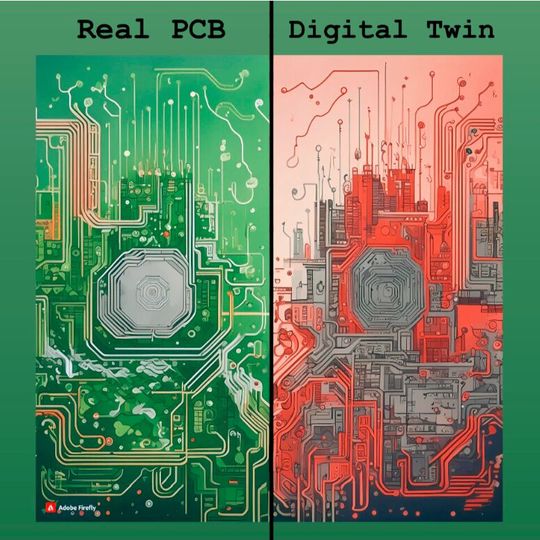
DT approach to designing better three-phase power converters
A recent study experimentally verified algorithms to implement a digital twin approach to monitor the operational conditions of a three-phase power electronics converter. Strikingly, the experiment showed that the DT acted like a “watchdog” to monitor real-time signals associated with the power converter.
:quality(80)/images.vogel.de/vogelonline/bdb/1884100/1884168/original.jpg "The ZEPOWEL project has shown that the digital revolution and the energy revolution do not have to exclude each other. (©putilov_denis - stock.adobe.com)")
SUSTAINABILITY
Greening the Internet of Things
Condition monitoring
The main idea behind condition monitoring is to “keep an eye” on the operation of the power electronic converter over time. Due to long-term operation, the power converter may change its electrical properties which affects its performance. Another possibility of electrical breakdown is also there.
Component deterioration is an indicator of performance degradation over time. Continuously monitoring the operating conditions of the power converter enables the replacement of faulty components and ensures seamless operation. Various methodologies have been verified to test the real-time functionality of components such as power semiconductors and capacitors.
Digital twin
The study created a DT for a 3L-NPC (Three Leg Neutral Point Clamped) power converter. The 3L-NPC power converter is a type of three-phase multilevel converter that uses clamping diodes to stabilize the neutral point voltage. These power converters are used in photovoltaic and https://www.power-and-beyond.com/what-is-wind-energy-definition-types-and-more-a-e95f3c16c898e889f0757f62ee91038d/ systems.
The 3L-NPC power converter produces voltages of various levels for efficient operation and low harmonic distortion. In addition, this power converter has a high number of power semiconductors. IGBTs are the switching devices in this power converter. PWM generates switching signals for these IGBTs.
The above-mentioned power converter is implemented as a dual hybrid converter through a VSC (Voltage Source Converter) topology. The first power converter functions like a UPS (Uninterrupted Power supply) with the load connected to the grid and the second one operates to be a compensator.
The DT approach is applied for the first converter. It takes feedback from the power converter to update its state and parameters. Such a DT approach is called a closed-loop digital twin. The digital twin responds just like the power converter.
Filter degradation
In every power converter, the filtering stage is crucial to reduce harmonic content in the output waveforms. Usually, an LC filter is used to suppress high-frequency harmonic components in voltages and currents. LC filter is a combination of the inductor (L) and a capacitor (C).
Over time, filters wear and tear out due to various electrical and mechanical stresses. Another limitation is the shift in resonant frequency with time. This study focuses on monitoring the “health” of LC filters in 3L-NPC power converters.
:quality(80):fill(efefef,0)/p7i.vogel.de/wcms/65/cb/65cb9c3a03849/webinar-efficient-electrolysis-through-comprehensive-power-conversion-solutions-coverbild.jpeg "Webinar_Efficient Electrolysis through Comprehensive Power Conversion Solutions_Coverbild (Infineon)")
GREEN HYDROGEN
Efficient Electrolysis through Comprehensive Power Conversion Solutions
The two main algorithms used are PSO (Particle Swarm Optimization) and GO (Genetic Algorithm). Both these algorithms validate the optimization of condition monitoring of LC filter circuits triggered by a programmed event. In simple words, both these algorithms measure the degradation estimation of LC filter circuits.
Results
Despite facing total harmonic distortion challenges, the overlapping signals between digital and physical twins validated the results. A high signal fidelity was seen on the embedded computing platform. The information from the digital twin is eventually fed to the real-time physical power converter to improve the performance.
Benefits of using the DT approach in power electronics
The DT approach offers a powerful toolbox for power electronics engineers, enabling:
- Digital twins perform real-time monitoring, predictive maintenance, optimization, and fault analysis in power electronic systems.
- Cost-effective approach to test a first-time or new converter topology.
- Optimization of the converter performance in advance.
- Replacement of faulty components.
- Cuts downtime.
- Saves time for product and systems engineering teams.
- Reduces manufacturing costs.
Further applications
About 29% of manufacturing companies have implemented the digital twin approach globally. Rapid growth is expected in the DT approach up to 2027. The projected CAGR is about 29%.
- Digital twins monitor operating conditions and perform fault analysis in renewable sectors like solar technologies and wind turbine farms.
- Digital twins are used for predictive grid maintenance.
- Digital twins are applicable in motor industrial applications.
References
www.sciencedirect.com
aws.amazon.com
iot-analytics.com
Power Electronics in the Energy Transition
The parameters for energy transition and climate protection solutions span education, research, industry, and society. In the new episode of "Sound On. Power On.", Frank Osterwald of the Society for Energy and Climate Protection Schleswig‐Holstein talks about the holistic guidance his organization can provide.
Listen now!
(ID:50072083)
:quality(80)/p7i.vogel.de/wcms/37/b2/37b2a11a859c819e4752711ca71df724/0126628873v2.jpeg "Multi-level converters and inverters have been around since the late 1800s. Their job is to work in groups and provide high-power outputs over long distances. Now their use and efficiency have made them enter the aerospace industry. Learn more here. (Source: © frank peters - stock.adobe.com)")
:quality(80)/p7i.vogel.de/wcms/0e/13/0e132310ca94e4d27cfc167cbcf567f9/0128546543v2.jpeg "GaN, SiC, and AI are reshaping power electronics in 2025, responding to rising energy demand and the rapid expansion of data centers, EVs, and electrification. (Source: © Dreamy Shots - stock.adobe.com)")