


:quality(80)/p7i.vogel.de/wcms/99/dd/99dd64ae87c0855129bd405f61d81f81/0133290217v2.jpeg "Microchip’s new 1.2 V SY757xx clock buffers connect modern low-voltage SoCs, FPGAs and AI accelerators with higher-voltage clock components, supporting frequencies up to 250 MHz and additive jitter as low as 26 fs. (Source: Microchip)")
:quality(80)/p7i.vogel.de/wcms/83/d0/83d0b8ea52378c77f98358e29ceccfc0/0133339307v2.jpeg "Capacitors are a critical yet often overlooked component in AI data center power supplies, buffering energy and stabilizing voltage as racks scale toward the megawatt range. (Source: © Parilov - stock.adobe.com)")
:quality(80)/p7i.vogel.de/wcms/10/fc/10fcb98e44d61826e641bc8d3f20f616/0133193677v2.jpeg "The new AEVA and AEVB Series aluminum electrolytic capacitors are engineered for harsh industrial environments, delivering high-CV, long-lifetime performance in compact, surface-mount packages that reliably withstand up to 30g acceleration and operating temperatures extending from -55° to +125°C. (Source: Kyocera)")
:quality(80)/p7i.vogel.de/wcms/f7/42/f74208db9f5f87dca384b38b71c4782e/0133196365v2.jpeg "YAGEO’s EC Flat‑Series temperature sensors combine fast, accurate measurement with resistance to vibration, shock, moisture and dust for demanding automotive and industrial applications. (Source: Yageo)")
:quality(80)/p7i.vogel.de/wcms/57/b6/57b6d33cb929fa4408ad56803ed5f0bc/0133311998v2.jpeg "Elmos and SK keyfoundry are expanding their collaboration on 130 nm technology and have agreed on long-term wafer capacity through 2037 to support reliable automotive semiconductor production. (Source: © remake - stock.adobe.com)")
:quality(80)/p7i.vogel.de/wcms/b4/0a/b40a1de3c8fa631b2aff74ec436c43db/0133314066v2.jpeg "ZF Aftermarket expands its EV service portfolio with new repair kits and solutions for e‑motors, inverters, hybrid modules, mechatronics and electric drive units. (Source: ZF Aftermarket)")
:quality(80)/p7i.vogel.de/wcms/48/e1/48e107b92f976652532facf5ca1e0855/0133290826v2.jpeg "Infineon and SolarEdge are extending their collaboration to develop solid-state protection solutions for 800 VDC AI data centers, aiming to improve fault response, system reliability and power density. (Source: © Grispb - stock.adobe.com)")
:quality(80)/p7i.vogel.de/wcms/99/84/9984f5888ecc71c249f65cea3f0658d1/0133069650v2.jpeg "Yokogawa’s integrated measurement setup helps Vertiv analyse AI-driven pulsed loads, combining power, waveform and thermal data to validate UPS performance and input power smoothing. (Source: YOKOGAWA)")
:quality(80)/p7i.vogel.de/wcms/a4/29/a429b944eb0a69e268015f8300ba8940/0133311989v2.jpeg "Hitachi Energy and Daikin are establishing a German supply of C4‑FN, a specialty insulating gas used in SF₆‑free high‑voltage equipment for more sustainable power grids. (Source: © Ahmed - stock.adobe.com)")
:quality(80)/p7i.vogel.de/wcms/d5/32/d5326e4b05d5cd759e88062f1c0b097a/0133344193v2.jpeg "Co-packaged optics is the latest innovation in data centers where optical modules on silicon chips can assist in scaling megawatt AI infrastructure. (Source: © Rachakrit - stock.adobe.com)")
:quality(80)/p7i.vogel.de/wcms/76/a9/76a9333bc7c6abbf7e29d1b910edb5e2/0133335959v2.jpeg "This article explains PMBus in data center power supplies. (Source: © Gibster - stock.adobe.com)")
:quality(80)/p7i.vogel.de/wcms/35/9c/359cfb6c855204e4d114f88cf5b98b5f/0133078984v2.jpeg "Photonic integrated circuits are next-level chips that will dominate data centers in the upcoming years. (Source: © pier - stock.adobe.com)")
:quality(80)/p7i.vogel.de/wcms/7b/76/7b76005554b556df2a7a3794bdf69d44/0132365246v2.jpeg "Hioki’s ST5680A DC Hipot Tester combines CE/UKCA/CSA compliance, an integrated capacitance‑based contact check and time‑series waveform recording (voltage, leakage current, insulation resistance) to standardize hipot and insulation testing across EV cell, module and pack production lines. (Source: Hioki)")
:quality(80)/p7i.vogel.de/wcms/af/7f/af7f7b0fb7f29219fc991b1130f65477/0132241333v2.jpeg "Comprehensive laboratory testing regimens—combining thermal cycling, high‑current stress, EMC, and accelerated lifetime tests—are essential to validate advanced power designs and ensure reliability in real‑world applications. (Source: PRBX)")
:quality(80)/p7i.vogel.de/wcms/16/3d/163df69363f8125315a9826e13ea4b05/0131927425v2.jpeg "Solution will maximize data center and AI factory profitability while delivering engineering-grade insights to design and operations for more efficient, sustainable, and resilient infrastructure. (Source: Cadence)")
:quality(80)/p7i.vogel.de/wcms/85/b7/85b7e90733a2bd8f21515d8f7137f2fc/0131917677v2.jpeg "Renesas acquires Pictorus to integrate its embedded application software platform with Renesas’ MCU and MPU portfolio, helping developers shorten time‑to‑market and simplify system integration. (Source: © lucadp - stock.adobe.com)")
DATA CENTERS Co-packaged optics in data centers
Related Vendors
:fill(fff,0)/p7i.vogel.de/companies/63/c7/63c7da97be945/diotec.png "diotec (Diotec Semiconductor AG)")
:fill(fff,0)/p7i.vogel.de/companies/68/2c/682c3e2e9a195/logotype-rvb.jpeg "logotype-rvb (MERSEN France)")
:fill(fff,0)/p7i.vogel.de/companies/66/8b/668becd1c07eb/dowa-logo-word--1-.jpeg "dowa-logo-word--1- (DOWA)")
Data centers consume enormous amounts of energy, more than 1.5% of the whole world. The power consumption is largely driven by servers and cooling solutions. Networking equipment, followed by storage, consumes less power than others, but innovative network packages can further reduce data center energy consumption. Enterprises are developing various solutions to combat high power consumption and distribution losses; one is to package optical components directly on the chip to reduce electricity bills. The solution is co-packaged optics (CPO), which combines fiber optics and networking at the chip level.
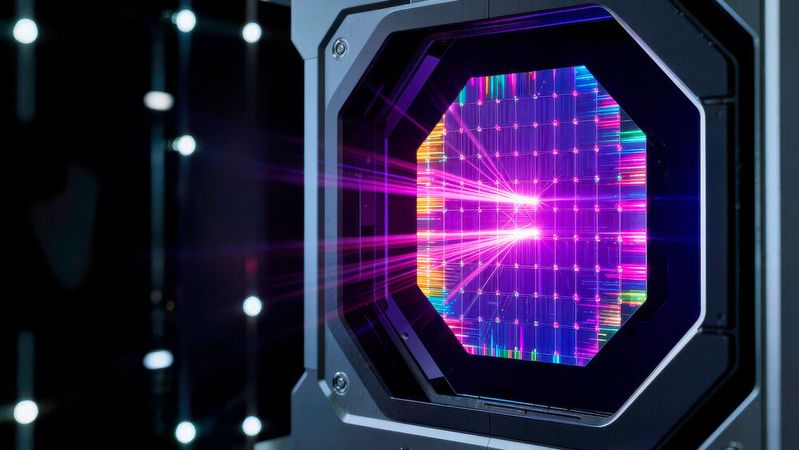
As fibers replace copper in data center networking, optical transceivers are placed as pluggable modules at the top of the rack in the network switch or connected to an application-specific integrated circuit (ASIC) or field-programmable gate array (FPGA) via external fiber cables. Copper PCB traces connect the front panel of the optical module to this ASIC or FPGA. Longer traces result in more signal losses and higher power consumption.
Optical components such as lasers, photodetectors, and waveguides make up pluggable optical modules. The main job of an optical component is to convert electrical data signals into light pulses for transmission through fiber cables, and convert received light pulses back to electrical signals. Co-packaged optics eliminate the need to place pluggable optical transceivers in the rack.
Co-packaged optics integrates optical transceivers directly into the network switch ASIC or FPGA, which sits at the top of the rack, alongside a copper-based power delivery system. The co-packaged ASIC or FPGA houses the chip and optical components in a single 3D IC package. The word “co-packaged” suggests that the design approach places optical modules next to the electrical chip on a low-loss substrate.
In technical terms, co-packaged optics is a silicon photonics application. Silicon photonics is an emerging technology that fabricates microphotonic elements on a silicon chip. Co-packaged optics integrates photonic integrated circuits (PICs) directly close to silicon-based electronic integrated circuits (EICs) using a cost-effective heterogeneous integration method, commonly used in CMOS fabrication units
:quality(80)/p7i.vogel.de/wcms/04/cf/04cfeaa8e01a009df9f6142730251a76/0131803674v2.jpeg "This article describes 12V, 48V, 400V, and 800V rack-level distribution voltage in data centers. (Source: © oselote - stock.adobe.com)")
DATA CENTERS
12V to 48V to 400V to 800V evolution of data center power distribution
Why co-packed optics in data centers?
Just like telcos, data centers are replacing copper with optical fiber for long-distance data transmission. The same copper, the one telcos are replacing, is the backbone of power delivery in data centers. When fibers replace copper, they take over the networking part, not the power system.
In electronics, copper is extensively used because of its exceptionally high conductivity. It can seamlessly carry and distribute power throughout the data center; however, copper in data transmission falls short in bandwidth and speed. Fiber optic cables transmit data in the form of photons [light]. Photons are the fastest particles or perhaps waves in the universe. Data is transmitted through copper cables as electrons, which incur resistance and are susceptible to crosstalk.
Copper provides a maximum bandwidth of 10 Gbps over a distance of 300 feet. Signal attenuation and crosstalk become a bottleneck beyond 100 feet. Power consumption increases at higher bandwidth. Massive AI and ML workloads require a larger bandwidth and lower latency. Optical fibers have no distance limits or crosstalk problems.
:quality(80)/p7i.vogel.de/wcms/94/ad/94adeaeec77b29a3b7686c34ee304809/0133333835v2.jpeg "AI data centers are moving toward 800 VDC distribution and megawatt-scale racks, creating a new power architecture in which SiC and GaN technologies serve different stages from the grid connection to the GPU. (Source: © Ahmed - stock.adobe.com)")
POWER GRIDS
From the 1 MW rack to the AI factory: rethinking power from grid to GPU
Towards the megawatt rack
Co-packaged optics is a solution by NVIDIA, Broadcom, Corning Optical Communications, and a few more vendors. The shipment was initiated in early 2025. Global Foundries recently announced advanced solutions for co-packaged optics in AI data centers. As we can see, only a few vendors provide co-packaged optic solutions.
The technology hasn’t matured yet. The industry lacks standardization and mass manufacturability. The market would merely reach USD 49 million in 2028. Increasing fiber switching, routing, and space constraints make deployment difficult. In addition, the thermal behavior of silicon and photonic components is different in 24x7 operational data centers.
Co-packaged optics is complex to manage. Any repair work requires expertise in both electrical and optical fields. Vendor staff can repair for a fee or based on the plan. Chances of vendor lock-in are quite high.
Low equipment spending: Co-packaged optics can reduce data center spending. Once deployed, separate optical transceiver deployment via copper cables is not required. Fewer digital signal processors (DSPs) are required, reducing power costs. Co-packaged optics can be easily deployed, enabling data center operations to scale beyond a 100 kW rack.
High-speed: Co-packaged optics offer higher bandwidth compared to traditional copper.
Low power consumption: When co-packaged optics are shipped in data centers, enterprises can expect a slightly reduced energy bill.
Lower losses: Co-packaged optics result in lower insertion losses than copper.
Improved efficiency: Co-packaged optics reduce the effective distance between optical modules and their respective place of operation. Direct integration of optical components into networking ASICs improves signal processing capabilities and enables faster operation.
Scaling: Co-packaged optics reduces heavy copper costs and meets the high-bandwidth demands of AI and machine learning workloads.
:quality(80)/p7i.vogel.de/wcms/35/9c/359cfb6c855204e4d114f88cf5b98b5f/0133078984v2.jpeg "Photonic integrated circuits are next-level chips that will dominate data centers in the upcoming years. (Source: © pier - stock.adobe.com)")
SILICON PHOTONICS
Photonic integrated circuits might replace silicon chips in data centers
Co-packaged optics is less of a power solution, more of a speed solution
Data centers are evolving from 12V to 48V to 400V to 800V, driven by power-hungry GPUs running AI and ML workloads. The three-phase 380V/480V AC is converted into 380V/480V DC at the facility level, which is stepped down to 48V/400V/800V DC at the rack level. 48V is the current rack-level standard for data center power. 400V is the ongoing transition, while 800V is a proof-of-concept.
Each component receives 48V/400V/800V, which is stepped down inside the chip. Point-of-load (PoL) converters at the rack step down the voltage to 5V, 3.3V, 1.8V, or 0.8V for individual components. Co-packaged optics will also receive these voltages, depending upon the rating. It is important to note that co-packaged optics don’t provide any voltage conversion. They assist faster fiber-based communication. However, integrated components result in slightly lower spending and bills.
References
- https://www.ansys.com/blog/what-is-co-packaged-optics
- https://www.marketsandmarkets.com/Market-Reports/co-packaged-optics-market-28874835.html
(ID:50954072)
:quality(80)/p7i.vogel.de/wcms/04/cf/04cfeaa8e01a009df9f6142730251a76/0131803674v2.jpeg "This article describes 12V, 48V, 400V, and 800V rack-level distribution voltage in data centers. (Source: © oselote - stock.adobe.com)")
:quality(80)/p7i.vogel.de/wcms/35/9c/359cfb6c855204e4d114f88cf5b98b5f/0133078984v2.jpeg "Photonic integrated circuits are next-level chips that will dominate data centers in the upcoming years. (Source: © pier - stock.adobe.com)")