


:quality(80)/p7i.vogel.de/wcms/2f/f3/2ff3221bf7665de2d0acf83760bfd1fa/0130031523v2.jpeg "Wolfspeed presents a 300 mm silicon carbide technology platform designed to support advanced packaging and high-efficiency power delivery for AI data center infrastructure. (Source: Wolfspeed)")
:quality(80)/p7i.vogel.de/wcms/c3/16/c316e955a97f5d72d9678297b237b9e5/0129932858v2.jpeg "Left: the single-phase version of the SENTRON ECPD with RCM, right: a model of the future three-phase version of the SENTRON ECPD. (Source: Siemens)")
:quality(80)/p7i.vogel.de/wcms/ef/0a/ef0adb0acf793fe147cc27c21f6a7a67/0129954238v2.jpeg "Empower Semiconductor introduces embedded silicon capacitors designed to improve power delivery and stability in AI and high-performance computing processors. (symbolic image) (Source: © IF.arc - stock.adobe.com)")
:quality(80)/p7i.vogel.de/wcms/53/f9/53f9301dfc9292d02960f7996c79cc6e/0129927601v2.jpeg "Wolfspeed’s new 10 kV SiC MOSFET enables high-voltage power conversion for grid and industrial applications. (symbolic image) (Source: © CREATIVE- 3.4 - stock.adobe.com)")
:quality(80)/p7i.vogel.de/wcms/6e/cd/6ecd41d095d5111cf4ed37b714844487/0129930878v2.jpeg "PCIM Asia Shenzhen provides a platform for industry experts to present new developments in power electronics and electrification technologies. (symbolic image) (Source: © killykoon - stock.adobe.com)")
:quality(80)/p7i.vogel.de/wcms/02/c0/02c0e9722f70b1134dbf96fb59a9c73d/0129655179v2.jpeg "The PCIM Conference 2026 will take place from June 9-11, featuring discussions on power electronics trends, including GaN technology and AI applications. (symbolic image) (Source: © Elmira - stock.adobe.com)")
:quality(80)/p7i.vogel.de/wcms/cc/67/cc670ea2029cd2af5c641af70e1bf734/0129816392v4.jpeg "Fraunhofer IAF coordinates the EU SUPREME project to accelerate GaN and SiC power semiconductor innovation in Europe. (Source: Fraunhofer IAF)")
:quality(80)/p7i.vogel.de/wcms/ea/e6/eae6aee30071e67a5627027974437134/0129544613v2.jpeg "GlobalFoundries and Renesas strengthen their collaboration to support U.S.-based semiconductor production and supply chain resilience. (Source: © ronstik - stock.adobe.com)")
:quality(80)/p7i.vogel.de/wcms/b1/5e/b15ee02b0ba02db70cf61e37d66ad1d3/0129349127v2.jpeg "Vehicle-to-grid (V2G) chargers enable bidirectional energy flow, allowing electric vehicles to act as mobile energy storage systems that can both draw power from and feed power back into the grid. (Source: © medienvirus - stock.adobe.com)")
:quality(80)/p7i.vogel.de/wcms/26/d5/26d591cc340077026eac56a0e7564faf/0129949603v2.jpeg "Flexible: The solid silicone-based electrolyte is elastic, thereby compensating for the voids that form in solid-state batteries during charging and discharging. (Source: Empa)")
:quality(80)/p7i.vogel.de/wcms/4d/e0/4de02f76a37cbb3df30dd231de589c8e/0128866890v2.jpeg "Both legacy and vGaN show higher carrier mobility and band gap energies compared to other power semiconductors. (Source: © phonlamaiphoto - stock.adobe.com)")
:quality(80)/p7i.vogel.de/wcms/18/0b/180b7b63afc91e523592d8a5ce161c96/0129847487v2.jpeg "InGaAs-based photodetectors enable sensitive and fast detection in the short-wave infrared spectrum for modern sensing and communication applications. (Source: © VITALII - stock.adobe.com)")
:quality(80)/p7i.vogel.de/wcms/be/c8/bec8d43fc0ee73414274be44608b2970/0129748903v2.jpeg "The Infiniium XR804KA real-time oscilloscope delivers faster response time, improved stability, and streamlined workflows for high-speed digital and compliance testing. (Source: Keysight)")
:quality(80)/p7i.vogel.de/wcms/23/ee/23ee4a97790d6009dbfd7d9577ffa723/0129220424v2.jpeg "The R&S FPL1044 with the new RTSA option makes 40 MHz real-time frequency analysis available up to 44 GHz. (Source: Rohde & Schwarz )")
:quality(80)/p7i.vogel.de/wcms/3c/d1/3cd1cacbceb792ba63727199c61ca434/0127801860v2.jpeg "Thanks to cloud technology, users can collaborate on projects from anywhere and always have access to the latest planning data. (Source: SIEMENS)")
:quality(80)/p7i.vogel.de/wcms/5a/a0/5aa0436498af618297961fd54ab36cdf/0126290792v2.jpeg "Siemens accelerates student-led semiconductor innovation across Europe’s leading technical universities through Cre8Ventures’ Open Higher Education Program developed in collaboration with Arm and University of Southampton (Source: Siemens Digital Industries Software)")
CHIP INDUSTRY NEWS Chip industry update: A review of Q1 2025
Related Vendors
:fill(fff,0)/p7i.vogel.de/companies/63/c7/63c7da97be945/diotec.png "diotec (Diotec Semiconductor AG)")
:fill(fff,0)/p7i.vogel.de/companies/60/7e/607ec89d5d9b5/white-frame.jpg "white frame.jpg (www.rohm.com)")
:fill(fff,0)/p7i.vogel.de/companies/62/95/6295c25c8dc1a/schunk-sonosystems-300dpi.png "schunk-sonosystems-300dpi (Schunk)")
The global chip industry hit record sales in early 2025, but demand for AI chips and advanced packaging is still outpacing supply. TSMC, Intel, and Samsung are struggling with yield and production issues.
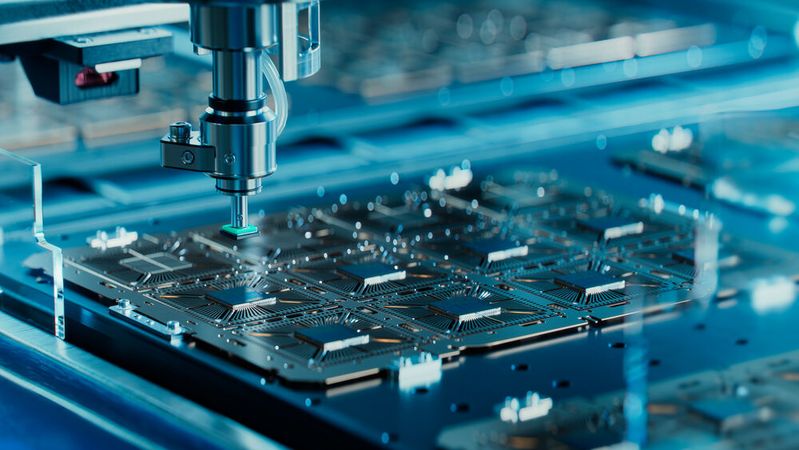
From January through March 2025, the semiconductor market stayed hot, especially in AI and data center chips. Global sales hit $ 56.5 billion in January alone — up nearly 18 % from last year. But underneath the growth, supply problems are still piling up.
The chip shortage of a few years ago is technically over. Consumer electronics and automotive sectors are mostly fine now. But anything tied to AI or cutting-edge nodes is still running into delays. The demand spike from AI, combined with yield issues at leading foundries and geopolitical trade limits, is creating a backlog that’s not improving fast enough.
AI chips are driving demand, but supply can’t keep up
AI accelerators are the main source of pressure. AI chip demand surged in 2024 and kept climbing in Q1 2025. These chips already made up about 20 % of total semiconductor revenue last year. This year, forecasts put that segment at over $ 150 billion.
:quality(80)/p7i.vogel.de/wcms/4c/5f/4c5f0fb776f0864a409a3b861dfe8757/0122700117v2.jpeg "Driven by AI, EVs, and high-performance computing, the semiconductor industry anticipates significant growth in 2025, reaching $717 billion in revenue, but faces challenges like supply chain strains, mature node shortages, and geopolitical uncertainties. Find out more here. (Source: Raitalinn - stock.adobe.com)")
SEMICONDUCTOR INDUSTRY
Semiconductor industry outlook for 2025: Demand growing alongside new challenges
That growth is being led by Nvidia, AMD, and new efforts from Huawei in China. Nvidia’s GPUs are still the market leader, and AMD is expanding fast, reporting $ 5 billion in AI chip revenue in 2024 and expecting strong double-digit growth this year.
But supply still lags demand. TSMC’s advanced packaging tech, especially CoWoS, is the choke point. This packaging process links processors with high-bandwidth memory and is used across nearly all high-end AI chips. TSMC doubled CoWoS capacity in 2024 and plans to do the same in 2025, but CEO C.C. Wei has said supply probably won’t match demand until late 2025 or 2026.
High-bandwidth memory (HBM) is another issue. These memory chips are in short supply, and packaging constraints only make it worse. As a result, companies building AI systems are dealing with long lead times and limited inventory.
Foundries are struggling with yields and production delays
Intel and Samsung are both running into serious yield issues with their advanced nodes. Intel’s 18A process is behind schedule, with current yield rates in the 20 – 30 % range. That’s not viable for volume production. Intel’s first 18A-based chips — Panther Lake — are in engineering testing now, but broader rollout in late 2025 is unlikely.
Samsung’s foundry arm is also underperforming. Its 3nm yields remain below 20 %. In response, the company slashed its 2025 foundry investment from KRW 10 trillion to KRW 5 trillion and is shifting R&D focus to 2nm and 1.4nm. Those next-gen lines won’t be ready in meaningful volume this year.
TSMC is doing better, though not without problems. The company’s Arizona fab, despite early construction delays, has achieved higher yields than comparable lines in Taiwan. But construction and permitting issues slowed the timeline. The company expects volume production to begin this year, but the scale will be limited at first.
On the other hand, TSMC’s Japan facility in Kumamoto is up and running but faces challenges of its own — earthquake risks, international management hurdles, and a tight talent pipeline are all in play. Across its global operations, TSMC is also feeling the effects of a skilled labor shortage, which has delayed staffing and expansion plans in several countries.
China’s AI ambitions still hitting a wall
Huawei is working hard to close the gap in AI chips with its Ascend 910C, built by SMIC using its N+2 7nm process. But production capacity is low, and yields are worse, reportedly around 20 %. That’s far below the 70 %+ needed to scale commercially.
SMIC doesn’t have access to EUV lithography tools due to U.S. export restrictions, so it’s using older DUV machines with multi-patterning to simulate advanced process nodes. This adds steps, increases defect rates, and pushes production costs higher. The result: chips that are slower, less efficient, and more expensive to make than what TSMC and Samsung can produce.
These limitations are forcing Huawei to prioritize domestic state contracts over commercial sales. Performance-wise, the 910C trails Nvidia’s H100 and H20 chips across every metric — transistor density, power consumption, and raw compute.
On the supply chain side, Huawei is also dealing with component shortages from the ongoing trade ban. It lost access to Intel and Qualcomm designs last year. It’s substituting with Chinese parts, but many of these lag in performance. Gray market prices for high-end parts like HBM and FPGAs have spiked, making production more expensive.
Despite heavy investment — China has earmarked over $ 140 billion in chip subsidies — progress is slow. Most of its fabs are still years behind top-tier global competitors. The gap is narrowing slightly, but not fast enough to change the supply picture in 2025.
:quality(80)/p7i.vogel.de/wcms/b4/54/b454dfbb87e7312b8c551bba6538ad93/0122692371v2.jpeg "Natural disasters, geopolitical instability, and fab construction delays challenged the semiconductor industry in Q4 2024, even as surging AI chip demand highlighted the sector's adaptability and future growth potential. Learn more about this here. (Source: Mikhail Vorobev - stock.adobe.com)")
CHIP SHORTAGE NEWS
The Global Semiconductor Crisis: A review of Q4 2024
Geopolitics and supply chain fragility still plague the industry
Even with stronger inventories and more regional diversification, the chip industry is still exposed to political and environmental risks that can cause sudden disruptions.
One recent example: Hurricane Helene in early 2025 caused major flooding in Spruce Pine, North Carolina. That area produces the bulk of the world’s ultra-pure quartz — an essential material for chipmaking. While most fabs had short-term buffer stock, a longer disruption could have affected production. This shows how single points of failure still exist, even deep in the supply chain.

China’s export controls on metals like gallium and germanium are another pressure point. These materials are used in power chips and specialty semiconductors. The trade restrictions, combined with the ongoing U.S. tech export bans, are increasing costs and limiting supply for some components.
There’s also political uncertainty. Tensions between the U.S. and China remain high. Taiwan still produces more than 90 % of the world’s most advanced chips, and any disruption there — military or economic — would ripple through every part of the global tech stack.
On the regulatory side, new U.S. policy proposals are under discussion that could add tariffs or limit imports from China, which would increase pricing pressure in the near term. The EU is also pushing for faster progress on its domestic chip industry, but that won’t pay off at scale for a few more years.
These risks won’t impact daily chip supply right now, but they keep the market unstable. Most companies in the semiconductor space are spending more time and money on risk planning and dual sourcing strategies to avoid getting caught off guard.
What this means going forward
Q1 2025 showed strong semiconductor sales, driven by AI chip demand. But production is still lagging in key areas. Packaging capacity is limited, and yield problems at Intel and Samsung are delaying next-gen chips. China’s attempts to build domestic capacity remain constrained by export restrictions and technical hurdles. On top of that, geopolitical risks and supply chain weak points — like rare materials and extreme weather events — continue to threaten stability. Supply is fine for mature chips, but advanced components remain hard to get.
PCIM Expo 2025: Become an exhibitor now

Let’s elevate your company’s global presence within the power electronics industry! Showcase your solutions, connect with the international community and shape the future at the PCIM Expo from 6 – 8 May 2025 in Nuremberg, Germany.
Learn more
(ID:50368942)
:quality(80)/p7i.vogel.de/wcms/73/1b/731b2a2ed1082e7a4bc6971b76566475/0125343087v2.jpeg "In Q2 2025, the semiconductor industry saw unprecedented growth driven by AI demand, but it masked underlying structural strains and geopolitical challenges, setting the stage for a future where resilience is as vital as innovation. (Source: © Rhony - stock.adobe.com)")
:quality(80)/p7i.vogel.de/wcms/37/e5/37e51381f4f8c8b5fa547e66fa63a8c2/0126972536v2.jpeg "Almost five years since supply chain chaos brought the semiconductor industry to its knees, most sectors have finally normalized. But AI supply remains constrained. (Source: © Dara - stock.adobe.com)")